
2027 How to Become a Nurse in Idaho

Co-Founder and Chief Data Scientist
Becoming a nurse in Idaho requires more than choosing a school and passing an exam. You need to understand which nursing role fits your goals, whether your program meets Idaho Board of Nursing expectations, how licensure works, and what the labor market looks like in hospitals, clinics, rural facilities, long-term care, and advanced practice settings.
This guide is for prospective nursing students, LPNs planning to become RNs, out-of-state nurses considering Idaho, and working nurses comparing advanced or non-clinical career paths. You will learn the practical steps to become licensed, how ADN, BSN, LPN, APRN, and bridge pathways differ, what mistakes to avoid, and how to evaluate cost, accreditation, job outlook, and long-term return on education.
Quick Answer: How do you become a nurse in Idaho?
To become a nurse in Idaho, choose the nursing license you want, complete a state-approved or accredited nursing program, pass the appropriate NCLEX exam, apply through the Idaho Board of Nursing, complete the required background check, and maintain your license through renewal and continuing education. LPNs usually complete a practical nursing program and take the NCLEX-PN, while RNs complete an ADN or BSN and take the NCLEX-RN. Advanced practice nurses need graduate education, national certification, and Idaho authorization for advanced practice.
Key Things You Should Know About Becoming a Nurse in Idaho
- Idaho has faced a meaningful nursing workforce gap, with earlier projections indicating a need for over 2,000 additional registered nurses by 2025. For students, that means nursing can be a practical career path, especially in areas where healthcare employers struggle to recruit.
- The average salary for registered nurses in Idaho is approximately $70,000 per year. Actual pay depends on location, employer type, experience, shift differentials, specialty, and whether the role is hospital-based, outpatient, rural, or advanced practice.
- The Bureau of Labor Statistics projected a 9% growth rate for registered nursing positions through 2030. In Idaho, demand is shaped by an aging population, rural healthcare access needs, retirements, and growth in outpatient and long-term care services.
- Idaho nursing candidates must complete an accredited or approved nursing program, such as an Associate Degree in Nursing (ADN), Bachelor of Science in Nursing (BSN), or practical nursing program, then pass the NCLEX-RN or NCLEX-PN to qualify for licensure.
- Idaho students can find nursing education through community colleges, universities, bridge programs, and programs with online coursework. However, clinical training must still meet program and state requirements, so students should confirm placement expectations before enrolling.
- What are the steps to becoming a nurse in Idaho?
- What are the educational requirements for becoming a nurse in Idaho?
- What types of nurses can legally practice in Idaho?
- What are the licensing requirements for nurses in Idaho?
- What types of nursing licenses are available in Idaho?
- What challenges should nurses expect in Idaho?
- Can a Compact nurse practice in Idaho?
- Can nurses transition to related healthcare careers in Idaho?
- How can I upgrade from LPN to RN in Idaho?
- What are the nurse practitioner education requirements in Idaho?
- How can advanced degrees accelerate nursing careers in Idaho?
- What are non-clinical career opportunities in Idaho's healthcare sector?
- How can I become an LVN in Idaho?
- Can you practice as a nurse without a license in Idaho?
- What are the ongoing license renewal and continuing education requirements in Idaho?
- How can I evaluate the quality of nursing programs in Idaho?
- How can I become a nurse midwife in Idaho?
- What is the state of nursing in Idaho?
- What is the job outlook for nursing in Idaho?
- What online resources are available for prospective nursing students in Idaho?
- What financial aid options are available for nursing students in Idaho?
What are the steps to becoming a nurse in Idaho?
The path to nursing licensure in Idaho depends on whether you want to become an LPN, RN, or advanced practice nurse. The overall sequence is similar: select the role, complete the right education, pass the national licensing exam, apply to the Idaho Board of Nursing, and keep the license active after approval.
| Step | What to do | Why it matters |
| 1. Choose your license path | Decide whether you want to become an LPN, RN, or APRN. | Your target role determines the program length, exam, scope of practice, and long-term advancement options. |
| 2. Check admissions requirements | Review prerequisites, GPA expectations, science courses, background check policies, immunization rules, and clinical eligibility. | Nursing programs are selective, and missing prerequisites can delay admission by a semester or more. |
| 3. Complete an approved program | Enroll in a practical nursing program, ADN, BSN, bridge program, or graduate nursing program that meets Idaho requirements. | Graduating from the right program is required before you can sit for licensure exams and apply for a nursing license. |
| 4. Pass the NCLEX | LPN candidates take the NCLEX-PN. RN candidates take the NCLEX-RN. | The NCLEX confirms entry-level readiness for safe nursing practice. |
| 5. Apply for Idaho licensure | Submit the licensure application, required documentation, background check materials, and fees to the Idaho Board of Nursing. | You cannot legally practice as a nurse in Idaho until the state grants the appropriate license or authorization. |
| 6. Plan for renewal | Track renewal deadlines, continuing education, employment verification, and background check requirements. | Letting a license lapse can interrupt employment and create administrative delays. |
- Select the nursing role that fits your timeline. An LPN route is usually the fastest entry into nursing, while an RN route through an ADN or BSN provides broader responsibilities and more advancement options. If you need a flexible entry route, research whether practical nursing coursework can be completed partly online while confirming local clinical requirements.
- Complete prerequisites early. RN programs often require anatomy and physiology, microbiology, chemistry, math, English, psychology, and other general education courses. Practical nursing programs may have fewer prerequisites but still require academic and clinical readiness.
- Choose a qualifying nursing program. LPN programs emphasize direct bedside care and foundational clinical skills. ADN programs prepare students for RN licensure in a shorter academic format. BSN programs add more depth in leadership, public health, evidence-based practice, and care coordination.
- Prepare seriously for the NCLEX. After graduation, candidates must pass the applicable National Council Licensure Examination. Reported pass rates for graduates are commendably high, ranging from 85% to 90%, but students should still evaluate each school’s recent NCLEX results before enrolling.
- Complete the Idaho licensure process. Idaho requires an application through the Idaho Board of Nursing, a social security number, and a criminal background check. Understanding the process before graduation helps prevent avoidable delays.
- Keep your license current. Idaho nursing licenses must be renewed every two years. Renewal includes continuing education requirements, including 30 contact hours, and another background check.
Nursing can also lead to higher-paying advanced roles. According to the U.S. Bureau of Labor Statistics (2022), nurse anesthetists had the highest median annual wage among the nursing roles listed, earning $195,610. Nurse practitioners earned a median annual wage of $120,680, while nurse midwives earned $112,830. Registered nurses earned $77,600, and licensed practical and licensed vocational nurses earned $48,070. By comparison, the national median annual wage for all occupations was $45,760 in 2022. These figures show why many nurses treat education planning as a long-term career investment rather than a one-time credential decision. These are shown in the graph below.
What are the educational requirements for becoming a nurse in Idaho?
Idaho’s nursing education requirements vary by license level. The most important decision is not simply “which school is cheapest,” but whether the program qualifies you for the role you want, prepares you for the NCLEX, offers reliable clinical placements, and supports your future plans for RN, BSN, MSN, DNP, or specialty certification.
| Nursing goal | Typical education route | Licensure or certification step | Best fit for |
| Licensed Practical Nurse | Approved practical nursing program, often about one year | NCLEX-PN and Idaho LPN licensure | Students who want a faster route into bedside care and may later bridge to RN |
| Registered Nurse through ADN | Associate Degree in Nursing, usually two years after prerequisites or program admission | NCLEX-RN and Idaho RN licensure | Students seeking a cost-conscious RN pathway, often through a community college |
| Registered Nurse through BSN | Bachelor of Science in Nursing, typically four years | NCLEX-RN and Idaho RN licensure | Students who want broader preparation for hospital roles, leadership, public health, or graduate school |
| Advanced Practice Registered Nurse | Graduate nursing degree, commonly an MSN or doctoral degree | National specialty certification and Idaho APRN authorization | RNs pursuing nurse practitioner, nurse midwife, nurse anesthetist, or clinical nurse specialist roles |
- LPN education: Practical nursing students complete classroom, lab, and clinical training in basic nursing care, medication administration, patient monitoring, communication, and safety. Graduates must pass the NCLEX-PN before Idaho licensure.
- RN education: Idaho RN candidates can complete either an ADN or BSN. ADN programs usually focus on entry-level RN preparation and clinical practice. BSN programs typically include additional coursework in leadership, population health, research, and systems-based care. Both pathways require NCLEX-RN success.
- APRN education: Nurse practitioners, nurse midwives, clinical nurse specialists, and nurse anesthetists need graduate-level preparation and national certification. Many APRN candidates first work as RNs to build clinical judgment before specializing.
- Accelerated and online options: Students who already hold a non-nursing bachelor’s degree may consider accelerated nursing programs. Working nurses may prefer online RN-to-BSN, MSN, or DNP coursework. Online learning can improve flexibility, but students must still confirm clinical placement rules, in-state authorization, and whether the program meets Idaho licensure expectations. Students comparing healthcare tracks may also look at top online sonography and ultrasound programs as a related allied health option.
Before committing to any program, verify accreditation, NCLEX pass rates, clinical site availability, transfer credit rules, total cost, and whether the program prepares you for Idaho licensure. A low tuition rate is not enough if the school has weak clinical placements or does not support your intended license pathway.
What types of nurses can legally practice in Idaho?
Idaho recognizes multiple nursing roles, each with a defined scope of practice. Choosing among them should be based on the level of responsibility you want, the amount of education you can complete now, and whether you plan to advance later.
- Registered Nurses (RNs): RNs assess patients, administer medications, coordinate care, educate patients and families, document changes in condition, and collaborate with physicians and other clinicians. Idaho RN candidates generally complete an ADN or BSN program. Programs accredited by the Accreditation Commission for Education in Nursing (ACEN) or the Commission on Collegiate Nursing Education (CCNE) are recognized in the state.
- Licensed Practical Nurses (LPNs): LPNs provide direct nursing care under the supervision required by their setting and scope. Duties may include vital signs, wound care support, medication-related tasks within scope, basic assessments, and assistance with daily patient needs. Candidates complete a state-approved practical nursing program and pass the NCLEX-PN.
- Advanced Practice Registered Nurses (APRNs): APRNs include Nurse Practitioners, Clinical Nurse Specialists, Nurse Anesthetists, and Nurse Midwives. These roles require graduate education, national certification, and Idaho authorization. Nurses planning a research, leadership, faculty, or advanced clinical path sometimes compare options such as the cheapest online nursing PhD programs, although a PhD is different from clinical APRN preparation.
The American Academy of Nurse Practitioners (AANP) reported in 2024 that family practice remains the largest nurse practitioner specialization, representing 70.3% of all NPs. This is one reason working RNs often consider flexible 12-month FNP program online options, especially when they want to move into primary care.
Adult-gerontology primary care was the second most common NP specialization at 8.9%. Psychiatric/mental health accounted for 6.5%, adult-gerontology acute care accounted for 6.1%, and the adult specialization accounted for 5.7%. These figures show how advanced nursing roles extend across primary care, mental health, acute care, and specialty services. These are shown in the graph below.
Some nurses also pair clinical credentials with administration, policy, or executive training. For example, nurses who want to move into healthcare leadership may compare nursing graduate degrees with the fastest executive MHA programs. The best choice depends on whether you want to diagnose and treat patients, manage teams, lead operations, teach, conduct research, or influence healthcare systems.
What are the licensing requirements for nurses in Idaho?
Idaho nursing licensure is designed to confirm that a candidate has completed appropriate education, passed the required exam, and meets state safety standards. The process is straightforward if you prepare documentation early and choose a qualifying program.
- Education: RN applicants generally need an ADN or BSN from an accredited or approved nursing program. LPN applicants complete a practical nursing program that meets state requirements.
- Examination: RN candidates must pass the NCLEX-RN. LPN candidates must pass the NCLEX-PN.
- Application: Candidates apply through the Idaho Board of Nursing and submit required proof of education, examination documentation, and an application fee, which is approximately $100.
- Background check: Idaho requires nursing applicants to complete a criminal background check. Fingerprinting is part of the process, and the fingerprinting fee varies but is generally around $50.
- Additional records: Applicants may need official transcripts, verification of previous licenses, name change documents, or other supporting materials depending on their situation.
| Requirement | Common mistake | Better approach |
| Program approval | Assuming every online nursing program qualifies for Idaho licensure | Confirm approval, accreditation, and clinical eligibility before enrolling |
| Background check | Waiting until the last minute to address prior legal issues | Review disclosure rules early and ask the board or program about documentation |
| NCLEX preparation | Relying only on course grades as proof of readiness | Use practice exams, remediation plans, and school-provided NCLEX support |
| Application paperwork | Submitting incomplete forms or missing transcripts | Create a checklist and track every board-required document |
The Idaho Board of Nursing is the primary authority for licensure rules and public protection. Applicants should use board guidance rather than relying solely on school marketing, social media advice, or employer assumptions.
What types of nursing licenses are available in Idaho?
Idaho nursing licenses align with different scopes of practice. The right license depends on how quickly you want to enter the workforce, how much responsibility you want, and whether your long-term goal is bedside care, specialty practice, leadership, or advanced clinical authority.
- Registered Nurse (RN): RNs complete an ADN or BSN, pass the NCLEX-RN, and qualify for a broad range of roles in hospitals, clinics, home health, public health, long-term care, and specialty settings. Working RNs who want stronger advancement prospects often compare fast track RN to BSN online programs.
- Licensed Practical Nurse (LPN): LPNs complete a practical nursing program, pass the NCLEX-PN, and provide direct patient care within the LPN scope. This route can be attractive for students who want to enter nursing sooner and later bridge to RN.
- Advanced Practice Registered Nurse (APRN): APRN roles include Nurse Practitioners, Clinical Nurse Specialists, Nurse Anesthetists, and Nurse Midwives. These roles require graduate nursing education, national specialty certification, and Idaho authorization. APRNs may diagnose, treat, prescribe, and manage care depending on their role and legal scope.
- Temporary licenses: Idaho may provide temporary authorization in certain circumstances, such as when applicants are waiting for exam results or credential review. Candidates should confirm current eligibility directly with the board before accepting employment based on temporary status.
Students comparing healthcare careers should also consider how nursing differs from allied health roles. For example, comparing nursing compensation with radiology tech earnings by state can help clarify whether you prefer nursing’s care coordination responsibilities or a more diagnostic imaging-focused career.
What challenges should nurses expect in Idaho?
Idaho can be a strong nursing market, but the job is not easy. Nurses should evaluate workload, location, advancement options, salary expectations, and support systems before choosing a school or employer.
- Rural staffing pressure: Rural facilities may rely on smaller teams, which can increase the range of duties a nurse handles in a shift. This can build strong clinical judgment, but it may also create burnout risk if staffing is consistently thin.
- Salary variation by region and specialty: Idaho pay can differ substantially between metropolitan hospitals, rural facilities, outpatient clinics, long-term care, and advanced practice settings. Students should compare local wages against debt, commuting, housing, and shift requirements.
- Limited local access to some specialties: Nurses pursuing highly specialized graduate training may need to consider online, hybrid, or out-of-state options. Clinical placement availability should be reviewed carefully before enrolling.
- Administrative and documentation demands: Electronic health records, quality reporting, insurance documentation, and compliance requirements can take significant time away from direct patient care.
- Emotional and physical demands: Nursing involves long shifts, difficult patient situations, family communication, exposure risk, and ethical decision-making. Strong employers provide onboarding, mentoring, staffing transparency, and mental health resources.
Advanced education can help some nurses move into specialty roles, leadership, teaching, or higher-responsibility practice. RNs planning advanced practice in the state may want to compare the best NP programs in Idaho before committing to a graduate pathway.
Can a Compact nurse practice in Idaho?
Yes. Idaho participates in the Enhanced Nursing Licensure Compact (eNLC), which allows eligible nurses with a multistate license to practice in Idaho without obtaining a separate single-state Idaho license. This is especially useful for travel nurses, telehealth nurses, nurses who live near state borders, and employers that need staffing flexibility.
- Multistate authority: A compact license can allow practice in Idaho and other participating compact states, provided the nurse follows compact rules and state practice requirements.
- Eligibility requirements: Compact licensure requires meeting specific standards, including holding a valid license in a compact home state and passing a criminal background check.
- Workforce impact: The eNLC can help Idaho employers recruit nurses more efficiently, especially when local staffing pipelines are not enough.
- Continuing obligations: Compact nurses still need to follow applicable continuing education, practice standards, and renewal requirements tied to their license and state of practice.
- Career planning value: Compact eligibility can improve mobility, but nurses should still verify employer requirements, specialty credentials, and state-specific scope rules before accepting a role.
A compact license does not remove professional accountability. Nurses practicing in Idaho must understand Idaho’s nursing rules, workplace policies, documentation standards, and patient safety expectations.
Can nurses transition to related healthcare careers in Idaho?
Yes. Nursing experience can transfer into several related healthcare careers, but each pathway has its own education, licensing, and certification rules. Nurses who enjoy medication safety, pharmacology, and patient counseling may explore pharmacy, while those interested in operations may move toward administration, billing, coding, compliance, informatics, or quality improvement. If pharmacy is the goal, review the specific steps for how to become a pharmacist in Idaho before assuming nursing coursework will satisfy pharmacy requirements.
How can I upgrade from LPN to RN in Idaho?
LPN-to-RN bridge programs are designed for practical nurses who want RN-level responsibility, broader employment options, and stronger long-term advancement potential. These programs usually build on prior nursing coursework and clinical experience, but they still require students to meet RN competencies and prepare for the NCLEX-RN.
When comparing bridge options, look beyond program speed. Ask whether credits transfer, how clinical placements are arranged, what the NCLEX-RN pass rate is, and whether graduates are eligible for Idaho RN licensure. Some students compare accelerated options such as LPN to RN online programs, but they should confirm that any online route includes legitimate clinical training and meets state expectations.
What are the nurse practitioner education requirements in Idaho?
To become a nurse practitioner in Idaho, you generally need an active RN license, graduate nursing education in the NP population focus, supervised clinical preparation, and national certification. Admission standards vary by school, but programs commonly expect a BSN, RN experience, transcripts, references, and a clear specialty goal.
NP candidates should choose programs aligned with the population they want to serve, such as family practice, psychiatric/mental health, adult-gerontology, pediatrics, or acute care. Before applying, review Idaho-specific guidance on nurse practitioner education requirements in Idaho, including certification and authorization steps.
How can advanced degrees accelerate nursing careers in Idaho?
Advanced nursing degrees can open doors to specialty practice, leadership, informatics, teaching, policy, quality improvement, and executive roles. The right degree depends on the outcome you want. An MSN may support nurse practitioner, educator, or leadership roles. A DNP emphasizes advanced clinical practice, systems improvement, evidence-based practice, and leadership. A PhD is usually more research-focused.
Working nurses often prefer flexible graduate formats because they need to balance shifts, clinical hours, family responsibilities, and tuition costs. If a doctoral clinical pathway is the goal, compare curriculum, clinical placement support, accreditation, and state eligibility rather than choosing only by convenience. Some nurses begin by reviewing the easiest DNP program online, but “easy” should never outweigh clinical quality, accreditation, and licensure fit.
What are non-clinical career opportunities in Idaho's healthcare sector?
Not every nursing career has to remain at the bedside. Idaho nurses with clinical experience may move into healthcare administration, case management, utilization review, infection prevention, informatics, quality assurance, risk management, compliance, education, public health, medical sales, or insurance review.
Non-clinical roles can be a strong fit for nurses who want predictable schedules, less physical strain, or more involvement in systems improvement. However, these roles may require new credentials, analytics skills, documentation expertise, management training, or software proficiency. Nurses interested in revenue cycle, claims, documentation, or compliance support can explore how to become a medical biller and coder in Idaho as one possible transition route.
How can I become an LVN in Idaho?
Idaho generally uses the term Licensed Practical Nurse (LPN), while Licensed Vocational Nurse (LVN) is the title used in some other states. If you want this level of practice in Idaho, you should look for practical nursing programs that prepare students for the NCLEX-PN and Idaho LPN licensure.
Before enrolling, confirm that the program is approved, includes supervised clinical experience, prepares graduates for the NCLEX-PN, and meets Idaho Board of Nursing expectations. For a step-by-step overview using the LVN terminology, review how to become an LVN in Idaho.
Can you practice as a nurse without a license in Idaho?
No. You cannot legally practice as a nurse in Idaho without the proper nursing license or authorization. Nursing licensure is not a formality; it protects patients by confirming that the nurse has completed required education, passed the licensing exam, and met state safety standards.
People who are not licensed may work in certain healthcare support roles if they meet employer and state requirements, but they cannot represent themselves as nurses or perform tasks reserved for licensed nurses. The correct route is to complete a qualifying nursing program, apply to the Idaho Board of Nursing, pass the applicable NCLEX, and maintain the license after approval.
- Finish an approved nursing program: Choose a practical nursing, ADN, BSN, or graduate program that matches your intended license.
- Apply for licensure: Submit the required materials to the Idaho Board of Nursing.
- Pass the NCLEX: Take the NCLEX-PN for LPN licensure or NCLEX-RN for RN licensure.
- Maintain active status: Complete renewal and continuing education requirements on time.
The broader healthcare labor market also includes support occupations. Approximately 209,400 openings for nursing assistants and orderlies are projected each year, but those roles are not a substitute for nursing licensure. They can, however, provide useful patient care exposure before or during nursing school.
-
: "
Many future nurses first gain experience by volunteering, shadowing, or working in supervised support roles. That exposure can strengthen motivation and help students understand the responsibility that comes with independent licensed practice.
"
What are the ongoing license renewal and continuing education requirements in Idaho?
Idaho nurses must renew their licenses on a regular schedule and meet continuing education expectations to remain eligible for practice. Renewal is not just administrative; it is how nurses document ongoing professional competence, current knowledge, and continued accountability to patients and employers.
Because renewal rules can change and may differ by license type, nurses should track deadlines, approved continuing education formats, employment verification, background check requirements, and any specialty certification obligations. For detailed renewal guidance, review the current requirements for nursing licensure in Idaho.
How can I evaluate the quality of nursing programs in Idaho?
A strong nursing program should prepare you for licensure, clinical practice, and your next career step. Accreditation and approval are the baseline, not the finish line. Students should also compare outcomes, support services, faculty, clinical partnerships, cost, and flexibility.
| What to check | Questions to ask before enrolling |
| Accreditation and approval | Is the program approved for Idaho licensure preparation and accredited by a recognized nursing accreditor? |
| NCLEX performance | What are the most recent NCLEX pass rates, and how do they compare with state expectations? |
| Clinical placements | Does the school arrange clinical sites, or must students find their own placements? |
| Total cost | What is the full cost after tuition, fees, books, uniforms, testing, background checks, transportation, and lost work time? |
| Student support | Are tutoring, simulation labs, advising, remediation, mental health support, and career services available? |
| Transfer and bridge options | Will credits apply toward an RN-to-BSN, MSN, DNP, or other future program? |
Prospective students can compare institutions using the best nursing schools in Idaho, but rankings should be only one part of the decision. The best school for you is the one that fits your license goal, budget, schedule, clinical location, and long-term career plan.
How can I become a nurse midwife in Idaho?
Nurse midwives are advanced practice registered nurses with specialized graduate preparation in pregnancy, birth, postpartum care, reproductive health, and newborn-related care within their scope. The pathway generally includes RN licensure, graduate midwifery education, supervised clinical experience, national certification, and Idaho advanced practice authorization.
Students should confirm that any midwifery program is accredited, prepares graduates for national certification, and provides appropriate clinical experiences. For a focused pathway overview, review how to become a nurse midwife in Idaho.
What is the state of nursing in Idaho?
Nursing in Idaho is shaped by three major forces: ongoing healthcare demand, uneven access between urban and rural communities, and the need for nurses with both bedside and advanced skills. The profession offers opportunity, but students should enter with realistic expectations about workload, location, salary variation, and continuing education.
- Employment demand: Idaho continues to need licensed nurses across hospitals, clinics, long-term care, outpatient centers, public health, and rural healthcare settings. Demand is especially important in communities where access to providers is limited.
- Workforce shortages: Retirements, turnover, rural staffing gaps, and specialty needs create hiring pressure. For new graduates, this can mean more job openings; for current nurses, it can mean heavier workloads if employers do not staff responsibly.
- Cost-of-living considerations: Idaho may be attractive to nurses seeking a different lifestyle, but affordability varies by city and housing market. Students should compare projected income with debt, rent, transportation, and family costs.
- Advanced practice growth: Nurses who want to expand their credentials may consider graduate routes, including accelerated doctoral options such as the top accelerated DNP degrees. The right route depends on whether the nurse wants clinical authority, leadership, teaching, research, or administration.
- Technology and care delivery changes: Idaho nurses increasingly work with electronic health records, telehealth, remote monitoring, quality dashboards, clinical decision tools, and AI-supported documentation. These tools can improve care coordination, but they also require strong judgment, privacy awareness, and documentation accuracy.
The best preparation for Idaho nursing is a program that builds clinical judgment, communication, adaptability, and technical confidence. Rural and urban roles may look different, but both require safe practice, careful documentation, teamwork, and patient-centered care.
What is the job outlook for nursing in Idaho?
The job outlook for nursing in Idaho is positive, especially for nurses who are flexible about setting, location, schedule, and specialty. According to the Idaho Department of Labor, employment of registered nurses is projected to grow by 20% from 2020 to 2030, significantly higher than the national average. Demand is connected to population aging, healthcare access needs, retirements, and continued reliance on nurses across care settings.
As of 2023, the average annual salary for registered nurses in Idaho is approximately $66,000. Pay can vary by experience, specialty, employer, shift, and region. Some registered nurses in higher-paying metropolitan areas can earn upwards of $75,000 annually.
Top-paying metropolitan areas for nurses in Idaho include:
- Boise City
- Coeur d'Alene
- Idaho Falls
Hospital roles often pay more than some outpatient or long-term care jobs, although the trade-off may include nights, weekends, holidays, higher acuity, and shift stress. Outpatient, home health, public health, and clinic roles may offer different schedules but can vary in salary and advancement opportunities.
Highest-paid nursing roles typically include:
- Nurse Anesthetists
- Nurse Practitioners
- Clinical Nurse Specialists
Licensed Practical Nurses generally earn less than RNs, averaging around $48,000 per year. This is one reason many LPNs eventually pursue RN bridge programs or BSN completion.
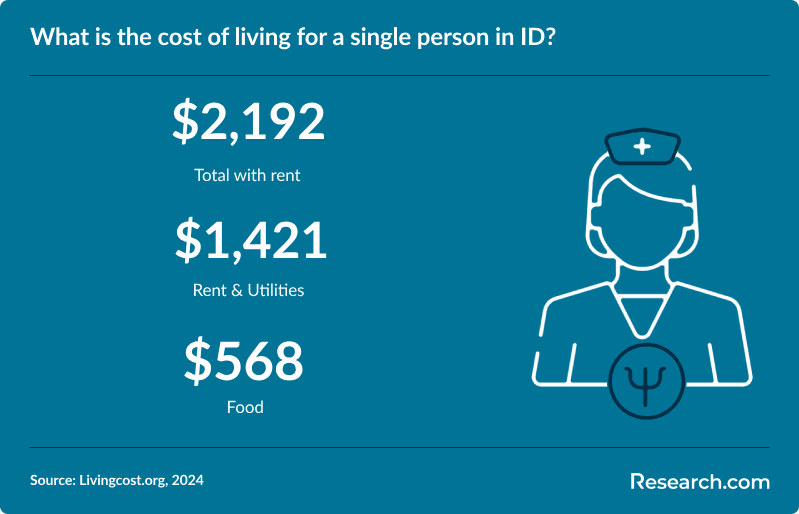
Cost of living should be part of your career calculation. In Idaho, the cost of living is $2,192 for a single person, which is as expensive as the national average. This includes $771 for living expenses without rent and $1,421 for rent and utilities. The cost of food in Idaho is $568. Based on these figures, Idaho ranks as the 28th most expensive state and the 46th best state to live in the United States. These are shown in the graphic below.
What online resources are available for prospective nursing students in Idaho?
Prospective nursing students should use online resources to verify requirements, compare programs, estimate costs, and understand licensure before applying. The most useful resources are those that help you answer practical questions: Is the program approved? What exam do graduates take? How much will the program cost? Where are clinicals held? What are the employment outcomes?
- Idaho Board of Nursing: Use the board for licensing rules, applications, renewal information, and official practice guidance.
- Program comparison pages: Compare tuition, format, accreditation, clinical expectations, and student support before choosing a school.
- School financial aid offices: Ask about grants, scholarships, payment plans, work-study, and whether aid applies to part-time or online study.
- Employer career pages: Hospitals, clinics, and long-term care facilities often list entry-level nursing roles, residency programs, and tuition assistance.
- Professional nursing associations: Associations can provide networking, continuing education, mentorship, and policy updates.
Students starting with practical nursing can review online LPN programs in Idaho to compare available options, but they should confirm clinical placement requirements and Idaho eligibility directly with each school.
What financial aid options are available for nursing students in Idaho?
Nursing school costs include more than tuition. Students should budget for fees, textbooks, lab supplies, uniforms, transportation to clinical sites, background checks, drug screening, immunizations, exam fees, and reduced work hours. Financial aid can make nursing education more manageable, but students need to compare total net cost rather than advertised tuition alone.
| Funding source | How it may help | What to verify |
| Federal grants and loans | May help cover tuition and approved education expenses | Program eligibility, enrollment status, borrowing limits, and repayment obligations |
| State-funded scholarships | May reduce out-of-pocket costs for eligible Idaho students | Residency rules, academic requirements, deadlines, and service obligations |
| School scholarships | Can support students based on need, merit, program, or background | Application dates, renewal rules, and whether awards continue each term |
| Employer tuition assistance | May support working CNAs, LPNs, RNs, or employees advancing internally | Work commitments, repayment clauses, approved schools, and grade requirements |
| Loan forgiveness or repayment programs | May benefit nurses serving high-need or rural areas | Eligible employers, length of service, tax treatment, and documentation rules |
Students considering flexible study should compare the best online nursing programs in Idaho, paying close attention to accreditation, clinical placement support, total cost, and whether online coursework fits their schedule and learning style.
What do nurses say about becoming a nurse in Idaho?
Anecdotal experiences cannot guarantee your outcome, but they can highlight what many Idaho nurses value: community connection, broad clinical responsibility, and access to outdoor lifestyle benefits outside of work.
- “I was drawn to Idaho because smaller care settings made it possible to know patients and families more personally. That connection makes the work meaningful, especially when you can see the long-term impact of care.” Meryl
- “Starting as an LPN gave me a practical foundation, and moving toward RN practice has expanded my options. Mentorship and local programs made the transition feel more realistic.” Nicole
- “For me, Idaho offers a balance between demanding clinical work and a life outside the hospital. The landscape helps me recharge, and the need for nurses makes the career feel stable.” Thea
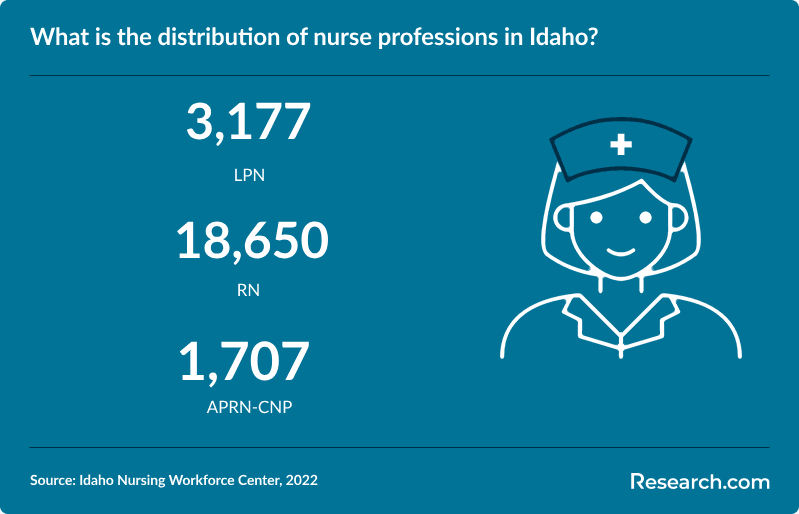
There are a total of 24,892 nursing professionals in Idaho. These include 3,177 licensed practical nurses (LPNs), 18,650 registered nurses (RNs), and several advanced practice registered nurse groups. The APRN category includes 1,707 nurse practitioners (CNP), 450 nurse anesthetists (CRNA), 71 certified nurse midwives (CNM), and 39 clinical nurse specialists (CNS). These figures show the range of nursing roles supporting healthcare delivery across Idaho. These are shown in the graphic below.
According to the Idaho Board of Nursing, Idaho is seeing growing demand for nurses, with a projected 15% increase in nursing jobs over the next decade. For students, the opportunity is real, but the smartest path is still to choose an approved program, understand licensure rules, compare total cost, and prepare for the realities of clinical work.
Related Articles for Nearby States
- 2027 How to Become a Nurse in Montana
- 2027 How to Become a Nurse in Washington
- 2027 How to Become a Nurse in Oregon
- 2027 How to Become a Nurse in Nevada
- 2027 How to Become a Nurse in Utah
- 2027 How to Become a Nurse in Wyoming
- 2027 How to Become a Nurse in California
- 2027 How to Become a Nurse in Colorado
- 2027 How to Become a Nurse in Arizona
- 2027 How to Become a Nurse in New Mexico
Common mistakes to avoid when becoming a nurse in Idaho
- Choosing a school before checking approval and accreditation: Always confirm that the program prepares graduates for Idaho licensure and the correct NCLEX exam.
- Comparing tuition only: Add fees, clinical travel, supplies, testing costs, and lost wages before deciding which program is most affordable.
- Assuming online means fully remote: Nursing programs require clinical training. Ask where clinicals take place and who arranges them.
- Ignoring NCLEX pass rates: A program’s licensure exam outcomes are one of the clearest indicators of readiness support.
- Waiting too long to plan advancement: If you want to move from LPN to RN, RN to BSN, or RN to APRN, ask early how credits transfer.
- Assuming salary averages apply to every job: Pay varies by city, employer, specialty, shift, and experience. Use averages as planning tools, not guarantees.
- Overlooking rural trade-offs: Rural roles may offer strong experience and demand, but staffing, commute, resources, and workload should be evaluated carefully.
Key Insights
- To become a nurse in Idaho, you must complete a qualifying nursing program, pass the NCLEX-PN or NCLEX-RN, apply through the Idaho Board of Nursing, complete background check requirements, and keep your license current.
- The fastest nursing entry route is usually practical nursing, but RN pathways through ADN or BSN programs offer broader scope, more job options, and stronger advancement potential.
- Idaho participates in the Enhanced Nursing Licensure Compact, so eligible multistate nurses can practice in Idaho without obtaining a separate single-state Idaho license.
- Program quality matters as much as convenience. Before enrolling, check accreditation, Idaho approval, NCLEX pass rates, clinical placement support, total cost, and transfer options.
- Idaho nursing demand is supported by workforce shortages, rural healthcare needs, aging populations, and projected job growth, but workload, salary variation, and geographic differences should be considered carefully.
- Advanced nursing education can lead to nurse practitioner, nurse midwife, nurse anesthetist, clinical specialist, leadership, education, informatics, or administrative roles, but each path has different licensure and certification requirements.
- The best decision is the one that matches your timeline, finances, preferred work setting, tolerance for clinical stress, and long-term career goals.
References:
- Dopl.idaho.gov. (2024). Idaho Board of Nursing. Idaho Board of Nursing.
- Glotalent.org. (2016, November 1). Idaho nurse RN licensing guide. Glotalent.org.
- Idaho Center for Nursing. (2022, June). Idaho biennial nursing workforce report. Idaho Center for Nursing.
- Idaho Nurses Association. (2024). Idaho Nurses Association. Idaho Nurses Association.
- Livingcost.org. (2024). Cost of living in Idaho. Livingcost.org.
- Nurse.org. (2024). Enhanced Nurse Licensure Compact (eNLC). Nurse.org.
- Nursejournal.org. (2024). Nursing in Idaho. Nursejournal.org.
- Nursinglicensemap.com. (2024). Idaho nursing license requirements. Nursinglicensemap.com.
- U.S. Bureau of Labor Statistics. (2024). Nursing assistants. U.S. Bureau of Labor Statistics.
Other Things You Should Know About Becoming a Nurse in Idaho
To become a nurse in Idaho in 2027, you must complete an accredited nursing program, which can be an associate degree in nursing (ADN) or a Bachelor of Science in Nursing (BSN). Afterward, passing the NCLEX-RN exam is required to obtain licensure as a registered nurse (RN) in Idaho.
To become a registered nurse in Idaho in 2027, you need to complete an accredited nursing program, either a nursing diploma, associate degree, or bachelor's degree. After completing your education, you must pass the NCLEX-RN exam and apply for licensure through the Idaho Board of Nursing.


