2027 BCBA vs Speech-Language Pathologist: Career Comparison

Co-Founder and Chief Data Scientist
BCBA and speech-language pathology can look similar from the outside because both careers often serve children, autistic clients, people with developmental disabilities, and families navigating school or healthcare systems. The difference is the professional lens: a BCBA studies behavior and designs behavior-change plans, while a speech-language pathologist evaluates and treats communication and swallowing disorders.
That distinction matters when you choose a graduate program. The two paths have different admissions expectations, clinical training models, certification rules, licensure requirements, work settings, and salary patterns. A strong fit depends on whether you are more drawn to data-driven behavior intervention, communication therapy, medical and educational assessment, or long-term clinical specialization.
This guide compares BCBA vs speech-language pathologist careers in practical terms: what each professional does, how education and certification work, what programs cost, how salaries and job outlooks compare, and how to decide which path better matches your strengths, schedule, and career goals.
Key Things You Should Know
- The average BCBA salary in 2024 is about $70,000, while speech-language pathologists average near $80,000, reflecting differences in demand and educational requirements.
- Becoming a BCBA requires certification in applied behavior analysis and typically a master's degree, whereas speech-language pathologists need a master's plus state licensure.
- Both careers focus on communication and behavioral interventions, but BCBAs primarily address behavior modification, while speech-language pathologists target speech and language development.
What is a BCBA vs speech-language pathologist?
A Board Certified Behavior Analyst (BCBA) is a behavior-analysis professional who uses applied behavior analysis to understand why behavior occurs and how it can be changed. BCBAs assess patterns, identify environmental factors that reinforce behavior, collect data, and design intervention plans to build useful skills and reduce behaviors that interfere with safety, learning, or independence.
BCBAs commonly work with individuals with autism spectrum disorder and developmental disabilities, though their methods can also apply in schools, behavioral health, organizational settings, and community programs. Their work often includes parent training, staff coaching, functional behavior assessments, behavior intervention plans, and ongoing progress monitoring.
A speech-language pathologist (SLP) assesses, diagnoses, and treats communication and swallowing disorders. SLPs work on speech sound production, expressive and receptive language, fluency, voice, social communication, feeding, and swallowing. Their clients may include toddlers with language delays, school-age children with articulation or literacy-related needs, adults recovering from stroke, and older adults with neurological or swallowing conditions.
The simplest distinction is this: BCBAs primarily ask, “What function does this behavior serve, and how can the environment be changed to support better outcomes?” SLPs primarily ask, “What communication, speech, language, voice, or swallowing difficulty is present, and what therapy will improve it?”
Core differences at a glance
| Factor | BCBA | Speech-language pathologist |
| Main focus | Behavior assessment, skill acquisition, behavior intervention, reinforcement strategies, and data-based treatment planning | Speech, language, communication, voice, fluency, feeding, and swallowing assessment and treatment |
| Common populations | Individuals with autism spectrum disorder, developmental disabilities, and behavioral support needs | Children and adults with communication, speech, language, neurological, or swallowing disorders |
| Typical work product | Functional assessments, behavior intervention plans, caregiver training, progress data, treatment modifications | Communication evaluations, therapy plans, speech and language goals, swallowing recommendations, progress notes |
| Professional orientation | Behavioral science and environmental contingencies | Communication sciences, clinical assessment, and rehabilitation |
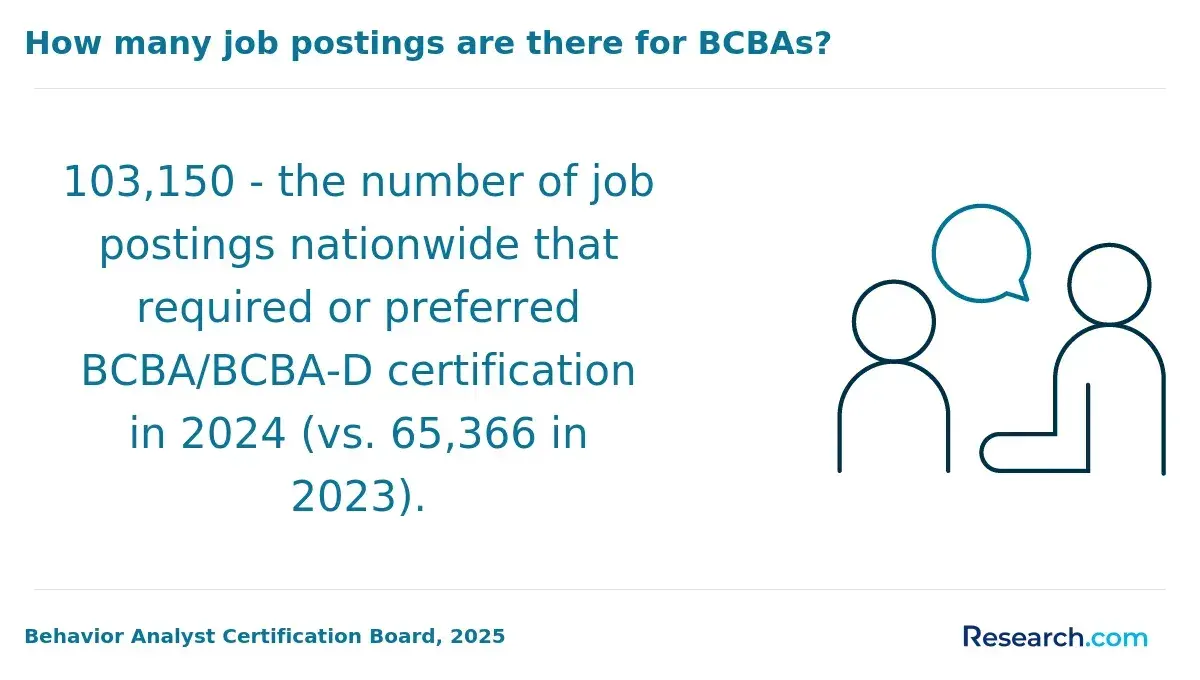
Demand is strong in both fields. According to the BLS Occupational Outlook Handbook, employment for speech-language pathologists is projected to grow 15% over ten years, well above average. Industry reports also show a 58% surge in BCBA demand between 2023 and 2024.
Training also differs. BCBA certification requires behavior-analysis coursework, supervised experience, and an exam. SLPs must complete a master’s degree in speech-language pathology and obtain state licensure. If you are considering the behavior-analysis route, you can compare flexible options through a BCBA program online.
What are the education requirements for each career?
Both careers require graduate-level preparation, but they are built around different accrediting bodies, clinical expectations, and professional scopes. A BCBA pathway is centered on behavior analysis and supervised fieldwork. An SLP pathway is centered on communication sciences, clinical practicum, and state licensure.
BCBA education requirements
To become a Board Certified Behavior Analyst, candidates generally need a master’s degree or higher in behavior analysis, education, psychology, or a closely related field from an accredited institution. The program must include required coursework in behavior analysis, including ethics, experimental design, assessment, and intervention techniques.
BCBA candidates must also complete supervised fieldwork totaling 1,500 hours before sitting for the BCBA examination. Students should verify that the program sequence aligns with Behavior Analyst Certification Board expectations and that fieldwork can be completed in approved settings. Prospective students can review BCBA accredited programs to compare eligible pathways.
Speech-language pathology education requirements
Speech-language pathologists need a master’s degree in speech-language pathology from a program accredited by the Council on Academic Accreditation in Audiology and Speech-Language Pathology (CAA). Graduate coursework typically covers anatomy, linguistics, neurology, therapy methods, assessment, and clinical practice.
SLP students must complete a required clinical practicum of at least 400 hours. After graduation, they must pass the Praxis exam and complete a state licensure process, often including a clinical fellowship year. Because SLP licensure is state-regulated, students should confirm that a program meets the requirements for the state where they plan to practice.
How the requirements affect your decision
BCBA certification is nationally standardized through the Behavior Analyst Certification Board, though state licensure rules may still apply. SLP licensure and certification are state-regulated and frequently require continuing education for license renewal.
The education investment also connects to earnings. SLPs earned a median annual salary of $95,410, while BCBA median salaries range from $70,000 to $75,000 nationally according to labor statistics and industry sources. These figures are not guarantees; pay depends on location, employer, role, experience, and specialty.
How do salaries compare between BCBAs and SLPs?
SLPs often show higher median or average earnings in national salary comparisons, but BCBA compensation can be competitive in clinical leadership, consulting, and high-demand autism service markets. The better financial choice depends on your location, employer type, willingness to supervise others, and long-term specialization.
A BCBA vs speech language pathologist salary comparison shows that BCBAs typically earn between $60,000 and $80,000 per year, with entry-level positions starting around $50,000, particularly in public education or community health. SLPs generally have higher average salaries due to their rigorous clinical training and master’s level education.
The average salaries for behavior analysts and speech therapists in the US range from $75,000 to $85,000 nationally, with experienced SLPs in hospitals frequently earning above $90,000. Urban areas tend to offer salaries 10-20% higher than rural locations for both professions, although cost of living can reduce the practical value of that increase.
Salary factors that matter most
- Work setting: Hospitals, specialty clinics, school districts, home-based ABA providers, rehabilitation centers, and private practices can pay very differently.
- Geography: Urban areas may pay more, while rural areas may offer incentives or faster hiring because of shortages.
- Experience and supervision: Professionals who supervise assistants, manage programs, or lead clinical teams usually earn more than entry-level clinicians.
- Specialization: Autism services, swallowing disorders, neurogenic communication disorders, telepractice, and consultation can influence pay.
- Credential fit: Employers may pay more when a candidate’s certification, licensure, and clinical background match a hard-to-fill service need.
Educational requirements also affect salary patterns. Graduate programs for SLPs are highly selective, often admitting just 20-30% of applicants, which creates a specialized workforce commanding higher pay. In contrast, BCBA certification, requiring a master’s degree and supervised experience, is more accessible with higher acceptance rates. This broader supply moderates salary growth.
Career development differs as well. SLPs benefit from strong demand across schools, healthcare, and telepractice. BCBAs can advance by specializing in autism or behavioral health and may supplement income through consulting, training, or program leadership. Students who need a flexible graduate route can compare ABA masters programs online.
The job outlook is favorable for both BCBAs and SLPs, but demand is shaped by different forces. BCBA growth is closely tied to autism services, insurance coverage, school-based behavioral support, and the expansion of applied behavior analysis providers. SLP growth is driven by schools, early intervention, healthcare, rehabilitation, telepractice, and the needs of an aging population.
The U.S. Bureau of Labor Statistics projects a 16% growth rate for behavior analysts through 2032, driven by increased insurance coverage and federal funding for applied behavior analysis services in schools, clinics, and home settings.
In comparison, job growth for speech-language pathologists is slightly slower but steady, with an 11% projected increase from 2022 to 2032. This reflects an aging population requiring speech rehabilitation and growing awareness of communication disorders. Employers prioritize candidates with strong clinical skills, especially in pediatric and geriatric care.
What the outlook means for students
- BCBA candidates should look closely at regional ABA provider networks, school district demand, state licensure rules, and access to supervised fieldwork.
- SLP candidates should evaluate clinical placement quality, state licensure alignment, medical vs school-based opportunities, and demand in pediatric or geriatric settings.
- Career changers should consider not only job openings but also the intensity of graduate training, supervision requirements, and daily client contact.
Certification also affects workforce availability. Entry into BCBA roles requires passing a challenging exam with about a 60% first-time pass rate. Speech-language pathologist certification exams usually have higher pass rates, which can affect job market saturation in various regions.
Both fields require rigorous credentialing and continuing education. Students considering the BCBA path can explore an applied behavior analysis degree online to understand available education formats and certification preparation options.
Certification and licensure are not optional details in these careers. They determine whether you can practice independently, bill for services, qualify for school or healthcare roles, and meet employer requirements. The BCBA route is governed by the Behavior Analyst Certification Board, while the SLP route combines accredited graduate education, clinical fellowship expectations, examination, and state licensure.
BCBA certification and licensure
Becoming a Board Certified Behavior Analyst requires a master’s degree in behavior analysis or a closely related field, completion of specific graduate coursework approved by the Behavior Analyst Certification Board (BACB), and 750 to 1,500 hours of supervised fieldwork. Many candidates complete fieldwork while employed in ABA-related roles, which can make the pathway more flexible for working adults.
The process concludes with the BACB exam. After certification, BCBAs must complete ongoing professional development and follow ethical standards. State requirements vary: some states require additional behavior analyst licensure applications, fees, supervision documentation, or other steps beyond BACB certification.
SLP certification and licensure
Speech-language pathologists earn a master’s degree in speech-language pathology from an accredited program. They then complete a clinical fellowship of about 1,260 supervised hours and pass the Praxis exam by the Educational Testing Service (ETS). Licensure is mandatory in every U.S. state, and renewal usually requires continuing education.
Key credentialing trade-offs
| Credentialing factor | BCBA | SLP |
| Primary credential | Board Certified Behavior Analyst certification through BACB | State SLP licensure, with professional certification commonly tied to ASHA expectations |
| Supervised training model | 750 to 1,500 hours of supervised fieldwork | Clinical fellowship of about 1,260 supervised hours |
| Licensure pattern | Varies by state | Mandatory in every U.S. state |
| Planning concern | Confirm both BACB eligibility and state behavior analyst rules | Confirm CAA accreditation, clinical hours, Praxis, fellowship, and state licensure rules |
The practical difference is flexibility. BCBA fieldwork may be easier to integrate with paid ABA employment, while SLP preparation requires tightly structured clinical training and a post-graduation fellowship. Before enrolling, confirm that the program’s coursework, supervision model, and clinical placements match the state where you want to work.
A BCBA curriculum trains students to apply behavioral science to real client needs. The coursework is not simply about “managing behavior.” It teaches students how to define behavior clearly, measure it accurately, identify why it occurs, design ethical interventions, and adjust treatment based on data.
Core topics include behavior assessment, intervention design, data collection, data analysis, treatment planning, ethics, and research methods. Programs also emphasize work with developmental disabilities and autism spectrum disorders because many BCBAs serve these populations in schools, clinics, homes, and community settings.
Common BCBA coursework areas
- Principles of behavior: reinforcement, punishment, extinction, stimulus control, motivating operations, and generalization.
- Behavior assessment: indirect assessment, direct observation, functional analysis, and experimental analysis techniques.
- Intervention design: skill acquisition plans, behavior reduction procedures, treatment integrity, and progress monitoring.
- Verbal behavior: assessment and teaching strategies related to communication from a behavior-analytic perspective.
- Ethics and professional conduct: client dignity, informed consent, accurate data reporting, scope of competence, and responsible supervision.
- Research and measurement: single-case design, graphing, decision-making from data, and evaluating intervention effectiveness.
Practical clinical training is central. Students complete supervised fieldwork, case studies, and applied assignments that prepare them for certification by the Behavior Analyst Certification Board (BACB). Typically, coursework involves about 1,500 hours, including 1,000 hours of supervised experience.
Program quality matters. Students should verify that the curriculum meets BACB standards, that supervision is available and well documented, and that practicum experiences involve evidence-based work with real clients rather than only observation or administrative tasks.
BCBA salaries vary widely by work setting and populations served. This contrasts with speech-language pathologists (SLPs), who see different median salaries across states, such as $112,030 in California and $100,120 in Hawaii. Those figures show why students should compare both professional fit and local labor markets before committing to a path.
A speech-language pathology program combines communication science, medical and educational assessment, therapy methods, and supervised clinical practice. The goal is to prepare students to evaluate and treat communication and swallowing disorders across the lifespan.
Core subjects include anatomy and physiology of speech and hearing, phonetics, language development, speech sound disorders, fluency and voice pathology, and swallowing disorders. Students also study research methods, assessment techniques, counseling, cultural and linguistic diversity, and evidence-based intervention for children and adults.
Typical SLP training components
- Foundational science: anatomy, physiology, acoustics, neurology, hearing science, and language development.
- Disorder-specific coursework: articulation, phonology, fluency, voice, language disorders, swallowing, and neurogenic communication disorders.
- Assessment training: standardized testing, informal evaluation, clinical observation, diagnosis, and report writing.
- Therapy methods: goal setting, treatment planning, progress measurement, and client-centered intervention.
- Clinical practicum: supervised work in settings such as schools, hospitals, outpatient clinics, rehabilitation centers, or university clinics.
- Professional preparation: ethics, interprofessional collaboration, family counseling, documentation, and licensure readiness.
Hands-on clinical experience is essential. Students work directly with clients, develop personalized treatment plans, and apply evidence-based interventions under supervision. These experiences prepare graduates for the American Speech-Language-Hearing Association (ASHA) certification, necessary for professional practice.
The service model differs from ABA in both intensity and focus. Applied Behavior Analysis programs often involve intensive interventions of 10 to 40 hours weekly per client, while speech-language pathology sessions usually last 30 to 60 minutes per client per week. SLP sessions are typically targeted to specific communication or swallowing goals, such as articulation, language comprehension, social communication, voice, fluency, or safe swallowing.
Some programs offer focused training in areas such as augmentative and alternative communication or neurogenic disorders. Students should choose programs based on clinical placement strength, licensure alignment, faculty expertise, and access to the populations they hope to serve after graduation.
Online and campus options differ sharply between BCBA and SLP preparation. BCBA education is often more adaptable to online learning because much of the coursework is didactic and supervised fieldwork can occur in approved external settings. SLP education usually requires more structured, in-person clinical training tied to licensure and accreditation rules.
BCBA online and campus options
Accredited online master’s or certificate BCBA programs are widely available. Many use asynchronous lectures for flexibility, paired with synchronous meetings, supervision coordination, or virtual practicum support. This format can work well for students who are already employed in ABA, education, or human services and can complete supervised fieldwork at an approved site.
Campus BCBA programs, although less common, may offer easier access to faculty, university clinics, research labs, and local practicum partners. Regardless of format, practicum sites must meet Behavior Analyst Certification Board (BACB) standards.
SLP online, hybrid, and campus options
SLP programs prioritize extensive clinical practicum, often through affiliated healthcare facilities, schools, rehabilitation centers, or university clinics. Hybrid models exist with online coursework and in-person clinical residencies, but fully online SLP programs remain rare because clinical experience is critical for state licensure and certification by the American Speech-Language-Hearing Association (ASHA).
Students considering SLP programs should ask detailed questions about clinical placements, travel requirements, residency weeks, state authorization, and whether the program supports licensure in the state where they plan to work.
Licensure makes format choice important
Licensure requirements shape program choices: BCBA licensure is required in 38 states, while SLP licensure is mandatory nationwide. This means SLP students must choose programs aligned with strict clinical hour mandates from all state boards. BCBA students may have more geographic flexibility with online options because state licensure requirements vary.
Before enrolling, confirm program accreditation by the BACB for BCBA preparation or by the Council on Academic Accreditation in Audiology and Speech-Language Pathology for SLP preparation. Flexibility matters, but eligibility matters more: a convenient program is not a good choice if it does not lead to the credential or license you need.
Both careers usually require a graduate degree, but total cost depends on tuition, residency status, clinical supervision fees, exam fees, commuting or relocation costs, and whether you can work while completing requirements. BCBA programs often offer more flexible work-and-study options, while SLP programs may have more intensive clinical scheduling.
BCBA program cost and timeline
Programs to become a Board Certified Behavior Analyst generally require a master’s degree in psychology, education, or a related field, with a specialized sequence in applied behavior analysis. These programs typically take 2 to 3 years of full-time study.
Tuition ranges from $15,000 to $50,000, depending on the institution and residency status. Additional fees for required supervision hours may add $3,000 to $7,000. Students should ask whether supervision is included in tuition, arranged through the program, or paid separately through an employer or outside supervisor.
SLP program cost and timeline
Speech-language pathologist programs also require a master’s degree and usually take about 2 years full-time. Tuition tends to be higher, ranging from $20,000 to $70,000.
Clinical practicum hours are mandatory and can affect overall costs, especially if extra supervised experiences are necessary. Licensure and certification exams add another $500 to $1,000 in fees. Students should also budget for background checks, immunizations, clinical attire, travel to placements, and possible relocation for practicum or fellowship opportunities.
Cost comparison
| Factor | BCBA pathway | SLP pathway |
| Typical full-time length | 2 to 3 years | About 2 years |
| Tuition range | $15,000 to $50,000 | $20,000 to $70,000 |
| Additional supervision or exam costs | Supervision may add $3,000 to $7,000 | Licensure and certification exams add $500 to $1,000 |
| Work flexibility during training | Often stronger if fieldwork can be completed through ABA-related employment | More constrained by practicum schedules and clinical placement requirements |
Job opportunities for SLPs are currently more abundant in rural areas due to acute shortages, resulting in higher relocation incentives and more openings. These factors can help offset education costs through financial aid or loan forgiveness programs tied to employment in underserved regions. While BCBA roles are in growing demand, they often have less geographic variation in incentives.
Before choosing a program, calculate the full price rather than tuition alone. Include lost wages, travel, supervision fees, exam fees, licensure fees, loan interest, and the likelihood of paid work during training.
How to choose between BCBA and SLP careers?
The best choice depends less on which career is “better” and more on which professional role matches how you want to help people. Choose BCBA if you are drawn to behavior patterns, data collection, environmental change, reinforcement systems, and measurable treatment plans. Choose SLP if you are drawn to speech, language, communication, swallowing, clinical diagnosis, and therapy across the lifespan.
Choose BCBA if you prefer:
- Analyzing why behavior occurs and designing intervention plans based on data.
- Working heavily with autism services, developmental disabilities, schools, clinics, homes, or caregiver training.
- Using structured measurement, progress monitoring, and reinforcement-based strategies.
- A graduate pathway that may offer more online options and flexible supervised fieldwork.
- Potential roles in clinical supervision, ABA program management, consultation, or staff training.
Choose SLP if you prefer:
- Diagnosing and treating communication, speech, language, voice, fluency, feeding, or swallowing disorders.
- Working across a broad age range, from early intervention to adult rehabilitation and geriatric care.
- Clinical practice in schools, hospitals, rehabilitation centers, outpatient clinics, or telepractice.
- A highly regulated licensure pathway with structured clinical practicum and fellowship requirements.
- Specialization options in pediatric language, medical speech-language pathology, swallowing, neurogenic disorders, or augmentative and alternative communication.
Educational paths differ clearly. BCBA certification requires a master’s degree in behavior analysis or a related field plus supervised experience. SLPs must earn a master’s in speech-language pathology and obtain state licensure. If you enjoy clinical work with communication challenges, SLP may be the better fit. If you prefer data-driven assessment and behavior intervention, the BCBA route may align better.
Salary can inform the decision but should not be the only factor. According to speechpathologyprograms.net, BCBA clinical directors make between $85,000 and $100,000 annually, whereas SLP supervisors average about $113,000, reflecting higher leadership earnings in speech-language pathology.
Work settings also differ. BCBAs often work in schools, clinics, or homes with intensive behavior-support plans and smaller treatment teams. SLPs work in hospitals, rehabilitation centers, schools, clinics, and educational settings, with opportunities to focus on pediatric, adult, medical, or geriatric populations.
Practical next steps before enrolling
- Shadow or interview at least one BCBA and one SLP in the setting you are most interested in.
- Compare graduate program prerequisites, admissions selectivity, clinical placement support, and total cost.
- Check certification and licensure requirements for the state where you want to work.
- Ask programs how supervision or clinical practicum placements are arranged.
- Consider daily work style: BCBAs may spend more time on behavior data, treatment plans, and staff or caregiver coaching; SLPs may spend more time on direct communication therapy, assessment, documentation, and interdisciplinary care.
Both careers can be meaningful and stable for the right person. The stronger choice is the one that fits your interests, your tolerance for the training model, your preferred client population, and the kind of clinical problem-solving you want to do every day.
Other Things You Should Know About Applied Behavior Analysis
BCBAs must complete 32 continuing education units every two years, including at least 4 ethics CEUs and 3 supervision CEUs if they supervise others. Certification is maintained through the Behavior Analyst Certification Board, and renewal also requires adherence to the BACB Ethics Code and recertification fees.
Ongoing supervision is a significant part of a BCBA's professional responsibilities. BCBAs provide supervision to registered behavior technicians (RBTs) and other trainees, ensuring that behavior analysis interventions are carried out correctly and ethically. This supervisory role requires documentation and regular direct observation.
Yes, BCBAs can specialize in areas such as pediatric or adult autism services, organizational behavior management, or educational consultation. These specializations allow BCBAs to focus their skills on particular populations or settings, enhancing their expertise and career options. Specializations often require additional training and experience beyond initial certification.
Single-subject experimental designs are the most common research methods used in applied behavior analysis. These involve detailed observation and analysis of behavior changes in individual clients rather than large groups. This approach allows for precise measurement of intervention effects and individualized treatment adjustments.
- Master of Science in Speech-Language Pathology https://www.mghihp.edu/health-rehabilitation-sciences/departments-programs/communication-sciences-disorders/master-science-speech-language-pathology
- A Day in The Life of a BCBA | Behavioral Innovations https://behavioral-innovations.com/blog/day-in-the-life-bcba/
- Considering a Career as a Board Certified Behavior Analyst (BCBA) https://aba-llc.com/considering-bcba/
- SLP vs BCBA: Salary, Education & Career Guide 2025 https://www.speechpathologygraduateprograms.org/blog/slp-vs-bcba/
- SLP Speech Therapy for Autism within ABA Therapy https://www.peachtreeautism.com/speech-consultation
- Studying Online vs On-Campus: Which Is Better for You? | UNF https://www.unfc.ca/blog/studying-online-vs-on-campus-which-is-better-for-you
- Becoming an SLP https://speechandhearingbc.ca/professional/careers/becoming-an-slp/
- Certificate vs Certification vs Licenses | Differences To Know https://honorlock.com/blog/differences-certificate-certification-licensure/
- College Tuition: What You Need to Know | ELFI https://www.elfi.com/how-does-college-tuition-work-how-do-you-pay-it/