2027 BCBA Master's for Non-Psychology Majors: Can You Qualify

Co-Founder and Chief Data Scientist
You do not need a psychology bachelor’s degree to become a BCBA, but you do need to choose your pathway carefully. The key question is not whether your major “counts.” It is whether your graduate program, coursework, supervised fieldwork, and exam preparation align with Behavior Analyst Certification Board expectations and employer requirements.
This guide is for career changers and graduates from fields such as education, social work, sociology, speech-language pathology, criminal justice, health sciences, and business who want to enter applied behavior analysis. It explains how non-psychology majors can qualify for BCBA master’s programs, what prerequisites may be required, how long the process can take, what online options offer, and how to compare programs without wasting time or tuition on a poor fit.
The most important takeaway: non-psychology applicants can be competitive, especially when they select a program with clear prerequisite support, verified behavior-analytic coursework, strong supervision guidance, and transparent BCBA exam outcomes.
Key Things You Should Know
- Non-psychology majors can qualify for BCBA master's programs by completing prerequisite coursework in behavior analysis, as 75% of accredited programs accept students from related fields if requirements are met.
- Most BACB-approved master's programs for 2026 include 1,500 hours of supervised fieldwork and coursework aligned with the 2022 BACB Task List, accommodating diverse academic backgrounds.
- Graduates with non-psychology degrees who obtain BCBA certification see a median salary increase of 20%, reflecting growing demand in clinical and educational applied behavior analysis roles across the U.S.
Can non-psychology majors qualify for BCBA Master's programs?
Yes. Non-psychology majors can qualify for BCBA master’s programs if they meet the school’s admission requirements and complete the behavior-analytic coursework and supervised experience required for certification. A psychology background can help, but it is not the only acceptable preparation for graduate study in applied behavior analysis.
Students from education, sociology, speech pathology, criminal justice, social work, healthcare, and related fields often bring useful experience with learners, clients, families, data, or service systems. What they may lack is formal training in behavior principles, measurement, research design, ethics, and assessment. Strong BCBA master’s programs either require those courses before admission or build them into the graduate sequence.
For example, Northern Kentucky University’s online ABA concentration, which had an 88% first-time BCBA pass rate according to BACB data, illustrates that a focused ABA curriculum can prepare students effectively even when their undergraduate major was not psychology.
Before applying, review program pages and speak with an advisor about whether your prior coursework satisfies prerequisites. Flexible options are available, including online BCBA coursework designed for working adults and career changers.
What non-psychology applicants should verify first
- Prerequisite policy: Ask whether introductory psychology, statistics, research methods, or behavior analysis courses are required before enrollment.
- Course sequence status: Confirm that the curriculum supports BCBA eligibility and is aligned with current certification expectations.
- Fieldwork support: Determine whether the school helps students locate qualified BCBA supervisors or practicum sites.
- Admission flexibility: Some schools offer conditional admission, bridge courses, or leveling work for students without ABA preparation.
- Exam outcomes: Review first-time BCBA exam pass rates where available, but interpret them alongside cohort size, student support, and fieldwork quality.
The common mistake is assuming that any master’s degree with “ABA” in the title automatically leads to certification. Non-psychology majors should map every requirement—degree, coursework, supervised fieldwork, and exam eligibility—before committing to a program.
What are BCBA certification requirements for Master's degrees?
BCBA certification requires more than admission to a master’s program. Candidates must complete an eligible graduate degree, behavior-analytic coursework, supervised fieldwork, and the BCBA certification exam. Non-psychology students should pay close attention to each step because a program can meet graduate degree requirements without automatically solving every certification requirement.
BCBA master’s degree requirements for non-psychology students generally center on coursework and supervised practice aligned with Behavior Analyst Certification Board standards. Candidates must earn a master’s degree in a related field such as education, psychology, or applied behavior analysis that includes BACB-approved coursework covering ethics, assessment, intervention, and behavior change procedures.
The program must contain at least 270 hours of verified behavior-analytic instruction. Students whose master’s degree is outside psychology should confirm whether the curriculum includes a verified course sequence or whether they need additional coursework to meet BCBA eligibility.
Hybrid and online programs can make this pathway more accessible. For example, the University of Pittsburgh’s ABA program offers flexible options and had a 100% first-time BCBA exam pass rate in 2024, according to appliedbehavioranalysisedu.org.
Core BCBA certification components
| Requirement | What it means for non-psychology majors |
| Graduate degree | You need an eligible master’s degree, commonly in applied behavior analysis, education, psychology, or another approved related area. |
| Behavior-analytic coursework | Your coursework must cover required topics such as ethics, assessment, measurement, intervention, and behavior-change procedures. |
| Verified instruction hours | The program must include at least 270 hours of verified behavior-analytic instruction. |
| Supervised fieldwork | You must complete 1,500 to 2,000 hours of supervised independent fieldwork under a qualified BCBA supervisor. |
| Certification exam | After meeting eligibility requirements, you must pass the BCBA certification exam and follow the BACB ethical code. |
Supervised fieldwork is often the most difficult requirement to coordinate. The hours must follow BACB supervision guidelines and include regular feedback, documentation, and performance evaluation. A program that explains fieldwork expectations early can prevent delays after coursework is finished.
Prospective students should verify program alignment, supervision options, and exam preparation resources before enrolling. For a broader comparison of programs that may meet these criteria, review Research.com’s guide to the best BCBA programs.
Do BCBA Master's programs require ABA undergraduate coursework?
No, many BCBA master’s programs do not require applicants to have completed ABA coursework as undergraduates. Programs often accept students from different academic backgrounds as long as they complete any missing foundational content before or during graduate study.
This flexibility matters for non-psychology majors because ABA is a specialized field. A student may have strong professional experience in teaching, human services, healthcare, or case management but still need formal instruction in behavior principles, data collection, research methods, and ethical practice.
How programs handle missing ABA coursework
- Conditional admission: The school admits the student but requires specific prerequisite ABA or psychology courses before full progression.
- Integrated foundations: Introductory ABA courses are built into the master’s curriculum, allowing beginners to start without a separate certificate.
- Post-baccalaureate coursework: Students complete a certificate or individual courses to satisfy ABA content before applying or while preparing for admission.
National University’s online MS in ABA, for example, enrolls 86% of students remotely and offers pathways tailored for students without an ABA undergraduate degree. Its tuition averages around $15,912 for in-state graduate students, making it a competitive option among online ABA master’s programs.
The best approach depends on how much preparation you already have. If you completed statistics, research methods, child development, learning theory, or special education coursework, you may need fewer bridge courses. If your degree was unrelated to behavioral science, plan for additional foundational work.
Before applying, ask each school for a written prerequisite review. This can help you avoid two common problems: starting a program only to discover missing certification coursework, or paying for redundant classes you do not need. Students comparing flexible formats can explore online ABA master’s options to understand how accelerated and distance programs structure coursework.
Non-psychology applicants are usually evaluated on academic readiness, relevant experience, and the clarity of their career goals. A psychology major is rarely the only route into a BCBA master’s program, but applicants must show that they can handle graduate-level behavior analysis coursework.
For 2026 applicants, most programs require a bachelor’s degree from an accredited institution. Many also expect applicants to complete or demonstrate readiness for foundational work in psychology, statistics, research methods, or behavior analysis.
Typical admission requirements
- Bachelor’s degree: Usually required from an accredited college or university.
- Foundational coursework: Programs may expect introductory psychology, statistics, behavior analysis principles, or research methods.
- Minimum GPA: A GPA around 3.0 is common, although some programs may consider conditional admission for lower GPAs.
- Official transcripts: Schools use transcripts to evaluate academic preparation and prerequisite completion.
- Letters of recommendation: Strong letters should speak to your professionalism, academic ability, service experience, or readiness for ABA work.
- Statement of purpose: Applicants should explain why they are moving into behavior analysis and how the degree supports their goals.
- Experience: Work or volunteer experience in schools, clinics, disability services, behavioral health, or human services can strengthen an application, though it is not always required.
Admissions committees are not simply checking whether an applicant has taken psychology courses. They are asking whether the student understands the profession, can work ethically with clients and families, and can manage intensive coursework and fieldwork. A clear statement of purpose can help career changers connect prior experience to ABA practice.
Some institutions offer bridge or leveling courses for students entering from other fields. The University of Kansas’ online MA in Applied Behavioral Science, for instance, supports non-psychology majors with preparatory options and reports a 93% first-time BCBA exam pass rate.
Applicants should compare requirements school by school rather than assuming they are standardized. If you are missing prerequisites, ask whether you can complete them before admission, during the first term, or through a certificate. Research.com’s guide to online master’s in ABA programs can help you identify programs with flexible structures for nontraditional applicants.
The strongest non-psychology applicants usually do three things well: document academic readiness, explain their transition into ABA, and choose programs that clearly support BCBA certification eligibility.
BCBA master’s programs for beginners generally take 2 to 3 years, including graduate coursework, supervised fieldwork, and preparation for the BCBA exam. Students who enter without psychology or ABA coursework may need additional bridge classes, which can lengthen the timeline.
Full-time students in structured programs may finish the degree in about 24 months. Part-time students, online learners balancing work, or students who must complete prerequisites may take up to 36 months. The biggest timing variable is often fieldwork, not coursework.
Timeline factors for non-psychology majors
| Factor | How it can affect completion time |
| Prerequisite coursework | Bridge courses in behavior principles, ethics, research methods, or psychology can add several months. |
| Enrollment status | Full-time study is usually faster; part-time study is more manageable for working professionals but extends the timeline. |
| Program format | On-campus, hybrid, and online formats vary in pacing, course availability, and practicum coordination. |
| Fieldwork arrangement | Programs with integrated supervised practicum may help students stay on schedule, while separately arranged supervision can create delays. |
| Exam preparation | Students may need additional study time after coursework and fieldwork before sitting for the BCBA exam. |
The BACB requires 1,500 hours of verified fieldwork, typically completed alongside coursework. If your job setting allows qualifying supervised experience, you may be able to progress more efficiently. If you need to find a new placement or supervisor, start that process before or early in the program.
Program outcomes can show whether schools support students through this sequence. Data from appliedbehavioranalysisedu.org shows that the University of Houston, Clear Lake recorded a 90% BCBA exam pass rate, demonstrating strong preparation for students from diverse academic backgrounds.
For beginners, the most realistic plan is to budget 2 to 3 years and ask each program for a sample timeline that includes prerequisites, coursework, fieldwork milestones, and exam preparation.
A BCBA master’s curriculum for non-majors is designed to build professional competence in applied behavior analysis from the ground up. The coursework moves from basic behavioral principles to assessment, intervention design, data-based decision-making, ethics, supervision, and applied practice.
Non-psychology majors should expect a steep but manageable learning curve. The most important skill is learning to think behavior analytically: defining behavior clearly, measuring it reliably, identifying environmental variables, testing interventions, and making ethical decisions based on data.
Common curriculum areas
- Concepts and principles of behavior analysis: Foundational learning theory, reinforcement, punishment, stimulus control, motivating operations, and functional relations.
- Behavior assessment: Functional assessment, indirect and direct assessment methods, and identifying variables that maintain behavior.
- Intervention strategies: Behavior-change procedures for clinical, educational, home, and community settings.
- Measurement and data collection: Defining behavior, selecting measurement systems, graphing data, and monitoring treatment progress.
- Research methods and experimental design: Evaluating evidence, using single-case design, and interpreting behavior-analytic research.
- Ethics: Professional conduct, client dignity, consent, confidentiality, scope of competence, and responsible supervision.
- Advanced applications: Adapting interventions for diverse populations, service settings, and behavior support needs.
- Supervised fieldwork or practicum: Applying coursework in real settings under qualified supervision.
Students without psychology degrees may complete prerequisite or bridge courses to fill gaps in psychological concepts, research literacy, or developmental foundations. These courses are not just administrative hurdles; they help students understand the assumptions and terminology used throughout ABA graduate training.
Niagara University’s online MA in ABA program reported a 71% first-time BCBA exam pass rate, showing that students can succeed through structured online curricula when coursework and supervised practice are aligned.
When comparing programs, review the course catalog, not just the program title. A strong curriculum should clearly cover behavior-analytic science, ethics, assessment, intervention, data analysis, and fieldwork preparation. Non-majors should also look for faculty access, tutoring, exam preparation, and advising that explains how each course connects to certification.
Yes. Online BCBA master’s options are available for non-psychology majors, including students from education, social work, healthcare, human services, and other fields. These programs can be especially useful for working adults who need to complete coursework while maintaining employment or arranging fieldwork locally.
Online does not mean easier. A quality online ABA program should still provide rigorous coursework, clear faculty contact, structured assignments, exam preparation, and guidance on supervised fieldwork. The main advantage is flexibility; the main risk is enrolling in a program that leaves students to figure out prerequisites and supervision on their own.
National University is one example, offering an ABA master’s degree with a total cost of $21,080 for 45 quarter credits. The program provides free tutoring and military support, which may be valuable for career changers, military-connected students, and adults returning to graduate school after time away.
What to look for in an online BCBA master’s program
- Beginner-friendly foundations: Courses or bridge options for students without psychology or ABA coursework.
- Transparent certification alignment: Clear explanation of how the curriculum supports BCBA eligibility.
- Supervision guidance: Help understanding fieldwork rules, documentation, and supervisor qualifications.
- Student support: Tutoring, advising, faculty office hours, mentoring, and writing support.
- Schedule flexibility: Part-time or asynchronous options for working professionals.
- Military and adult learner support: Dedicated services can make the transition smoother for nontraditional students.
Online students should ask where fieldwork will occur, who approves supervisors, how supervision hours are documented, and whether the program has experience supporting students in their state or region. These questions matter because certification preparation is both academic and practical.
For non-psychology majors, the best online programs are not merely convenient. They are structured enough to teach the foundations, flexible enough to fit adult schedules, and transparent enough to help students avoid certification gaps.
BCBA master’s programs for non-psychology majors vary widely in cost, typically ranging from around $20,000 to more than $60,000. The final price depends on institution type, residency status, delivery format, required prerequisites, supervision costs, and fees beyond tuition.
Public universities often offer lower tuition for in-state students, sometimes below $25,000. Private institutions and out-of-state options can exceed $50,000. Online programs generally fall between $30,000 and $45,000, although pricing varies by credit system and institutional fees.
Programs with strong reputations and high BCBA exam pass rates may cost more. For instance, the University of Pittsburgh’s BCBA master’s program is priced toward the upper end. The University of Miami’s on-campus master’s in psychology with an ABA specialization, which achieved a 91% pass rate, is slightly more affordable but still a major investment.
Costs to include in your budget
| Cost category | Why it matters |
| Tuition | The largest expense; ranges from around $20,000 to more than $60,000 depending on school and residency. |
| Prerequisite or bridge courses | Non-psychology majors may need extra coursework before or during the program. |
| University fees | Technology, distance learning, student services, graduation, and program fees can increase the total cost. |
| Textbooks and materials | ABA texts, assessment tools, and exam preparation materials can add to expenses. |
| Supervision costs | Some students pay separately for qualified fieldwork supervision if it is not included through employment or practicum. |
| Exam-related costs | Certification exam and application-related expenses should be included in the total investment. |
Do not compare programs by tuition alone. A lower-cost program may become more expensive if it requires extra prerequisites, offers limited course availability, or provides little help with fieldwork. A higher-cost program may be worthwhile if it shortens the pathway, offers strong supervision support, and has reliable exam preparation.
- Tuition ranges from $20,000 to over $60,000 depending on institution and residency.
- Higher BCBA exam pass rates often correspond with higher tuition costs.
- Additional fees, supervision expenses, materials, and exam costs contribute to the total investment.
- Financial aid options differ widely across programs.
Prospective students should ask for a full cost estimate in writing, including tuition, fees, prerequisite courses, fieldwork-related expenses, and available financial aid. Employer tuition reimbursement, scholarships, assistantships, and payment plans may reduce out-of-pocket cost, but availability varies by school and employer.
BCBA certification can lead to roles in clinical, educational, residential, community, and organizational settings. Many BCBAs work with individuals with autism or developmental disabilities, but the credential can also apply to school consultation, staff training, caregiver coaching, behavioral health programs, and organizational behavior management.
Common roles include behavior therapist, BCBA clinician, early intervention specialist, school-based consultant, program supervisor, clinical director, and organizational behavior consultant. The right path depends on your fieldwork experience, client population, state requirements, and preferred work setting.
Common BCBA roles and salary ranges
- Behavior Therapist: $45,000-$60,000.
- BCBA Clinician: $60,000-$75,000.
- Clinical Director or Program Supervisor: $75,000-$95,000+.
- Organizational Behavior Consultant: $70,000-$90,000+.
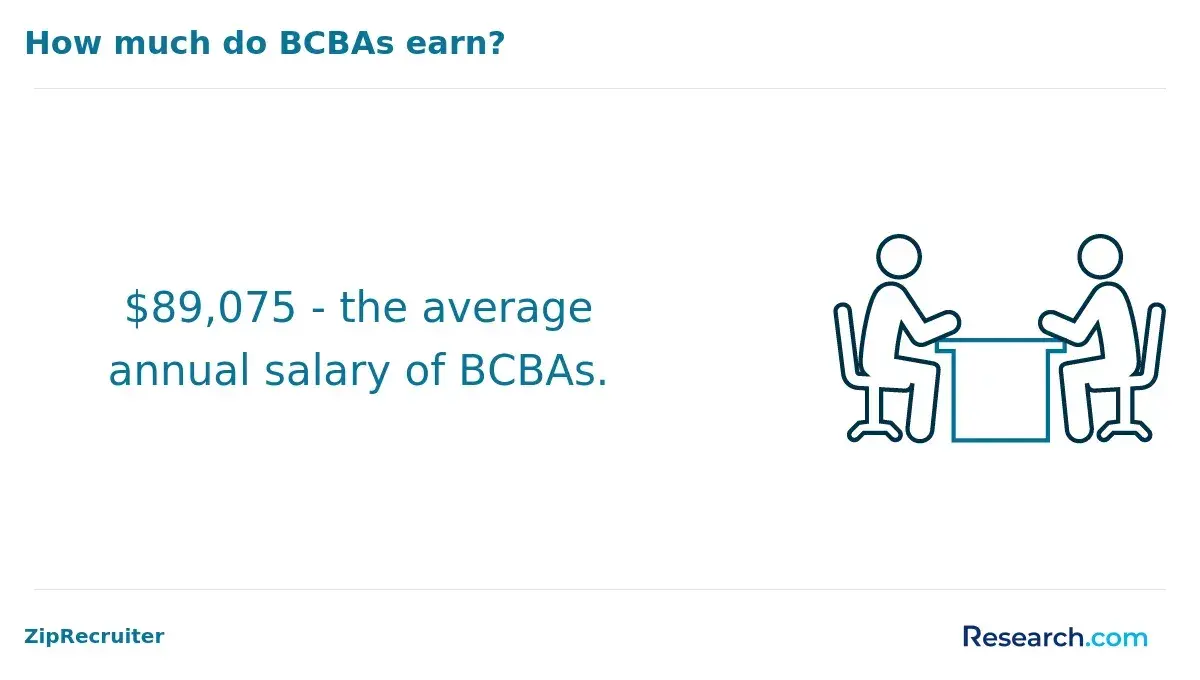
Entry-level positions typically start near $50,000 annually, while experienced BCBAs in metropolitan areas or specialized roles can earn $90,000 or more. Salaries vary by region, employer type, client population, caseload expectations, supervisory responsibilities, and whether the role is school-based, clinic-based, home-based, or consultative.
The growing demand for BCBAs reflects wider recognition of applied behavior analysis in clinical and educational services. Graduates from the 29 ABAI-accredited U.S. master’s programs gain coursework verification that can improve eligibility clarity and marketability. Accreditation and verified coursework help signal that a program meets recognized standards expected by employers and certification bodies.
Salary differences also depend on work environment. Urban and private clinical settings tend to offer higher wages than rural areas or public schools, although public-sector roles may provide more predictable schedules or benefits. Supervisory and consulting roles can increase earning potential, but they also require stronger leadership, documentation, training, and ethical decision-making skills.
For non-psychology majors, prior experience can shape career direction. Teachers may move into school consultation, social workers may be drawn to family-centered services, and healthcare professionals may pursue clinical or interdisciplinary roles. Continuing education, high-quality supervision, and diverse fieldwork experience are important for long-term career growth.
How to choose accredited BCBA programs for non-majors?
Non-psychology majors should choose BCBA programs by verifying three things first: the program’s recognized accreditation or coursework status, its support for students without ABA backgrounds, and its supervised fieldwork guidance. A convenient or inexpensive program is not a good value if it does not support certification eligibility.
Use the term “accredited” carefully. In ABA education, students should look for recognized program accreditation, such as ABAI accreditation where applicable, and confirm that coursework aligns with BACB certification requirements. The goal is to avoid enrolling in a master’s program that sounds relevant but leaves gaps in coursework or supervised experience.
Selection checklist for non-psychology majors
- Verify recognized accreditation or coursework status: Confirm that the program supports BCBA certification eligibility and meets current behavior-analytic education standards.
- Ask about prerequisite support: Look for bridge or leveling courses in behavior analysis, research methods, psychology foundations, and ethics.
- Review first-time BCBA exam pass rates: Prioritize programs with strong outcomes, while also considering cohort size and student support.
- Confirm fieldwork assistance: Ask whether the program helps students secure supervisors, understand documentation, and complete required hours.
- Evaluate faculty expertise: Faculty mentorship is especially important for students transitioning from another field.
- Compare formats: On-campus, hybrid, and online programs can all work if they match your schedule and fieldwork opportunities.
- Calculate total cost: Include tuition, fees, prerequisites, supervision, materials, and exam-related expenses.
- Check program length: Accelerated tracks may help career changers enter the field faster, but only if the pacing is realistic.
Format should fit your learning style and supervision access. On-campus programs may offer more direct faculty interaction and practicum coordination. Auburn University’s on-campus MS in ABA demonstrates the potential strength of in-person learning, maintaining a 100% first-time BCBA exam pass rate over five years. Online and hybrid programs may be better for working students, but they require careful planning around fieldwork.
Ask direct questions before enrolling: What prerequisites will I need? Is fieldwork built into the program or arranged separately? Who verifies my coursework? What happens if certification requirements change? What student support is available for someone without a psychology degree?
The best BCBA program for a non-major is not necessarily the cheapest, fastest, or most selective. It is the program that gives you a clear, documented path from your current background to certification eligibility, supervised competence, and employable ABA skills.
Other Things You Should Know About Applied Behavior Analysis
Only supervised fieldwork approved under BACB standards counts toward BCBA eligibility. In 2027, candidates must complete 2,000 supervised fieldwork hours or 1,500 concentrated fieldwork hours, plus meet supervision and documentation rules set by the Behavior Analyst Certification Board.
Clinical experience is a key component of the BCBA certification process. Candidates must complete supervised fieldwork hours as part of the BACB's requirements, which involve direct implementation or oversight of applied behavior analysis interventions. Without this practical experience, candidates cannot qualify for the BCBA credential.
The Behavior Analyst Certification Board (BACB) certification is nationally recognized across the United States. However, some states have additional licensure requirements for behavior analysts practicing within their jurisdictions. It is important for candidates to verify specific state regulations beyond BACB certification to ensure full compliance.
To qualify for a BCBA Master's program in 2027 without a psychology background, ensure you meet the prerequisite coursework common to behavior analysis education. This usually includes completing foundational courses in behavior analysis, obtaining a related undergraduate degree, and submitting your academic records for evaluation.
- Association for Behavior Analysis International Accreditation Board https://accreditation.abainternational.org/accredited-programs.aspx
- “I’m in an ABA Graduate Program … Now What?” https://www.hopebridge.com/blog/fieldwork-hours-for-aba-graduate-students/
- How to Become a Behavior Analyst https://onlinecounselingprograms.com/mental-health-careers/how-to-become-behavior-analyst-bcba/
- Abamastersprograms https://abamastersprograms.org
- BCBA Requirements: College Years Explained | Divine Steps https://www.divinestepstherapy.com/blog/bcba-exam-college-years
- How Long Does It Take to Become a BCBA® and Keep Learning? https://dobettercollective.com/how-long-does-it-take-to-become-a-bcba-and-keep-learning/
- BCBA Requirements Without Master’s in Frederick | Admire ABA https://www.admireabatherapy.com/blog/bcba-without-masters-frederick-md/
- Applied Behavior Analysis Master’s—100 % Online https://www.baypath.edu/academics/graduate-programs/applied-behavior-analysis-ms/
- How Long Does It Take to Become a BCBA? https://bluegemsaba.com/how-long-does-it-take-to-become-a-bcba/
- Top Online ABA Master's Degrees Of 2026 | Psychology.org https://www.psychology.org/rankings/best-online-masters-applied-behavior-analysis/