
2027 Which Speech Pathology Degree Careers Have the Lowest Unemployment Risk?

Co-Founder and Chief Data Scientist

Reviewed by Rhea Paul, PhD
SLP Education & Research Expert
Choosing a speech pathology career path is not only a question of interest or salary. It is also a job-security decision. Graduates who want stable employment need to understand where demand is strongest, which settings are protected by law or public funding, and how specialization affects hiring resilience during economic shifts.
Speech-language pathologists work across schools, hospitals, rehabilitation centers, long-term care facilities, private clinics, public agencies, and telepractice platforms. Some roles are more exposed to local budget cuts, reimbursement changes, or employer concentration. Others benefit from licensure requirements, legally mandated services, aging-population demand, or specialized skills that are difficult to replace.
This guide explains which speech pathology degree jobs tend to have lower unemployment risk, how the field compares with the national unemployment average, what specializations employers are seeking, and how credentials, geography, graduate education, and technology shape long-term stability. It is designed for prospective students, current speech pathology majors, graduate applicants, and practicing clinicians considering a more secure career direction.
Key Things to Know About the Speech Pathology Degree Careers With the Lowest Unemployment Risk
- Historical unemployment rates for speech pathology careers average below 3%-ten-year demand projections indicate 25% growth, reflecting aging populations and increased early intervention programs.
- Licensure combined with graduate education and professional certification mitigates automation risk and recession impacts by enhancing practitioner adaptability and marketability.
- Geographic market selection critically affects stability-rural and underserved areas show lower unemployment due to persistent demand despite overall economic fluctuations.
What Makes Speech Pathology Degree Jobs More or Less Resistant to Unemployment?
Speech pathology jobs are generally more resistant to unemployment when they are tied to legally required services, licensed clinical work, aging or pediatric population needs, and employers that cannot easily replace specialized human judgment with lower-cost labor or software. The most secure roles are usually found where demand is recurring, funding is stable, and the work requires a credentialed professional.
Unemployment risk in speech pathology can be understood in three ways. Structural unemployment happens when the labor market changes so much that some roles lose long-term demand. Frictional unemployment is short-term joblessness during a move, career transition, or first job search. Cyclical unemployment occurs when recessions or funding downturns reduce hiring across sectors.
Key factors that protect speech pathology jobs
- Licensure requirements: Most clinical roles require state licensure, which limits entry into the profession and prevents employers from freely substituting unlicensed workers.
- Essential-service status: Speech-language services in healthcare, rehabilitation, and special education are often treated as necessary rather than optional, which helps preserve demand during downturns.
- Multiple employer types: Speech pathology graduates can work in schools, hospitals, outpatient clinics, skilled nursing facilities, public agencies, private practices, and telepractice settings. This reduces dependence on one industry.
- Specialized clinical judgment: Assessment, treatment planning, counseling, swallowing care, and interdisciplinary coordination require human expertise. Technology can assist these tasks, but it does not fully replace licensed clinicians.
- Population-driven demand: Pediatric developmental needs and geriatric conditions such as stroke, dementia, and swallowing disorders create recurring demand across regions.
- Advanced credentials: Specializations such as pediatric therapy, geriatric therapy, AAC, dysphagia, bilingual services, and medical speech-language pathology can make a clinician harder to replace.
Job security is not identical across all speech pathology roles. A school-based clinician in a district with strong special education funding faces a different risk profile than a solo private practitioner in a small market. A hospital-based clinician with dysphagia experience may have different options than a generalist in a region with few healthcare employers.
The practical takeaway is to evaluate speech pathology careers by demand source, employer diversity, credential barriers, specialization, and location—not by salary alone. Students comparing healthcare fields may also want to examine adjacent pathways, such as accelerated medical assistant programs, because each healthcare occupation has a different training timeline and employment-risk profile.
Which Speech Pathology Career Paths Have the Lowest Historical Unemployment Rates?
The speech pathology career paths with the lowest historical unemployment risk are typically those connected to medical necessity, special education mandates, early childhood services, aging-population care, or highly specialized clinical expertise. These roles have remained relatively resilient through the 2008-2009 recession, the 2020 pandemic, and the 2022-2024 labor market normalization period.
Medical speech-language pathologists
Medical speech-language pathologists work in hospitals, rehabilitation centers, outpatient clinics, and related healthcare environments. Their stability comes from recurring demand for communication, cognition, and swallowing services.
- Aging Baby Boomers face higher stroke and neurodegenerative disease rates requiring speech therapy.
- Regulatory and insurance structures recognize speech therapy as an essential reimbursable health service.
- Clinicians trained for complex medical cases are not easily replaced by generalists.
Educational speech-language pathologists
School-based speech-language pathologists benefit from federal and state obligations to provide services to students with communication disorders and disabilities.
- Special education compliance makes these roles difficult for districts to eliminate entirely.
- K-12 enrollment creates recurring demand for evaluations, therapy, documentation, and family collaboration.
- Licensure and school certification requirements limit the qualified applicant pool.
Early intervention speech-language pathologists
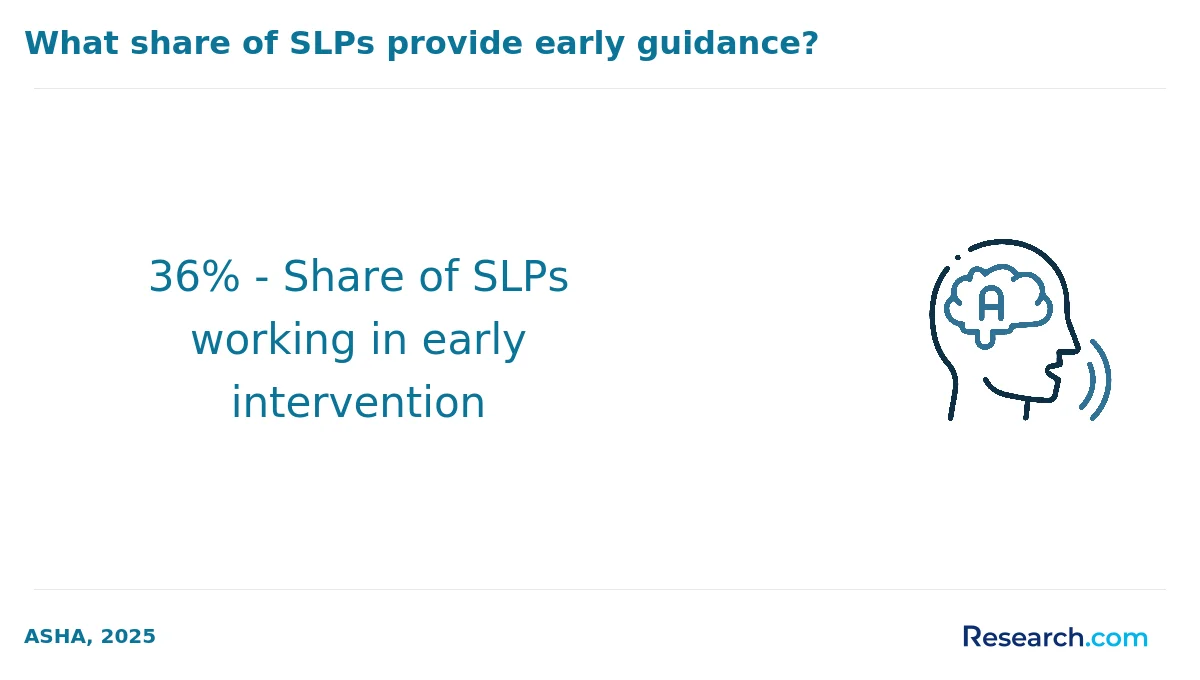
Early intervention specialists serve infants and toddlers with developmental delays. These roles are supported by public policy, parent awareness, and clinical evidence favoring early support.
- Rising identification of speech and language delays sustains demand for early services.
- Government funding and mandated programs can help stabilize employment during recessions.
- Specialized training in family-centered care creates a higher barrier to entry.
Private practice speech-language pathologists
Private practice roles vary more than public-sector jobs, but established practices with diversified clients can be resilient. Group practices generally offer more stability than starting a solo practice immediately after graduation.
- Serving pediatric, adult, and geriatric clients can reduce dependence on one referral source.
- Telepractice adoption during COVID-19 helped many practices continue services.
- Entrepreneurial flexibility allows clinicians to adjust services to local demand.
Speech-language pathologists in skilled nursing facilities
Skilled nursing and long-term care settings are closely tied to aging demographics and post-acute rehabilitation needs.
- Structural aging creates consistent patient inflows after hospitalization.
- Rehabilitative care regulations in nursing homes protect many therapy opportunities.
- Specialized knowledge in dysphagia, cognition, and geriatric communication supports employability.
Research and academia in speech pathology
Research and academic roles can be competitive, but unemployment risk is often moderated by high credential barriers and specialized expertise.
- Federal and private grants support positions tied to longitudinal studies, clinical trials, and research programs.
- Graduate degree requirements limit the pool of qualified applicants.
- Funding can decline during economic stress, but specialized roles may remain more stable than less credentialed positions.
Students comparing speech pathology with other healthcare education paths should consider not only demand but also training cost. For example, resources on affordable online nursing programs can help illustrate how different healthcare professions vary in cost, credentialing, and job-market structure.
How Does the Speech Pathology Job Market Compare to the National Unemployment Average?
The speech pathology job market is typically stronger than the overall market for college graduates. The unemployment rate for college graduates nationwide averages about 2.5%, while speech pathology degree holders, particularly those in clinical, educational, or healthcare settings, tend to face lower formal unemployment, near 1.3%.
That difference matters because lower unemployment usually means shorter job searches, fewer income gaps, and more bargaining power when choosing among employers. However, unemployment alone does not tell the whole story. Graduates should also watch for underemployment, regional shortages, caseload quality, benefits, supervision, and advancement opportunities.
- Employment stability: Demand across schools, hospitals, clinics, and private practices can shorten the transition from graduation to employment.
- Underemployment concerns: Some graduates may accept roles that do not fully use their training, offer limited supervision, or provide fewer advancement opportunities. Federal Reserve Bank analysis indicates their underemployment rates are lower than many fields but still notable.
- Regional variation: A national unemployment rate can hide local differences. A graduate in a healthcare-rich metro may see a very different job market from one in a rural area with few employers.
- Data interpretation: Because speech pathology is a specialized profession, small labor-force changes can affect reported rates. Long-term patterns are more useful than one-year snapshots.
- Career strategy: Licensure, internships, clinical placement quality, specialization, and geographic flexibility all reduce risk more effectively than relying on the overall field outlook.
One graduate described the first job search as competitive but manageable because demand was steady. The turning point was not applying broadly to every opening, but targeting roles that matched clinical training, completing relevant internships, and staying flexible about location. That approach reduced job-search time and helped the graduate avoid accepting a poor-fit position simply to become employed.
What Speech Pathology Specializations Are Most In-Demand Among Employers Right Now?
The most in-demand speech pathology specializations are those aligned with pediatric development, aging-related disorders, medical complexity, AAC technology, telepractice, voice care, and swallowing disorders. Demand is not evenly distributed across the field, so students should match specialization choices with employer needs in the region and setting where they intend to work.
- Pediatric speech pathology: Demand is supported by early intervention policies, school-based services, and increased recognition of developmental delays in young children.
- Geriatric speech pathology: An aging population sustains need for clinicians who can address stroke recovery, cognitive-communication disorders, dementia-related communication needs, and swallowing concerns.
- Medical speech pathology: Hospitals and rehabilitation centers need clinicians prepared for acute care, neurological conditions, dysphagia, and interdisciplinary medical teams. Demand may vary with reimbursement and healthcare policy changes.
- Augmentative and alternative communication (AAC): Speech-generating devices and communication technologies create demand for clinicians who can assess needs, train users, and integrate systems into daily life.
- Telepractice speech pathology: Remote service delivery expands access for schools, rural communities, and families, although clinicians must understand state licensure rules and telehealth compliance.
- Voice and swallowing disorders: These niches require focused clinical skill and can strengthen job security because qualified specialists are less common.
Before committing to a specialization, prospective students should compare job postings, clinical placement options, state licensure requirements, employer preferences, and professional salary surveys. The best specialization is not always the one with the highest general demand; it is the one that matches regional hiring needs, your clinical strengths, and a clear credential pathway.
Students who need flexible graduate education options should also compare accredited online slp master's programs carefully, especially if they plan to build experience while preparing for licensure.
For readers considering adjacent advanced healthcare paths, online PhD nursing programs show how doctoral-level preparation can support specialized roles in a related labor market.
Which Industries Employing Speech Pathology Graduates Offer the Greatest Job Security?
The industries offering the strongest job security for speech pathology graduates are usually healthcare, educational services, government and public health, rehabilitation and long-term care, and established private or specialty clinics. Each sector has a different mix of stability, pay potential, workload, and advancement.
Healthcare
Healthcare settings include hospitals, outpatient clinics, rehabilitation centers, and medical specialty practices. These roles are protected by recurring patient need and the importance of speech-language pathology in recovery, swallowing care, and neurological rehabilitation.
- Core work includes diagnosing and treating communication and swallowing disorders.
- Success requires clinical judgment, documentation skill, patient-centered care, and collaboration with physicians, nurses, occupational therapists, and physical therapists.
- Speech-language pathologists usually report to clinical supervisors, rehabilitation managers, or department leaders.
- Licensure and medical specialization make clinicians integral to care teams.
Educational services
Public schools employ speech-language pathologists to support students with speech, language, fluency, voice, and communication needs. Stability is supported by federal laws such as IDEA and the ongoing requirement to provide services through individualized education programs.
- Work includes evaluations, therapy plans, progress monitoring, consultation, and family communication.
- Knowledge of special education law, school documentation, and collaboration with teachers is essential.
- Reporting lines often include school administrators or special education coordinators.
- Mandated services help preserve positions even when district budgets tighten.
Government and public health
Government and public health roles may serve veterans, underserved communities, early childhood programs, public hospitals, or community rehabilitation initiatives.
- Responsibilities can include clinical services, program development, outreach, research, and policy-related work.
- Important skills include cultural responsiveness, grant awareness, public-service documentation, and interagency coordination.
- Reporting may flow to program managers, public health directors, or agency administrators.
- Essential-service status and public funding can reduce layoff exposure compared with purely market-driven roles.
Rehabilitation centers and long-term care facilities
These settings serve patients recovering from strokes, injuries, surgeries, or chronic conditions. They are closely tied to aging demographics and post-acute care needs.
- Key duties include therapy planning, caregiver education, multidisciplinary coordination, and progress documentation.
- Clinicians need knowledge of neurological conditions, geriatric care, dysphagia, cognition, and compliance standards.
- Speech-language pathologists commonly report to clinical directors, rehabilitation managers, or nursing leadership.
- Stable rehabilitation demand supports workforce security, though reimbursement changes can affect staffing patterns.
Private practice and specialized clinics
Private practices can be less predictable than public employers, but established clinics with strong referral networks and specialized services may provide durable employment.
- Work includes assessment, individualized treatment, parent or caregiver coaching, telehealth services, and niche care such as pediatric language, voice, fluency, or AAC.
- Entrepreneurship, client communication, billing knowledge, and technology adoption are valuable.
- Reporting structures vary from employee roles under clinic owners to fully independent practice.
- Specialization and patient loyalty can protect long-term income, but new solo practices carry more risk.
A practicing clinician described the strongest job-security strategy as skill diversification. Specializing created expertise, but experience across both educational and healthcare settings provided more options when regulations, caseloads, or technology changed. Continuous learning, not one credential alone, was the factor that kept new doors open.
How Do Government and Public-Sector Speech Pathology Roles Compare in Unemployment Risk?
Government and public-sector speech pathology roles generally carry lower unemployment risk than many private-sector roles because they are tied to essential services, public funding, formal hiring systems, and civil service protections. The trade-off is that starting pay and promotion speed may be less attractive than in some private settings.
- Unemployment rates: Public-sector speech-language pathologists tend to experience lower joblessness during economic downturns because healthcare, education, disability services, and rehabilitation remain public priorities.
- Layoff frequency: Federal agencies, state and local governments, public schools, and public universities often use formal budget and personnel procedures. Layoffs may happen, but they are less likely to occur abruptly than in revenue-sensitive private employers.
- Career tenure: Pension plans, union agreements, seniority systems, and comprehensive benefits can encourage longer employment tenure.
- Federal agency roles: These positions may offer strong job protections and benefits, but hiring can be slow, competition can be high, and promotions may take time.
- State and local government roles: Stability depends partly on local budget health, but public health, disability, and school-based services often remain funded because they meet community needs or legal obligations.
- Public universities and research institutions: These roles may combine public benefits with research expectations. Stability can depend on grant cycles, enrollment, department priorities, and clinical program funding.
- Quasi-governmental organizations: These employers may blend public funding with more flexible operations, offering a middle ground between public-sector stability and private-sector adaptability.
- Financial trade-offs: Government jobs may offer lower early compensation than private practice, but benefits such as pensions, comprehensive leave, and eligibility for public service loan forgiveness can improve long-term financial security.
Public-sector roles are best suited for clinicians who prioritize stable employment, predictable benefits, and mission-driven work. Private-sector roles may appeal more to clinicians seeking faster income growth, entrepreneurship, or rapid advancement, but they can involve greater exposure to reimbursement shifts, referral changes, and business-cycle risk.
What Role Does Licensure or Certification Play in Protecting Speech Pathology Degree Holders From Unemployment?
Licensure is one of the strongest protections against unemployment for speech pathology degree holders because it legally controls who can practice. Employers in schools, healthcare facilities, rehabilitation centers, and many clinics cannot simply replace a licensed speech-language pathologist with an unlicensed worker. This creates a stable demand floor for qualified clinicians.
- Mandatory licensure: Nearly all states require Speech Pathologists to complete a master's degree, pass the Praxis exam in Speech-Language Pathology, and fulfill supervised clinical hours before obtaining a license. This legal requirement narrows the labor pool and protects qualified professionals from open competition with uncredentialed workers.
- Economic protection: Licensing restricts supply and preserves demand because employers must hire properly credentialed clinicians for regulated services. This matters most during recessions, budget reviews, and reimbursement changes.
- Non-mandatory certifications: The Certificate of Clinical Competence in Speech-Language Pathology (CCC-SLP) from the American Speech-Language-Hearing Association is not legally required in the same way as state licensure, but many employers treat it as a strong quality signal or hiring preference.
- Specialty credentials: Credentials in areas such as AAC, bilingual practice, dysphagia, pediatric care, or medical speech-language pathology can reduce competition for advanced roles.
- Credential strategy: Students and early-career clinicians should first secure the credentials required for legal practice, then add certifications that match the employer setting and specialization they want.
- Recent trend: According to the Bureau of Labor Statistics, employment of Speech-Language Pathologists is projected to grow 17% from 2025 to 2035, much faster than average, illustrating sustained labor demand supported in part by credentialing requirements.
The main mistake is spending money on optional credentials before completing the requirements that actually unlock licensure and employability. A practical sequence is to confirm state requirements, choose an accredited graduate pathway, complete supervised clinical experience, pass required exams, and then pursue targeted certifications that align with real job postings.
How Does Geographic Location Affect Unemployment Risk for Speech Pathology Degree Graduates?
Geographic location strongly affects unemployment risk for speech pathology graduates because job availability depends on local employer density, healthcare infrastructure, school funding, population age, and state licensure rules. A strong national outlook does not guarantee easy hiring in every local market.
Healthcare-rich metropolitan areas such as Boston, Minneapolis, and San Diego tend to offer lower unemployment risk because they have multiple employer types: hospitals, outpatient clinics, rehabilitation centers, school districts, government agencies, universities, and specialized practices. This diversity protects clinicians from relying on a single employer or sector.
Rural and smaller metro areas can be more complicated. Some have severe shortages and strong demand, while others have few employers, limited specialty care, and longer job-search timelines. The issue is not simply rural versus urban; it is whether the region has enough funded positions, referral sources, and clinical infrastructure to support stable employment.
Telepractice changes the geography equation. Remote-capable speech pathology roles can expand access to employers beyond a clinician's immediate area, especially in pediatric, school-based, and some adult services. However, telepractice does not erase licensure requirements. Clinicians must confirm where they are legally allowed to serve clients and how reimbursement or school contracts are structured.
- Demand clusters: Healthcare-rich metros like Boston, Minneapolis, and San Diego consistently show lower unemployment rates for speech pathology graduates due to diverse employer bases.
- Industry concentration: Regions with hospitals, public schools, government health agencies, universities, and rehabilitation networks provide more recession-resistant job markets.
- Remote work flexibility: Telepractice can reduce dependence on the local economy by widening the pool of reachable employers and clients.
- Regional variability: Rural and smaller metro areas may offer strong openings in shortage regions, but fewer employers can mean longer searches if one role ends.
- Recent trend: Telepractice positions have grown by over 35% nationwide in the past five years, indicating a major shift toward remote-enabled employment.
Graduates should review BLS area-specific employment data, compare LinkedIn job postings by location, speak with local employers, and evaluate regional wage benchmarks before deciding whether to stay local, relocate, or pursue remote-friendly work. Those comparing healthcare occupations can also review an online ultrasound tech school resource to see how geographic demand varies across allied health fields.
Which Speech Pathology Careers Are Most Vulnerable to Automation and Technological Disruption?
The speech pathology careers most vulnerable to automation are those dominated by routine documentation, standardized scoring, repetitive exercises, scheduling, and rules-based administrative work. Roles centered on complex diagnosis, individualized treatment planning, counseling, dysphagia care, ethical judgment, and interdisciplinary decision-making are much less likely to be replaced outright.
Frameworks such as the McKinsey Global Institute's automation susceptibility, Oxford Martin School's occupational automation probability, and MIT Work of the Future's task-level automation analysis all point to the same principle: technology is more likely to automate predictable tasks than relationship-based clinical reasoning.
- Standardized assessment and data entry roles: Work that involves entering scores, compiling test results, or producing routine reports is exposed to machine learning tools and automated documentation systems.
- Document review and administrative coordination: Insurance forms, scheduling, template-based reporting, and repetitive compliance tasks can be handled increasingly well by rule-based systems and robotic process automation.
- Basic client interaction and repetitive therapy drills: Apps and virtual therapy platforms can support practice for articulation, fluency, or language exercises. They may reduce demand for some routine support tasks, but they do not replace full clinical oversight.
- Specialized clinical decision-making: Complex cases involving swallowing disorders, neurological conditions, AAC, counseling, co-occurring disabilities, or medical risk require licensed human judgment and remain less vulnerable.
The best response is not to avoid technology. Speech-language pathologists who learn to evaluate AI-generated outputs, use digital assessment tools responsibly, manage telepractice platforms, and maintain ethical oversight can become more valuable. Technology will likely change how clinicians work; it is less likely to eliminate clinicians who handle complex, regulated, person-centered care.
Automation risk should be considered alongside licensure, specialization, employer setting, and geography. A role with some automated tasks can still be secure if the clinician provides services that are legally required, clinically complex, and difficult to standardize. Professionals considering broader healthcare credentials can compare pathways such as RN to nurse practitioner programs to understand how advanced clinical training may affect career resilience in technology-influenced healthcare settings.
How Does a Graduate Degree Reduce Unemployment Risk for Speech Pathology Degree Holders?
A graduate degree reduces unemployment risk for speech pathology degree holders mainly because it enables licensure, advanced clinical training, and access to specialized roles with smaller applicant pools. In many speech-language pathology roles, a bachelor's degree alone is not enough for independent clinical practice.
Data from Georgetown University Center on Education and the Workforce and the Bureau of Labor Statistics reveal that holders of graduate credentials in speech pathology face unemployment approximately 2 to 3 percentage points lower than bachelor's degree holders. Advanced degrees often bring a median wage increase between 15% and 30%, especially within clinical and research environments.
Graduate credentials that can improve job security
- Professional master's degrees: These programs are the main route to licensure eligibility and clinical practice. They are often the most important credential for stable employment in speech-language pathology.
- Research-oriented master's and doctorates: These degrees can lead to research, academic, advanced clinical, and leadership roles where competition is narrower but entry requirements are higher.
- MBA programs: For speech pathology graduates interested in administration, healthcare operations, education management, or clinic leadership, an MBA can broaden employment options beyond direct service roles.
Costs and trade-offs
- Cost: Total tuition and fees generally range from $20,000 to $60,000 depending on the program and institution.
- Duration: Most professional master's degrees require about two years full-time, while doctoral programs extend from four to six years.
- Opportunity cost: Time in school can delay earnings and full-time experience, so students should compare projected stability and earnings against debt and lost income.
Graduate school is not automatically the best investment unless it leads to the credential or role the student actually needs. Before enrolling, verify accreditation, state licensure alignment, clinical placement support, Praxis preparation, graduation outcomes, and employer reputation. Targeted certifications, relocation to high-demand areas, or choosing a stronger employer may also reduce unemployment risk with less time and cost.
What Entry-Level Speech Pathology Career Paths Offer the Fastest Route to Long-Term Job Stability?
The entry-level speech pathology paths that most quickly lead to long-term stability are those with structured supervision, strong employer demand, clear credentialing, and promotion pathways. The safest first job is often not the highest-paying offer; it is the role that builds transferable skills and keeps the clinician employable across settings.
Public school speech-language pathologist
School-based roles are a common stable entry point because they are tied to special education services, public funding, and recurring student needs.
- Schools often provide structured calendars, defined caseloads, and internal advancement opportunities.
- Experience can lead to specialized, supervisory, or administrative roles within five to ten years.
- Licensure and school-based experience can remain transferable across many districts and states, subject to local requirements.
Healthcare-based clinical speech pathologist
Hospitals, rehabilitation centers, and outpatient clinics can provide strong long-term stability for graduates who want medical experience.
- Medical roles build skills in neurological care, swallowing disorders, acute rehabilitation, documentation, and interdisciplinary teamwork.
- Experience in these settings can support movement into outpatient, specialty, senior clinician, or supervisory roles.
- Typical entry-level tenure lasts two to four years before promotion to senior or supervisory roles, signaling solid job longevity.
Early intervention specialist
Early intervention roles serve infants, toddlers, and families. They are strong options for graduates interested in developmental services and community-based care.
- These roles develop collaboration skills with families, physicians, educators, social workers, and other therapists.
- Integrated service models can support professional development and upward mobility.
- Advancement typically occurs between three to six years, progressing toward managerial positions.
Private practice speech pathologist in a networked clinic
Group clinics are usually safer entry points than launching a solo private practice immediately after graduation.
- Networked clinics can provide mentorship, referrals, administrative support, and exposure to varied cases.
- Clinicians can develop niche services while learning billing, documentation, and client-retention practices.
- Early referral network building improves resilience during economic downturns.
New graduates should evaluate employers by supervision quality, retention, promotion history, caseload expectations, benefits, mentorship, and specialization opportunities. A role with slightly lower starting pay but strong training and advancement may create better long-term stability than a high-paying job with weak support and high turnover.
What Graduates Say About the Speech Pathology Degree Careers With the Lowest Unemployment Risk
- : "Graduating with a degree in speech pathology opened doors to specialized roles in pediatric rehabilitation—a field with remarkably low unemployment. I found that pursuing certification in bilingual speech-language hearing practices dramatically enhances job stability, especially in diverse urban areas. This career has given me both purpose and a sense of security I hadn't anticipated. — Kayden"
- : "Reflecting on my journey, I can confidently say that focusing on geriatric speech pathology within healthcare systems across the Southwest proved to be a wise choice. The credentialing path for this specialization is rigorous but pays off by minimizing job turnover at every career stage. It's rewarding to serve an aging population while maintaining steady employment throughout my career. — Cannon"
- : "The most valuable insight I gained is the importance of early-career certification in school-based speech pathology programs, especially in regions with growing demand like the Pacific Northwest. Mid- and senior-level credentialing in this niche ensures a strong competitive edge and continued career growth. This profession offers not only stability but also diverse opportunities to impact lives meaningfully. — Nolan"
Other Things You Should Know About Speech Pathology Degrees
The 10-year employment outlook for speech pathology careers with the lowest unemployment risk is generally positive, with projected job growth rates exceeding the average for all occupations. Demand is driven by an aging population requiring treatment for speech and swallowing disorders and increased awareness of speech therapy benefits in schools. Roles in healthcare and education settings tend to offer the most stable opportunities over the next decade.
Mid-career speech pathologists specializing in pediatric speech therapy, medical speech-language pathology, and neurogenic communication disorders appear most in demand. These areas combine a high volume of cases with ongoing needs for advanced clinical skills, which reduces unemployment risk. Specialization in complex disorders or working within hospitals and rehabilitation centers often leads to the strongest job prospects.
Freelance and self-employed speech pathologists face variable unemployment risk depending on their ability to build a client base or secure contracts in schools and healthcare organizations. While self-employment can offer flexibility, it may lack the stability of salaried positions, especially early in a career. Licensing and certification increase credibility, which is critical for reducing risk when pursuing freelance opportunities.
Speech pathology fields have shown resilience during economic recessions due to the consistent demand for communication disorder treatments. However, funding cuts or reduced healthcare spending can temporarily impact employment opportunities, although core services often remain necessary, maintaining a relatively stable job market.
References
- U.S. Bureau of Labor Statistics - Speech-Language Pathologists https://www.bls.gov/ooh/healthcare/speech-language-pathologists.htm
- ASHA EdFind - Accredited Speech-Language Pathology Programs https://find.asha.org/ed/
- ETS Praxis - Speech-Language Pathology (5331) https://praxis.ets.org/test/speech-language-pathology-5331.html
- Auburn University, Montgomery - Master of Science in Speech-Language Pathology https://www.aum.edu/degree/ms-speech-language-pathology/
- Pennsylvania Western University - Master of Science in Speech-Language Pathology https://online.pennwest.edu/programs/speech-language-pathology-grad/index.php
- Pepperdine University - Master of Science in Speech-Language Pathology https://healthscience.pepperdine.edu/online-masters-in-speech-language-pathology/
- California State University-East Bay - Online Master of Science in Speech-Language Pathology https://ce.csueastbay.edu/programs/speech-language-pathology/
- Idaho State University - Master of Science in Speech-Language Pathology (Online/Distance Education) https://www.isu.edu/slp/programs-offered/slp-graduate-program/


