2027 What Jobs Can You Get With an MLIS in Scholarly Communication?

Co-Founder and Chief Data Scientist
An MLIS can prepare you to help researchers publish, share, and preserve their work, but scholarly communication jobs vary widely in their degree requirements and day-to-day work. That distinction matters when choosing a graduate program.
The U.S. Bureau of Labor Statistics projects 2.6% employment growth for librarians and media collections specialists from 2025 to 2035, a broad category that includes some potential employers but does not measure this specialty separately. This guide maps the roles, skills, costs, and salary evidence so prospective students and career changers can judge whether an MLIS is the right investment.
Key Things You Should Know
- An MLIS can lead to scholarly communication librarian, repository, open-access, and research-support roles; some adjacent jobs accept other degrees or relevant experience.
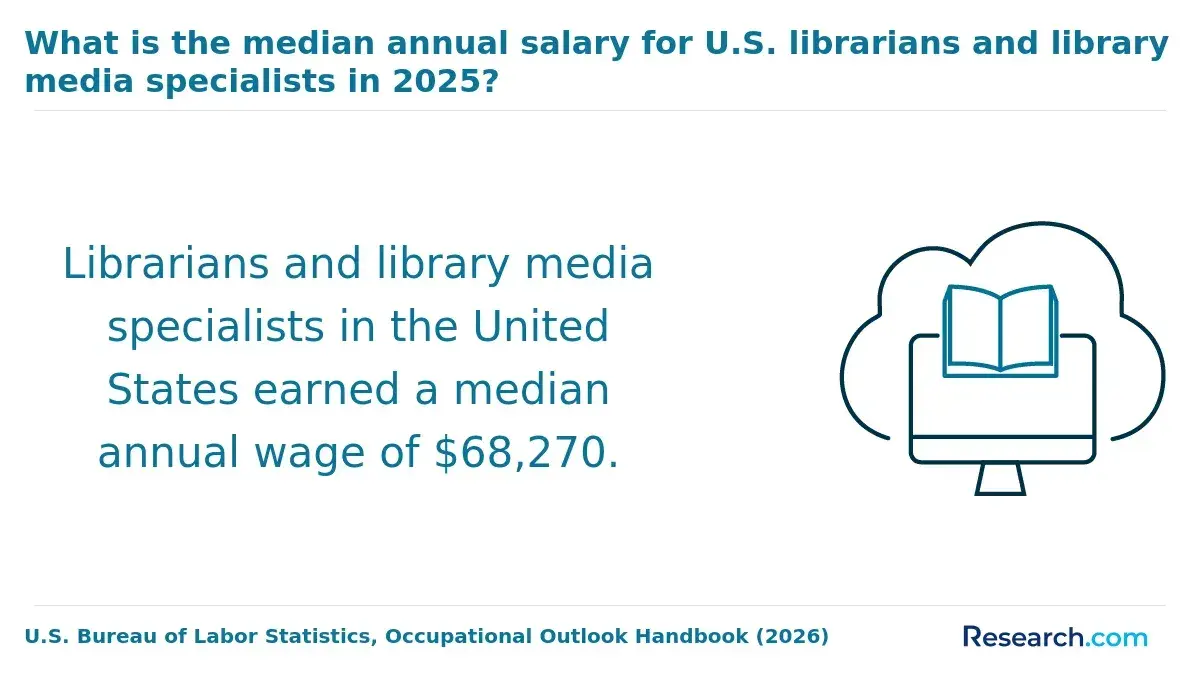
- The May 2025 median annual pay for U.S. librarians and media collections specialists was $68,270, but that figure is not a salary estimate for scholarly communication specialists.
- Choose a program by checking ALA accreditation, relevant electives, applied projects, course scheduling, and total cost, not by assuming a course title represents a formal specialization.
What is scholarly communication in library science?
Scholarly communication is the system through which research is created, reviewed, published, discovered, shared, and preserved. In libraries, the work often centers on helping authors understand publishing choices and making research accessible within copyright, funder, and institutional requirements.
That can mean explaining open-access options, managing an institutional repository, helping faculty identify which version of an article they may deposit, or coordinating support for research data sharing.
It overlaps with digital preservation and metadata management, but it is not identical to either: a repository needs technical stewardship, while researchers also need guidance on publishing rights and access policies.
What jobs can you get with an MLIS in scholarly communication?
Scholarly communication librarian is the closest match, but employers also divide the work among open-access, repository, copyright, and research-support positions. The table distinguishes professional librarian posts from adjacent roles whose degree requirements may be broader:
| Job title or pathway | Typical focus | How an MLIS fits |
| Scholarly communication or open-access librarian | Author consultations, publishing options, rights education, and campus outreach | Often relevant to professional academic-library positions; check each posting's requirements |
| Institutional repository librarian or manager | Deposits, metadata, workflows, access, and preservation coordination | Strong preparation, especially with repository experience; some manager roles accept other backgrounds |
| Copyright or scholarly publishing librarian | Educational guidance on reuse, licenses, and author agreements | Useful alongside demonstrated copyright knowledge; responsibilities and qualifications vary |
| Research data or digital scholarship librarian | Data-sharing guidance or support for digital research outputs | Relevant when paired with data or technical skills; some roles favor disciplinary expertise |
| Publisher, consortium, or research-office specialist | Publishing operations, agreements, research administration, or policy support | One possible qualification, not necessarily a requirement |
Most librarian positions in this specialty sit in academic libraries, while repository and publishing work can also occur in research institutes, publishers, and consortia. Search by responsibilities as well as title: a "digital initiatives" opening may involve scholarly communication, while a similarly named job may focus mainly on digitization. For a broader comparison, see library science jobs by specialization.
What qualifications do scholarly communication librarian jobs require?
Professional academic-library postings commonly seek an ALA-accredited library and information science master's degree, often called an MLIS or MLS. The credential name varies by institution, so assess the specific program and the employer's wording rather than assuming every information-related master's qualifies.
Repository specialists, publishing staff, and research-office employees may instead qualify through another degree and directly relevant experience.
Employers may look for the ability to explain copyright and licensing in plain language, work with repository metadata, interpret research-sharing requirements, teach researchers, and collaborate with faculty and campus offices.
Requirements differ by position: a data-focused role may demand more technical experience, while an outreach-focused role may place greater weight on instruction and consultation.
Career changers can use prior experience in academic publishing, research administration, software support, or teaching to demonstrate relevant skills, but experience does not automatically replace a degree when a posting requires one.
If admission requirements are a concern, compare published policies and request an individual review where appropriate; library information science for career changers offers additional context on fitting graduate study around work.
What does a scholarly communication librarian do?
A scholarly communication librarian helps researchers make informed decisions about where and how their work can be shared. A typical assignment might begin with an author asking whether an accepted manuscript can go into the university repository.
The librarian checks the relevant agreement or policy, explains the available options, and helps route an eligible version through the deposit workflow. They provide guidance rather than promising that every manuscript can be posted.
Depending on the employer, the job can also include teaching workshops on publishing choices, maintaining repository submission guidance, improving descriptive metadata so work can be found, or partnering with research offices on sharing requirements.
Open-access agreements and AI-assisted discovery make clear rights information and reliable metadata especially important: wider discovery is useful only when records accurately describe what users can access and reuse.
The balance varies. A small library may combine these duties with liaison or instruction work; a larger institution may have separate repository, copyright, and data-support teams. Read the responsibilities in a job posting to learn whether the position is primarily consultative, technical, or operational.
What coursework prepares you for scholarly communication careers?
Look for a curriculum that connects publishing decisions to the systems used to describe and provide access to research. Useful subjects include scholarly publishing and open access, copyright and information policy, metadata, digital repositories, research data management, instruction, and assessment.
An institution may offer these as electives without offering a formal scholarly communication concentration.
Applied work helps turn coursework into evidence for employers. A supervised project could produce repository deposit instructions, a metadata review of research outputs, or an accessible workshop explaining author rights.
In a portfolio, describe the audience, the policy or workflow you analyzed, your contribution, and how you checked the accuracy of the result. Use hypothetical or approved materials when rights or institutional information are sensitive.
Before relying on a catalog listing, ask when the relevant elective last ran and whether it is expected to run during your enrollment. A course that cannot fit your schedule offers less value than a broader class paired with a feasible project or practicum.
Are online MLIS programs suitable for scholarly communication careers?
Yes, an online MLIS can be suitable if the specific program is ALA-accredited and gives you access to relevant coursework and credible applied experience. Online delivery alone says nothing about accreditation, specialization, or whether an internship can be completed remotely.
Compare live-session requirements, elective schedules, group-work expectations, and the rules for arranging a practicum at a local academic library or research organization.
If you already work at a university, ask whether a supervised project there can meet program requirements. If you do not, find out who secures placements before treating a practicum as a reliable route into the field.
Published online MLIS admissions and tuition information can help you build a shortlist, but confirm the current catalog, schedule, and charges directly with each program.
How much does an MLIS cost and how long does it take?
There is no reliable single price or completion time for an MLIS: required credits, per-credit tuition, residency rules, fees, course sequencing, and enrollment pace vary by program.
For a usable estimate, multiply required credits by the tuition rate that applies to you, then add mandatory fees and likely expenses for materials, technology, travel, or a practicum. Compare that gross cost with confirmed employer support or other funding; the remainder is not necessarily what you will borrow.
Completion time also depends on whether required courses and specialty electives run when you need them. Ask a program to map a realistic part-time or full-time schedule using the courses you intend to take. A library information degree duration comparison is a starting point, not a substitute for that individual schedule.
When considering financial aid, verify current eligibility and borrowing terms for your enrollment period with the school's aid office and Federal Student Aid. The financial case is strongest when the degree meets the requirements of jobs you actually want and its full cost fits your budget - not when a published tuition rate is mistaken for the total bill.
What salary can you earn in scholarly communication careers?
The U.S. Bureau of Labor Statistics reports a $68,270 median annual salary in May 2025 for librarians and media collections specialists. This is the most useful broad occupational benchmark for many librarian-titled roles discussed here, but it does not isolate scholarly communication jobs or predict an offer. Pay for repository, publishing, and research-office positions may follow different job classifications.
For a personal estimate, compare current postings for your target title, location, and experience level, including whether the employer publishes a salary range.
Consider the likely pay difference from your current work alongside tuition, forgone earnings if you reduce work hours, and the possibility that an entry-level offer falls below the broad occupational median.
What is the job outlook for scholarly communication professionals?
BLS projects 2.6% employment growth from 2025 to 2035 for librarians and media collections specialists. That modest broad-category projection should not be read as a forecast for scholarly communication openings: BLS does not provide a separate figure for this specialty.
Open-access publishing, institutional repositories, and research-sharing requirements give libraries continuing work to organize and explain, but staffing and job titles depend on each employer's budget and priorities.
To judge your local prospects, review a sample of recent postings over time. Note how often they combine scholarly communication with liaison duties, copyright, repository management, or data support, then develop experience that matches those combinations rather than training for a title alone.
How do you choose an accredited MLIS program for scholarly communication?
First, check the specific master's program in the current American Library Association accreditation directory. Institutional accreditation is not the same as ALA program accreditation, and ALA accreditation does not verify a scholarly communication concentration, a particular elective, or online delivery.
Next, build a short comparison using each program's current catalog and a conversation with an adviser. Confirm whether relevant courses are required or elective, when they are expected to run, whether you can complete a repository or publishing project, and how placements are arranged.
Ask for a course sequence and an itemized cost estimate based on your residency and study pace. Admissions policies can differ too; guidance on online library science application flexibility can help you identify questions to take to admissions staff, but only the institution can confirm your eligibility.
Choose an MLIS when your target postings call for a professional librarian credential and the program lets you demonstrate specialty skills at a manageable cost.
If you primarily want publishing operations, research administration, or a technical repository role that accepts other qualifications, compare a targeted course, certificate, or relevant work experience before committing to the full degree.
Other Things You Should Know About Library Science
Sometimes. Repository deposit may be permitted under the author's agreement or another applicable policy, even when the publisher's open-access option has a fee. Check the permitted version and any embargo before posting.
No. An ORCID iD helps distinguish a researcher and connect their work to them. An institutional repository stores or provides access to research outputs under its own submission and preservation practices.
Librarians can explain policies, agreements, and common options as part of their work. A question requiring a legal determination should go to the institution's appropriate legal or copyright authority.
It is an arrangement between a publisher and an institution or consortium that links journal access with provisions for publishing open-access articles. Terms vary, so authors should check their institution's eligibility rules and covered journals.
References
- Open Access and Scholarly Communication - Research Guides https://libguides.colostate.edu/open-access
- What is Scholarly Publishing? - Power, Profit, and Privilege | University of Kansas https://opentext.ku.edu/pppscholarlypublishing/chapter/definitions/
- Scholarly Publishing - Scholarly Communications | Research Guides at Augusta University https://guides.augusta.edu/scholarlycommunications/scholarlypublishing
- MLIS Career Outcomes | College of Information Science https://infosci.arizona.edu/ma-library-information-science/career-outcomes
- What Can You Do With a Library Science Degree? | Syracuse University Online Master's Programs https://onlinegrad.syracuse.edu/information-science/mslis/library-science-careers/
- Non-traditional jobs for librarians | American Library Association https://www.ala.org/educationcareers/careers/paths/jobtypes/privatesector
- Scholarly Communication Work: On the Ground Perspectives | acrl.org https://crl.acrl.org/index.php/crl/article/view/27013/34901
- Office of Scholarly Communication - Ithaka S+R https://sr.ithaka.org/publications/office-of-scholarly-communication/
- NASIG Core Competencies for Scholarly Communication Librarians https://www.nasig.org/Competencies-Scholarly-Communication