
2027 Online MLIS Programs With Classes Held Only After 6 p.m. Eastern Time

Co-Founder and Chief Data Scientist
An online MLIS can fit around a workday - until a required seminar, group meeting, or practicum lands before 6 p.m. Eastern. That distinction matters if daytime attendance is impossible. The U.S. Bureau of Labor Statistics reports a May 2025 median annual salary of $68,270 for librarians and media collections specialists, making the degree a significant career and financial decision.
This guide explains what an evening-only schedule would require, how to verify it with a program, and how to weigh accreditation, cost, and career goals before enrolling.
Key Things You Should Know
- No online MLIS program should be treated as entirely after 6 p.m. Eastern without written confirmation covering every required course, live session, orientation, and placement throughout the degree.
- Asynchronous coursework offers the strongest protection against daytime class conflicts, but deadlines, group work, and practica may still limit flexibility.
- The BLS projects 2.6% employment growth for librarians and media collections specialists from 2025 to 2035; compare that outlook with the full cost of the degree, not tuition alone.
What are online MLIS programs with classes held only after 6 p.m. Eastern Time?
For a student with a strict daytime conflict, the phrase means that every required real-time academic activity starts after 6 p.m. Eastern - not merely that most lectures are online. An MLIS is a Master of Library and Information Science; schools may use other degree names, including MLS or Master of Information. The exact degree title does not establish its schedule.
There is an important difference between a program that allows evening study and one that guarantees evening-only attendance. An asynchronous course may have no scheduled class meetings, while a program advertising evening classes may still require a daytime orientation, exam, advising appointment, or field placement. Without comprehensive, current program documentation, no named program can responsibly be presented as meeting an after-6 p.m. Eastern requirement across its entire curriculum.
Define your boundary before contacting schools: whether a meeting starting exactly at 6 p.m. is acceptable, whether weekends work, and whether the restriction applies to internships and group meetings as well as classes. Specify Eastern Time, which changes between standard and daylight time, rather than assuming that a school's posted local time matches yours.
How do evening online MLIS programs structure live and asynchronous classes?
Delivery format determines how much control you have over your hours. The comparison below separates scheduled attendance from independent work; individual courses within one degree can use different formats.
| Format | Scheduled attendance | Main scheduling risk |
| Asynchronous | Usually no recurring live class meeting | Fixed deadlines, team projects, or occasional required events |
| Synchronous evening | Live sessions at published times | A required section may start too early or change in a later term |
| Mixed or hybrid online | Varies by course and activity | Daytime meetings, campus visits, or placement hours |
A short completion timeline can make the scheduling problem harder: required courses may have fewer available sections, and taking more credits at once increases the hours needed outside class. When considering an accelerated accredited MLIS, compare its actual course sequence with your available evenings, not just its advertised completion time.
Ask the program coordinator for a term-by-term plan at your intended enrollment pace. Request the expected Eastern-time start and end of required live meetings, how often required courses run, whether recordings can replace attendance, and whether any orientation, presentation, exam, or practicum must occur before 6 p.m. A sample schedule is helpful, but ask which parts the school can guarantee for your cohort.
Which online MLIS programs are accredited by the American Library Association?
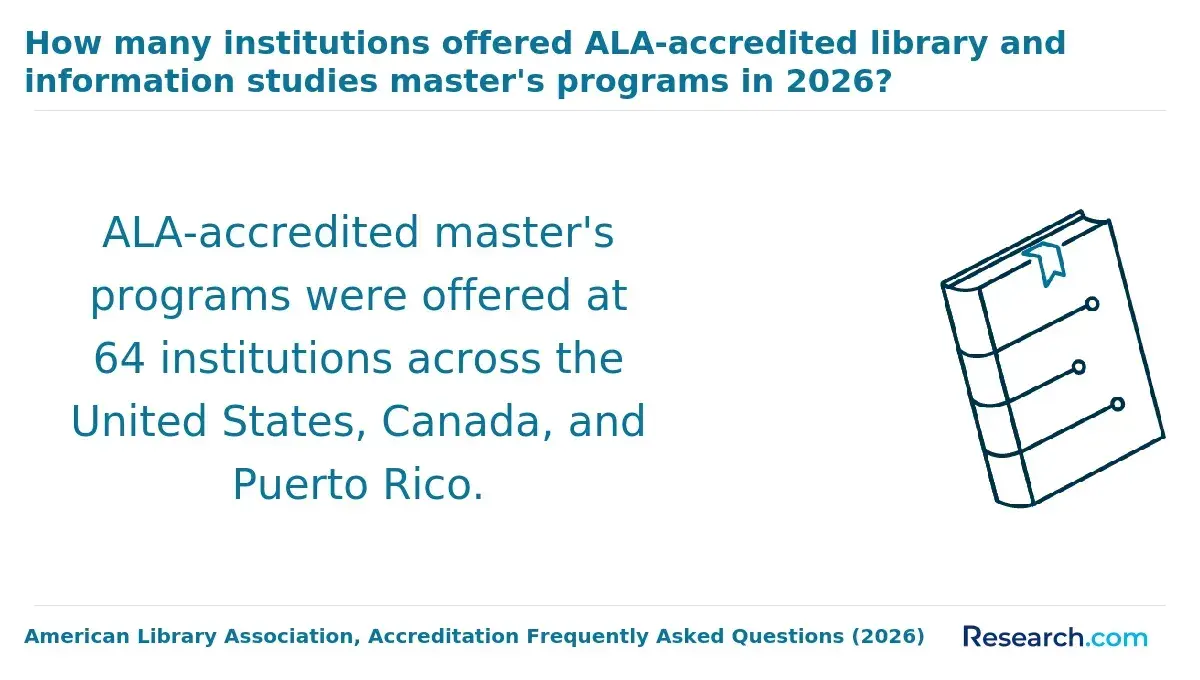
The American Library Association accredits specific master's programs in library and information studies, not every degree offered by an accredited university. Use the current ALA directory to check the specific program and degree you plan to enter, then confirm with the university that its online route leads to that degree. Accreditation does not verify evening class times, an elective's availability, or eligibility for school librarian licensure.
Geography may affect tuition and placement options even when instruction is online. If location matters, accredited Southern library science degrees can be a starting point for comparison, but verify each program's current ALA status, online delivery, residency rules, and schedule directly. No particular program can be identified here as evening-only without that additional evidence.
What coursework do online MLIS programs typically include?
Common subjects include information organization, reference and research services, collection development, information technology, management, and the ethical provision of access. Electives may support work in archives, digital collections, school libraries, or research data services. Requirements vary by degree, so distinguish a required course from an elective that might not run during your enrollment.
For example, a student interested in cataloging might look for coursework in metadata creation and standards such as MARC or Dublin Core, plus a project that demonstrates the work. A metadata and cataloging concentration is a formal pathway only when the university explicitly names and documents it; a related elective alone is not proof of a concentration.
For an evening-only student, the most useful curriculum question is whether every required course has an accessible section when you need it. Check the catalog against recent course schedules, and ask how a delayed elective or required practicum would affect your graduation plan. Course listings show what a school may offer, not what it guarantees each term.
What are the admission requirements for online MLIS programs?
Applicants generally need a bachelor's degree and must submit materials specified by the university, which may include transcripts, a statement of purpose, recommendations, or a résumé. Minimum grades, tests, deadlines, and prerequisites are school-specific; professional library experience does not automatically replace a stated degree requirement.
If you are changing careers, use your statement to connect prior work to the information services you hope to provide, then ask admissions whether a course or placement has prerequisites you lack. Ask separately about funding eligibility rather than assuming admission brings an award. Resources on library science tuition assistance can help identify questions for financial aid staff, but the university must confirm current awards and your eligibility.
How long do online MLIS programs take, and how much do they cost?
Completion time depends on required credits, course availability, enrollment pace, and any placement or capstone. An evening-only constraint can extend the timeline if a required course's available section meets during the day. Ask for a degree map at the number of courses you can realistically take while working, including what happens if you cannot attend the proposed section.
To compare costs, multiply each school's published tuition rate by its required credits, then add mandatory fees, materials, and any travel or placement expenses. Check the academic year, residency classification, and whether a slower pace adds terms with recurring fees. Published tuition is not the full cost of attendance, and an online designation does not necessarily mean every student pays the in-state rate.
A comparison of value online library science masters is most useful when programs are evaluated on the same cost basis. Keep gross program cost separate from what you might pay after verified assistance and from the amount you would borrow. If you expect to use federal aid, have the financial aid office confirm eligibility and loan terms for your enrollment period rather than relying on an older estimate.
What careers can you pursue with an online MLIS degree?
An MLIS can prepare graduates for public and academic library roles involving reference, instruction, collections, or community services. It can also support work in metadata, digital collections, archives, records management, and research support. Job requirements differ: a professional librarian opening may specify an ALA-accredited master's degree, while an adjacent information-management role may accept several degree backgrounds and prioritize experience.
Choose coursework and applied projects that match a target job. A prospective reference librarian might build instruction and research-service experience; a digital collections applicant might document a metadata or preservation workflow. Ask whether internships can be completed at a suitable local site and during hours you can work. Online classes do not make fieldwork automatically remote or available in the evening.
If your goal is an entry-level library technician position or a role primarily in another field, compare the MLIS with relevant work experience, a focused certificate, or another degree before committing to graduate tuition.
What salaries can MLIS graduates expect in library and information careers?
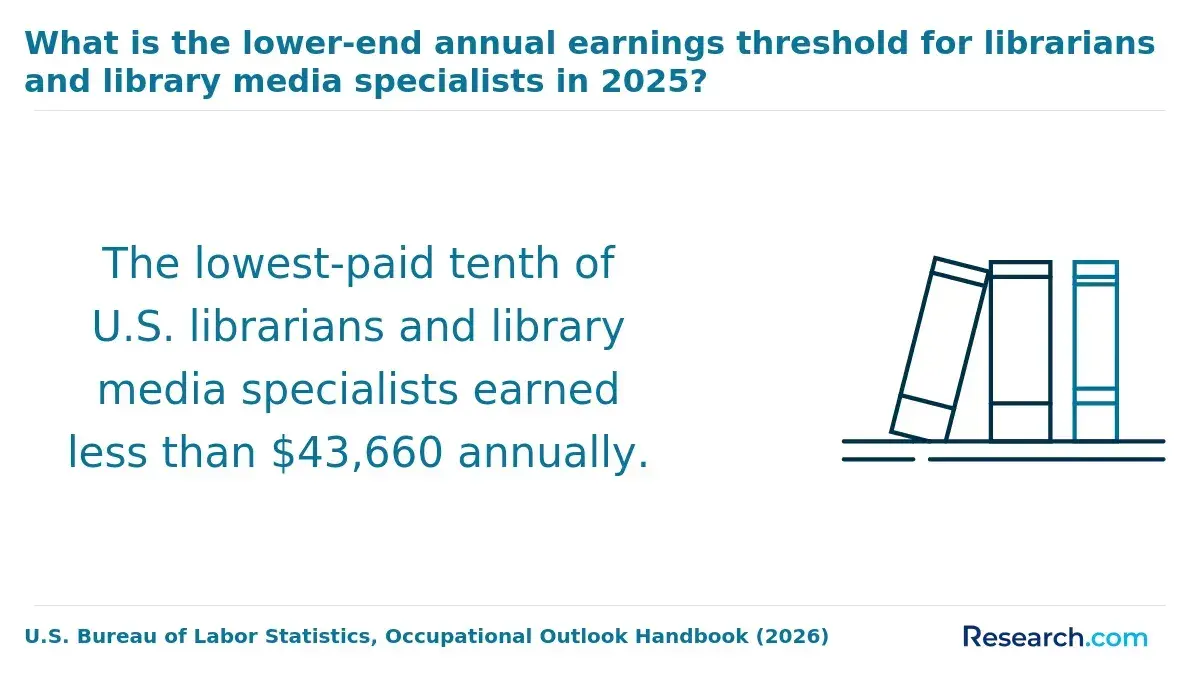
National occupational medians provide context, not a prediction of an individual graduate's pay. These U.S. Bureau of Labor Statistics figures are for May 2025 and cover workers in each occupation regardless of which university they attended.
| Occupation | Median annual salary, May 2025 |
| Librarians and media collections specialists | $68,270 |
| Archivists | $64,550 |
| Library technicians | $44,580 |
These are different occupations, not interchangeable MLIS outcomes. Library technician jobs are generally distinct from professional librarian positions, and archive hiring may depend heavily on relevant experience. Compare local job postings, their degree requirements, and your current earnings before deciding whether a particular program's cost is justified.
What is the job outlook for librarians and information professionals?
The BLS projects 2.6% growth in employment for librarians and media collections specialists from 2025 to 2035. That is an occupational projection, not a placement rate for MLIS graduates or a forecast for a particular city. It gives you a reason to examine local openings and experience requirements rather than assume that earning the degree alone will secure a position.
Digital collections, accessible discovery, privacy, and responsible use of AI-assisted tools can shape library work, but employers may seek different combinations of these skills. Review postings for the setting you want - such as public, academic, or special libraries - and seek projects or supervised experience that demonstrate the work those employers describe.
Do online MLIS graduates need state licenses or professional certifications?
There is no single state librarian license required for every U.S. library job. School librarian roles are a notable exception: states set their own certification or endorsement rules, which may include educator preparation, supervised experience, or exams. An ALA-accredited online MLIS does not automatically qualify a graduate to work as a school librarian in every state.
Before enrolling for a school library career, check the education agency in the state where you intend to work and ask the university whether its specific pathway meets those requirements. For public, academic, law, medical, or archival positions, check individual job descriptions. Additional subject knowledge or credentials may be preferred for specialized work, but should not be mistaken for a universal legal requirement.
Other Things You Should Know About Library Science
Possibly. The receiving university decides which graduate credits qualify, how many it will accept, and whether prior courses meet its requirements. Request a written evaluation before relying on transfer credit to shorten your plan.
Often, but confirm that the university can enroll students in your state and that any required placement can be completed where you live. Enrollment permission and professional licensure eligibility are separate questions.
Diploma wording varies by university. Ask the registrar for the wording used on both the diploma and transcript if the distinction matters to you.
Yes, though opportunities vary. Ask about student organizations, faculty advising, alumni events, and access to local internships. A program's networking options are more useful when you can attend them at times that fit your schedule.
References
- Academic Years, Academic Calendars, Payment Periods, and Disbursements | 2025-2026 Federal Student Aid Handbook https://fsapartners.ed.gov/knowledge-center/fsa-handbook/2025-2026/vol3/ch1-academic-years-academic-calendars-payment-periods-and-disbursements
- Distance Education and Innovation | Federal Register https://www.federalregister.gov/documents/2020/09/02/2020-18636/distance-education-and-innovation
- History of Time Zones and Daylight Saving Time (DST) | bts.gov https://www.bts.gov/explore-topics-and-geography/geography/geospatial-portal/history-time-zones-and-daylight-saving
- Uniform Time | US Department of Transportation https://www.transportation.gov/regulations/time-act
- Class Scheduling Policy - Policy Library https://www.stmarytx.edu/policies/academic-affairs/class-scheduling-policy/
- Modes of Instruction - Office of the Registrar https://registrar.berkeley.edu/modes-of-instruction/
- Library Science Master's Online - UW Information School https://ischool.uw.edu/programs/mlis/degree-options/online
- What's the Difference Between Asynchronous and Synchronous Learning? | Ohio State Online https://online.osu.edu/content-hub/blogs/whats-the-difference-between-asynchronous-and-synchronous-learning/
- Course Meeting Times - Office of the Provost https://www.provost.pitt.edu/course-meeting-times
- Class Scheduling Policy | Office of the University Registrar https://registrar.ua.edu/academics-policies/class-scheduling-policy/


