2027 SLPA to SLP: Compare Master's Programs, Prerequisites, and Work Compatibility

Co-Founder and Chief Data Scientist

Reviewed by Rhea Paul, PhD
SLP Education & Research Expert
Working as a speech-language pathology assistant can make the SLP path feel familiar, but an SLPA license does not replace the graduate education, supervised practicum, clinical fellowship, or state licensure required of a speech-language pathologist. This guide is for SLPAs weighing a master's degree while managing work and financial obligations. It explains which programs may fit, what prior experience can and cannot do, and how to avoid enrolling in a program that does not support your intended state license.
Key Things You Should Know
- An SLPA-to-SLP transition normally requires a CAA-accredited graduate degree, at least 400 supervised practicum hours during qualifying education, a Clinical Fellowship, and state-specific licensure steps; SLPA employment hours generally do not substitute for graduate clinical clock hours.
- Speech-language pathologists had a median annual wage of $97,870 in May 2025, and the U.S. Bureau of Labor Statistics projects 17% employment growth from 2025 to 2035; those figures support demand but do not guarantee an individual job or salary.
- Working as an SLPA may strengthen an application and inform clinical interests, but full-time employment is usually difficult during semesters with daytime practica, externships, or full-time clinical placements.
How does the SLPA role differ from the fully licensed SLP path in responsibilities and authority?
An SLPA works under the supervision of a licensed speech-language pathologist and helps deliver services within the limits set by state law, an employer, and the supervising SLP. A licensed SLP has substantially broader independent clinical responsibility: assessing communication and swallowing disorders, developing plans of care, making clinical decisions, supervising support personnel, and documenting services for professional and payer requirements.
The exact scope of an SLPA differs by state and setting. Some states license or register assistants, while others rely on education-agency rules for school employees or employer policies. That variability is why an SLPA should treat prior work as valuable preparation rather than evidence that graduate requirements can be waived.
The comparison below highlights why the master's degree is more than a job-title upgrade.
| Area | SLPA | Licensed SLP |
| Clinical authority | Provides delegated services under required supervision | Evaluates, diagnoses within scope, plans treatment, and makes clinical judgments |
| Assessment | May assist with tasks allowed by state and supervisor | Selects, administers, interprets, and reports assessments within professional scope |
| Treatment planning | Implements activities and documents delegated services | Develops, adjusts, and is accountable for the plan of care |
| Supervision | Receives supervision | May supervise SLPAs, students, and other personnel when qualified and permitted |
| Education pathway | Requirements vary by state | Typically requires a qualifying master's degree, supervised clinical experience, fellowship, examination, and state licensure |
For many assistants, the best reason to become an SLP is not simply higher pay. It is the ability to take responsibility for assessment and treatment decisions, expand practice settings, and pursue specialties that require an independently licensed clinician. If you enjoy implementing therapy but do not want the cost and intensity of graduate clinical education, remaining an SLPA can also be a valid career choice.
What master's degree routes exist for SLPA professionals who want to become SLPs?
Most SLPAs enter a Master of Science or Master of Arts program in speech-language pathology or communication sciences and disorders. The degree title matters less than whether the program is accredited by the American Speech-Language-Hearing Association's Council on Academic Accreditation (CAA), satisfies academic and clinical requirements, and is compatible with the licensing rules where the student intends to practice.
Your undergraduate preparation usually determines which route is realistic. Applicants with a bachelor's degree in communication sciences and disorders often apply directly to a traditional graduate cohort. Applicants with a degree in another field may need prerequisite or leveling coursework before, or sometimes alongside, graduate admission.
| Route | Best fit | Main trade-off |
| Traditional residential master's program | Applicants with a CSD background who can attend campus-based classes and placements | Often less compatible with full-time work and relocation constraints |
| Online or hybrid entry-level master's program | Students who need location flexibility and can complete required local or travel-based clinical training | Clinical placements, synchronous classes, and travel can still limit flexibility |
| Post-baccalaureate or leveling route followed by a master's | SLPAs with a non-CSD bachelor's degree or missing foundational courses | Adds time and tuition before graduate clinical training |
| Combined or extended sequence with prerequisites included | Career changers seeking one coordinated admissions process | Usually takes longer than a standard graduate program and may have limited pacing choices |
Programs described as fast-track speech pathology programs can appear attractive to experienced assistants, but acceleration does not eliminate clinical competencies, supervised placement requirements, or licensure rules. A shorter published sequence may fit students who already hold prerequisites and can attend full-time; it is rarely the best choice for someone who must retain a full-time SLPA schedule.
Choose an extended route if you need prerequisite science courses, predictable part-time pacing, or time to save money. Choose a standard full-time program if you have the academic background, financial capacity, and schedule flexibility to focus on graduate clinical work.
What prerequisite coursework and clinical hours do SLPA-to-SLP master's programs typically require?
Admission prerequisites and degree-completion requirements are separate. A program may admit an experienced SLPA conditionally or welcome applicants from other majors, yet still require foundational coursework before advanced graduate classes and require every enrolled student to complete its own approved clinical practicum sequence.
Common prerequisite categories include communication sciences and disorders content, statistics, and sciences. Individual programs decide course titles, acceptable equivalents, minimum grades, recency rules, and whether coursework may be completed after admission.
- Anatomy and physiology of speech, hearing, and swallowing mechanisms
- Phonetics, language development, speech science, and hearing science
- Introduction to communication disorders, audiology, and speech-language assessment
- Research methods or statistics, depending on the program
- Biological science, physical science, behavioral or social science, and statistics coursework used to meet certification standards
For the ASHA Certificate of Clinical Competence pathway, graduate education must include a minimum of 400 supervised clinical practicum hours, including at least 375 hours of direct client or patient contact and 25 hours of guided clinical observation. A CAA-accredited program structures its curriculum around these expectations, but students should still ask how hours are documented and what happens if a placement is interrupted.
SLPA service delivery may build useful skills in data collection, behavior support, therapy materials, family communication, and school routines. However, paid assistant hours generally are not automatically transferable as graduate practicum hours because clock hours must meet specific educational, supervision, and documentation conditions. Never assume a supervisor can retroactively convert employment time into graduate clinical credit.
Before applying, request a written prerequisite review. This step is especially important for applicants with older coursework, a non-CSD bachelor's degree, international transcripts, or science courses that do not clearly match a school's published descriptions.
How do online, hybrid, and campus SLP master's programs compare for working SLPAs?
For working SLPAs, delivery format is primarily a scheduling and clinical-placement decision, not a shortcut around professional training. Online programs may reduce commuting or relocation costs, but most still include live classes, simulation activities, required in-person experiences, and clinical placements during normal business hours.
This comparison focuses on the constraints most likely to affect whether you can continue working.
| Format | Potential advantage for an SLPA | Work-compatibility limitation | Best fit |
| Campus-based | Direct access to university clinics, faculty, and local placement networks | Fixed daytime classes and commuting can limit employment | Students near campus who can reduce work hours |
| Hybrid | Some coursework is remote while retaining structured faculty contact | May require recurring campus visits or intensive residencies | Students within practical travel distance who want partial flexibility |
| Online with clinical placements | Coursework may be accessible from home and may serve more geographic areas | Placements, live sessions, travel, and state authorization can be restrictive | Self-directed students with local support and flexible employers |
Do not interpret "online" as asynchronous. Ask whether lectures are live, whether attendance is required at set times, which time zone controls class meetings, how many campus immersions occur, and whether clinical placement days can be scheduled around work. These details often matter more than the online label.
Students who already know they need to work may want to compare accelerated speech pathology programs online against part-time and hybrid options rather than assuming the shortest curriculum has the lowest financial risk. A program that permits a manageable schedule may cost more in tuition over time but reduce lost wages or the likelihood of delayed clinical completion.
Which SLP master's programs explicitly welcome licensed or experienced SLPA applicants?
Few graduate SLP programs create a separate admissions track that guarantees preference for SLPAs. More commonly, programs state that they review applicants holistically, accept applicants with varied academic backgrounds, or value relevant clinical, educational, and healthcare experience. An SLPA should verify current language directly with each admissions office rather than relying on an informal claim that assistants receive special consideration.
The following program types are worth investigating when an SLPA has relevant experience. They are not interchangeable, and "welcomes" does not mean prerequisites, GPA expectations, observation requirements, or clinical standards are waived.
| Program type | Why it may suit an SLPA | What to confirm before applying |
| CAA-accredited programs using holistic review | Professional experience may add context to an application alongside academics and recommendations | Whether experience is evaluated formally, required prerequisite grades, and application expectations |
| Programs accepting non-CSD majors | Useful for assistants whose bachelor's degree is outside communication sciences and disorders | Leveling sequence length, total cost, and whether all prerequisites can be completed remotely |
| Online or hybrid CAA-accredited programs | May reduce relocation barriers for employed assistants | State eligibility, residency requirements, live-session schedule, travel, and clinical placement process |
| University programs with school-based clinical connections | May align with an SLPA's knowledge of educational settings | Whether school employment creates a conflict with student-clinician supervision or placement rules |
A strong SLPA application translates experience into graduate-ready evidence. Explain the populations served, the level of supervision received, data and documentation responsibilities, ethical boundaries observed, and what you learned about an SLP's role. Avoid presenting assistant work as independent diagnostic or treatment authority.
Also compare admission selectivity with fit. A list of schools described as an speech language pathologist degree option may help generate leads, but the practical question is whether the program accepts your prerequisites and supports licensure in your state. Apply to several realistic programs rather than choosing solely on perceived ease of admission.
How do ASHA CAA accreditation and state licensure rules shape SLPA-to-SLP program choices?
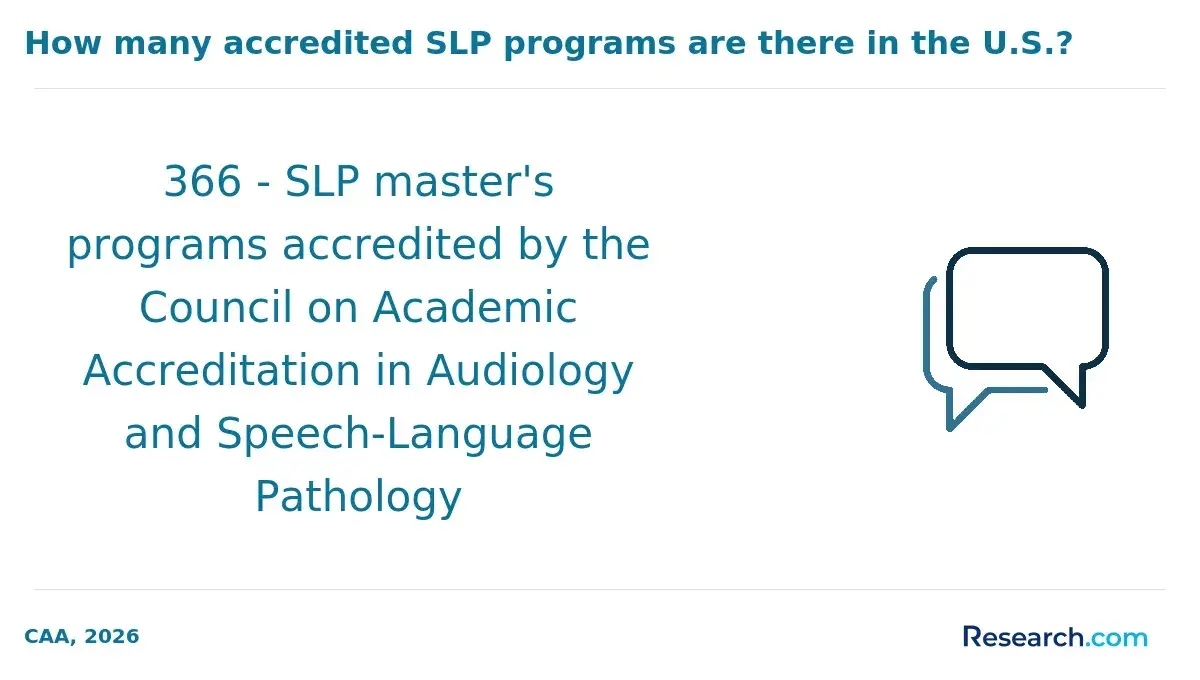
CAA accreditation is one of the most important screening criteria for an aspiring SLP. The Council on Academic Accreditation accredits graduate education programs in audiology and speech-language pathology. Graduation from a CAA-accredited program is generally central to meeting ASHA certification expectations and commonly supports state licensure eligibility, but licensure is issued by states, not by ASHA or a university.
State rules can differ on the required degree, supervised postgraduate experience, examination, background review, telepractice, and school credential. A school may be accredited while being unable to enroll residents of a particular state because of state authorization, or its curriculum may not meet a state's specific professional-licensure rules. Accreditation alone therefore does not answer every licensing question.
Use this sequence before paying an application deposit.
- Find the program in ASHA's CAA directory or EdFind and confirm its current accreditation status, including any conditions or candidacy information.
- Read the school's professional-licensure disclosure for your state and ask for written clarification when the disclosure is broad or inconclusive.
- Check your state speech-language pathology licensing board's current requirements for degree, practicum, fellowship, examination, and application steps.
- If you plan to work in public schools, separately verify the state education agency's school-based credential requirements.
- Keep copies of program responses and confirm requirements again before graduation because regulations can change.
CAA accreditation is not merely a credentialing detail. It affects the portability and credibility of your education. A less expensive program that cannot support the license you need can become far more costly than a program with transparent state eligibility and a reliable clinical-placement system.
Can current SLPAs keep working while enrolled in a master's SLP program, and under what limits?
Yes, some SLPAs keep working, especially during prerequisite coursework or early semesters with primarily academic classes. The limiting factor is usually clinical training. Practica and externships commonly occur during weekday business hours, require preparation and documentation outside placement time, and may expand to multiple days per week as the program progresses.
The most workable arrangement is often a reduced, flexible SLPA schedule rather than full-time employment. A supportive employer may allow evening work, a reduced caseload, seasonal scheduling, or unpaid release time for practicum. Even then, students need to protect time for coursework, travel, clinical notes, and exam preparation.
| Enrollment stage | Typical work feasibility | Planning consideration |
| Prerequisites or leveling | Often compatible with part-time or full-time work | Check live class times, lab requirements, and course load |
| Early graduate coursework | Part-time work may be possible for some students | Plan for reading, group work, simulations, and skill labs |
| On-campus or local practicum | Usually requires reduced work hours | Placement schedules may change each term |
| Full-time externship | Full-time outside work is generally impractical | Budget for reduced income, commuting, and possible travel |
A common mistake is budgeting only for tuition. Build a month-by-month plan that includes reduced earnings, health insurance changes, transportation, childcare, required technology, professional fees, and a contingency fund for placement changes. Ask each program for a sample weekly schedule from both an academic term and a full-time clinical term.
Do not assume your current employer can count as your placement site. Programs must approve sites and supervisors, protect educational objectives, and prevent conflicts between paid job duties and student clinical responsibilities.
How do SLPA experience and prior supervision affect graduate clinical placements and clock hours?
SLPA experience can make the transition to graduate clinic smoother because you may already understand service routines, confidentiality, professional communication, and the importance of supervision. It can also help you identify populations or settings you want to explore further, such as early intervention, schools, medical speech-language pathology, voice, or adult neurogenic disorders.
It does not usually reduce the number of graduate clinical hours required. Graduate placements are educational experiences with program-approved supervisors, stated competencies, observation and feedback procedures, and documentation standards. Hours earned as an employee generally remain employment hours, even if the work looks similar to student-clinician tasks.
Prior supervision can nevertheless help you prepare strategically. Before applying, ask your current supervising SLP whether they can describe your reliability, responsiveness to feedback, ethical judgment, and ability to work within scope in a recommendation. Those qualities can be more persuasive than simply listing the number of months or years worked.
During graduate school, do not expect to select only familiar placements. Broad clinical exposure is intentional: future SLPs need supervised experience across different ages, diagnoses, service models, and settings. Your program may consider preferences, but placement availability, client needs, supervisor capacity, and competency requirements control the final assignment.
One important red flag is any promise that an employer can "sign off" on all needed graduate hours without formal university approval. Obtain confirmation from the program's clinical education office before changing work schedules, accepting a placement, or assuming a current workplace can serve both roles.
What funding options, employer support, and loan considerations matter most for SLPA-to-SLP students?
The financial decision is broader than tuition. An SLP master's program can require several semesters of reduced work capacity, so the true cost includes tuition and fees plus foregone income, travel to placements, housing changes, technology, background checks, immunizations, testing, and professional expenses.
Federal financial aid begins with the Free Application for Federal Student Aid. Eligible graduate students may use Direct Unsubsidized Loans and, subject to eligibility and credit review, Graduate PLUS Loans. Borrow only after comparing the program's net cost, your expected enrollment pattern, and the possibility that clinical semesters will restrict employment.
- Employer tuition assistance or reimbursement, especially from school districts, healthcare systems, and rehabilitation organizations
- Scholarships offered by universities, state speech-language-hearing associations, foundations, and workforce programs
- Federal work-study or graduate assistantships when available, recognizing that clinic schedules may limit eligibility
- Part-time enrollment, if the program permits it and the longer timeline remains financially manageable
- Service-related benefits or loan-repayment opportunities for eligible students and professionals, subject to current program rules
Employer support can be valuable, but read repayment and employment-commitment terms carefully. A reimbursement agreement may require you to remain employed for a set period or repay funds if you leave early. It may also cover tuition only, leaving clinical travel and reduced income unfunded.
The career upside can be meaningful: the Bureau of Labor Statistics reports a $97,870 median annual wage for speech-language pathologists in May 2025. That is a national occupation-wide median, not a forecast for a new graduate, a school-based role, or a particular state. To evaluate return on investment, compare your likely borrowing with realistic entry-level wages in your intended setting and the time you will be unable to work full-time.
If earnings potential is a central factor, review the settings and responsibilities associated with becoming a highest-paid SLP rather than borrowing on the assumption that every specialty or region pays similarly. Medical, geographic, employer, experience, and productivity expectations can all affect compensation.
How should SLPAs verify program quality, accreditation, and licensure outcomes before enrolling?
Verify the facts that determine whether you can complete the degree and obtain the license you want. Marketing language about flexibility, national reach, or career preparation is less useful than a clear answer about accreditation, state eligibility, clinical placements, schedule, and total required costs.
Use the following questions in writing with admissions and clinical education staff. Their answers will reveal whether a program is a practical match for your work, location, and licensing goals.
- Is the program currently CAA accredited, and what is the accreditation period or status?
- May a resident of my state enroll, complete clinical placements, and pursue the intended professional license after graduation?
- Which prerequisites do I still need, which courses may transfer, and must they be completed before admission?
- What are the expected synchronous class times, required campus visits, and full-time clinical placement periods?
- Who secures clinical placements, what geographic travel may be required, and what happens if placement matching is delayed?
- What is the published tuition and mandatory fee estimate for the full program, excluding or identifying variable clinical costs?
- What outcomes does the program publish for program completion, Praxis examination performance, employment, and on-time completion?
- Can I speak with an advisor about how my SLPA employment could affect scheduling, conflicts of interest, and placement eligibility?
Compare answers using the same categories for every school. Do not compare one institution's per-credit tuition with another institution's total program estimate, and do not treat a part-time completion estimate as equivalent to an accelerated full-time sequence.
Common mistakes include enrolling before checking state authorization, assuming an online program guarantees a local placement, treating SLPA hours as graduate clock hours, and choosing solely by advertised tuition. The safer approach is to select the program that provides written, current confirmation of accreditation, state compatibility, clinical expectations, and realistic completion costs.
Finally, recheck requirements near graduation. Licensing boards, school credentialing agencies, and certification standards can change while you are enrolled, and the responsibility to submit a complete licensure application ultimately remains with the applicant.
Other Things You Should Know About Speech Language Pathology
The timeline depends on your bachelor's degree, missing prerequisites, program pacing, and clinical placement sequence. Someone with a CSD bachelor's degree may enter a standard master's program directly, while an SLPA with a different undergraduate major may need leveling coursework first. After graduation, most candidates also complete required postgraduate fellowship and state licensing steps.
It can help with professional confidence, therapy routines, documentation awareness, and understanding supervision. It does not make the academic workload or graduate clinical requirements disappear. Students still need to learn assessment, diagnosis, research, counseling, ethics, and clinical decision-making at the graduate level.
Possibly, but only if the university formally approves the site and supervisor and the arrangement meets its clinical education requirements. Your paid SLPA duties and student-clinician responsibilities must be clearly separated. Get approval from the program before relying on this arrangement.
No. A qualifying master's degree is a major requirement, but practice authority also depends on state licensure. States commonly require supervised postgraduate experience, a passing examination, an application, fees, and other documentation. School-based jobs may require an additional education credential or state-specific authorization.
References
- Common Prerequisites for Speech Pathology Graduate... https://bouve.northeastern.edu/news/6-common-prerequisites-for-speech-pathology-graduate-programs/
- Pre-Master of Speech-Language Pathology (PreSLP) | WCU https://westcoastuniversity.edu/online-programs/pre-master-of-speech-language-pathology
- How to Get into SLP Grad School: Key Application Tips https://www.usa.edu/blog/how-to-get-into-grad-school-for-speech-pathology/
- Master's in Speech Pathology: Complete Guide 2026 https://www.speechpathologygraduateprograms.org/masters-in-speech-language-pathology/