2027 Public Health BS Tuition Refunds When a Required Placement Is Delayed

Co-Founder and Chief Data Scientist
A required placement can keep a public health BS student from finishing even when every classroom course is complete. The delay may also create another term of tuition, lost work hours, or uncertainty about financial aid.
This guide explains when a refund or credit may be available, which office can authorize a remedy, and how to document the costs. It is for students whose internship or other required field experience cannot start on schedule - and for applicants comparing programs before they take that risk.
Key Things You Should Know
- A delayed placement does not automatically entitle a student to a tuition refund; the enrolled course, withdrawal deadline, school policy, and cause of the delay matter.
- Request a written graduation and cost plan before accepting a later placement, especially if the delay would require another term or change your financial-aid enrollment.
- CEPH accreditation does not guarantee a placement or a refund. Check the exact BS requirements and the school's responsibility for securing an approved site.
What happens when a required public health placement is delayed?
A required placement is an approved internship, field experience, or other supervised activity that a program counts toward graduation. A host may postpone a start date, a school may be unable to approve a site or supervisor, or required agreements and clearances may remain unfinished. A willing host is not necessarily an approved placement.
The academic effect depends on where the requirement sits in the degree plan. A delay might move one course to a later term, prevent a final grade, or postpone graduation. Ask the fieldwork coordinator which requirement remains unmet, whether an approved alternative is possible, and the earliest realistic completion date. Accelerated online coursework for public health undergraduates may help with remaining classes, but a shorter course schedule does not shorten an unapproved placement.
Can students get tuition refunds for delayed public health placements?
Possibly, but not automatically. A student may qualify for a published course or term refund by withdrawing before the applicable deadline. A school may also offer a fee reversal, tuition credit, no-charge deferral, or exception when its actions prevented a required course from proceeding. Those remedies differ: a credit applies to future charges, while a refund returns money. Neither should be assumed until the school confirms it in writing.
Separate three questions in your request: What did you pay for the affected course or term? What instruction or supervision was delivered? What additional charge would the proposed fix create? If you remain enrolled in other classes, a refund for the entire term may be less plausible than relief for the affected course or an extra term caused by the delay. The school's catalog, enrollment agreement, refund schedule, and applicable state rules control the answer; financial aid can change what is returned to you personally.
If the available remedy still makes completion unaffordable, compare the affordable public health programs with faster schedules cautiously. A transfer may not remove the placement requirement, and the new institution - not the old one - decides which credits satisfy its degree.
What placement policies should public health BS programs disclose?
Before enrolling, ask for the catalog and fieldwork handbook that apply to your entry term. The most consequential distinction is who finds a site versus who approves it: a program may support the search while still requiring students to identify a host. Neither arrangement, by itself, promises a start date.
Policies should make clear the required hours or deliverables, site and supervisor qualifications, approval deadlines, geographic or remote-work restrictions, clearance costs, and what happens if a host cancels. They should also explain grading, deferral, withdrawal, refunds, appeals, and whether a delayed student must pay to enroll again. Compare those terms across public health degree options with lower tuition; a lower advertised rate may be offset by an extra paid term of fieldwork.
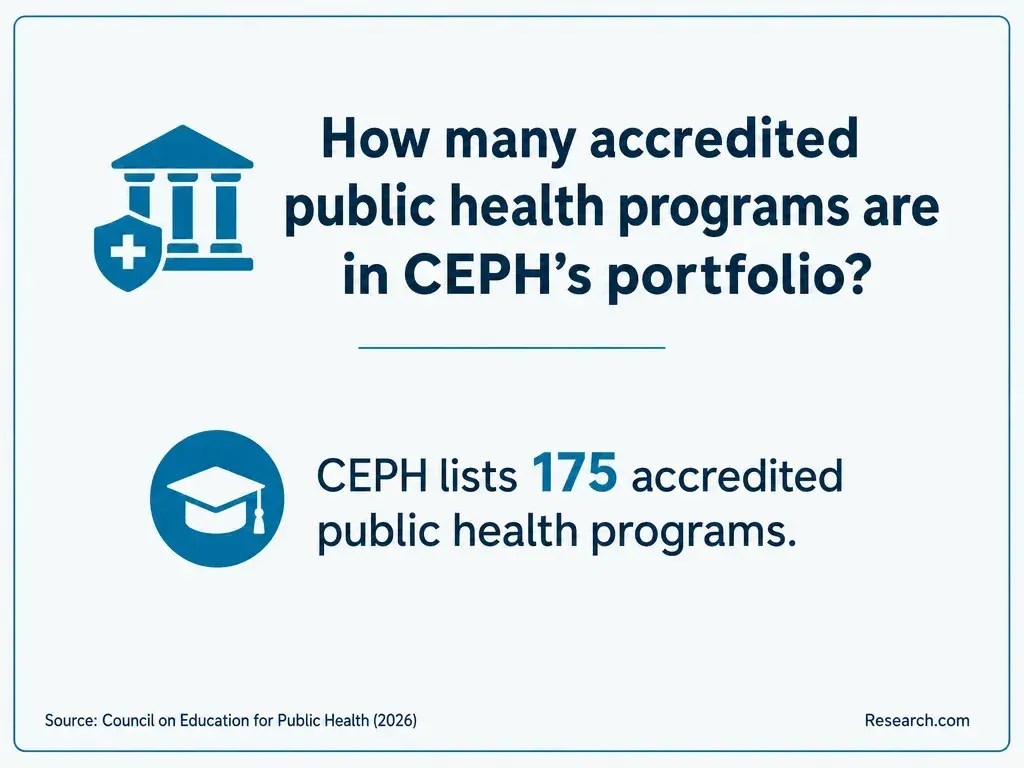
The Council on Education for Public Health (CEPH) accredits specified public health schools and programs. Check its directory and the institution's documentation to determine whether the particular undergraduate degree is within the accredited scope. Institutional accreditation is a separate matter.
CEPH status is relevant to how a covered program demonstrates undergraduate public health learning, but it does not establish an individual student's placement, require a particular host to accept them, or set their tuition-refund entitlement. Likewise, do not import graduate applied-practice rules from CEPH-accredited Master of Public Health programs into a BS handbook. Ask which BS requirement actually applies and which office approves alternatives.
Public health BS programs commonly combine general education with population health, epidemiology, introductory statistics or data interpretation, health behavior, environmental health, policy, and program planning. The precise curriculum and whether an internship, capstone, or other applied experience is required vary by school.
That distinction matters during a delay: completing coursework does not necessarily substitute for supervised practice, and an unrelated job does not automatically earn fieldwork credit. Ask faculty to identify the learning outcomes still missing and whether an approved project could meet them. Students considering graduate study can later compare specialization fit across public health master's degrees, but an MPH plan does not waive an outstanding BS graduation requirement.
No. Online coursework does not, by itself, mean a program supplies local sites, permits remote fieldwork, or can approve a placement wherever a student lives. Approval may depend on supervisor availability, site agreements, allowable tasks, and the student's location. A remote project can also require scheduled meetings and permission to use organizational data.
When comparing online public health undergraduate education options, ask for the placement process for students in your state, examples of permissible tasks, and the written contingency if no site is approved on time. Treat claims about flexibility as unverified until you know the actual weekly schedule and who bears travel or clearance costs.
Act before a withdrawal or registration deadline passes. The following sequence helps preserve both academic and financial options:
- Save dated emails, the approved degree audit, placement applications, host communications, and the applicable catalog and refund policy.
- Ask the fieldwork coordinator in writing why the placement cannot start, who must resolve the issue, and which approved alternatives are available.
- Request an updated degree plan showing the expected completion term, any required re-enrollment, and who will pay each resulting charge.
- Ask the registrar or bursar for a written decision on withdrawal, refund, fee reversal, credit, or exception; consult financial aid before changing enrollment.
- If the response does not address the documented issue, use the school's published academic or financial appeal process and keep copies of each decision.
If a delay also affects your academic record, ask how an incomplete or withdrawal will appear before choosing one. A later graduate application is a separate decision; low-GPA pathways to public health master's study should not be mistaken for a remedy for an unresolved BS requirement.
There is no reliable single price for a public health BS or for a placement delay. Compare the school's published charges against your remaining degree audit, then request an itemized estimate for each proposed completion plan. Include the following costs rather than comparing tuition rates alone:
- Tuition and mandatory fees for remaining courses and any extra enrollment term.
- Placement-related travel, clearances, equipment, and possible lost work hours.
- Changes to grants, loans, or employer assistance if enrollment intensity or graduation timing changes.
Ask financial aid how a withdrawal, incomplete, or later enrollment would affect your individual award; do not assume a bursar refund equals the amount you will receive after aid adjustments. University scholarship options for MPH applicants concern a different degree and cannot be counted as funding for the present BS delay.
A completed BS can support applications for entry-level work such as program assistant, community outreach coordinator, or health education support roles, depending on the employer and the graduate's experience. Placement work may provide evidence of community engagement, data handling, or program evaluation - but a delayed placement means that evidence is not yet available. A BS alone does not confer clinical licensure or qualify someone for every epidemiology or management job.
Do not use an occupation-wide median wage as a predicted salary for one program's graduates. Compare actual local postings for the tasks and experience they require, then ask the school for clearly defined graduate outcome data if available. If a target job requires further study, MPH programs with less restrictive admissions are one possible later comparison - not a reason to pay an avoidable extra BS term without first seeking a remedy.
How can students choose a reputable public health BS program?
Verify the institution's accreditation, the exact BS curriculum, and any claimed CEPH coverage independently. Then request the current fieldwork handbook and ask for a written explanation of site-finding responsibilities, approval timing, backup arrangements, and charges if placement moves to another term. For a transfer student, obtain a degree audit showing which accepted credits actually satisfy requirements; accepted credit alone does not establish a graduation date.
Program reputation should rest on policies you can evaluate, not a promise that placement will be "supported." If you are planning an MPH afterward, compare its admissions rules separately: public health graduate programs with no recommendation letters may simplify a future application, but that feature says nothing about the undergraduate program's placement reliability.
Other Things You Should Know About Public Health
Sometimes. The program must approve the site, supervision, duties, and any conflict-of-interest arrangements. Payment alone neither qualifies nor disqualifies the experience.
Only if the program approves it. Students may need distinct learning objectives and supervised tasks beyond their usual job duties.
Check the host's and school's rules first. Remove confidential information and obtain permission before sharing organizational documents, data, or community-facing materials.
Not necessarily. Ask an advisor which remaining courses can proceed and ask financial aid how a different credit load would affect your award before changing registration.
- Student Complaints - Texas Higher Education Coordinating Board https://www.highered.texas.gov/student-complaints/
- Policy Protecting Students from Fees and Penalties Due to VA Payment Delay - Education and Training https://benefits.va.gov/gibill/fgib/transition_act.asp
- Satisfactory Academic Progress Policies | studentaid.gov https://studentaid.gov/understand-aid/eligibility/staying-eligible
- Higher Education Student Complaints | iowa.gov https://educate.iowa.gov/higher-ed/student-complaints
- General Requirements for Withdrawals and the Return of Title IV Funds | 2025-2026 Federal Student Aid Handbook https://fsapartners.ed.gov/knowledge-center/fsa-handbook/2025-2026/vol5/ch1-general-requirements-withdrawals-and-return-title-iv-funds
- Deferred Tuition Arrangements in Enrollment Agreements | NYS Education Department https://www.acces.nysed.gov/bpss/schools/deferred-tuition-arrangements-enrollment-agreements
- Rule 3357:3-3-15 | Tuition, fees, refunds, financial aid. https://codes.ohio.gov/ohio-administrative-code/rule-3357:3-3-15
- Public Health Degree Requirements: A Complete Guide | American Public University https://www.apu.apus.edu/area-of-study/nursing-and-health-sciences/resources/public-health-degree-requirements/
- Procedures for Academic and Non-Academic Appeals | Florida State College at Jacksonville Catalog https://catalog.fscj.edu/about/procedures/general-academic-and-non-academic-appeals
- Undergraduate Degree Requirements | umich.edu https://sph.umich.edu/undergrad/degrees/degree-requirements.html