2027 From Food Service Supervisor to Public Health: Planning a Bachelor's Pathway

Co-Founder and Chief Data Scientist
As a food service supervisor, you may already manage safety procedures, train staff, and respond to problems that affect people's health. Moving into public health means learning to apply those skills beyond one workplace - and deciding whether a bachelor's degree is the right way to do it.
This guide compares relevant degrees, explains how to protect existing college credits, and identifies the coursework and experience that can support a career change. It also helps you distinguish realistic first jobs from roles that require further training.
Key Things You Should Know
- Start with a target role: food safety inspection, community health, and program coordination call for different degrees and experience.
- A bachelor's degree commonly takes four years of full-time study from the beginning; prior credits reduce that timeline only if the receiving school applies them to graduation requirements.
- Before enrolling, obtain a written degree audit and confirm accreditation, fieldwork arrangements, total remaining cost, and the qualifications employers require.
What Is Public Health, and How Can Food Service Experience Transfer?
Public health works to prevent harm and improve health across populations rather than treating one patient at a time. For a food service supervisor, the most direct connection may be food safety: preventing contamination, documenting procedures, training workers, and responding to incidents. Food access, nutrition programs, workplace health, and community education offer other connections, but they involve different responsibilities.
Your strongest transferable evidence is specific: staff training you delivered, inspection preparation you coordinated, procedures you improved, or records you maintained. Those activities show operational judgment. They do not, by themselves, establish proficiency in epidemiology, population-level data analysis, or public health regulation. Even lower-cost epidemiology research training and aid concerns a much later, specialized path - not a necessary first step for this career change.
Choose a target before choosing a major. Someone seeking local food inspection should investigate the agency's science and hiring requirements; someone interested in food access programs should look for community partnership and program-evaluation experience. Your supervisory background is an advantage in either case, but the missing preparation differs.
What Bachelor's Degree Pathways Lead From Food Service to Public Health?
A public health major is not the only useful route. The best choice depends on the work you want to do and which of your previous courses will actually satisfy degree requirements. This comparison identifies where each pathway is strongest.
| Pathway | Strongest fit | Check before choosing |
| BA or BS in public health | Broad preparation for community programs, prevention, and population-health work | Science and statistics depth, applied learning, and access to food-related electives |
| Community health or health education | Outreach, health communication, and program delivery | Whether coursework aligns with any health education credential you want |
| Environmental health or related science | Food protection, environmental monitoring, or regulatory work | Laboratory science requirements and the qualifications of your target agency |
| Nutrition or dietetics | Nutrition-focused work, potentially including a regulated dietetics career | Whether the exact program provides a qualifying route toward the intended credential |
For a returning student, compare credits that apply to the degree, not just credits a university accepts. An associate degree in applied studies, for example, may transfer differently from a transfer-oriented degree. Ask each school for a preliminary evaluation followed by an official degree audit. A resource on comparing public health tuition and study length can help frame the search, but your remaining required courses determine your own timeline and expense.
How Do You Choose an Accredited Public Health Bachelor's Program?
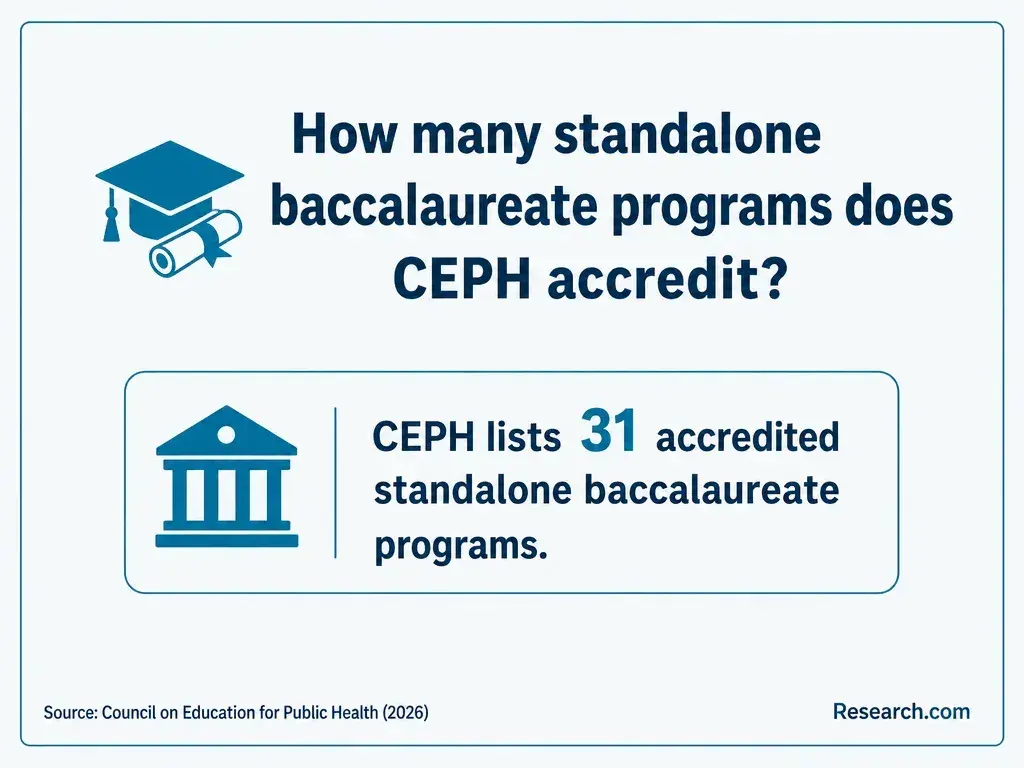
First, verify that the institution holds recognized institutional accreditation. Then check whether the particular public health bachelor's degree is covered by Council on Education for Public Health (CEPH) accreditation; accreditation of a university or another degree at that university does not establish coverage of the bachelor's program. Ask the school to identify the accredited school, unit, or standalone program and confirm the status that applies to your entry term.
Accreditation is a starting point, not a substitute for fit. Request a course rotation, transfer evaluation, fieldwork rules, and information about where recent students completed applied work. If a later MPH is part of your plan, public health master's programs accredited by CEPH are a separate comparison; you do not need to choose a bachelor's program solely by assuming you will enter a particular graduate school.
For your immediate decision, ask an adviser: Which of my existing courses satisfy the major? Which required courses run only once a year? Can a food-access organization or health department host the required experience? Get answers reflected in an individualized degree plan before committing.
Online study may let you keep a supervisory schedule, but it is not automatically self-paced. Classes may require live meetings, group projects, scheduled exams, or daytime fieldwork. Campus study can offer easier access to laboratories, faculty, and local partners, but commuting may make full-time employment harder.
Compare a sample term's actual meeting times with your work shifts. Ask whether required science courses have in-person labs, whether internships can be arranged near home, and who finds the placement. Short-session courses for online public health majors may reduce the number of simultaneous classes while increasing the weekly workload in each one. Choose the format you can sustain through the required field experience, not just the format that makes enrollment convenient.
Most public health bachelor's pathways combine general education with introductions to epidemiology, statistics, environmental health, health behavior, policy, and program planning. Exact requirements vary. A BS may require more laboratory science or quantitative coursework than a BA, but the degree letters alone do not establish what you will learn.
Match electives and projects to your intended work. For food protection, prioritize environmental health, microbiology where available, and interpretation of inspection or surveillance information. For food access programs, prioritize community assessment, respectful partnership, communication, and evaluation. A statistics course should help you interpret evidence; it does not make you a specialist analyst.
Online biostatistics education for working learners is an advanced option to consider only if a later, data-intensive goal justifies it.
Ask whether an internship or capstone is required and what students actually produce. A supervised assessment, educational resource, or evaluation plan can give you stronger evidence for job applications than a course title alone. Your current workplace counts as a placement only if the program approves the site, supervision, and work in advance.
Requirements depend on whether you apply as a first-year student, transfer student, or returning adult. Schools commonly review prior transcripts and may set separate conditions for entry to a competitive major. Admission to the university does not necessarily mean admission to public health, and accepted transfer credits do not necessarily fulfill major prerequisites.
Gather transcripts from every college attended, course descriptions or syllabi for uncertain equivalents, and documentation of relevant workplace training. Ask the admissions and registrar's offices who evaluates prior credits, then ask the department which courses satisfy its major.
If an old science course or a food safety certificate is important to your plan, request a written ruling rather than assuming it counts. Graduate admissions rules are different; information on low-GPA eligibility for public health graduate programs should not be used to predict an undergraduate transfer decision.
Four years of full-time study is a common starting estimate for a bachelor's degree, not a completion promise for a transfer student. Your timeline depends on credits applied to requirements, prerequisite order, course availability, enrollment pace, and any internship. An accepted elective may add to your credit total without shortening the sequence to graduation.
Compare schools using the cost to finish: remaining tuition and mandatory fees, books, commuting or technology, required fieldwork expenses, and earnings you may forgo. Request a term-by-term degree audit and an estimate based on your likely enrollment pace.
Confirm financial-aid eligibility with each school; changing pace or transferring credits can affect the plan. If graduate study might follow, comparing lower-tuition MPH programs can inform a separate future budget, but it should not be added to the bachelor's cost as though an MPH were required.
A less expensive school is not necessarily the lower-cost route if it requires substantially more coursework. Conversely, paying more for speed only makes sense if you can complete the scheduled classes while working and the resulting role meets your goals.
Look for openings by duties, not degree title alone. A bachelor's degree plus documented supervisory experience can support applications to program assistant, outreach coordinator, food access program, or health education support roles. Some food inspection or environmental health positions may also fit, but agencies can require specified science credits, training, or other qualifications. This comparison separates plausible entry points from roles needing further preparation.
| Target work | Likely first responsibilities | Additional qualification to verify |
| Community or food access programs | Coordinate services, partners, records, and outreach | Employer expectations for community work and program reporting |
| Health education support | Help deliver materials, events, and participant follow-up | Job-specific degree or certification preferences |
| Food protection or environmental health | Support inspections, education, or compliance work | Agency science credits and any state or local requirements |
| Epidemiology or advanced analysis | Typically more specialized study and analytic work | Graduate education, methods skills, and relevant experience |
Build experience before graduation through an approved internship, a community food organization, or a supervised project with a health department. If you later decide a graduate degree is necessary, compare job requirements first rather than choosing among online MPH programs by admissions accessibility alone. A bachelor's degree is a starting qualification, not an automatic route into an epidemiologist or management position.
There is no reliable single salary for "a public health graduate." Pay depends on the occupation, employer, location, responsibilities, and experience. The US Bureau of Labor Statistics publishes occupation-wide wage and outlook data for roles such as community health worker and health education specialist; those figures describe everyone in the occupation, not new bachelor's graduates or graduates of a particular school.
For a useful comparison, collect local postings for the specific jobs you could qualify for now and after graduation. Compare their posted pay, required skills, benefits, and advancement conditions with your current compensation as a supervisor. If you later consider an MPH, the earnings outlook for public health master's holders is a separate question; a higher degree should be evaluated against the jobs it would actually open and its additional cost.
Which Public Health Certifications and Licenses Are Required?
A general public health bachelor's degree does not itself grant a clinical license or professional certification. Many program and outreach jobs have no universal public health license, while food inspection and environmental health requirements can vary by jurisdiction and employer. Check the exact job posting and the responsible state or local agency before selecting coursework.
Certifications also serve different purposes. Certified in Public Health (CPH) and Certified Health Education Specialist (CHES) have distinct eligibility rules set by their certifying organizations; neither should be assumed to follow automatically from a public health major. Food handler or food protection manager training may strengthen your existing operational background without replacing a degree or an agency's science requirements.
Keep graduate prerequisites separate from job credentials. If a future role genuinely calls for an MPH, public health graduate prerequisite completion options may become relevant. They are not certifications needed to begin every bachelor's-level public health job.
Other Things You Should Know About Public Health
Speak with people doing the specific work you want and look for a limited volunteer or shadowing opportunity with a food access organization or local health agency. Compare their daily tasks with what you enjoy about supervision.
Describe the procedure you managed, your responsibility, and a result you can substantiate. Emphasize training, safety documentation, coordination, and communication without claiming regulatory or research duties you did not perform.
Yes. Food access programs employ people in outreach, coordination, logistics, and evaluation. Providing regulated dietetics services is a different career path with its own education and credential requirements.
Consider it when a defined target role requires or strongly prefers graduate preparation and you can explain what the additional training would let you do. First check whether bachelor's-level experience would move you toward the same goal.
- Food Safety Certification and Knowledge | cdc.gov https://www.cdc.gov/restaurant-food-safety/php/practices/food-safety-certification-knowledge.html
- Cost of Attendance (Budget) | 2025-2026 Federal Student Aid Handbook https://fsapartners.ed.gov/knowledge-center/fsa-handbook/2025-2026/vol3/ch2-cost-attendance-budget
- Accreditation in the U.S. | ed.gov http://www.ed.gov/laws-and-policy/higher-education-laws-and-policy/college-accreditation/accreditation-in-the-us
- What Are 3 Bachelor of Science in Public Health Concentrations? A Complete Guide | About the University of Cincinnati https://www.uc.edu/blog/what-are-3-bachelor-of-science-in-public-health-concentrations-a-complete-guide.html
- Public Health Degree Requirements: A Complete Guide | American Public University https://www.apu.apus.edu/area-of-study/nursing-and-health-sciences/resources/public-health-degree-requirements/
- Careers | ucsd.edu https://globalhealthprogram.ucsd.edu/undergraduate-program/careers.html
- Public Health, BS | Program Requirements | ASU Degree Search https://degrees.asu.edu/checksheet/2025/CHL/NHPBHBS/null
- Pre-Public Health - Office of Academic and Advising Services https://aas.mercer.edu/pre-graduate-and-professional-school-advising-resources/pre-professional-health-programs/pre-public-health/
- How Long Does It Take to Get a Bachelor's Degree? | University of Kansas https://admissions.ku.edu/blog/How-Long-Does-It-Take-to-Get-a-Bachelors-Degree
- Regional vs. National Accreditation: Which is Better? | Drexel University Online https://www.online.drexel.edu/news/national-vs-regional-accreditation.aspx