2027 Public Health BS Part-Time Enrollment: How Aid Eligibility Can Change

Co-Founder and Chief Data Scientist
Taking fewer public health courses can make a bachelor's degree manageable alongside work or caregiving, but it can also change the aid that makes enrollment affordable.
The important threshold is not simply whether your school calls you "part-time": Pell Grants, federal loans, and school-funded aid can follow different rules. This guide explains those differences, shows which credits may count, and helps you compare schedules and program costs before you register.
Key Things You Should Know
- In a standard semester program, 6 credits is generally half-time undergraduate enrollment for federal Direct Loans; falling below half-time can end eligibility for a new loan disbursement and affect repayment on existing loans.
- An eligible undergraduate may receive a Pell Grant below half-time, but the award is generally adjusted for enrollment intensity: 6 eligible credits out of a 12-credit full-time load represents 50% intensity.
- Check that planned courses apply to your degree. Enrolling in 6 credits does not necessarily establish half-time aid eligibility if some courses cannot be counted for your program.
What Is Part-Time Enrollment in a Public Health Bachelor's Degree?
Part-time enrollment means taking fewer credits than the school's full-time undergraduate load. In a conventional semester program, full-time is generally 12 or more credits, while students taking fewer credits enroll at varying part-time intensities.
Schools may also use quarter calendars, short sessions, or other academic structures, so confirm how your particular term is measured.
A lighter load can preserve time for employment and family responsibilities, but it usually extends the calendar time needed to finish. Public health majors should look beyond weekly class hours: statistics assignments, group projects, community-based work, and a required internship or capstone may have fixed scheduling demands.
Comparing accelerated public health undergraduate schedules can help you distinguish shorter course sessions from a genuinely lighter workload.
How Does Part-Time Enrollment Affect Federal Financial Aid Eligibility?
Part-time status does not automatically eliminate federal aid. Eligible undergraduates can receive Pell Grants at less than half-time enrollment, while federal Direct Loans generally require at least half-time enrollment.
Federal Work-Study depends on the school's award and available funding; changing your load may also alter institutional or state aid under their separate rules.
Enrollment is only one condition. You must meet applicable federal eligibility requirements, submit the FAFSA for the relevant award year, maintain satisfactory academic progress, and take coursework that counts toward your eligible program.
Dropping a course can change an award even after aid was initially offered. If you fall below half-time, ask your loan servicer when repayment may begin; existing loans commonly have a six-month grace period, but your loan history matters.
These undergraduate aid rules should not be treated as rules for a later graduate degree. Likewise, public health master's admissions exceptions explained concern admission decisions, not an exception to federal enrollment or aid requirements.
Do Part-Time Public Health Students Qualify for Pell Grants?
Yes, potentially. Pell Grant eligibility is based on factors including undergraduate status, the FAFSA calculation, cost of attendance, and enrollment intensity, not on being a public health major or attending full-time.
A student taking fewer than 6 eligible semester credits may still qualify. The actual award could be smaller than a full-time award, and an eligible student is not guaranteed a payment at every credit load.
For a standard semester term, enrollment intensity compares eligible enrolled credits with 12 credits for full-time undergraduate study. Thus, 9 credits represents 75% intensity and 6 credits represents 50%.
The school calculates the award under applicable federal rules; these fractions are not promises of a particular payment. A school's recalculation date and a later course withdrawal can matter, so request a revised aid estimate for the exact schedule you intend to keep.
Pell eligibility is generally an undergraduate consideration. If you are weighing this BS against future graduate study, inexpensive online MPH study pathways require a separate funding comparison rather than an assumption that your undergraduate Pell award will continue.
For a standard undergraduate semester program, half-time enrollment is generally at least 6 credits; for a standard quarter program, it is generally at least 8 quarter credits.
Ask the financial aid office to confirm the threshold for your program and term, particularly if it uses nonstandard calendars or courses that begin later in the term.
The distinction matters because different aid types respond differently to the same schedule. This comparison assumes a conventional semester calendar and credits that are eligible to count toward the student's degree:
| Semester credits | Typical enrollment classification | Federal aid implication |
| 12 or more | Full-time | Meets the enrollment threshold for Direct Loans; other eligibility rules still apply. |
| 6-11 | At least half-time, below full-time | May meet the Direct Loan enrollment threshold; Pell generally reflects enrollment intensity. |
| 1-5 | Below half-time | Generally does not meet the Direct Loan enrollment threshold; Pell may still be available. |
Credits must generally count toward the eligible degree program to count for federal aid. Before relying on a 6-credit schedule, have an adviser and the aid office confirm whether each course applies to your degree audit.
A future graduate course has its own program and enrollment rules: biostatistics graduate education for employed adults, for example, should not be evaluated using this undergraduate semester threshold.
Requirements vary by school, but a public health BS commonly combines general education with population health, epidemiology, introductory biostatistics or statistics, health behavior, policy, and program-planning coursework.
Some programs require environmental health, research methods, an internship, or a capstone. A BS may also have science requirements that differ from those of a BA or an adjacent community health degree.
For a part-time student, sequence matters as much as the course list. A statistics prerequisite offered only in one term, followed by an epidemiology course offered in another, can delay completion even when the remaining credit total looks small.
Ask for a term-by-term degree plan that identifies prerequisites, course availability, and any fieldwork hours. If graduate study is a longer-term possibility, review online public health master's entry requirements separately; no single undergraduate course plan satisfies every master's program's expectations.
They can be. Online delivery by itself does not disqualify a program from federal student aid. What matters is whether the institution and specific educational program are eligible, whether you meet aid requirements, and whether your enrolled courses count toward that program.
Do not assume that an online course offered by an otherwise eligible school is automatically eligible under every arrangement.
Online also does not guarantee flexible attendance. Live sessions, timed exams, group meetings, and in-person fieldwork may be difficult to combine with a part-time job or caregiving.
When comparing online public health bachelor's pathways, request the actual course schedule, fieldwork policy, and written aid eligibility information for the degree - not just a description of the school's online platform.
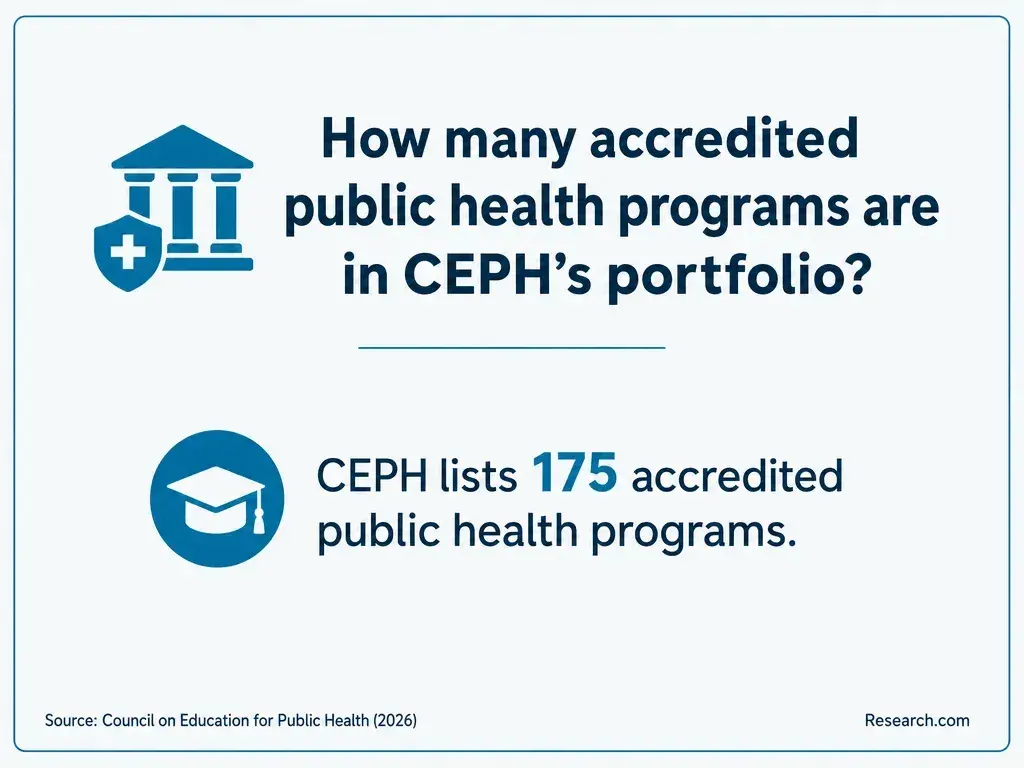
CEPH accreditation is a public health-specific quality signal, but it is not the same as federal financial aid eligibility. For aid, verify the institution's recognized accreditation and the program's federal eligibility with the school's financial aid office.
Do not assume that a bachelor's degree lacks federal aid solely because it is not covered by CEPH accreditation.
If CEPH status matters to your educational or career plans, check the accreditor's listing for the exact school or program and confirm whether the bachelor's degree is included.
Accreditation of an MPH elsewhere at the institution does not automatically extend to its BS. The distinction is also useful when reviewing accredited online MPH pathways later: always check the credential covered, not just the university name.
There is no reliable single price for a part-time public health BS. Schools may charge per credit or per term, and the bill can include mandatory fees, books, technology, and travel or lost work time for fieldwork. Part-time enrollment may reduce each term's tuition while increasing the number of terms in which you pay recurring fees.
Compare offers using the remaining credits that actually satisfy your degree, not just the advertised tuition rate. A returning student should obtain a degree audit showing how accepted transfer credits apply to general education, the major, electives, and residency requirements.
Then compare a proposed term-by-term bill with the school's aid estimate; public health bachelor's cost comparisons are a starting point, not a substitute for your personal calculation.
Ask the aid office how each proposed credit load changes your Pell Grant, loan eligibility, and cost-of-attendance budget. Also check satisfactory academic progress rules: a slower schedule or repeated coursework can affect eligibility independently of the price per credit.
A public health BS can support applications for entry-level community health, health education support, program coordination, outreach, and research-assistant work, depending on the employer and your experience.
These roles may involve coordinating services, communicating prevention information, tracking program activities, or helping collect and organize data. An internship or supervised project can provide stronger evidence of readiness than the degree title alone.
Job titles need careful interpretation: a community health worker role may have different training requirements from a health education specialist position, and epidemiologist roles commonly require more advanced preparation.
A BS does not confer clinical licensure or automatically qualify someone for management. If pay is central to your decision, do not apply master's-level occupational figures to undergraduate roles; public health graduate salaries by career address a different mix of credentials and jobs.
How Can You Choose a Reputable Part-Time Public Health Program?
Start with the schedule you can sustain and the amount of aid available at that load. A lower-priced program is not necessarily the better choice if its required courses are rarely offered part-time, transferred credits fail to meet major requirements, or fieldwork conflicts with your job.
Before enrolling, obtain written answers to the questions that determine both completion time and affordability:
- Ask admissions and the registrar for a degree audit showing which prior credits satisfy specific requirements and how many credits must be completed at the institution.
- Ask the department for a part-time course sequence, including prerequisites, online attendance obligations, and internship or capstone scheduling.
- Ask financial aid for estimates at your likely credit loads and for its policies on eligible coursework, recalculation dates, satisfactory academic progress, and institutional aid.
- Verify institutional recognition, program eligibility for federal aid, and any claimed CEPH coverage with the appropriate school offices and accreditor.
Evaluate the BS on its own terms rather than assuming it provides a shortcut into every later credential. Even comparing accessible public health doctoral programs is a separate decision with different admissions, experience, and funding considerations. The immediate choice is whether this bachelor's program offers an affordable, workable route to the undergraduate qualification you need.
Other Things You Should Know About Public Health
Often, yes. Report employer assistance to your financial aid office so it can determine whether your aid package must be adjusted under applicable rules. Check the employer's grade, course, and repayment conditions separately.
You may owe money to the school, and the school may have to return some federal aid under withdrawal rules. Contact the aid office before withdrawing to request an estimate based on your dates and attendance.
Possibly. Tax credits have their own income, expense, and enrollment rules; they do not follow Pell or Direct Loan eligibility exactly. Check current IRS guidance or consult a qualified tax professional.
Add the new school to your FAFSA and ask both aid offices about the transition. The new school determines its own award using your remaining eligibility, and you cannot receive federal aid from two schools for the same enrollment period except under an approved arrangement.
- Cost of Attendance (Budget) | 2025-2026 Federal Student Aid Handbook https://fsapartners.ed.gov/knowledge-center/fsa-handbook/2025-2026/vol3/ch2-cost-attendance-budget
- Filling Out the FAFSA® Form | Federal Student Aid https://studentaid.gov/apply-for-aid/fafsa/filling-out
- Program Integrity Questions and Answers - Satisfactory Academic Progress | U.S. Department of Education http://www.ed.gov/laws-and-policy/higher-education-laws-and-policy/program-integrity-information-questions-and-8
- Award Changes & Reductions - Financial Aid | Towson University https://www.towson.edu/admissions/financialaid/guide/requirements/changes.html
- Learn more about Satisfactory Academic Progress (SAP) | UW-La Crosse https://www.uwlax.edu/finaid/actions/understand-satisfactory-academic-progress-sap/
- How Enrollment Affects Your Federal Student Loans | The University of Iowa https://financialaid.uiowa.edu/types-aid/loans/how-enrollment-affects-your-federal-student-loans
- How many credits do I need to take to receive financial aid? | tcc.edu https://help.tcc.edu/s/article/How-many-credits-do-I-need-to-take-to-receive-financial-aid
- Pell Recalculation Policy | Office of Scholarships & Financial Aid https://financialaid.arizona.edu/policies/pell-grant-eligibility
- Financial Aid Glossary & Terms | Newman University https://newmanu.edu/financial-aid/financial-aid-glossary-terms