2027 Public Health BS Residency Credit Requirements for Transfer Students

Co-Founder and Chief Data Scientist
A college may accept your transfer courses and still require substantial coursework before awarding its Public Health BS. That gap often comes down to residency credits: credits you must earn through the degree-granting institution. For transfer and returning students, the distinction can change graduation dates and costs even when a transcript shows plenty of completed credits. This guide explains how residency interacts with major requirements, online study, and transfer evaluation so you can compare programs using the credits you would actually have left to earn.
Key Things You Should Know
- Residency means credits earned through the institution awarding the BS; transferred credits generally cannot satisfy that institution's residency minimum.
- A transfer course can be accepted for credit yet count only as an elective, leaving a public health core course or prerequisite unfinished.
- Before enrolling, request a term-specific degree audit showing accepted credits, requirement matches, remaining residency credits, and the courses needed for graduation.
What residency credit requirements apply to transfer students pursuing a Public Health BS?
Academic residency is the minimum coursework a student must complete through the institution granting the degree. It does not mean living in the state, qualifying for in-state tuition, or necessarily attending class on campus. An online course taught and awarded by the degree-granting school may count toward academic residency; a course transferred from another school generally does not.
There is no single US-wide residency minimum for a Public Health BS. A university may require a minimum number of its own credits overall, additional upper-division or major credits, or coursework during the final part of the degree. These rules may apply simultaneously. The catalog for your intended entry term and a written degree audit - not a general transfer-credit maximum - determine what remains.
The distinctions below show why a generous transfer policy may not produce a short path to graduation.
| Policy | What it measures | Possible transfer-student consequence |
| Overall residency | Credits earned through the degree-granting institution | Additional institutional coursework may be required even after other degree credits are met. |
| Major or upper-division residency | Specified public health or advanced courses taken there | Transferred public health electives may not replace required in-house courses. |
| Final-credit rule | Where coursework near graduation must be completed | Taking a late course elsewhere may require advance approval or delay graduation. |
Ask the registrar which courses count as institutional residency, and ask the public health department which must be taken within the major. If speed matters, comparing accelerated public health undergraduate schedules is useful only after confirming that required residency courses are offered often enough to follow the advertised pace.
How many transfer credits can apply toward a Public Health BS degree?
The applicable amount is the smallest amount allowed by several constraints: the school's transfer-credit limit, its residency rules, the credits required for the BS, and the extent to which prior courses satisfy specific requirements. A school might accept a course on the transcript without letting it replace a statistics prerequisite, general-education category, or public health core course.
For an illustrative calculation, not a program policy, suppose a degree requires 120 semester credits and a student has 90 accepted transfer credits. That does not establish that 30 credits remain.
If required upper-division courses have not been satisfied, the student may need more than 30 credits; if a separate residency minimum applies, that must also be met. Quarter-hour coursework, military learning, examinations, competency-based study, international credentials, and applied associate degrees may receive different evaluations.
Compare programs by credits remaining in each requirement category, not by the headline number a school says it will accept. When weighing public health degree choices for undergraduate students, obtain an individualized audit from each institution before assuming one will preserve more of your prior work.
What accreditation should transfer students look for in public health programs?
First, verify that the degree-granting institution holds recognized institutional accreditation. This matters for academic quality oversight and can affect whether another institution considers its credits, although accreditation alone never guarantees transfer.
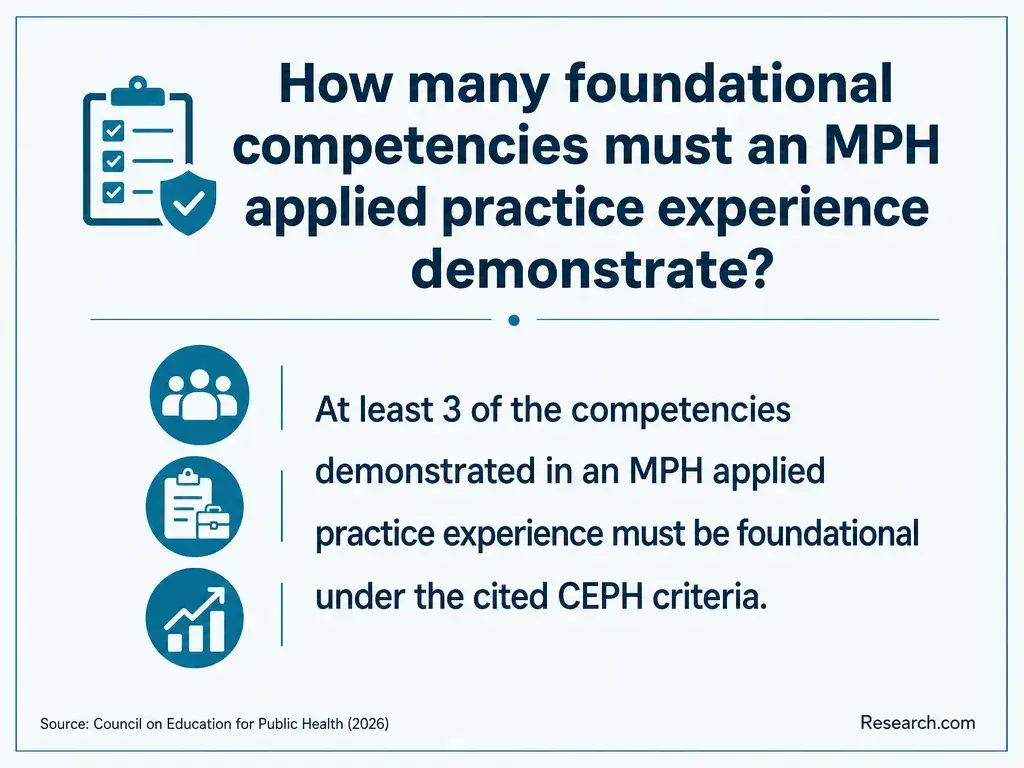
Then check whether the relevant public health school, unit, or individual bachelor's program is accredited by the Council on Education for Public Health (CEPH). Confirm that the specific BS you are considering falls within the accredited scope; accreditation of a related MPH does not establish that it does.
Ask the receiving university which prior institutions and types of learning it evaluates and whether any program-specific accreditation affects course equivalency. Its transfer office - not the sending school or accreditor - decides how accepted coursework applies to its degree.
CEPH scope also matters if you later compare graduate public health degree and concentration options, but graduate accreditation should not be mistaken for approval of an undergraduate major.
Evaluation usually has two stages. A registrar or transfer office determines whether coursework can be accepted and records its credit value. The public health department, general-education office, or other authorized academic unit then determines whether a course satisfies a particular requirement. Similar titles are not enough: a course may differ in statistical content, laboratory work, level, or learning outcomes.
For a useful review, assemble official transcripts, course descriptions or syllabi from the terms you attended, laboratory details where relevant, and documentation of military, examination, competency-based, or international study.
Request written decisions on equivalencies and substitutions, including how quarter credits convert to semester credits and whether older coursework meets current prerequisites. If a decision seems inconsistent with the course content, ask about the formal appeal process before repeating the class.
Keep undergraduate transfer evaluation separate from later graduate admissions. For example, MPH programs with broader admissions criteria may assess applicants differently; their admissions flexibility does not change the BS institution's course-equivalency or residency rules.
A Public Health BS commonly combines general education with population-health coursework such as epidemiology, introductory biostatistics, environmental health, health policy, social and behavioral health, and program planning. Schools may also require biology or other sciences, research methods, communication, an internship, or a capstone. The exact combination - and whether courses must be completed in sequence - varies by program.
For transfer planning, identify prerequisites to upper-division public health courses first. An accepted introductory statistics course might meet a general-education requirement but not the major's statistics prerequisite; conversely, a documented equivalent could prevent an unnecessary repeat. Ask whether required courses are offered every term and whether an internship has prerequisites or an approval deadline.
If graduate study is a possible later goal, prioritize solid preparation in data interpretation and research methods without assuming you need to purchase additional education now. A public health master's degree investment guide addresses that separate decision after you establish what it will take to finish the BS.
Potentially, but delivery mode does not waive academic residency. Confirm whether online courses offered by the degree-granting institution count, whether all required upper-division courses are available online, and whether exams, orientation, labs, or internships require attendance at specified locations. An online major may still rely on a local field placement or scheduled live sessions.
For working students and caregivers, compare the actual meeting times, placement hours, course rotation, and part-time options - not simply the "online" label. On-campus study may offer easier access to some courses or community placements, while an online option may reduce travel. Neither format guarantees that a required course will be available in the term you need it.
Online degree comparisons can also obscure differences in academic level. Information about lower-tuition online PhD programs in public health, for instance, does not indicate whether a Public Health BS can be completed remotely or how its undergraduate residency credits are counted.
Admission to the university, admission to the public health major, and approval of prior credits are separate decisions. A school may review transferable coursework and academic standing for university admission while the major has additional prerequisites, a minimum GPA, or a separate application. Being admitted does not mean every course on your transcript will apply to graduation.
Check the entry-term requirements for transcripts, completed prerequisites, application deadlines, and any separate major declaration. If you hold an associate degree, ask whether it fulfills general education under a specific agreement or merely supplies individually evaluated credits. Returning students should also ask how prior attempts, repeated courses, and academic renewal affect admission and the degree audit.
Advanced public health admissions follow different rules. Public health doctorate eligibility comparisons should not be used to judge whether an undergraduate applicant can enter a BS program or transfer a prerequisite.
Your remaining required credits, course sequence, residency minimum, and available enrollment pace determine completion time. A student with many accepted electives may take longer than one with fewer accepted credits that directly satisfy the major. A course offered only once in an academic year can create a delay even if few credits remain.
Request a term-by-term completion plan and an estimate that separates tuition from mandatory fees, materials, travel or placement expenses, and any costs of extending enrollment. Compare the total for the remaining plan, not just the advertised per-credit rate.
Comparing public health bachelor's tuition rates can help narrow choices, but an individualized audit is needed to estimate what you would actually pay. Verify aid eligibility and satisfactory academic progress with each school's financial aid office before relying on an enrollment plan.
A BS can support applications for entry-level work in community health programs, health education, outreach, public health operations, and research or program support. Employers may value evidence of communication, basic data handling, community engagement, and supervised project work alongside the degree. Job titles vary, and some roles require additional experience, a graduate degree, or a separate credential.
For salary comparisons, use a clearly defined occupation and location rather than a supposed "Public Health BS salary." US Bureau of Labor Statistics wages for occupations such as health education specialists describe workers across employers, experience levels, and educational backgrounds; they are not predicted earnings for new BS graduates.
Compare local entry-level postings and their stated qualifications before assigning a likely return to your remaining tuition. A doctorate is not the standard next step for most entry-level roles. If an eventual research career makes doctoral study relevant, employer tuition support for epidemiology doctorates is a separate financing question, not a reason to incur extra BS credits now.
Does a Public Health BS prepare graduates for certification or licensure?
A Public Health BS does not itself award a professional certification or a clinical license. Depending on the curriculum and the certifying organization's current rules, graduates may be able to pursue a credential such as Certified in Public Health (CPH) or Certified Health Education Specialist (CHES). Eligibility depends on the specific pathway; a degree title alone is insufficient evidence. Licensed clinical roles have separate education and state requirements.
If a credential matters to your target job, ask the certifying organization about eligibility, ask the BS program which required courses it offers, and check whether the employer actually requests that credential. Further degrees should be evaluated against a specific role rather than treated as automatic upgrades: weighing tuition for a public health doctorate is relevant only if doctoral training fits your longer-term work.
Other Things You Should Know About Public Health
Usually, prior-learning credits are evaluated separately from courses taken through the degree-granting institution. Ask the registrar whether they can satisfy degree requirements and whether any exception to the residency rule applies.
Possibly. Campuses in one system may be treated as separate institutions for residency purposes. Confirm how the degree-granting campus classifies the specific course before registering.
The location alone does not decide. An approved internship registered, supervised, and awarded for credit by your degree-granting institution may count; independently arranged work does not automatically earn academic credit.
Previously earned institutional credits may remain on your record, but readmission and the applicable degree requirements can change. Ask the registrar and major adviser for a new audit before relying on an earlier graduation plan.
- The Landscape of US Undergraduate Public Health Education | nih.gov https://pmc.ncbi.nlm.nih.gov/articles/PMC6134569/
- Transfer Resources - Texas Higher Education Coordinating Board https://www.highered.texas.gov/transfer-resources/
- University of California Schools of Public Health https://health.universityofcalifornia.edu/education/public-health
- York College, CUNY - Degree Transfer Agreement https://www.qcc.cuny.edu/transfer/agreements/PUB-r-AS-PublicHealth-York-College.html
- Undergraduate Degree Requirements | umich.edu https://sph.umich.edu/undergrad/degrees/degree-requirements.html
- BSPH Degree Requirements - Public Health https://cosspp.fsu.edu/publichealth/bachelors-degree-requirements/
- Public Health | University of Florida Catalog https://catalog.ufl.edu/UGRD/colleges-schools/UGPBH/PBH_BPH/
- Graduation Requirements for Transfer Students | newschool.edu https://www.newschool.edu/lang/graduation-requirements-transfer-students/
- For Students: Bachelor's Degree Transfer - Gen Ed @ UMD https://gened.umd.edu/students/transfer-students/students-bachelors-degree-transfer
- Requirements for the Bachelor's Degree | University at Albany https://www.albany.edu/undergraduate-bulletin/requirements-for-bachelors-degree.php