2027 Online MS in Psychology - Forensic Psychology for Medical Records Clerks: What to Check Before Changing Careers
Audited and Verified:
Our Editorial and Data Verification Process
Research.com uses government datasets, official education statistics and primary institutional information to support its career and degree guides. Our review process checks factual accuracy, occupational definitions, source dates and the requirements associated with the credentials discussed.
How This Article Was Fact-Checked
Our editorial team verifies salary estimates, employment projections, education requirements and program information against original data providers and official organizations. Salary figures are checked against the relevant occupational definitions and reporting periods. Information about licensure, accreditation and required in-person training is reviewed separately.
Fact-checked and verified on:

Co-Founder and Chief Data Scientist
Medical records clerks already work with sensitive information, documentation rules, and healthcare teams - experience that may transfer to some justice- and behavioral-health-adjacent jobs. An online MS in forensic psychology could help with that transition, but it is not a shortcut to becoming a licensed psychologist. Before committing tuition and study time, you need to identify the work you want, the qualifications employers require, and whether the program offers relevant experience.
This guide helps you test those questions against your background and compare a master's degree with more direct routes.
Key Things You Should Know
- Match the degree to a job, not a title: Records, privacy, and data-handling experience may support a move into justice-system administration, research support, or service coordination; employers may still require direct experience.
- Know the credential boundary: A nonclinical forensic psychology MS does not, by itself, authorize psychological evaluations, diagnosis, therapy, or independent practice as a psychologist.
- Calculate the full investment: Compare required credits, tuition and fees, placement obligations, and time away from work against the qualifications in actual job postings.
What Is an Online Master's in Forensic Psychology for Medical Records Clerks?
An online master's in forensic psychology studies psychological science in legal and justice settings. Depending on the school, it may emphasize research, behavior in legal contexts, victim services, corrections, or policy. "Online" describes course delivery, not necessarily a fully remote experience: live meetings, supervised projects, or site visits may still be required.
For a medical records clerk, the strongest connection is often information stewardship. Accurate documentation, restricted access, and careful communication matter in research and service systems as well as healthcare. But familiarity with patient records is not training to interpret psychological tests or use records for a student project. Those activities require the appropriate qualifications and permissions.
If you do not yet have a bachelor's degree, establish that step first. Three-year online forensic psychology degree options can provide a comparison point, but only a school's evaluation can establish how your prior credits apply.
Can Medical Records Clerks Become Forensic Psychologists With a Master's Degree?
Not solely by earning a forensic psychology master's. In the United States, independent work as a licensed psychologist generally requires qualifying doctoral training, supervised experience, examinations, and state authorization. The rules for professional titles and permitted duties depend on the jurisdiction. Forensic evaluation is a specialized application of professional qualifications, not a right conferred by a concentration name.
A more achievable near-term transition may be into records or program administration in a justice setting, research coordination, victim-service support, or corrections-related program support. The distance between your current job and each role varies: a records-focused position may value your existing experience, while direct service may call for interviewing, referral, crisis-response, or casework experience. Review master's-level forensic psychology employment pathways as possibilities to investigate, then check local postings for the actual duties and qualifications.
Does an Online Forensic Psychology Master's Lead to Licensure?
Most nonclinical forensic psychology master's programs should not be assumed to lead to counseling or psychologist licensure. A course on psychopathology, interviewing, or assessment does not substitute for a licensing board's required curriculum, supervised practice, and examinations. A school's statement that a degree "prepares" students for the field is not a determination of eligibility.
If your goal is to provide therapy, compare the requirements for the specific credential and state where you intend to practice. A qualifying counseling or social work program may be more direct than a nonclinical forensic MS. Lower-cost accredited counseling degree pathways are useful to compare only after confirming that a particular program meets your state's educational requirements.
First, verify that the institution holds recognized institutional accreditation and that it applies to the school awarding the degree. Then check the specific program's degree name, location, and stated purpose. Institutional accreditation supports the standing of the institution; it does not establish that a nonclinical MS satisfies any state's licensure rules.
Do not reject a general or forensic psychology MS simply because it lacks APA accreditation: APA accreditation covers specified professional psychology training, not every psychology master's program. Conversely, do not assume that accreditation attached to another program at the same university covers this one. If you are comparing a licensure-oriented alternative, examine its applicable program recognition and state-board alignment; accredited counseling study with accelerated schedules still requires careful checks of placements and eligibility.
Curricula differ, but relevant subjects may include research methods and statistics, psychology and law, ethics, psychopathology as academic study, victimization, and behavior in correctional settings. Some programs offer a thesis, capstone, or supervised nonclinical experience; others rely mainly on coursework. Ask which components are required rather than assuming that a course title signals practical training.
For records clerks, methods and ethics may have particular value. They can strengthen your ability to evaluate evidence, explain data limitations, and distinguish authorized use of information from inappropriate access. Before choosing electives on addiction or co-occurring needs, decide whether you want broad forensic study or a more focused undergraduate foundation such as accredited college pathways in addiction psychology. Neither route alone grants authority to counsel or diagnose.
Expect schools to review an earned bachelor's degree and academic record, but verify each program's accepted majors, GPA policy, prerequisite courses, and application materials. A psychology major is not universally required. If your bachelor's is in health information management, business, criminal justice, or another field, your documentation and analytical experience may strengthen your application; you may still need introductory psychology, statistics, or research-methods preparation.
Ask admissions to distinguish required prerequisites from recommended coursework and to confirm whether missing courses may be completed before or after admission. If you have not earned a bachelor's and your goal is specifically substance-use support rather than forensic research, compare a more direct starting point such as lower-cost addiction counseling bachelor's career preparation. Check the relevant state's credential rules before assuming that any bachelor's program qualifies you for counseling work.
Completion time depends on required credits, course availability, enrollment pace, and any thesis or placement. An accelerated schedule can reduce calendar time while increasing the weekly workload - an important trade-off if you intend to keep working. Compare published requirements and charges for your entry term rather than relying on an advertised completion time.
Build a total-cost estimate from tuition for every required credit plus mandatory fees, materials, technology, travel, and any placement-related expense. Also account for reduced work hours, if applicable, and ask whether your employer offers education assistance. A comparison of costs of one-year forensic psychology master's pathways is a starting point, not a substitute for an itemized estimate from each school. Shorter is not automatically cheaper or more compatible with full-time work.
The best prospects connect your current evidence of competence to the target job's tasks. The following distinctions can help you search by responsibilities rather than assuming every position with "forensic" in its title has the same entry requirements.
| Possible direction | Experience you may already have | Likely gap to investigate |
| Justice or behavioral-health records administration | Documentation accuracy, access controls, workflow coordination | Agency-specific records rules and hiring requirements |
| Research or program support | Data quality checks and organized recordkeeping | Research methods, approved data access, and project experience |
| Victim-service or case-coordination support | Confidential communication and referral-system familiarity | Direct-service skills, supervision, and agency training |
For direct-service roles, seek supervised experience and learn the boundary between providing information or referrals and delivering treatment. If your interest is specifically in recovery services, understanding career progression in addiction recovery may reveal more targeted entry routes; certification and permitted duties vary by state and employer. A new degree may help, but it cannot replace required experience or credentials.
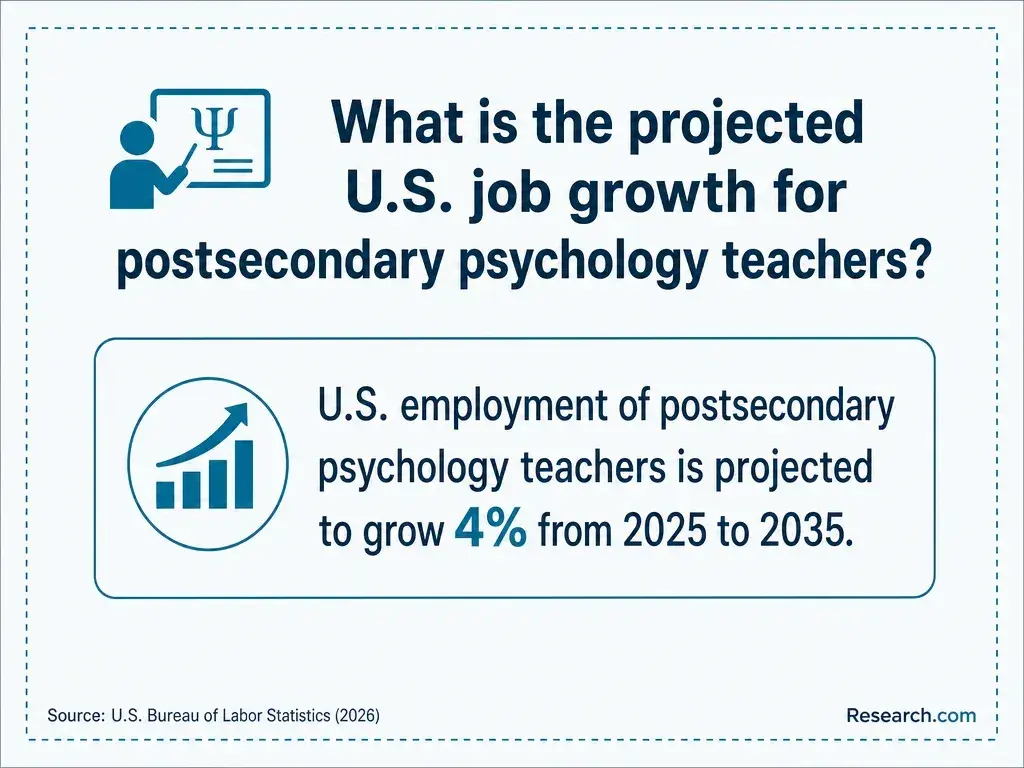
There is no single reliable salary or employment-growth figure for "forensic psychology graduates." The US Bureau of Labor Statistics reports data by occupation, not by master's concentration. Its psychologist figures describe an occupation with qualifications that a nonclinical MS alone generally does not meet; they should not be treated as your expected pay after graduation.
Instead, choose two or three realistic job titles from local postings and compare their pay ranges, required credentials, and experience levels. For broader context, check the Bureau of Labor Statistics Occupational Outlook Handbook entry that actually matches each role. Then weigh that evidence against your total education cost and current earnings. Comparing affordable graduate psychology programs can help frame the education-cost side of that calculation, but no tuition figure establishes a salary return.
How Should You Compare Online Forensic Psychology Programs?
Start with a target job and work backward. A program is a stronger fit when its curriculum, practical opportunities, schedule, and documented outcomes address requirements you can identify in real postings - not merely when its name sounds close to the career you want.
Use the same questions with every admissions and career-services office so the answers are comparable:
- Is this degree nonclinical, and does the school claim it meets any specific state's professional-licensure requirements?
- Which courses or projects build the skills in my target job postings, and who supervises any applied work?
- Are live classes, campus visits, or placements required, and can a working student arrange them locally?
- What is the itemized cost at my planned pace, and what evidence is available about graduates' actual job titles?
Request answers in writing and confirm that they apply to your entry term. If speed matters, use under-two-year forensic psychology graduate program options to identify schedules worth checking - not to assume an internship, relevant supervision, or career outcome comes with faster completion. If postings favor experience you can gain through your current employer or targeted training, test that lower-cost route before enrolling.
Other Things You Should Know About Psychology
Not without the required organizational permission and any applicable privacy, data-use, or research review. Removing names alone may not make a dataset permissible to access or share.
Only if the program approves the site, duties, supervision, and learning objectives. Your existing employment does not automatically satisfy an applied-learning requirement.
Policies vary by institution. Ask the school what appears on its diploma and transcript; employers may also ask separately about your projects and experience.
Usually, assess the course schedule, finances, and target job market first. Keeping your job while testing relevant volunteer, project, or internal-transfer opportunities may reduce the risk of an unproven career switch.
- Cost of Attendance (Budget) | 2025-2026 Federal Student Aid Handbook https://fsapartners.ed.gov/knowledge-center/fsa-handbook/2025-2026/vol3/ch2-cost-attendance-budget
- Types of Financial Aid: Grants, Work-Study, and Loans | studentaid.gov https://studentaid.gov/understand-aid/types
- Ethical and Professional Considerations in the Forensic... - PMC https://pmc.ncbi.nlm.nih.gov/articles/PMC7278774/
- Frequently Asked Questions - California Board of Psychology https://www.psychology.ca.gov/licensees/faq.shtml
- Skills You'll Build in a Master's Degree in Forensic Psychology | Neumann https://learn.neumann.edu/neuperspectives/skills-built-in-a-masters-degree-in-forensic-psychology
- A Career in Forensic and Public Service Psychology | apa.org https://www.apa.org/education-career/guide/subfields/forensic/education-training
- Career Options for Forensic Psychology Students | LSU Online https://online.lsu.edu/newsroom/articles/what-can-you-do-forensic-psychology-degree/
- Forensic Psychology in Criminal Justice | Touro University Worldwide https://www.tuw.edu/psychology/forensic-psychology-criminal-justice/
- Online Forensic Psychology Master's Degree | ASU Online https://asuonline.asu.edu/online-degree-programs/graduate/master-science-forensic-psychology/
- MS in Forensic Psychology | Neumann University https://www.neumann.edu/academics/grad/masters-degree-in-forensic-psychology