2027 Online BA in Psychology - Addictions vs. an Associate Degree in Addiction Studies: Compare Curriculum, Cost, and Career Fit
Audited and Verified:
Our Editorial and Data Verification Process
Research.com uses government datasets, official education statistics and primary institutional information to support its career and degree guides. Our review process checks factual accuracy, occupational definitions, source dates and the requirements associated with the credentials discussed.
How This Article Was Fact-Checked
Our editorial team verifies salary estimates, employment projections, education requirements and program information against original data providers and official organizations. Salary figures are checked against the relevant occupational definitions and reporting periods. Information about licensure, accreditation and required in-person training is reviewed separately.
Fact-checked and verified on:

Co-Founder and Chief Data Scientist
If you want to work in addiction services, the broader degree is not automatically the better starting point. An online BA in psychology can build research skills and support future study; an associate degree in addiction studies may offer more directly relevant coursework and field experience sooner. But neither degree alone establishes permission to counsel clients.
This comparison is for prospective students and career changers weighing time, cost, online flexibility, and a specific job goal. It shows how to check whether either program actually moves you toward the credential and work you want.
Key Things You Should Know
- An associate degree typically requires about 60 semester credits; a BA typically requires about 120. Compare remaining credits after an official transfer evaluation, not just advertised program length.
- For an entry-level addiction counseling credential, state-approved addiction coursework and supervised experience may matter more than a degree's title. Neither option automatically qualifies you for independent clinical practice.
- Choose the BA for broader psychology and graduate-study preparation; consider the associate degree for a potentially shorter, more occupation-focused route, provided its courses and placement match your state's rules.
What is the difference between an online BA in psychology and an associate degree in addiction studies?
An online BA in psychology is a bachelor's degree centered on psychological science. An addictions concentration, if offered, is a defined group of courses within that degree; a few addiction-related electives are not necessarily a formal concentration.
An associate degree in addiction studies is a shorter undergraduate credential organized more closely around substance-use services and related support work.
The key distinction is breadth versus occupational focus. The table describes common patterns, not guarantees about any particular school. Explore psychology major options at online colleges alongside each school's actual degree requirements.
| Decision factor | Online psychology BA | Addiction studies associate degree |
| Academic emphasis | Psychological theory, research, statistics, and multiple areas of behavior | Substance-use education, recovery systems, service skills, and local practice context |
| Typical credit scope | About 120 semester credits for the full degree | About 60 semester credits for the full degree |
| Applied experience | Varies; an addictions focus does not ensure a counseling placement | May include fieldwork, but hours and supervision vary |
| Later study | Meets the degree-level starting point for many graduate applications, subject to program prerequisites | May transfer toward a bachelor's degree, subject to the receiving school's evaluation |
An online classroom does not make an addiction-services placement remote. Ask where fieldwork occurs and whether your location is eligible before choosing either format.
Which degree better prepares you for addiction counseling careers?
For the earliest state-recognized addiction counselor pathway, the better program is the one whose specific courses, supervised hours, and degree level satisfy your state's rules.
An associate program designed around those requirements may be more direct than a general psychology BA. Conversely, a state or employer may require a bachelor's degree for the role you want, making the BA the stronger starting point.
Look beyond course titles. Ask the state credentialing authority whether it accepts the program's addiction-specific instruction, who may supervise required experience, and whether hours can begin before graduation.
Then ask the school which of those requirements its graduates have completed, not merely whether graduates have studied counseling techniques. Online undergraduate addiction psychology program comparisons can help identify bachelor's options to investigate, but the state authority decides credential eligibility.
If your goal is independently providing psychotherapy, neither degree is a complete route. You will need to identify an appropriate qualifying professional program and the jurisdiction's subsequent supervised-practice and examination requirements.
How do curriculum and coursework compare between the two degrees?
A psychology BA commonly includes statistics and research methods alongside developmental, social, biological, and abnormal psychology. An addictions focus may add courses on substance use, prevention, recovery, or service systems. That breadth is useful if you may later pursue research, program evaluation, or graduate study, but it may leave gaps in state-specified addiction training.
An addiction studies associate degree commonly spends more of its limited curriculum on substance-use topics, professional boundaries, documentation, referral, and supervised observation or service work. Its practical emphasis is valuable only if the actual courses and field experience meet your intended credential's standards. Academic discussion of screening or treatment does not authorize a student to diagnose or provide therapy.
Specialization should follow the work you intend to do. For example, forensic psychology bachelor's completion planning addresses a different academic focus; forensic electives should not be counted as addiction-specific training without confirmation from the credentialing authority.
First, verify that the college or university holds institutional accreditation recognized by the U.S. Department of Education or the Council for Higher Education Accreditation. Check the institution and campus offering your degree, not just an accreditation logo on a promotional page.
Institutional accreditation matters for issues such as federal aid eligibility and credit review, but it does not establish that an addiction course meets a state's credential rules.
Next, check for any program approval or curriculum requirements specified by your state addiction counselor board or certifying authority. Request a written explanation of how the school maps courses and fieldwork to those requirements.
The American Psychological Association does not accredit general psychology BA programs. Professional accreditation may become important for a later qualifying counseling program; accelerated accredited clinical mental health counseling programs involve a different degree level and credential pathway.
First-year applicants to either undergraduate route generally need a high school diploma or accepted equivalent and the institution's required application materials.
Some programs admit students to the college first and apply separate requirements to the major, concentration, or field placement. Transfer applicants should expect an official transcript review rather than an automatic award of advanced standing.
If you already hold an associate degree or have prior coursework, ask the BA institution for a degree audit showing which credits satisfy general education, psychology major, addiction-focus, and remaining residency requirements.
An accepted credit may count only as an elective. For an associate program, check whether placement eligibility involves background screening, immunizations, transportation, or a site interview; admission to the degree does not necessarily mean admission to a particular placement.
Graduate admissions are a separate decision. Even intensive forensic psychology master's admissions and study plans have requirements distinct from undergraduate admission and do not establish addiction counselor eligibility.
A full-time associate degree often takes about two academic years; a full-time BA often takes about four. Those are planning benchmarks, not completion promises.
Transfer credit, part-time enrollment, course sequencing, and placement availability can change the timeline substantially. An associate degree followed by a BA may be economical, but only if the receiving institution applies enough credits toward the bachelor's requirements.
Compare total remaining cost, not advertised tuition alone. For each school, obtain the price per credit and multiply it by the credits left after an official evaluation. Add mandatory fees, books, technology, travel to placements, and any lost earnings from unpaid fieldwork.
Published psychology degree tuition and affordability comparisons are a starting point; your personalized degree audit and aid offer determine the more useful estimate.
If you are working while enrolled, confirm the number of live classes, the hours available for supervised placement, and whether required courses run every term. A lower tuition quote may offer little savings if scheduling delays graduation or makes paid work difficult to maintain.
Either degree may support applications for nonclinical roles such as recovery-services support, intake assistance, outreach, referral coordination, or program support, depending on the employer and your experience.
The associate degree may align more closely with an entry-level addiction-services opening; the BA may also support broader human-services, research-support, or program-evaluation applications. Neither degree alone guarantees a job title or permission to deliver counseling.
Read postings for tasks rather than matching only the title. Intake and support employees may document information and connect people with services, but assessment, diagnosis, and treatment decisions can be restricted to appropriately credentialed staff.
If your longer-term interest shifts toward a different specialty, evaluating faster-paced forensic psychology master's degrees addresses a separate career decision, not an upgrade that automatically qualifies you for addiction treatment work.
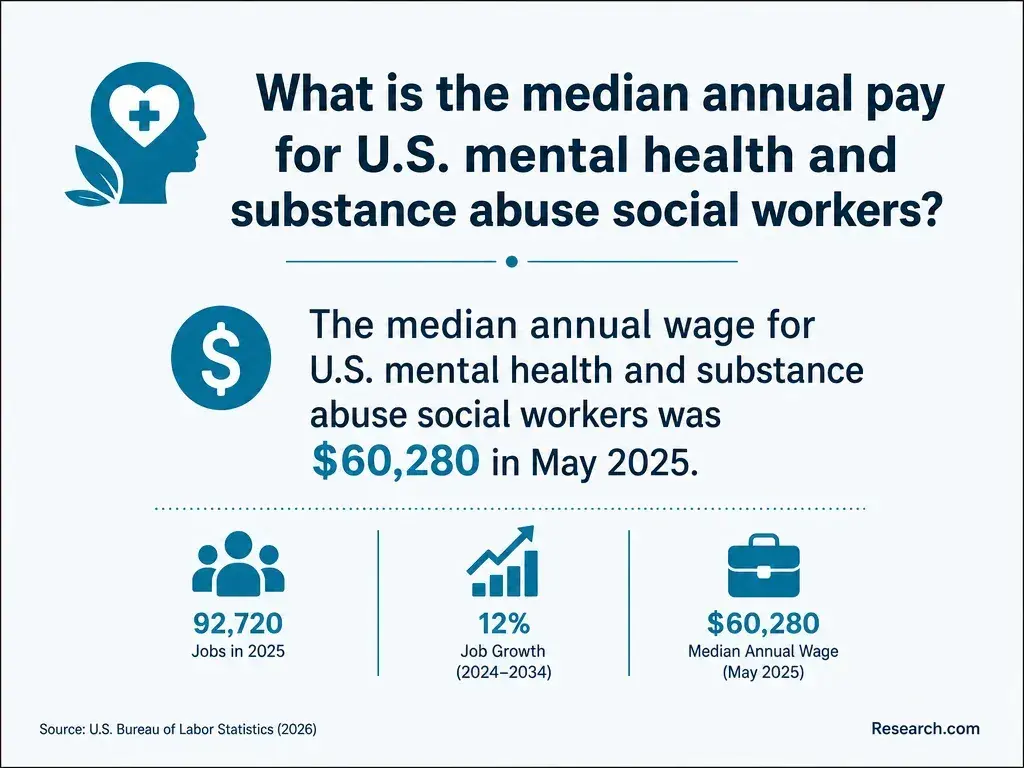
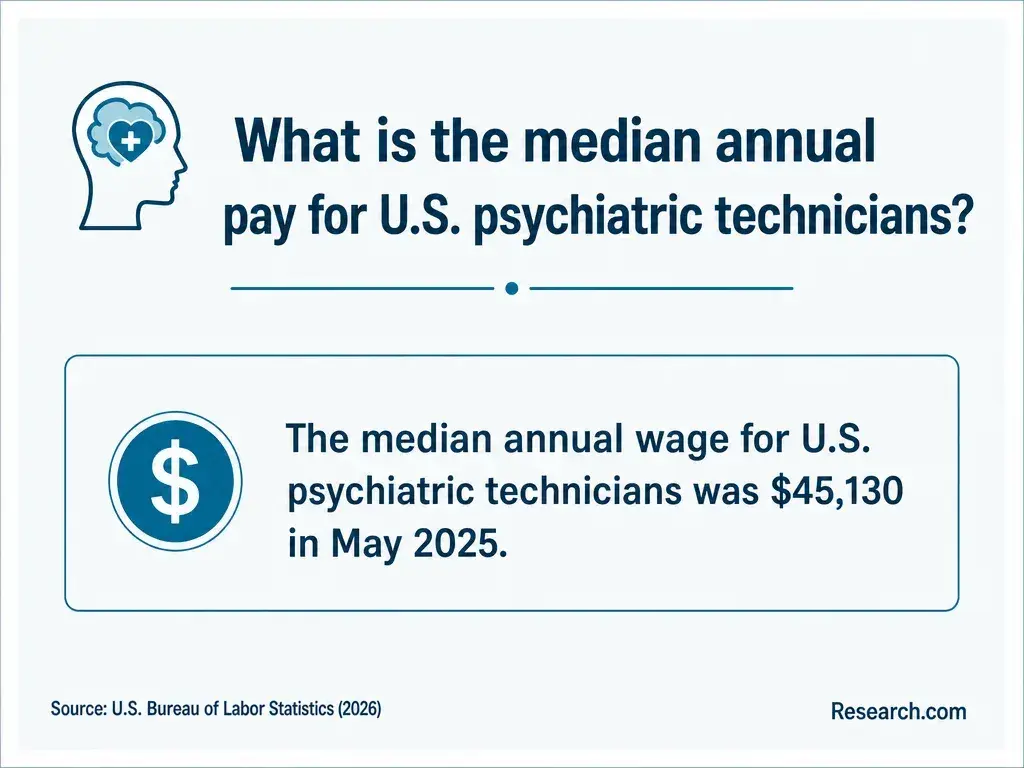
The U.S. Bureau of Labor Statistics reports a 2024 median annual wage of $59,190 for the combined occupation of substance abuse, behavioral disorder, and mental health counselors.
It projects 17% employment growth from 2024 to 2034 for that occupation. Growth suggests demand for qualified workers, but the wage combines several counselor roles with different education and license requirements. It is not the expected pay for a new associate or BA graduate.
For a realistic comparison, find local postings for the exact roles you could enter after each program and separate their advertised pay from pay for licensed positions. If your eventual target is a qualifying master's-level counseling role, account for that additional education when considering clinical mental health master's tuition and career value.
State addiction counselor credentials can distinguish trainee or entry-level status from more advanced or independent practice. Requirements may include specified addiction coursework, a minimum degree level, supervised work, an examination, and ongoing education.
A school cannot waive a state requirement by calling its degree "addictions-focused." Peer-support credentials, where available, have their own training and role boundaries and are not interchangeable with counselor licenses.
Licensed mental health counseling generally requires a qualifying graduate degree plus jurisdiction-specific supervised experience and examinations. Becoming a licensed psychologist ordinarily requires substantially different doctoral-level professional preparation. If graduate study is your plan, include fees and placement-related expenses when comparing mental health counseling program charges beyond tuition.
Before enrolling, send the state credentialing authority the proposed program name and course list. Ask which credential you could pursue, which requirements the program would satisfy, and what supervised steps would remain. Keep its response with your enrollment records.
How can you choose a reputable online psychology or addiction studies program?
Start with your target job and state, then compare programs against that destination. A school's promise of speed or flexibility is less useful than a clear answer about credential alignment, transfer credit, placement access, and remaining cost.
Fast-track psychology degree programs online are worth considering only after checking whether their pace leaves room for any required supervised experience.
Use the following checks to turn program descriptions into a decision you can verify:
- Ask the state authority which degree, courses, and supervised experience the target credential requires; confirm whether the proposed program meets any of them.
- Request an official degree audit and a written estimate of remaining credits, tuition, mandatory fees, and placement expenses.
- Confirm institutional accreditation, the exact award and concentration name, course availability, and any live sessions or campus visits.
- Ask who secures placement sites, where students may complete hours, what supervisors must hold, and whether employed students can meet the schedule.
- Compare published outcomes only when the school explains which students were counted, over what period, and whether credential attainment was independently verified.
Choose the associate route when it is demonstrably aligned with an accessible entry credential or support role and the transfer plan remains acceptable. Choose the BA when its broader preparation and bachelor's-level opportunities justify the extra credits and cost.
If neither program satisfies your state's requirements efficiently, a state-recognized training route or a different qualifying degree may be the better investment.
Other Things You Should Know About Psychology Programs
Lived experience can be valuable in recovery-support work, but it does not automatically replace required coursework, supervised hours, or examinations. Check the rules for the specific role or credential.
Possibly. Background-screening rules differ by state, credential, employer, and placement site. Ask the relevant authority and prospective program about eligibility before paying nonrefundable charges.
Often, but confirm that the school can enroll students in your location and arrange any required fieldwork there. Its home-state curriculum may not satisfy your state's credential rules.
Only if the school and any relevant credentialing authority approve the site, duties, supervision, and documentation. Employment alone does not make work hours eligible.
- Board of Alcohol and Drug Abuse Counselors | tn.gov https://www.tn.gov/health/licensure/adac.html
- Programmatic Accrediting Agencies | ed.gov http://www.ed.gov/laws-and-policy/higher-education-laws-and-policy/college-accreditation/programmatic-accrediting-agencies
- Price of Attending an Undergraduate Institution - COE https://nces.ed.gov/programs/coe/indicator/cua/price-of-attending-an-undergraduate-institution
- 4 Types of Psychology Degrees: Picking the Right Program | Bouvé College of Health Sciences https://bouve.northeastern.edu/news/4-types-of-psychology-degrees-picking-the-right-program/
- Applied Psychology: Addictions Studies, B.S. - CPS, CPSO | University of New Hampshire https://www.unh.edu/program/bachelor-science/applied-psychology-addictions-studies
- Addiction Studies - Spokane Falls Community College https://sfccbeta.spokane.edu/What-to-Study/education-social-behavioral-science/Addiction-Studies
- Tuition & Costs | New Jersey Institute of Technology https://www.njit.edu/admissions/tuition-costs
- A Guide to Professions in Addiction Studies and Recovery | University of the Cumberlands https://www.ucumberlands.edu/blog/guide-to-professions-in-addiction-studies-and-recovery
- What Degree Do I Need to Become a Counselor or Therapist? | Palo Alto University https://paloaltou.edu/resources/blog/what-degree-do-i-need-become-counselor-or-therapist
- Career Paths in Addictions Counseling | UMN CCAPS https://ccaps.umn.edu/story/exploring-career-paths-addictions-counseling