Online MBA in Technology Management: admissions guide for public sector professionals

Co-Founder and Chief Data Scientist
Managing a government technology project can require as much judgment about budgets, procurement, and organizational change as it does about software. An online MBA in technology management may help public sector professionals build that broader management perspective, but admission requirements and program fit vary.
This guide explains how to assess your readiness, prepare an application that reflects public service experience, and compare the degree with more targeted options before committing time and money.
Key Things You Should Know
- Most applicants need a bachelor's degree; work experience, testing, prerequisites, and interview policies depend on the school—not on the technology management concentration alone.
- Public sector experience can strengthen an application when you show measurable responsibility for budgets, vendors, teams, service delivery, or change.
- Compare total cost and employer support against a realistic career path: the $126,520 median wage for US management occupations in May 2025 is not a forecast for an MBA graduate or a government employee.
What Is an Online MBA in Technology Management?
It is a graduate business degree that pairs an MBA's general management core with coursework on leading technology-related decisions. Schools may call the focus a concentration, specialization, track, or group of electives. Confirm the official designation and required courses: one technology elective does not necessarily constitute a formal concentration.
For a public agency, relevant work might include evaluating a new case-management system, overseeing implementation, or explaining its budget and service implications to leadership. The MBA approaches these as management decisions; it does not ordinarily replace technical training in software engineering or cybersecurity. Professionals whose primary goal is technical leadership can also compare online MBA programs for engineers, checking whether their curricula address governance and procurement as well as innovation.
Is an Online Technology Management MBA Worth It for Public Sector Professionals?
It may be worthwhile if your next role involves leading cross-functional technology initiatives and your employer values graduate management education. Its value is less certain if advancement depends chiefly on civil-service classification, tenure, a required technical credential, or an opening that has not materialized. An MBA does not override an agency's hiring rules.
Start with a likely target position and its published qualifications. Compare those requirements with the MBA's courses, tuition and fees, time away from work or family, and any employer reimbursement conditions. Ask a supervisor or human resources office whether the degree qualifies for education assistance or affects eligibility for a particular role; do not assume it triggers a pay increase.
For a move into private industry, examine recruiting support and relevant employer connections rather than treating public and private salary paths as interchangeable. Broader career-focused choices in online MBA programs can help frame that comparison.
If you need one skill for a current assignment—such as contract management or project delivery—employer training or a focused certificate may offer a more direct return. An MPA may fit a career centered on public policy and administration; a specialized technology master's may fit a career centered on deeper technical practice.
What Careers Can an Online Technology Management MBA Prepare You For?
The most plausible path builds on duties you already perform. Technology management coursework can support movement from project coordination or technical supervision toward broader responsibility, but job titles and qualification rules differ among federal, state, and local employers.
The comparison below connects potential roles to prior experience, so you can distinguish a credible next step from a substantial career change:
| Potential role | Relevant experience to build on | Likely gap to check |
| Technology program manager | Delivering agency projects across teams | Budget authority and program-level accountability |
| IT or digital services manager | Supervising technical staff or service operations | People management and relevant technical oversight |
| Technology procurement or vendor manager | Working with contracts, vendors, or implementations | Agency-specific procurement rules and delegated authority |
| Organizational change leader | Rolling out systems or redesigning services | Stakeholder engagement and demonstrated adoption results |
Healthcare agency and public-hospital staff should also check whether a role calls for health-system knowledge beyond general technology management. For clinicians shifting into operational leadership, MBA study for clinicians moving into management healthcare administration may be a closer curricular match. Neither route replaces clinical licensure where a position requires it.
First, verify that the university holds institutional accreditation recognized by the US Department of Education. This matters when assessing degree recognition and federal student-aid eligibility. Then check whether its business school or MBA has additional programmatic accreditation, such as AACSB, ACBSP, or IACBE. Institutional and business-school accreditation serve different purposes; one should not be mistaken for the other.
Use the accreditor's directory to confirm the school and the scope of its accreditation, then ask the university whether the online MBA is included. Also check your employer's education-assistance rules: an agency may impose its own conditions on eligible institutions or programs.
A bachelor's degree and application materials are common starting points. Schools set their own policies for professional experience, GPA, GMAT or GRE scores and waivers, interviews, deadlines, and prerequisite courses. Do not assume that a technology management focus requires a computer science degree—or that an online format makes admission automatic.
For public sector applicants, the strongest evidence often shows scope and results rather than job title alone. Use the following preparation sequence to turn agency work into a clear application:
- Check each program's current requirements, deadlines, testing policy, technology management designation, and eligibility for employer funding.
- Map your experience to management work: identify budgets, staff, vendors, procurement decisions, service outcomes, and stakeholders you influenced.
- Prepare a résumé and statement that explain your target role and why business training, rather than solely technical training, addresses your gap.
- Choose recommenders who can describe your judgment and impact, and review your readiness for accounting, finance, and quantitative coursework.
If your academic record or experience does not fit one school's expectations, compare its stated criteria with online study options for online MBA programs with accessible admissions. "Accessible" should still mean a credible institution and a curriculum that serves your goals.
The MBA core commonly covers accounting, managerial finance, operations, strategy, organizational behavior, and decision-making. Technology-focused coursework may address digital strategy, innovation, data-informed management, technology governance, or implementation. An applied project, if offered, can be useful when it lets you work through a real organizational problem; verify its availability to online students.
Read course descriptions rather than relying on the concentration name. A public sector professional should look for opportunities to examine constrained budgets, procurement, security and privacy obligations, accessibility, and accountability. Private-sector case studies can teach useful methods, but an agency cannot always adopt their pricing, staffing, or purchasing assumptions.
A nonbusiness bachelor's degree is not inherently a barrier. Schools differ on whether they require foundation coursework, embed introductory material, or expect applicants to prepare independently. Compare those policies when considering MBA eligibility with prior academic credits online MBA programs, and ask whether any foundation courses add time or cost.
Both depend on the university, required credits, course sequence, and whether you enroll part time or at an accelerated pace. A shorter advertised completion time may assume a course load that is difficult alongside agency deadlines. Ask when concentration courses run and whether a pause in enrollment changes your ability to finish.
Compare a written, program-specific estimate of tuition and mandatory fees with the costs of books, software, and any required campus travel. Check whether tuition is charged per credit, course, or term, whether fees change with enrollment pace, and whether foundation courses cost extra. No single price accurately represents all online technology management MBAs.
Employer assistance can change the calculation substantially, but verify reimbursement caps, grade requirements, approval procedures, and any obligation to remain employed. If borrowing, include interest and repayment in your personal budget rather than comparing programs on advertised tuition alone.
Online study can let you remain in your public sector role and apply coursework at work. Campus study may offer more frequent in-person contact and easier access to some events or recruiting activities. Neither format is uniformly more flexible or more valuable: the relevant question is which program's actual design fits your schedule and career goal.
Before choosing, compare live-session times, group-work expectations, exams, residencies, and access to faculty and career services. Ask whether online students can join the same employer events and applied projects as campus students. If your goal is internal promotion, staying employed while studying may matter more than campus recruiting; if you seek a substantial private-sector transition, access to employers and a suitable professional network may carry more weight.
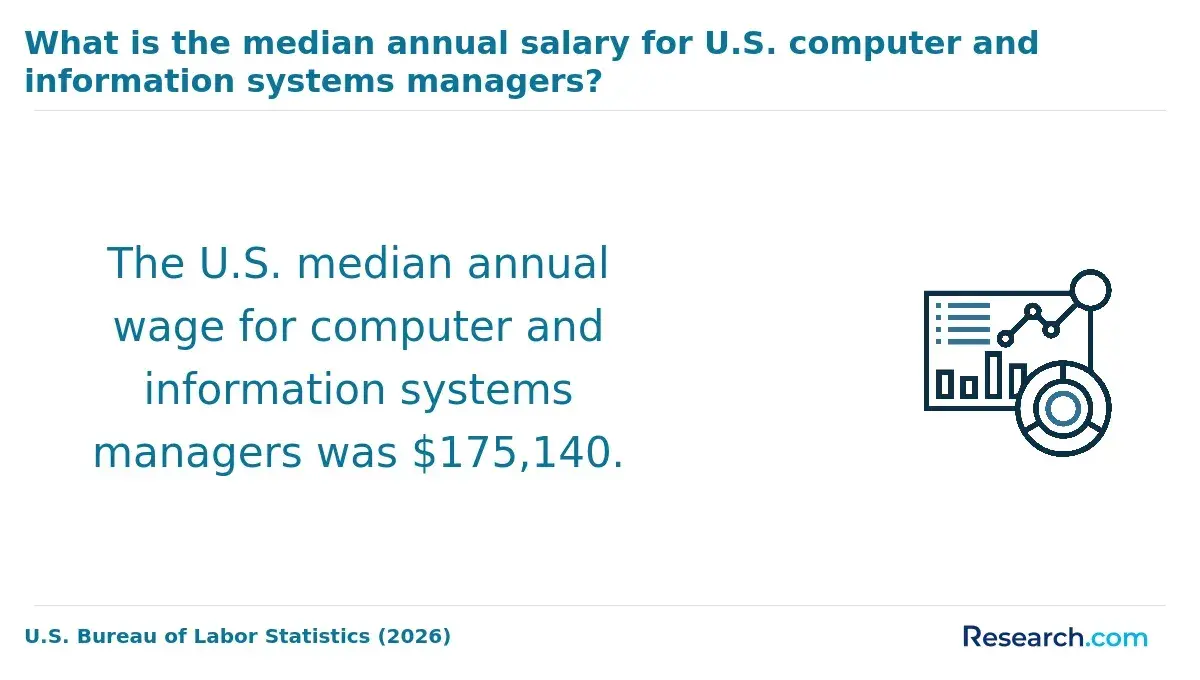
The US Bureau of Labor Statistics reports a May 2025 median annual wage of $126,520 for management occupations as a group. That figure covers many occupations and employers; it is not the expected salary of a technology management MBA graduate or a public sector technology manager. Your agency's pay schedule, location, grade or classification, and prior experience are more useful for estimating an internal move.
BLS projects about 1.1 million annual openings, on average, across management occupations from 2025 to 2035, including openings created when workers leave those occupations. This broad outlook does not establish demand for a particular agency role. For a realistic estimate, compare posted qualifications and pay ranges for positions you could pursue now and after completing the degree.
Which Certifications Complement an Online Technology Management MBA in Public Service?
Choose a credential to address a defined job requirement, not merely to add letters after your name. Project management certification may complement an MBA for delivery-focused roles; a procurement credential may be more relevant to contracting responsibilities; and a cybersecurity governance or risk credential may fit oversight positions. Each has its own eligibility rules, experience expectations, and continuing-education requirements.
Review actual vacancy announcements and your agency's training policies before paying for an exam. Where an employer provides role-specific training or requires its own acquisition qualifications, that route may be more immediately useful than an external certification. MBA coursework can strengthen managerial judgment, but it does not itself confer a professional certification.
Other Things You Should Know About MBA
Yes, if you stay within your employer's confidentiality, security, and records policies. Remove protected details and seek approval before using nonpublic budgets, vendor information, or project materials.
No. Advancement depends on the applicable classification and hiring rules, available positions, and your qualifications. Check the requirements for the specific role you want.
It may. A collective bargaining agreement can influence pay progression, education benefits, or how vacancies are filled. Consult your agreement and human resources office before assuming the degree changes compensation.
Possibly, for eligible federal loans and borrowers who meet the applicable program rules. Employment alone does not qualify a loan for forgiveness; verify current requirements before borrowing on that assumption.
- Financial aid for military service - Minnesota MyHigherEd https://myhighered.mn.gov/paying-college/financial-aid-military-service
- Determining an IT Project | nc.gov https://it.nc.gov/documents/procurement/determining-it-project/download
- Students & Recent Graduates | U.S. Office of Personnel Management https://www.opm.gov/policy-data-oversight/hiring-information/students-recent-graduates/
- GMAT and GRE Waiver Policies | JHU Carey Business School https://carey.jhu.edu/admissions/gmat-gre-waiver-policies
- 4.1.21 Instructional Modalities and Distance Education | Illinois State https://policy.illinoisstate.edu/academic/4-1-21
- What is Public Service? - Cornell Career Network https://career.cornell.edu/resources/what-is-public-service/
- Policies for Online Teaching | Teaching and Learning Resource Center https://teaching.resources.osu.edu/teaching-topics/policies-online-teaching
- GRE and GMAT Test Score and Waiver Options | umn.edu https://carlsonschool.umn.edu/graduate/resources/gre-gmat-test-score-waivers
- Course Modes & Definitions - Office of the University Registrar https://registrar.washington.edu/classrooms/course-modes/
- Showcasing Quantitative Skills for the MCIT Online Application | Penn Engineering Online https://online.engineering.upenn.edu/admission-advice/mcit-online-quantitative-ability/