2027 Online Ed.D. in Leadership and Learning in Organizations: Moving from Higher Education Administration to Learning Consulting
Audited and Verified:
Our Editorial and Data Verification Process
Research.com uses government datasets, official education statistics and primary institutional information to support its career and degree guides. Our review process checks factual accuracy, occupational definitions, source dates and the requirements associated with the credentials discussed.
How This Article Was Fact-Checked
Our editorial team verifies salary estimates, employment projections, education requirements and program information against original data providers and official organizations. Salary figures are checked against the relevant occupational definitions and reporting periods. Information about licensure, accreditation and required in-person training is reviewed separately.
Fact-checked and verified on:

Co-Founder and Chief Data Scientist
Higher education administrators often know how to develop staff, improve student-facing services, and lead change within a university. Learning consulting asks them to apply those skills across clients, diagnose unfamiliar performance problems, and demonstrate results. An online Ed.D. in Leadership and Learning in Organizations may help, but it is neither a required consulting credential nor a substitute for client-facing experience. This guide shows how to assess the degree's career value, build evidence of consulting readiness, compare alternatives, and check the practical commitments before enrolling.
Key Things You Should Know
- The strongest transition combines higher education leadership experience with documented needs assessment, learning design, evaluation, and client communication - not an Ed.D. alone.
- An Ed.D. can deepen applied research and change-leadership skills, but a targeted certificate or supervised consulting project may be a more direct first step.
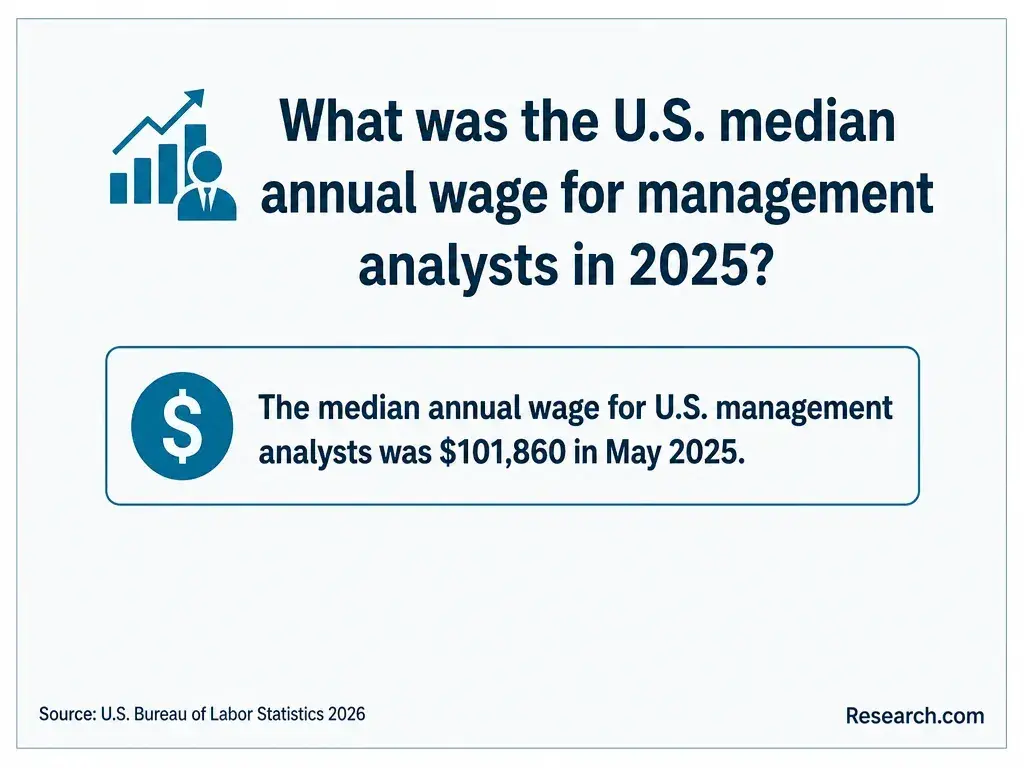
- Management analysts, a broad category that includes some organizational consultants, had a $101,860 median annual salary in May 2025; that figure is not a predicted salary for new learning consultants.
What is an online Ed.D. in Leadership and Learning in Organizations?
It is a practice-oriented Doctor of Education focused on how people learn and how organizations lead, adapt, and improve. Depending on the university, study may combine adult learning, organizational change, leadership, research methods, and an applied doctoral project. "Online" describes where much of the instruction occurs, not necessarily a self-paced program or one without campus visits.
For a higher education administrator, the important distinction is between studying how to run a university and studying learning across organizations. A broadly focused leadership and learning Ed.D. may support work with employers, nonprofits, or public agencies; a higher-education administration doctorate may concentrate more heavily on institutional governance and policy. Neither degree automatically qualifies someone to advise clients.
Applicants who already hold an education specialist degree can compare advanced study options after an Ed.S., but they should obtain a written evaluation of admission eligibility and any credits that would actually apply to the doctorate.
How can an Ed.D. help higher education administrators become learning consultants?
Administrators can bring valuable experience: coordinating professional development, working across departments, managing stakeholders, and interpreting institutional evidence. Consulting adds a different obligation. The client expects a defined problem, a feasible recommendation, and a way to judge whether an intervention worked - not simply a training program.
An Ed.D. can help an administrator move from delivering learning to diagnosing performance. For example, low participation in staff training might reflect scheduling, managerial incentives, or unclear job expectations rather than poor course design. Coursework in organizational diagnosis and evaluation can help test those possibilities. An applied project may also produce a work sample, provided the program permits the project and the organization authorizes data use and public sharing.
Before committing to a doctorate, seek a cross-functional improvement assignment or a supervised project with an external organization. Document the question, your role, the methods used, recommendations, and limitations; report outcomes only when they were measured and can be disclosed. If you cannot yet explain how your university experience translates into a client deliverable, gaining that experience may be more valuable than enrolling immediately.
What careers can you pursue with an Ed.D. in Leadership and Learning?
The degree can be relevant to several paths, but each calls for different evidence of readiness. This comparison separates roles that can otherwise sound interchangeable.
| Path | Typical work | What a higher education administrator must demonstrate |
| Learning consultant | Diagnoses client needs, designs learning or performance solutions, and evaluates implementation. | Client discovery, scoped recommendations, facilitation, and evidence of results. |
| Organizational development consultant | Examines culture, processes, leadership, and change barriers. | Organizational diagnosis and change work beyond training delivery. |
| Learning and development manager | Leads an employer's training strategy, staff, vendors, and budget. | People management and operational ownership, often in the target sector. |
| Higher education learning leader | Directs staff development or institution-wide improvement. | Institutional influence, resource decisions, and measurable implementation. |
Moving into an internal university learning role is generally a closer transition than winning independent contracts in an unfamiliar industry. For the latter, sector knowledge, referrals, proposals, and project delivery may matter more initially than the doctorate. A master's-level learning or organizational development program, targeted training, and consulting experience can be more efficient if the immediate goal is a first client-facing role.
Relevant programs may teach adult learning and learning transfer, organizational diagnosis, change leadership, qualitative and quantitative inquiry, and program evaluation. For a prospective consultant, the test is whether coursework connects these subjects to decisions a client actually faces: what problem to investigate, what evidence is credible, what change is feasible, and how to assess it.
Examine the required courses and doctoral deliverable, not just elective titles. A course in analytics does not by itself establish advanced data-science competence, and a leadership course is not necessarily a formal concentration. Ask whether students practice stakeholder interviews, needs assessment, implementation planning, and communicating findings to decision-makers.
Project format matters particularly for a career changer. Compare the school's actual dissertation or capstone rules with online Ed.D. capstone alternatives to compare; "without a dissertation" does not mean without substantial doctoral research or an applied project. Confirm faculty supervision, project-site rules, and whether a confidential university assignment can produce a shareable, appropriately redacted portfolio sample.
Online study can let an administrator remain employed while examining problems in a current workplace. Campus study may make in-person faculty contact and local networking easier. Neither format inherently offers better consulting preparation; the decisive features are project access, feedback, collaboration, and opportunities to work beyond the student's existing institution.
Ask for the actual live-class schedule, group-meeting expectations, attendance policy, required campus convenings, and project milestones. Location flexibility will not help if meetings conflict with evening university events or peak enrollment periods. Compare travel and time away from work as well as tuition. When weighing formats and prices across schools, affordable online doctorates in education can be a starting point, but verify each program's delivery requirements and charges directly.
Requirements vary. Programs may request prior graduate study, professional experience, transcripts, recommendations, a statement of purpose, and evidence that the applicant can undertake applied inquiry. Some specify a completed master's degree or other academic conditions; do not assume that every program requires an education master's, a senior title, or published research.
For this career transition, a persuasive application should connect actual administrative responsibilities to a specific learning or organizational challenge. Describe decisions you made, stakeholders you worked with, and what you still need to learn to serve clients responsibly. Distinguish a proposed project from an approved project or a measured result.
If you previously began doctoral study, review Ed.D. completion pathways after unfinished doctoral study and request a written evaluation from each prospective program. Credits used to establish admission eligibility are not necessarily transferable credits that reduce the Ed.D.'s requirements.
There is no reliable universal timeline or price. Required credits, term schedules, enrollment pace, doctoral-project approvals, and whether a student pauses study all affect completion. Request the program's published curriculum sequence and ask what happens if work or project access changes.
For an administrator considering consulting, the financial comparison should include total tuition and mandatory fees, any travel and lodging, time away from work, and the cost of continuing a project beyond the planned schedule. Ask your employer whether tuition assistance covers doctorates, whether reimbursement depends on grades or continued employment, and whether outside consulting creates a conflict of interest.
Use the school's current charges to compare the full expected expense with a smaller experiment: targeted methods training plus a supervised consulting project. If cost is the limiting factor, research choosing a lower-cost online Ed.D., then confirm what its quoted price includes. Do not count on a salary increase to repay the degree.
First, confirm that the university - not merely a marketing page - lists the exact Ed.D. you intend to enter and identifies the institution's recognized accreditor. Check the accreditor's own institutional listing and the U.S. Department of Education's accreditation database for the university's status. Then ask the program which institution awards the degree and whether any separate professional recognition applies to that specific program.
Institutional accreditation is not evidence that a broadly focused leadership Ed.D. prepares graduates for school-administrator licensure or a consulting certification. If a particular regulated role matters to you, obtain the program's licensure disclosure and check eligibility with the relevant state authority before applying.
General organizational learning consulting does not have a single U.S. professional license or mandatory certification. Clients may nevertheless prefer evidence of instructional design, facilitation, evaluation, coaching, or change-management capability. A voluntary certification can support a defined service offering, but its value depends on the clients you want and the work you can demonstrate.
Do not confuse that position with regulated work. Providing services that cross into licensed counseling, psychology, or certain school leadership roles can trigger different requirements. Define your proposed services, check applicable state rules and employer policies, and avoid advertising expertise or credentials you do not hold.
What are the salary and job outlook for learning consultants and education leaders?
"Learning consultant" is not one uniform Bureau of Labor Statistics occupation. The closest category depends on the work: an organizational adviser may resemble a management analyst, while someone designing and delivering employee development may resemble a training and development specialist. The following U.S. occupational figures provide context, not Ed.D. graduate outcomes or independent-consultant earnings.
| Occupation | Median annual salary, May 2025 | Projected employment change, 2025-2035 |
| Management analysts | $101,860 | +10.1% |
| Training and development specialists | $69,280 | +10.8% |
| Postsecondary education administrators | $104,590 | +1.8% |
The differences reinforce a career decision: remaining in higher education, joining an employer's learning team, and selling consulting services are distinct markets. An independent consultant must also secure clients and cover business expenses. Compare specific job postings or prospective contracts with your current compensation, benefits, and experience before treating a doctorate as a financial investment.
Other Things You Should Know About EdD Leadership
Possibly. Check your institution's outside-employment, conflict-of-interest, use-of-resources, and intellectual-property policies before accepting work. Approval to study does not necessarily authorize a consulting business.
Not necessarily. An authorized internal project or a supervised assignment can help you test the work first. Before accepting paid independent clients, get appropriate advice on contracts, taxes, and business requirements in your state.
Not automatically. Colleges set position-specific expectations for disciplinary expertise, teaching experience, and research or professional practice. Check postings in the field and at the type of institution where you hope to teach.
Tell your faculty adviser promptly. Ask whether the project can continue with existing permissions, needs a new site or approvals, or must be rescoped. Do not assume that a former employer's data access or authorization continues after you leave.
- Connecting higher education to workplace activities and earnings - PMC https://pmc.ncbi.nlm.nih.gov/articles/PMC10016720/
- What Does a Higher Education Consultant Do? | Northeastern University Graduate Programs https://graduate.northeastern.edu/knowledge-hub/what-does-a-higher-education-consultant-do/
- Student-Community Partnerships | umn.edu https://www.hhh.umn.edu/capstone-projects-student-community-partnerships
- Leadership and Learning in Organizations Online Ed.D. | Peabody College of Education and Human Development https://peabody.vanderbilt.edu/academics/edd-programs/online-leadership-learning-organizations/
- Online Ed.D. in Leadership and Learning in Organizations | VU-EDU https://peabodyonline.vanderbilt.edu/edd-in-organizational-learning/
- Career Paths with a Master's in Higher Education Administration | Lindenwood University https://www.lindenwood.edu/blog/career-paths-with-a-masters-in-higher-education-administration/
- 2026 UNC Online EdD in Organizational Learning & Leadership https://online.unc.edu/online-doctoral-programs/online-edd-organizational-learning-and-leadership/
- Internships and Capstones | Career Preparation https://scds.uoregon.edu/career-preparation/internships-capstones