2027 MPH Programs: Questions About Project Data Access Before Enrollment

Co-Founder and Chief Data Scientist
An MPH program may advertise real-world projects without guaranteeing that students can use the data needed for the work they want to do. For applicants interested in epidemiology, evaluation, or analytics, that distinction can determine whether a practicum or capstone is feasible. This guide explains the questions to ask about datasets, partner permissions, privacy, supervision, and online access before you commit. It also shows how to weigh those answers against coursework, cost, and your career goal - whether you are entering public health or building on experience you already have.
Key Things You Should Know
- Ask for examples of student-accessible projects, not just faculty research or agency partnerships; enrollment alone does not grant access to restricted data.
- Verify three separate approvals where relevant: academic approval of the project, the data holder's permission to use its data, and any required privacy or research-ethics review.
- Compare programs on a feasible backup project as well as the preferred one; an approved public-use dataset can be more valuable than a promised partnership that never yields usable access.
What project data access should MPH applicants verify before enrolling?
Project data access means more than being able to see a dataset. You need to know whether a student may obtain it, analyze it for a particular purpose, receive supervision, and present an acceptable deliverable. Ask the program director or applied-practice coordinator for recent examples from your intended concentration and delivery format - not merely a list of institutional partners.
These data categories help distinguish a realistic project from one that depends on approvals outside the program's control.
| Potential data source | What it may support | Access question |
| Public-use health data | Reproducible descriptive analysis or an evaluation plan | Do courses and advisors support a project using this source? |
| Partner-provided, deidentified data | Analysis tailored to an organization's decision | Who authorizes student use, and what restrictions apply to outputs? |
| Restricted or identifiable records | Questions requiring detailed individual-level information | Are students eligible for access, training, secure computing, and required approvals? |
Ask when access decisions occur relative to project deadlines, who finds a replacement dataset if approval fails, and whether the student can still meet graduation requirements. Delays can affect completion costs, so include project contingencies in public health degree affordability and completion planning. A named partnership is useful evidence of opportunity, but it is not a student data-use agreement.
Is an MPH degree required for public health data careers?
Not universally. Employers hire for distinct tasks, and requirements vary by position. Someone with statistics, computing, clinical, or community-program experience may be able to enter data support or evaluation work through supervised projects and targeted training. An MPH is more compelling when the goal requires combining analysis with epidemiology, population-health context, community priorities, and practice experience.
If you are earlier in your education, compare online public health bachelor's program features with entry-level job requirements before assuming a graduate degree is the first step. For method-intensive research, an MS with deeper quantitative training may fit better than a generalist MPH. Neither degree alone substitutes for evidence that you can clean data, explain limitations, and communicate findings responsibly.
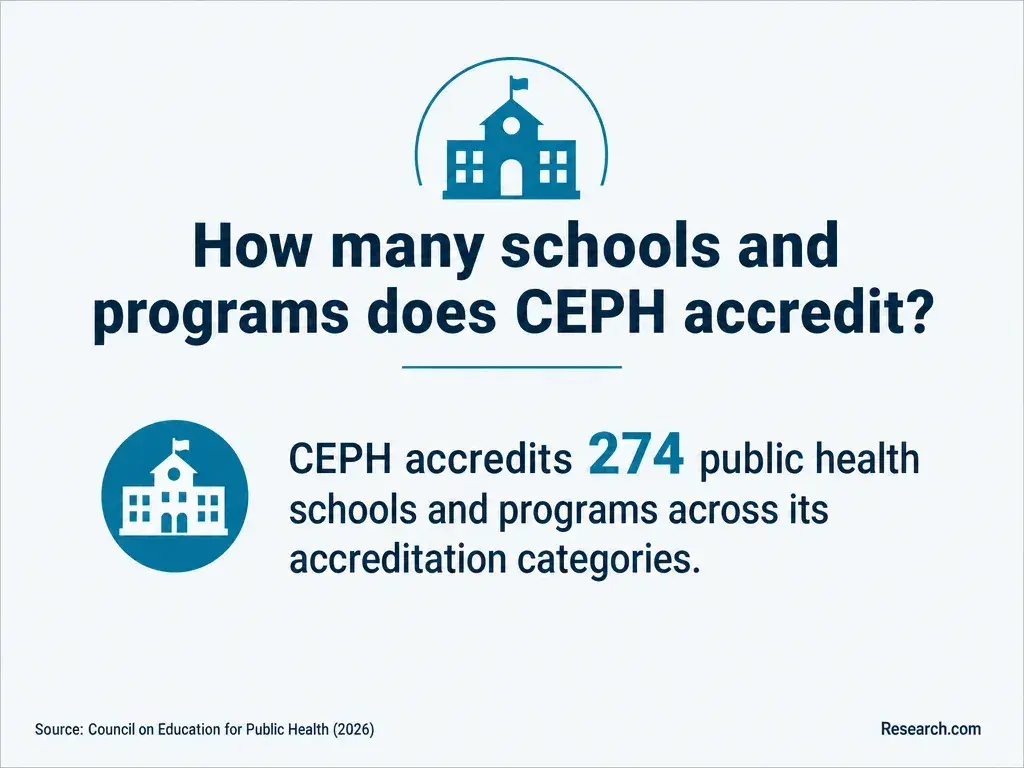
How does CEPH accreditation affect MPH project opportunities?
CEPH accreditation indicates that a public health school or program has been evaluated against public health education standards, including applied and integrative learning expectations for covered MPH degrees. It does not certify that a particular student can use an agency's records, join a faculty study, or obtain a preferred placement. Check the accreditor's current listing for the exact school or program and confirm that your degree falls within its scope; institutional accreditation answers a different question.
Then ask how the MPH fulfills its applied practice experience and integrative learning requirements, which office approves sites, and what students produce when partner data are unavailable. If you are also considering a practice-focused doctoral route, compare its project expectations and total commitment separately rather than treating it as an MPH with better data access; affordable public health doctorates by study duration provides a starting point for that different decision.
Some do, but online delivery neither guarantees nor prevents it. A remote student might analyze an authorized partner dataset through a secure environment, work with an approved local organization, or use public-use data. Access depends on the partner's rules, the project agreement, supervision, and the school's technology - not the word "online" in a program description.
Ask whether the examples shown involved online students, whether a local placement must be secured independently, and whether live meetings, travel, or campus-based secure computing are required. Working applicants should check those obligations against their schedules. When finding online MPH programs that fit your profile, treat admission accessibility and workable project access as separate criteria.
Rules depend on the source and purpose of the data. Public-use files may be broadly available but still have use conditions. A partner can restrict even deidentified data through a data-use agreement. Identifiable health information may trigger HIPAA obligations when a covered entity or its business associate is involved; other records can be governed by different laws and organizational policies. Deidentification is not a blanket permission to share or publish.
Research involving people or their identifiable private information may require an institutional review board determination or review. A class exercise, program evaluation, or quality-improvement activity is not automatically exempt from institutional assessment simply because a student conducts it. Before requesting records, ask the data holder and university who determines the applicable review path, where files may be stored, and what can appear in a final presentation.
If your goal is sustained research with restricted datasets, investigate supervision and funding as well as access. Even affordable epidemiology doctoral study with aid would not itself confer permission to use a research group's data.
Look for a sequence that moves from epidemiologic questions and biostatistical interpretation to data management and an applied analysis. The right depth depends on the proposed deliverable: a community needs assessment may emphasize descriptive measures and data quality, while an epidemiologic analysis may require study design, regression, missing-data assessment, and careful treatment of confounding. A software demonstration alone is not evidence that students can choose a defensible method.
Request syllabi and check which courses must be completed before the project begins, what software and secure-computing support are available, and whether feedback comes from someone qualified in the method you plan to use. Compare that preparation with its cost: public health master's affordability and earnings should be considered alongside the specific analytical skills you would leave with, not as a substitute for evaluating them.
Requirements differ by school and concentration. Programs commonly evaluate prior degree work and application materials, but statistics preparation, work experience, recommendations, tests, and deadlines must be checked against the specific program's current instructions. An applicant from a non-public-health discipline should distinguish a formal prerequisite from a recommended course and ask whether preparation can be completed before or after admission.
If your background has a gap, obtain a written answer about acceptable coursework or conditional pathways rather than assuming project experience will waive a requirement. Public health master's admission requirement alternatives can help frame that conversation. Admission also does not establish eligibility for a restricted-data project; ask about project prerequisites separately.
Completion time depends on required credits, course sequencing, enrollment pace, and when applied projects are offered. Calculate the price from the school's current tuition schedule and required fees rather than a headline rate. Add software, travel, potential unpaid fieldwork, and any extra term that a delayed data agreement could cause. Ask whether a project can be changed without extending enrollment.
Use comparing lower-tuition MPH programs as an initial screen, then request an individualized cost and completion plan from each school. A lower tuition rate may not be the lower-cost option if the feasible project route takes longer or requires travel.
Relevant roles include program evaluator, public health analyst, health education specialist, and epidemiologist, but they involve different duties and hiring standards. An MPH project can demonstrate analytical judgment, partner communication, and ethical data handling; it does not guarantee entry into a particular occupation or a salary. Epidemiology and other specialist positions may require substantial methods preparation or relevant experience.
For pay comparisons, use the US Bureau of Labor Statistics occupation that matches the work you want, including its stated wage year and entry requirements. Its occupational median describes workers across backgrounds and career stages - not new MPH graduates. Weigh that evidence against your own costs and potential aid; public health master's tuition after university aid is more relevant to your decision than a published price you may not actually pay.
How can applicants compare MPH programs and project resources?
Compare written answers for the same proposed project at each school. Describe the population-health question, likely data source, intended output, and whether you need identifiable records. That makes vague assurances easier to spot. A strong response identifies the approval owner, a realistic timeline, appropriate supervision, and a fallback that still satisfies degree requirements.
Send program staff these questions before paying an enrollment deposit, and ask which answers are policy versus examples from past students:
- What recent student project used a data source comparable to mine, and what was the student's permitted output?
- Who approves the site, the data-use arrangement, the analysis environment, and any ethics review?
- What happens to my project and graduation timeline if the partner declines access?
- Who supervises my proposed method, and what support is available to online or part-time students?
Finally, check application demands without letting ease of application outweigh project fit. If recommendations are a barrier, comparing online MPH reference letter policies can narrow your options - but verify data access with the programs that remain.
Other Things You Should Know About Public Health
Often only in an approved form. Ask who owns the work and whether a public summary, synthetic example, or redacted methods description is permitted; do not post restricted data or identifying outputs.
Contact your academic coordinator promptly. A revised question, another approved site, or public-use data may be possible, but the program must confirm that the replacement meets its requirements.
Possibly, subject to the data agreement, partner permissions, authorship expectations, and any required research review. A course grade or capstone approval is not publication permission.
Ownership and sharing rights depend on university policy and any placement or data-use agreement. Clarify those terms before building code you hope to reuse, and keep restricted data out of shared repositories.
- Sample Data Use Agreement - NCBI - NIH https://www.ncbi.nlm.nih.gov/books/NBK574757/
- MPH Capstone experiences: promising practices and lessons learned | nih.gov https://pmc.ncbi.nlm.nih.gov/articles/PMC10213715/
- Frequently Asked Questions | Protecting Student Privacy https://studentprivacy.ed.gov/frequently-asked-questions
- HealthData.gov https://healthdata.gov/
- Data Security Guidance for Human Subjects Research | University of Connecticut https://ovpr.uconn.edu/services/rics/irb/data-security-guidance-for-human-subjects-research/
- Health Informatics: Capstone Data Sources | LibraryGuides at Creighton University https://culibraries.creighton.edu/health-informatics/data-sources
- Course Related Student Projects - Human Subjects Office https://hso.research.uiowa.edu/get-started/do-i-need-irb-approval/course-related-student-projects
- Understanding Data Use Agreements and Confidentiality Agreements - Inside Montclair https://inside.montclair.edu/news/understanding-data-use-agreements-and-confidentiality-agreements
- Data Use Agreement Guidance - OSP https://osp.unc.edu/resources/guidance-faqs/dua-guidance/
- Data Agreements - Stanford Office of Research Administration https://ora.stanford.edu/data-use-agreements