2027 MLIS Programs for Information Professionals Leaving Public Libraries

Co-Founder and Chief Data Scientist
Leaving public libraries does not mean leaving information work, but choosing an MLIS requires a clear destination. The U.S. Bureau of Labor Statistics reports a May 2025 median annual wage of $68,270 for librarians and media collections specialists; that occupational figure is not a promise of higher pay in another setting.
This guide helps public library professionals assess which roles value their experience, whether graduate study is necessary, and how to compare programs by accreditation, practical training, scheduling, and total cost.
Key Things You Should Know
- For librarians and media collections specialists, projected U.S. employment growth is 2.6% from 2025 to 2035; a targeted transition plan matters more than relying on degree completion alone.
- An ALA-accredited master's can preserve eligibility for many professional librarian roles, but archives, records, and information-management employers may accept other qualifications.
- Choose a target job before choosing electives: compare its required skills with actual course availability, applied projects, and the full cost of attendance.
What Is an MLIS Degree for Public Library Professionals?
A Master of Library and Information Science (MLIS) is a graduate degree covering how information is organized, found, preserved, and used. Related degrees may be called an MLS, a Master of Science in Library Science, or a Master of Information; the title alone does not establish a program's curriculum or accreditation.
For someone leaving public libraries, the degree's value depends on the gap it fills. Reference interviews and community instruction may transfer well to academic research support.
Collection work may provide a foundation for metadata or digital collections, but those jobs can require tools and workflows not used in a public branch. Before applying, collect several postings for one target role and separate qualifications you already have from those you need to develop.
Geography can affect that decision even for online students. If you are comparing programs based in the region, an affordable library information science south comparison can provide a starting point; confirm current tuition and residency rules directly with each university.
Do You Need an ALA-Accredited MLIS to Become a Librarian?
Not universally, but ALA program accreditation is an important eligibility check. Many professional librarian employers request or prefer a master's from an ALA-accredited program, while requirements differ by employer and position.
Check the current ALA directory for the specific master's program under consideration: a university's institutional accreditation does not establish ALA accreditation for its LIS degree.
If you already hold an accredited MLIS, another full degree may add less value than focused coursework, experience, or a certificate. If you do not, compare target job postings before committing: an academic librarian role may call for an accredited LIS master's, while a records or knowledge-management position may accept several degree backgrounds.
School librarianship is a separate check. State certification or endorsement requirements can include preparation and assessments beyond the graduate degree; an online MLIS does not automatically qualify a graduate in every state. Verify requirements with the state education authority where you intend to work.
Which MLIS Career Paths Suit Professionals Leaving Public Libraries?
The strongest transition usually connects an existing public-service skill to evidence of a new setting's methods. The table distinguishes plausible pathways from credentials employers may request; none is an automatic outcome of an MLIS:
| Target path | Transferable experience | Preparation to investigate |
| Academic or special libraries | Reference, instruction, collection decisions | Discipline-specific research support, information literacy, licensing |
| Metadata and digital collections | Catalog use, description, discovery troubleshooting | Metadata schemas, quality control, digital preservation workflows |
| Archives and records | Local history, stewardship, privacy practices | Archival description, appraisal, retention rules, hands-on processing |
| Research data or scholarly communication | Teaching, research assistance, stakeholder communication | Data management, repositories, copyright or publishing workflows |
| Information governance or knowledge management | Policy implementation, findability, staff training | Records governance, taxonomies, organizational systems |
Academic libraries may expect subject expertise; medical and law libraries may value field-specific training or experience. Archives and corporate information roles may accept an MLIS, another graduate degree, or substantial relevant work.
When you choose an MLIS concentration, distinguish an officially named track from electives or a self-directed project. The best fit is the pathway whose requirements you can demonstrate, not simply the one with the most appealing title.
Are Online or Campus-Based MLIS Programs Better for Career Changers?
Neither format is inherently better for employment. Online study can let working professionals remain employed, while campus study may make local networking and access to facilities easier. In either format, the decisive question is whether you can complete relevant courses and applied work within your schedule and location.
Ask whether courses are asynchronous or require live attendance, whether desired electives run often enough to fit your plan, and whether a practicum can be arranged near home. An online course does not necessarily mean flexible deadlines or a remote internship.
If speed matters, use fast online masters for librarians as a comparison starting point, then ask the program to map its actual course sequence against your available study time. Faster completion may leave less room for an internship or portfolio project.
What Do MLIS Programs Teach Information Professionals?
Core LIS study commonly addresses information organization, research, user needs, and professional ethics. For a move beyond public libraries, inspect the catalog for the skills named in your target postings rather than assuming the core curriculum will supply them.
Metadata work, for example, may involve describing resources using standards such as Dublin Core and checking that records remain useful across systems; an archives role calls for different practices, including arrangement and finding aids.
Look for a way to produce evidence of those skills: a described digital collection, a records-retention exercise, an instruction plan for a new audience, or a research-data support project.
Competency based MLIS outcomes can help frame what a portfolio should demonstrate, but confirm which assignments and applied opportunities the particular program actually offers. A course listed in a catalog is not a guarantee that it will run during your enrollment.
What Are the Admission Requirements for MLIS Programs?
Start with each program's current graduate admissions page. Applicants generally need to document prior undergraduate study, but transcript, statement, recommendation, test, and prerequisite policies vary.
Public library experience can strengthen an application by showing professional judgment and a defined career goal; do not assume it replaces a published academic requirement.
Use the statement of purpose to connect specific work to a realistic next step. Rather than saying you enjoy helping people, describe an instruction, access, or collections problem you handled and explain what new training you need.
If you already have graduate credits, request an individual review of the program's graduate transfer-credit policy before assuming they will shorten the degree.
How Long Do MLIS Programs Take and What Do They Cost?
Completion time depends on required credits, course sequencing, enrollment pace, and any practicum or capstone. Ask for a term-by-term plan using the electives you actually want; a shortest-advertised timeline may not reflect a working student's schedule.
Compare cost using the same calculation for every program: required credits multiplied by the tuition rate that applies to you, plus mandatory fees and likely materials, travel, and practicum expenses.
Check whether a slower schedule adds terms or fees, and do not assume online enrollment qualifies you for in-state tuition. Published tuition is not total attendance cost.
An affordable online library science masters list can narrow the search, but obtain a current, individualized estimate from each university. Separate gross program cost from what an employer may reimburse, what you can pay yourself, and what you would borrow.
Confirm aid eligibility and loan terms with the financial aid office for your enrollment period. If you already earn a professional librarian salary, compare the expense against the requirements and realistic pay range of your target role, not against an assumed promotion.
What Jobs Can You Get With an MLIS Degree?
Possible titles include academic librarian, special librarian, metadata librarian, digital collections librarian, archivist, records manager, and research-support librarian.
Titles can hide important differences: a metadata librarian may need an accredited LIS degree, while a metadata analyst opening may emphasize demonstrated systems experience instead. An archivist employer may prioritize processing experience, and some information-governance employers consider degrees outside LIS.
For a credible first move, translate public library work into the language of the target job. Instruction sessions can become evidence of teaching and assessment; catalog troubleshooting can support a discovery-systems application.
Add a supervised project, internship, or carefully documented work sample where experience is missing. If postings consistently accept another credential and your gap is narrow, targeted training or relevant work experience may be more proportionate than a second master's degree.
How Much Can MLIS Graduates Earn in Information Careers?
U.S. occupational medians provide context, not an MLIS graduate salary or a forecast for someone changing sectors. The following May 2025 Bureau of Labor Statistics figures cover workers across each occupation, including people with different education and experience levels:
| U.S. occupation | Median annual wage, May 2025 |
| Librarians and media collections specialists | $68,270 |
| Archivists | $64,550 |
| Library technicians | $44,580 |
The distinction between professional librarian and technician occupations matters when evaluating a job offer, but these medians do not measure the raise a degree would produce. Compare actual openings in your location, their credential requirements, benefits, and your current compensation before borrowing for a career change.
What Is the Job Outlook for Librarians and Information Professionals?
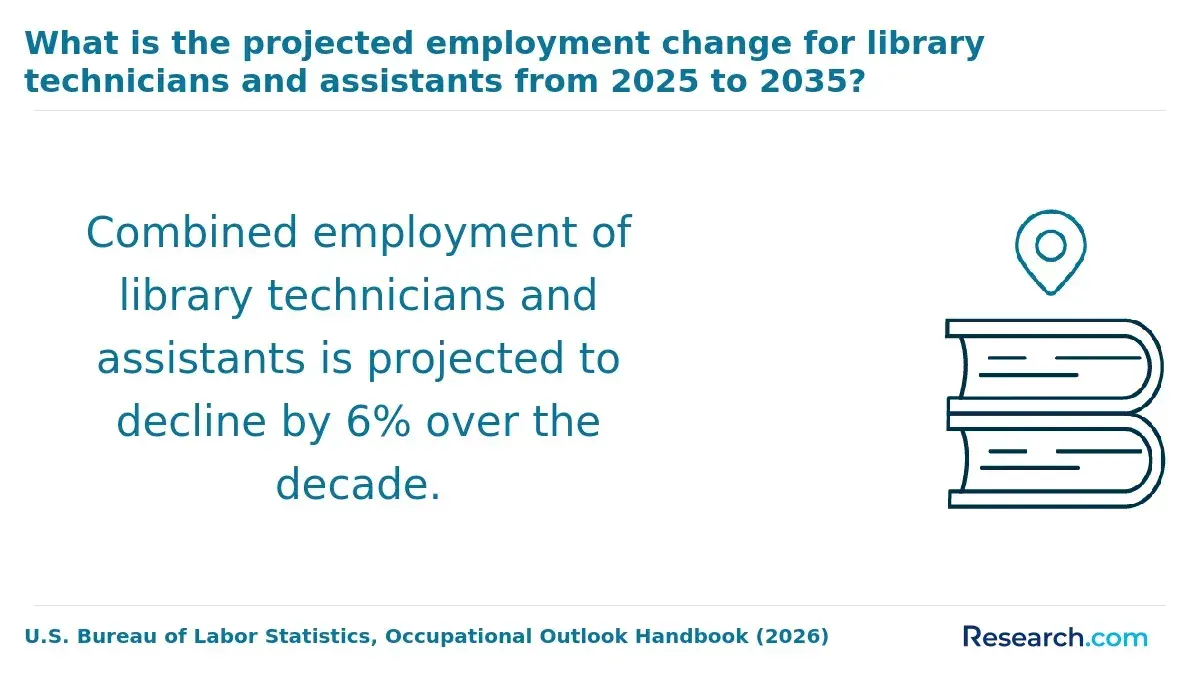
The Bureau of Labor Statistics projects 2.6% U.S. employment growth for librarians and media collections specialists from 2025 to 2035. That modest occupational growth does not describe demand for every specialty or local market.
Openings may require experience with digital collections, research support, accessibility, or information systems that a general MLIS alone does not demonstrate.
Review a sample of recent postings in the setting and region you want. Note which requirements recur, which are merely preferred, and whether entry-level opportunities would let you gain the missing experience.
Treat AI-assisted discovery and description as reasons to understand quality control, privacy, and human review - not as evidence that a particular role will disappear or that a technology elective guarantees employment.
Other Things You Should Know About Library Science
Yes, if you explain the problem, your contribution, and the result in terms relevant to the new role. Obtain permission where needed and remove patron information, internal records, and other confidential material.
Possibly. Ask the program whether it permits placements at an existing workplace and whether the proposed duties must differ from your regular job. Employer approval alone may not satisfy academic requirements.
Yes. Speaking with people who hire or do your target job can reveal which qualifications they use, what entry-level work looks like, and whether another degree would address a real hiring barrier.
There is no universal rule. Keep a record of transferable work - such as instruction, supervision, and access services - and check future postings for skills or recent experience you would need to refresh.
References
- Partnering with Students to Develop a Capstone for a... - PMC https://pmc.ncbi.nlm.nih.gov/articles/PMC11732519/
- General and Program Specific Requirements for Library Media Specialist | nysed.gov https://www.nysed.gov/college-university-evaluation/general-and-program-specific-requirements-library-media-specialist
- 1580 School Library Media Specialist - Delaware Regulations https://regulations.delaware.gov/AdminCode/title14/1580
- MLIS Career Outcomes | College of Information Science https://infosci.arizona.edu/ma-library-information-science/career-outcomes
- Master's Degree (MSLS) in Library & Information Science | University of Kentucky https://online.uky.edu/masters/library-information-science/msls
- The Master of Library and Information Science (MLIS) Program | Southern Connecticut State University https://inside.southernct.edu/information-and-library-science/mlis
- What Can You Do With a Library Science Degree? | Syracuse University Online Master's Programs https://onlinegrad.syracuse.edu/information-science/mslis/library-science-careers/
- Library and Information Science | Universities of Wisconsin Online https://online.wisconsin.edu/degrees-programs/uw-milwaukee-library-and-information-science-ms/
- Admissions - Master of Library and Information Science (MLIS) https://info.umd.edu/academics/masters-programs/master-of-library-and-information-science/admissions/
- Library Science Careers - UW Information School https://ischool.uw.edu/programs/mlis/careers