2027 What Jobs Can You Get With an MLIS in Corporate Research?

Co-Founder and Chief Data Scientist
An MLIS can prepare you to find, evaluate, organize, and deliver information for business decisions, but "corporate research" is not one job with one hiring standard.
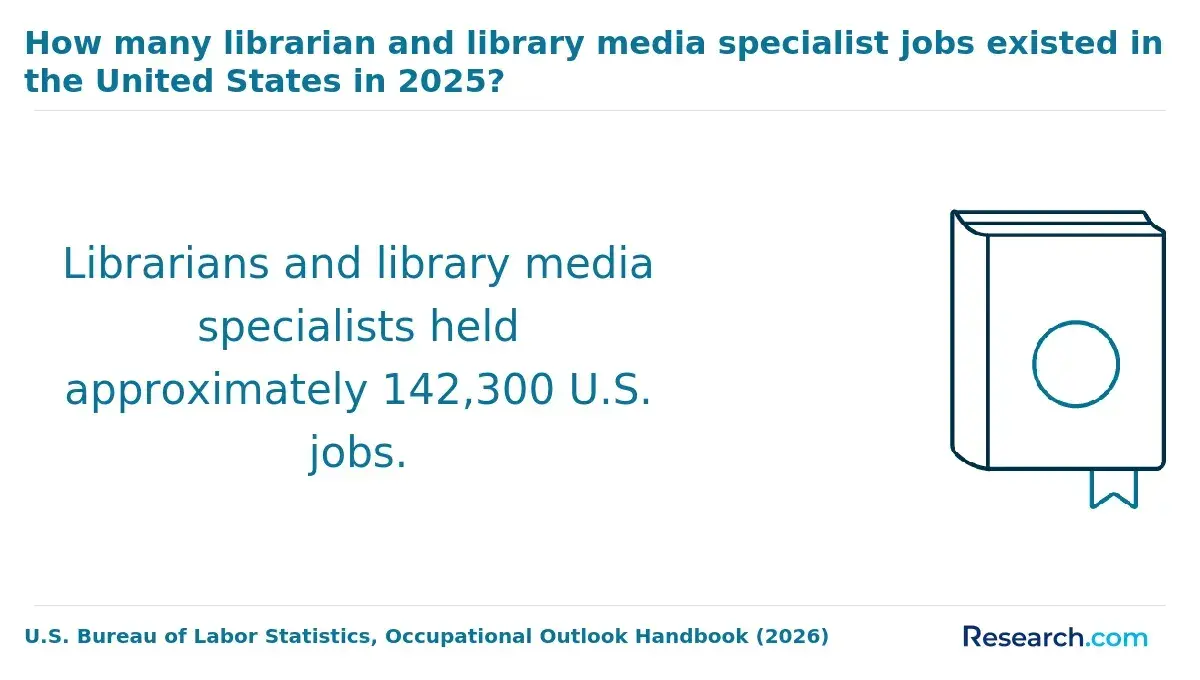
The U.S. Bureau of Labor Statistics (BLS) projects 2.6% growth for librarians and media collections specialists from 2025 to 2035, a useful reference point that does not measure corporate research hiring directly. If you are weighing an MLIS or planning a career move, this guide maps the roles, qualifications, pay evidence, and program features worth checking before you invest.
Key Things You Should Know
- An MLIS can support corporate research, competitive intelligence, knowledge management, and information-services roles, but employers may also accept business, subject-area, or technical backgrounds.
- The BLS reports a May 2025 median annual salary of $68,270 for librarians and media collections specialists; it is not a corporate research salary estimate.
- Choose an MLIS for demonstrable research skills and applied experience, not a concentration name alone; the BLS projects 2.6% growth for the broader librarian occupation from 2025 to 2035.
What corporate research jobs can you get with an MLIS?
MLIS graduates can pursue roles that turn outside sources and internal knowledge into usable answers for colleagues. Titles vary by employer, so search by responsibilities as well as job name. This table distinguishes closely related paths and the qualifications you should check in individual postings:
| Role | Typical focus | Where an MLIS fits |
| Corporate research librarian or information specialist | Answers research requests, manages sources, and teaches colleagues to search effectively | Often directly relevant, particularly when the employer maintains an information service |
| Competitive intelligence analyst | Tracks competitors, markets, and developments using lawful, documented sources | Strong research preparation; analysis and business experience may carry equal weight |
| Knowledge management specialist | Makes internal expertise and documents findable and reusable | Relevant for taxonomy, metadata, search, and information governance work |
| Research or insights analyst | Synthesizes evidence for strategy, product, or client teams | Useful when work emphasizes secondary research; some roles favor quantitative or industry-specific training |
| Research operations or information governance specialist | Maintains research resources, access rules, or information workflows | Relevant alongside records, privacy, systems, or project-management skills |
Potential employers include companies with internal research teams, consulting firms, professional-services organizations, and vendors serving business researchers.
An entry-level analyst posting may offer a better route in than a position requiring years of industry-specific intelligence work. Conversely, an experienced researcher may not need an MLIS to qualify for every analyst role.
What does a corporate research professional with an MLIS do?
The work usually begins by clarifying a business question: what decision is being made, which evidence is acceptable, and when an answer is needed.
A researcher then searches licensed databases and other appropriate sources, checks reliability and usage rights, compares findings, and delivers a brief, source-documented answer rather than a pile of search results.
In an information-services role, that might mean finding company filings for a strategy team, maintaining a searchable collection of past research, negotiating access to research resources, or training staff to use them.
In knowledge management, it might mean developing a taxonomy, a consistent set of categories, so colleagues can retrieve the right documents. Some teams use AI-assisted search or summarization, but researchers still need to verify claims, protect confidential material, and follow employer rules on approved tools.
What qualifications do employers require for MLIS corporate research jobs?
Requirements depend on the position. A corporate librarian posting may specify an MLIS, MLS, or another library and information science master's degree.
A competitive intelligence or insights posting may accept several degrees and place greater weight on business knowledge, analytical writing, database proficiency, or sector experience. Read the required and preferred qualifications separately; neither the job title nor the degree name settles eligibility.
Across these paths, useful evidence includes advanced searching, source evaluation, concise writing, stakeholder interviews, spreadsheet analysis, and careful handling of licensed or confidential information.
If you are changing careers, translate prior work into research outcomes: a documented market scan, a redesigned internal search workflow, or a briefing that explains how evidence informed a decision. Relevant experience can improve your application, but it does not automatically replace a degree when an employer explicitly requires one.
Which MLIS specializations prepare you for corporate research careers?
Information organization, research services, knowledge management, and information governance are all relevant directions. A formal specialization is an officially named program track; a few related electives are not the same thing.
Compare the best library science specializations for career growth against the work you actually want to perform, then confirm each program's current requirements.
For client-facing research, favor a pathway with advanced reference, business information, and evidence synthesis. For knowledge management, look for metadata, taxonomies, enterprise search, and information systems. For governance work, records management, retention, privacy, and policy courses may be more useful.
A general MLIS with well-chosen electives and a substantial project can be a stronger fit than a named concentration without accessible, relevant courses.
What courses should you take for corporate research and information services?
Build a course plan around the tasks in your target job postings, not simply the largest number of business-themed electives. Advanced search and reference courses develop the questioning and retrieval skills central to research requests.
Business information or competitive intelligence coursework, where offered, can add practice with company, industry, and market sources. Information organization, metadata, and taxonomy courses matter when the job includes making internal knowledge findable.
Choose at least one assignment that produces an employer-readable work sample: a sourced industry briefing, a reproducible search strategy, or a small taxonomy with a rationale for its categories. Remove confidential and copyrighted material before sharing it.
When considering the best online path to librarianship, check the current catalog and ask when the relevant electives next run; a course appearing in a catalog may not fit your graduation schedule.
How do online and campus-based MLIS programs compare for corporate research?
Either format can support corporate research if it gives you access to relevant instruction and applied work. The practical difference is how easily you can complete that work alongside your job and reach potential employers. This comparison highlights constraints to verify rather than assuming one format is inherently better:
| Factor | Online program | Campus-based program |
| Scheduling | May reduce travel, but live meetings and fixed deadlines can still apply | Requires attendance at set times; local course options may simplify planning |
| Applied experience | May allow a local or remote placement if the program approves it | May offer access to nearby employers and campus projects |
| Networking | Requires attention to virtual events, alumni contacts, and placement support | Offers in-person access, though relevant employers may not be nearby |
| Costs to check | Tuition, fees, equipment, and any required travel | Tuition, fees, commuting, and possible relocation |
Ask whether core courses and career-relevant electives are asynchronous, whether a practicum is required, and who approves placements.
Online delivery does not guarantee an evening-only schedule or a remote internship. If you plan to keep working, compare working student library degree options using actual term schedules and total costs, not the delivery label alone.
How much do corporate research professionals with an MLIS earn?
There is no single reliable salary figure for all corporate research professionals with an MLIS: the roles span different occupations, industries, and seniority levels.
The BLS reports a May 2025 median annual salary of $68,270 for librarians and media collections specialists. That is an occupational benchmark, not the median for corporate researchers or MLIS graduates; an analyst position may be classified elsewhere.
For a realistic earnings comparison, gather pay ranges from current postings matching your target title, location, and experience level.
Compare those ranges with your current compensation and the full cost of study, including required credits, fees, books, and any placement-related expenses. Best value MLIS programs are worth evaluating by total cost and relevant preparation together; low tuition alone cannot establish a return on investment.
What is the job outlook for MLIS corporate research careers?
The BLS projects 2.6% employment growth for librarians and media collections specialists from 2025 to 2035. That projection provides context for librarian positions but cannot predict demand for competitive intelligence, insights, or knowledge management jobs, which may fall under other occupational categories.
For a more useful local outlook, review current openings across several related titles and note which skills recur. Pay particular attention to industry expertise, research synthesis, internal search, and responsible use of AI-assisted tools where those appear in postings.
A narrow search for "corporate librarian" can miss suitable work; a broad search without checking qualifications can make the market look larger than the number of jobs you could realistically pursue.
Do corporate research jobs require an ALA-accredited MLIS or professional certification?
There is no universal ALA-accredited MLIS or professional certification requirement for corporate research. Some professional librarian employers require or prefer a master's degree from an American Library Association (ALA)-accredited program; other corporate employers accept different degrees and experience.
Check each posting rather than applying a librarian requirement to every analyst or knowledge-management role.
ALA accreditation applies to a specific master's program, not automatically to every degree at an institution. Verify a program's current status in the ALA directory before relying on it, especially if you want to preserve eligibility for jobs that specify an ALA-accredited degree.
An MLIS, MLS, or institution-specific information degree should be assessed by its program accreditation and curriculum, not its initials alone. Optional professional credentials may help in a particular specialty, but they do not substitute for checking an employer's stated requirements.
How can you choose the best MLIS program for corporate research?
Start with several real postings you would want to qualify for. Compare their requirements with each program's documented core, available electives, and opportunities to produce research work samples.
Then ask the program when those electives are expected to run, whether working students can access relevant projects or placements, and what career support exists for corporate rather than only traditional library roles.
Compare the total required credits and published tuition and fees under the rate that applies to you. If you have prior graduate coursework, investigate MLIS programs with transfer credits, then obtain a school-specific assessment; a transfer policy does not mean every course will count toward your degree.
Choose an MLIS when its librarian and information-services preparation opens roles you want. If your target jobs primarily demand financial modeling, advanced statistics, or deep sector expertise, relevant work experience, focused training, or another graduate degree may be a better investment.
Other Things You Should Know About Library Science
Work arrangements vary by employer and team. Some research can be done remotely, while access rules, collaboration needs, or confidential materials may require office time. Check the specific posting and ask how the team handles research requests and secure access.
Only if your employer's policies and approved tools permit it. Do not put confidential documents, client information, or licensed database content into an unapproved service. Verify AI-generated findings against sources you can inspect.
Typically, employers decide which research resources their teams can access. Before accepting a role, ask what databases, budgets, and support are available; resource access can shape what you can deliver.
Search strategy, source evaluation, and clear reporting can transfer, but industry vocabulary and evidence sources may not. Keep examples that show both your transferable process and how you learned a new subject area.
References
- Competitive Intelligence - SJSU - School of Information https://ischool.sjsu.edu/post/competitive-intelligence
- MLIS Career Outcomes | College of Information Science https://infosci.arizona.edu/ma-library-information-science/career-outcomes
- Types of Libraries: 6 Categories and Their Roles | Syracuse University https://ischool.syracuse.edu/types-of-libraries/
- Competitive Intelligence Analysts | Independent Management Consultants https://umbrex.com/resources/guide-to-corporate-titles/what-is-a-competitive-intelligence-analyst/
- What Are Employers Looking for When Reviewing College Students' Resumes? | naceweb.org https://www.naceweb.org/talent-acquisition/candidate-selection/what-are-employers-looking-for-when-reviewing-college-students-resumes
- Core Knowledge and Specialized Skills in Academic Libraries | acrl.org https://crl.acrl.org/index.php/crl/article/view/24336/32167
- Non-traditional jobs for librarians | American Library Association https://www.ala.org/educationcareers/careers/paths/jobtypes/privatesector
- MLIS Careers Beyond the Library: Salaries & Paths | mastersinlibraryscience.org https://www.mastersinlibraryscience.org/articles/lis-careers-beyond-libraries/