2027 MLIS Programs for Academic Library Research Impact Support

Co-Founder and Chief Data Scientist
Choosing an MLIS for research impact support means looking beyond a program's general academic librarianship label. Faculty and institutions need help interpreting citations, managing researcher profiles, and communicating the reach of their work without overstating what metrics prove. The U.S. Bureau of Labor Statistics reports a $68,270 median annual salary for librarians and media collections specialists in May 2025, but that figure is not specific to impact-support jobs.
This guide helps prospective students identify relevant coursework, test whether applied opportunities are available, compare costs, and decide whether an MLIS fits their intended role.
Key Things You Should Know
- Look for an ALA-accredited master's program with documented coursework and projects in scholarly communication, bibliometrics, research data, or repository services; a relevant elective is not necessarily a formal concentration.
- Research impact support combines metric interpretation with researcher consultation, data quality, and responsible assessment; a portfolio demonstrating those skills may be more useful than a program label alone.
- BLS projects 2.6% employment growth for librarians and media collections specialists from 2025 to 2035. Compare local job requirements and total degree costs before treating that broad outlook as a forecast for this specialty.
What are MLIS programs for academic library research impact support?
These are library and information science master's programs that can prepare students to help researchers and universities describe, understand, and communicate the reach of scholarly work. "Research impact support" usually describes a career function, not the name of a degree or a guaranteed concentration. Depending on the institution, preparation may come from electives, an academic-library pathway, an internship, or a self-directed project.
In practice, an impact-support librarian might explain citation reports to a faculty member, help correct an author profile, advise on persistent identifiers, or show a department why database coverage affects its results. The work can overlap with scholarly communication, institutional repositories, research data management, and outreach. Good support also means explaining what a metric cannot establish: citation counts, for example, do not independently measure research quality.
When evaluating a program, ask for evidence at the right level. An officially named track establishes a formal specialization; a catalog course establishes relevant coursework; a documented placement or capstone establishes an applied opportunity. None, by itself, confirms that a particular elective will run when you need it or that a placement is guaranteed.
Why is ALA accreditation important for academic library careers?
American Library Association (ALA) accreditation is a useful first screen because many professional academic-library positions specify an ALA-accredited master's degree or an accepted equivalent. The accreditation applies to an eligible master's program, not automatically to every degree offered by its university. Check the current ALA directory for the specific program and degree before applying.
Accreditation does not certify a research-impact concentration, confirm that a course is offered regularly, or make a graduate eligible for every library position. Compare it with job postings for the roles you want, then examine the program's actual curriculum. If you are considering online librarian degrees in Southern states, make the same program-level accreditation check before comparing location or price.
What degree pathways prepare students for academic library research support?
An MLIS, MLS, Master of Science in Library Science, or Master of Information may be relevant; degree titles and curricula differ by institution. For a professional academic-librarian goal, prioritize the program's accreditation and evidence of research-support preparation over its initials. Pair broad LIS foundations - reference, information organization, and information ethics - with targeted study in scholarly communication and assessment.
A different route may fit a different job. Someone focused on institutional analytics or research administration might find a data, policy, or higher-education degree more directly applicable, while an experienced librarian may need only targeted continuing education. A short library science program that pays well can be worth exploring for a narrower training goal, but check whether the credential satisfies the master's-degree requirements in your target job postings.
For the strongest MLIS pathway, plan an applied project with a clear deliverable: a researcher-profile cleanup workflow, a guide to interpreting field-normalized metrics, or an anonymized impact consultation. Confirm that a faculty supervisor and appropriate data access are available before building your enrollment decision around that idea.
How do online and campus-based MLIS programs compare?
Delivery format affects access to courses and practical experience, not just where lectures happen. The comparison below highlights questions that matter when a student needs both specialist instruction and a credible portfolio.
| Factor | Online study | Campus-based study |
| Course scheduling | May reduce travel, but live sessions, group work, and fixed deadlines can still apply. | May offer predictable in-person contact, but commuting and set meeting times can constrain work schedules. |
| Applied experience | May allow a local placement or remote project if the program and host approve. | May make campus-library contacts easier to develop; placements still depend on availability. |
| Specialized electives | Access depends on the program's rotation and enrollment rules, not the online label. | Access likewise depends on scheduling, prerequisites, and capacity. |
Ask whether research-impact electives are offered in your delivery format, whether any campus visits are required, and how remote practica are approved. Do not assume asynchronous study means unrestricted pacing. Students comparing assessment based MLIS programs should also verify how progress is measured and whether the format permits the electives and applied work they need.
What courses do MLIS programs offer for research impact support?
No single course title establishes readiness. The most useful curriculum combines an understanding of scholarly publishing with the ability to interpret imperfect data and communicate findings responsibly. Catalog descriptions can help you distinguish a course that teaches these tasks from one that merely mentions research metrics.
| Curricular area | Relevant preparation | Evidence to look for |
| Scholarly communication | Publishing models, open access, author rights, and research dissemination. | Assignments advising researchers on publishing or sharing decisions. |
| Bibliometrics and assessment | Citation sources, metric limitations, and comparisons across fields. | Projects that explain methods, database coverage, and uncertainty. |
| Research data and repositories | Data stewardship, descriptive metadata, and access workflows. | Work with a repository record, dataset description, or deposit process. |
| Reference and instruction | Consultations, teaching, and communication with researchers. | Practice translating technical findings for a non-specialist audience. |
Useful adjacent skills include working with ORCID researcher identifiers, digital object identifiers, spreadsheets, and data visualization. AI-assisted discovery may appear in this work, but students should learn to verify outputs, respect privacy, and disclose methodological limits rather than treat automated summaries as evidence. Ask advisers which courses are required, which are electives, when electives are expected to run, and whether a relevant independent study is possible.
What are the admission requirements for MLIS programs?
Applicants generally need an undergraduate degree and must meet the institution's graduate admission rules. Programs may request transcripts, a statement of purpose, recommendations, and a résumé; testing, prerequisite, and minimum-grade policies vary. Read the requirements for the exact degree and entry term rather than assuming one MLIS application represents every school.
A research background can strengthen an application, but it is not a universal prerequisite. In a statement of purpose, connect your experience - such as reference work, faculty support, data cleaning, or publishing - to the consultations you hope to perform. If your record is unusual or you want to transfer prior graduate credit, request a written, individual review; neither professional experience nor undergraduate credits automatically replace graduate admission or degree requirements.
How long do MLIS programs take and how much do they cost?
Completion time depends on required credits, course load, elective rotation, and any practicum or capstone. A part-time student may need extra terms if a key elective is offered infrequently. Ask the program to map your intended research-impact courses into a realistic term-by-term plan before relying on its advertised completion time.
Without a school-specific tuition schedule, there is no reliable single price for this pathway. Calculate a comparable estimate by multiplying the applicable tuition per credit by required credits, then adding mandatory fees, materials, and any travel or placement expenses. Confirm residency rules for online tuition. Separate that gross cost from what you expect to pay personally after confirmed support and from any amount you plan to borrow.
A value focused online MLIS comparison can help establish a shortlist, but the least expensive published tuition may not be the lowest-cost route to the courses you need. Ask about scholarships, assistantships, employer support, and applicable federal aid directly; eligibility and award amounts are individual, not guaranteed.
What careers can academic library research support graduates pursue?
Relevant titles include scholarly communication librarian, research impact librarian, bibliometrics librarian, research services librarian, and research data librarian. Duties vary: one position may emphasize faculty consultations and citation analysis, while another centers on open-access services, repository operations, or data management. Read the responsibilities, not just the title.
Professional librarian openings often seek an MLIS or equivalent, alongside evidence of teaching, consultation, and collaboration. A first role might be broader - such as academic reference or scholarly communication support - before specializing. Build a portfolio that demonstrates a responsible analysis, explains its data limitations, and shows how you would present it to a researcher. Library technician jobs can provide experience but are distinct from professional librarian roles.
Research offices, publishers, and analytics teams offer adjacent work, sometimes accepting other graduate degrees or substantial domain experience. Examine competitive library science careers in light of actual posting requirements; an MLIS alone does not substitute for specialized experience.
What salaries and job outlook apply to academic librarians?
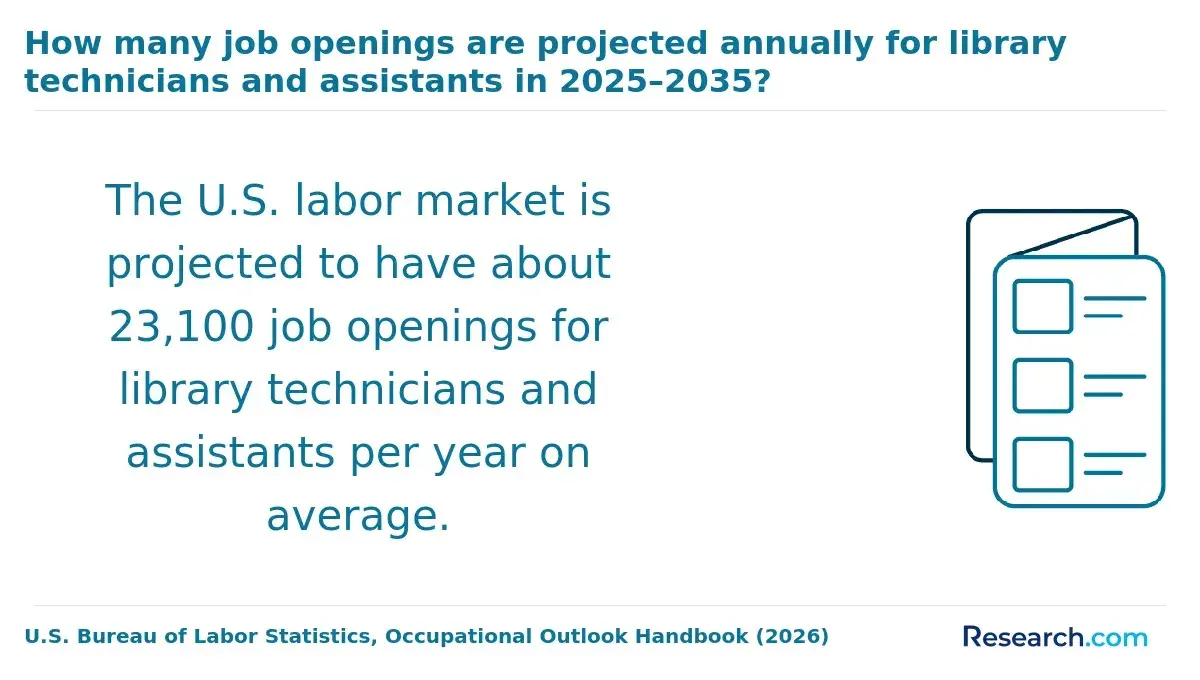
The U.S. Bureau of Labor Statistics reports a May 2025 median annual salary of $68,270 for librarians and media collections specialists and projects 2.6% employment growth for that occupation from 2025 to 2035. These are national figures for a broad occupational group - not salaries or projected openings specifically for academic-library research impact specialists.
Use the figures as context, then compare current openings in your intended region by salary range, contract length, degree requirements, and duties. A position combining assessment, scholarly communication, and data work may be classified or paid differently across institutions. For a personal return-on-investment decision, compare realistic local opportunities with your existing earnings, total education cost, and likely borrowing rather than assuming the national median will be your starting pay.
Which certifications and professional standards support academic librarianship?
There is no universal certification specifically required to provide academic-library research impact support. For many professional librarian openings, the central education credential is a relevant master's degree, often from an ALA-accredited program or an accepted equivalent. Additional certificates can document targeted learning, but their value depends on the employer and the work.
Professional guidance matters more than accumulating badges. Principles associated with the San Francisco Declaration on Research Assessment (DORA) encourage careful, contextual use of research indicators rather than treating a journal-level metric as a proxy for an individual article's quality. Familiarity with identifiers such as ORCID and with the metadata practices behind repository records also helps prevent misleading reports. Ask prospective employers which assessment methods and tools they use; choose continuing education to close a demonstrated skill gap.
Other Things You Should Know About Library Science
Citations record references from other scholarly works as indexed by a particular source. Altmetrics describe other forms of online attention, which may include news or social-media mentions. Neither measure, on its own, establishes research quality, and coverage varies by source.
Check author identifiers, affiliations, publication dates, and the original records before combining results. Document unresolved ambiguity rather than attributing a similarly named author's work to the researcher.
Not automatically. Confirm the purpose, the researcher's consent where appropriate, institutional privacy policies, and any database-use restrictions before distributing a report. An internal consultation does not imply permission for public release.
They can, if the report's purpose calls for them and the source covers them. Label preprints clearly, explain the source and date of the data, and check for a later published version to avoid double-counting the same work.
References
- Data Competencies | NNLM https://www.nnlm.gov/resources/data/data-competencies
- Using Publication Metrics to Highlight Academic Productivity and Research Impact - PMC https://pmc.ncbi.nlm.nih.gov/articles/PMC4987709/
- Library and Information Science, M.L.I.S. | UNC Greensboro https://www.uncg.edu/academics-support/degrees-programs/online-degrees/library-and-information-science-m-l-i-s/
- Program: Library and Information Science, MLIS - Pitt Catalog https://catalog.upp.pitt.edu/preview_program.php
- Master of Library and Information Science (MLIS) | du.edu https://morgridge.du.edu/academics-advising/programs-gr/mlis-library-and-information-science
- Research Impact Challenge: Impact Metrics - Research Guides https://libguides.uthsc.edu/impactchallenge/metrics
- Unlocking Scholarly Publishing: New federal public access requirements and what CU Boulder researchers need to know https://libraries.colorado.edu/2026/03/23/unlocking-scholarly-publishing-new-federal-public-access-requirements-and-what-cu
- Library and Information Science, MLIS (Online) | Southern Connecticut State University https://www.southernct.edu/academics/programs/library-and-information-science-mlis
- Master of Library and Information Science (MLIS) | umd.edu https://info.umd.edu/academics/masters-programs/master-of-library-and-information-science/
- Scholarly Research Impact Metrics: Altmetrics - Subject Guides https://subjectguides.library.american.edu/c.php