2027 MLIS Programs With Community Library Practicum Support

Co-Founder and Chief Data Scientist
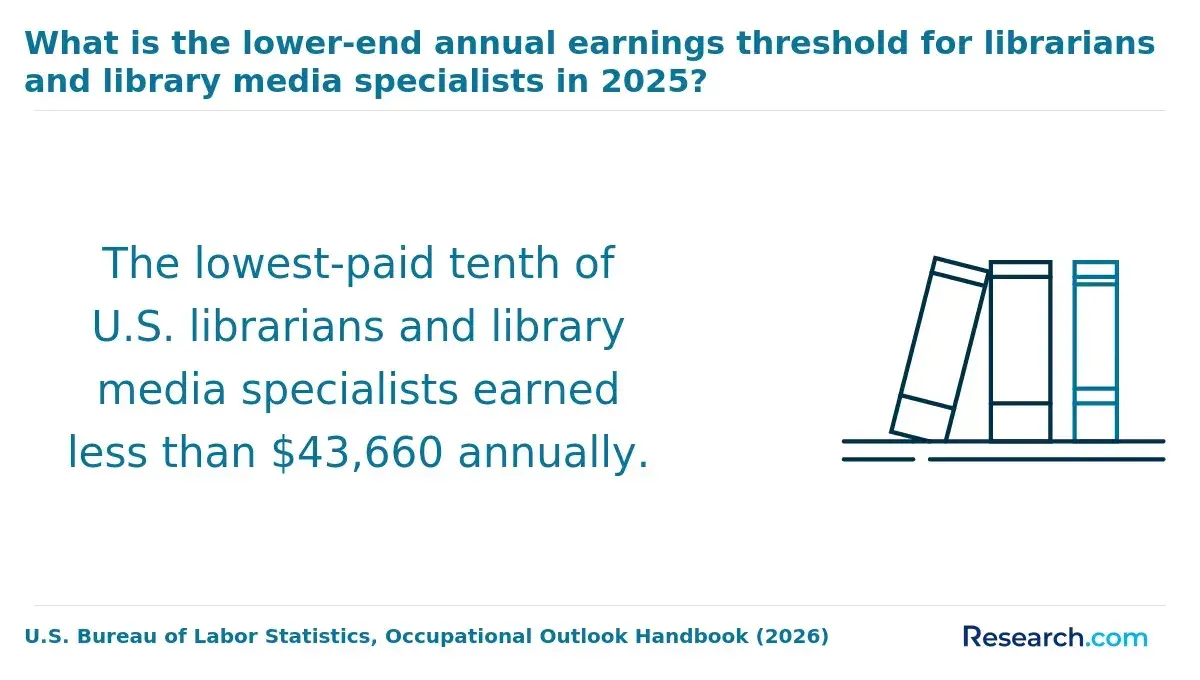
A community library practicum can turn an MLIS into supervised experience with patrons, collections, and local outreach - but not every program will approve the site you have in mind. The U.S. Bureau of Labor Statistics reports a May 2025 median annual salary of $68,270 for librarians and media collections specialists, making program cost and career preparation worth weighing together.
This guide is for prospective students comparing placements, especially those studying online or hoping to train near home. It explains what to verify before enrolling and how to judge whether a program's practical support fits your goals.
Key Things You Should Know
- Look for documented placement approval, a qualified site supervisor, and a way to earn academic credit; a public-library elective alone does not establish practicum support.
- For online students, confirm who finds the site and whether required hours can fit around work; online classes do not necessarily mean a remote practicum.
- The May 2025 median pay of $68,270 covers a broad librarian occupation, not graduates of a particular MLIS program or community library placements.
What Are MLIS Programs With Community Library Practicum Support?
These are library and information science master's programs that allow students to complete supervised, degree-related work in a community-serving library. A public library or branch is the clearest example; a nonprofit or volunteer-run library may be possible if the university approves its services and supervision. The placement might be called a practicum, internship, fieldwork, or independent study, and it may be required or elective.
Support means more than permission to seek experience. A useful arrangement identifies who approves the site, who supervises the work, what learning objectives apply, and how the student's work is assessed. Projects might involve reference interviews, accessible programming, collection development, or outreach. A placement should let students practice professional judgment, not merely complete routine shelving tasks.
Degree names vary: an MLIS, MLS, Master of Science in Library Science, or Master of Information may provide relevant preparation. The name alone does not establish the degree's accreditation or whether community library fieldwork is available. An overview of library science degree programs can help you compare degree types before checking each program's specific policies.
Which MLIS Programs Offer Community Library Practicums?
No named program should be treated as a confirmed community library practicum option without checking its current catalog and fieldwork policies. A listing for "internship" may cover many settings without confirming that a public library near you qualifies. Likewise, a placement described on a program page may depend on available supervisors or approval in a particular term.
The distinctions below help compare programs on evidence that matters for this decision. Use them to separate a documented opportunity from a promising but unconfirmed one.
| Evidence to find | What it establishes | What remains to verify |
| Public library concentration or pathway | Named curricular focus, if officially documented | Whether it includes fieldwork and when electives run |
| Fieldwork course in the current catalog | A possible route to supervised academic credit | Eligibility, credit requirements, and permitted sites |
| Published placement guidance | How approval and supervision are handled | Whether the university helps secure a local opening |
| Public library course or project | Relevant academic preparation | Whether any in-library experience is available |
Start with the current ALA directory to check accreditation for the specific master's program, then review the university's current catalog and fieldwork handbook. Ask the fieldwork coordinator whether students have completed approved placements in public libraries, whether you may propose your own site, and what happens if that site cannot take a student. ALA accreditation and practicum availability are separate findings.
Why Choose an ALA-Accredited MLIS Program With Practicum Experience?
ALA accreditation is a meaningful credential check because many professional librarian employers specify or prefer a master's degree from an ALA-accredited program. It applies to a particular graduate program - not automatically to every degree at an institution. Confirm the program's current status in the ALA directory rather than relying only on institutional accreditation or an older advertisement.
A well-matched practicum adds a different benefit: supervised evidence of what you can do. For community library work, that could mean designing a program around local needs, helping patrons navigate information and technology, or evaluating whether a service reaches its intended audience. Ask whether you can retain a de-identified project plan or assessment for a portfolio; patron privacy and the host library's policies come first.
Neither accreditation nor a practicum guarantees a job. If professional librarian positions are your goal, the combination may be worth prioritizing. If you want to test the field before committing to graduate tuition, paid library assistant work or volunteering may offer a lower-cost first step, though neither is a substitute for an MLIS where an employer requires one.
How Do Online MLIS Programs Arrange Community Library Practicums?
An online program may let a student propose a nearby host library, provide placement assistance, or use an existing workplace if the work meets academic requirements. Those are different levels of support. Confirm the arrangement with the coordinator before assuming that a convenient library - or your current job - will qualify.
For a proposed local placement, ask who contacts the host, what credentials the supervisor must hold, how agreements and evaluations are completed, and whether work must occur during the library's public hours. Also check whether orientation, seminars, or other course components have fixed meeting times. Online coursework does not make patron-facing fieldwork remote or automatically compatible with a full-time schedule.
Students considering an accelerated online librarian program should check the fieldwork calendar especially carefully. A short degree timeline is useful only if the required courses, placement approval, and host library's availability can fit within it.
What Coursework Do Community-Focused MLIS Programs Include?
Relevant preparation usually combines broad LIS foundations with public-service choices. Look for courses in reference and information services, collection development, information organization, community engagement, and management. Youth services, accessibility, and digital inclusion may be especially useful depending on the patrons and position you hope to serve.
Compare required courses with electives rather than assuming every listed subject will appear in your schedule. Ask how often a desired elective has run recently and whether its prerequisites fit before the practicum. For instance, a student planning an outreach placement may benefit from studying program planning or community assessment first; a catalog listing alone does not confirm that sequence will be possible.
Digital services also matter in community settings. Practice with discovery tools, privacy-conscious patron assistance, and accessible online resources can complement in-person service. Choose projects based on the host library's needs rather than assuming a particular technology belongs in every placement.
What Are the Admission Requirements for MLIS Programs?
Applicants generally need a bachelor's degree and must submit the materials specified by each graduate program, which may include transcripts, a statement of purpose, recommendations, and a résumé. Minimum grades, tests, deadlines, and any experience expectations vary. Prior library work can strengthen an application, but it should not be assumed to replace a published degree requirement.
Use the statement of purpose to explain why community library service interests you and how you hope to use supervised experience. Applicants changing careers can connect previous work - such as teaching, customer service, language access, or community organizing - to library responsibilities without claiming it is equivalent to professional librarian experience.
Before accepting an offer, ask admissions and fieldwork staff separate questions: whether you qualify to enroll and when you become eligible for a placement. If affordability affects your decision, compare documented aid terms as well as admission offers; a scholarship friendly online MLIS is useful only if its funding conditions and practicum arrangements fit your circumstances.
How Long Do MLIS Programs With Practicums Take and Cost?
Completion time depends on the program's required credits, your course load, course sequencing, and the term in which fieldwork can begin. Compare the published degree plan with a realistic schedule for part-time or full-time study. Placement approval can take time even when the fieldwork course itself fits into one term.
For a meaningful cost comparison, multiply the tuition rate that applies to you by required credits, then add mandatory fees, materials, and any travel or reduced work hours associated with the placement. Check whether the fieldwork carries tuition-bearing credits and whether an extra term would add fees. Published tuition is not the same as total cost, and an online student should not assume an in-state rate applies.
Employer assistance and scholarships can reduce personal out-of-pocket costs but may have eligibility or service conditions. Borrowing changes when you pay, not the program's gross price; confirm current aid eligibility and loan terms with the financial aid office before estimating what you would finance. A budget accelerated library information science comparison is a starting point, not a substitute for a program-specific cost and fieldwork schedule.
What Library Careers Can Practicum-Supported MLIS Graduates Pursue?
A community library placement most directly supports applications for public service, reference, outreach, youth services, and branch librarian roles. Titles vary by employer. These jobs can combine patron assistance, program design, collection decisions, technology help, and partnerships with local organizations; the strongest practicum is one that provides evidence relevant to the duties you want.
Graduates may also pursue academic, special, or government library work, but a public library placement will not automatically supply those settings' specialized experience. Library assistant and technician roles can be entry points and may not require an MLIS. For adjacent information-management jobs, employers may value other degrees or technical experience instead.
Compare actual job postings in your intended area before choosing electives or a placement. If compensation is a major factor, an overview of highest paying library science jobs can suggest roles to investigate, but pay in another specialty should not be treated as an expected return from a community library practicum.
What Salaries and Job Outlook Can Librarians Expect?
According to the U.S. Bureau of Labor Statistics, librarians and media collections specialists had a median annual salary of $68,270 in May 2025. That is an occupation-wide midpoint, not a starting salary, a public-library-only figure, or an outcome for graduates of any program. Local employer budgets, responsibilities, and experience matter when evaluating an offer.
BLS projects 2.6% employment growth from 2025 to 2035 for the same occupation. This indicates modest projected growth, not a guarantee of openings in a particular community. Check local postings for degree requirements, schedules, and pay ranges before deciding how much to spend on graduate study.
Do Librarians Need State Licenses or Professional Certifications?
Requirements depend on the job and jurisdiction. A public library employer may specify an ALA-accredited master's degree or a state credential for certain positions; applicants should check the posting and the relevant state authority rather than assume one nationwide rule. Professional certifications may be useful in some settings without being universally mandatory.
School librarian preparation is a separate decision. State educator licensure, certification, or endorsement rules can involve coursework and supervised experience beyond an MLIS. A community public library practicum should not be assumed to satisfy school placement requirements, and an online degree should not be assumed to qualify in every state. Check the state education authority before selecting a program for school librarianship.
Other Things You Should Know About Library Science
Often, but obtain the host library's permission first. Remove patron information and any confidential planning or assessment details; describe your contribution if the work was collaborative.
Do not assume travel is reimbursed. Ask the program and host library about transportation, parking, and any required on-site expenses before accepting a placement.
Contact the university's accessibility office early to discuss accommodations and how they would work at a host site. Placement duties should be reviewed individually rather than assuming a particular setting is inaccessible.
A placement can build contacts and references, but it is not a job offer. Ask about feedback and future openings while continuing to apply through the employer's normal hiring process.
References
- MLIS Graduate Students - Volunteering - Library Research https://research.fairfaxcounty.gov/c.php
- College Internships & Library Practicum | nashville.gov https://library.nashville.gov/ar/support/internships
- Library Jobs FAQ - State Library of North Carolina https://library.nc.gov/nc-libraries/current-library-jobs/library-jobs-faq
- Library Science | Degree Explorer | ECU https://degrees.ecu.edu/degree/library-science-mls/
- Practicum Guidelines - Current students | Wayne State University https://sis.wayne.edu/students/classes/practicum-guidelines
- Practicum - School of Information Science & Learning Technologies https://cehd.missouri.edu/information-science-learning-technologies/practicum/
- Master of Library and Information Science (MLIS) | umd.edu https://info.umd.edu/academics/masters-programs/master-of-library-and-information-science/
- Employment-Based Practicum Placements | charlotte.edu https://socialwork.charlotte.edu/practicum-education/employment-based-practicum-placements/
- Practicum FAQ - Department of Social Work https://cehsp.d.umn.edu/departments-centers/departments/social-work/practicum/practicum-faq
- Practicum FAQs | ua.edu https://socialwork.ua.edu/academics/oepcp/practicum-faqs/