2027 Is a Accounting Focus Worth Adding to a BS in Business Administration If You Already Work as a bookkeeper?
Audited and Verified:
Our Editorial and Data Verification Process
Research.com uses government datasets, official education statistics and primary institutional information to support its career and degree guides. Our review process checks factual accuracy, occupational definitions, source dates and the requirements associated with the credentials discussed.
How This Article Was Fact-Checked
Our editorial team verifies salary estimates, employment projections, education requirements and program information against original data providers and official organizations. Salary figures are checked against the relevant occupational definitions and reporting periods. Information about licensure, accreditation and required in-person training is reviewed separately.
Fact-checked and verified on:

Co-Founder and Chief Data Scientist
Bookkeeping experience gives you a head start in an accounting classroom, but it does not make every accounting course equally valuable. If you are finishing a BS in Business Administration, the decision is whether an accounting focus will help you take on work beyond recording transactions - or add time and cost without changing your options.
This guide compares the focus with a standalone accounting degree, explains the career and CPA limits, and shows what to verify in a program before committing.
Key Things You Should Know
- An accounting focus is most useful when it adds financial reporting, analysis, and controls skills beyond your current bookkeeping duties without delaying graduation substantially.
- Choose a standalone accounting degree - or map required accounting courses carefully - if becoming a CPA is a serious goal; a business concentration alone does not establish licensure eligibility.
- The U.S. Bureau of Labor Statistics reports a $83,680 median annual wage for accountants and auditors in May 2025, but that occupation-wide figure is not a starting salary or a guaranteed outcome for bookkeepers who earn a degree.
Is an accounting focus worth adding to a business administration degree for bookkeepers?
Usually, yes - if the focus fills a specific skill gap and fits your graduation plan. A BS in Business Administration teaches across business functions; an accounting focus is a defined set of additional accounting courses within that degree, if the school formally offers one. Your bookkeeping work may already demonstrate transaction recording, reconciliations, payroll support, or routine reporting. The incremental value lies in learning to interpret statements, investigate variances, understand controls, and explain financial information to decision-makers.
Compare the focus against the job you want next. If your employer needs someone to support month-end close, budgets, or reporting, relevant courses plus documented work responsibilities may strengthen your case. If you mainly need better command of one software system or payroll procedure, targeted training may be faster and cheaper. If you want audit, tax, or CPA-track work, the focus may be too shallow.
Ask an adviser for a degree audit showing whether the focus uses electives you already need or adds courses, prerequisites, and terms. That distinction matters more than the label. Comparisons of business administration degrees compared by cost duration and outlook can help you frame the trade-off, but your remaining requirements determine your actual investment.
What career opportunities can bookkeepers pursue with an accounting-focused business degree?
The most direct move is toward broader accounting support: helping prepare financial statements, analyzing account differences, supporting budgets, or coordinating a close process. Titles such as accounting specialist, staff accountant, payroll analyst, and financial operations coordinator vary widely by employer. Review postings for the duties and degree requirements, not just the title; some staff accountant jobs expect substantial accounting coursework or experience.
Your current role can provide evidence that a classroom assignment cannot. Document, without disclosing confidential records, which reconciliations you own, whether you resolve exceptions, and how you communicate findings. Seek supervised exposure to reporting or controls work before applying for a more specialized position. A degree can support that transition, but it does not automatically qualify you to manage an accounting team.
If your actual goal is coordinating systems implementations or cross-department projects rather than accounting work, compare that route separately. Compare affordable project management schools only after checking whether your target jobs call for project experience, accounting knowledge, or both.
How does an accounting focus compare with a standalone accounting degree?
The difference is accounting depth versus breadth across business functions. Neither degree title guarantees a particular course sequence, so compare current catalogs and the courses that will apply to your degree. This table shows the practical distinction for someone already employed as a bookkeeper.
| Path | Likely emphasis | Best fit for a working bookkeeper | Main limitation |
| BS in Business Administration with accounting focus | Business core plus selected accounting courses | Broader financial or operations responsibility | May omit advanced accounting courses needed for some jobs or CPA pathways |
| Standalone accounting bachelor's degree | Longer accounting course sequence alongside general and business requirements | Accounting-specialist, audit, tax, or potential CPA-track goals | May require more prerequisite courses or a longer completion path |
| Targeted courses or training | A specific gap, such as payroll, spreadsheets, or an accounting system | Improving current performance without needing another degree | Does not substitute for a required bachelor's degree or licensing coursework |
If your strongest interest is inventory flow, purchasing, or logistics rather than financial reporting, neither accounting option may be the best specialization. Compare the actual roles and curriculum before considering shorter online supply chain degree pathways. A different degree is worthwhile only if it better matches the work you intend to pursue.
Expect a business core and a smaller accounting sequence, but verify the school's official requirements. Financial and managerial accounting often establish the foundation. A focus may then offer intermediate accounting, cost accounting, taxation, auditing, accounting information systems, or financial statement analysis. Course names alone are not enough: read descriptions and prerequisites to see whether you will practice skills beyond your current bookkeeping tasks.
For a bookkeeper, intermediate accounting can deepen financial reporting knowledge, while cost accounting can connect transactions to pricing and operational decisions. Accounting information systems may be especially useful if you help maintain workflows or investigate errors. Ask whether these courses are guaranteed to run in the format and terms you need, and whether a required capstone can address an accounting problem without using confidential employer data.
If inventory accounting is the part of your job you most enjoy, distinguish accounting for inventory from managing suppliers and distribution. An online supply chain bachelor's fast-track guide may be more relevant to the latter goal, but accelerated scheduling will not replace the experience a logistics role requires.
Possibly, but the concentration itself does not qualify you. CPA rules are set by the state board where you seek licensure. Boards specify education, examination, and experience requirements; the required accounting subjects and available pathways can differ. A business administration degree may include some applicable courses yet leave gaps in advanced accounting, audit, or other required study.
If CPA licensure is a realistic goal, identify the intended state board before choosing electives. Request a course-by-course review of your transcripts and planned courses against that board's requirements, and ask the school which office can document course content. Confirm the rules directly with the board before paying for additional classes. Keep admission to a degree program, permission to sit for an exam, and full licensure separate in your planning.
Speed is a poor substitute for this review. US rankings for accelerated business bachelor's degrees may help you find programs to investigate, but a short completion timeline says nothing by itself about CPA coursework eligibility.
Choose the format that lets you complete required accounting courses consistently while maintaining your job. Online study may remove a commute and allow you to apply concepts at work. Campus study may offer a more predictable class meeting and easier in-person access to faculty or local employers. Neither format is inherently more rigorous or more flexible.
For an online program, ask specifically about live sessions, fixed deadlines, proctored exams, group projects, software access, and whether upper-level accounting courses are offered every term. For campus study, check travel time and whether required classes meet outside your working hours. Compare actual schedules - not just advertised delivery labels - when reviewing business administration programs supporting continued employment.
Completion time depends on credits that apply to the degree, your course load, and the accounting course sequence. Prior college credit may satisfy general education or introductory business requirements without satisfying the focus. Likewise, years of bookkeeping experience do not automatically award academic credit.
Request a written degree audit that identifies remaining general education, business core, accounting focus, elective, and residency requirements. Then map prerequisites and course availability against a schedule you can sustain alongside work. Online degrees with accelerated terms may offer an earlier finish, but shorter terms can mean denser weekly assignments; confirm the real workload before assuming they save time.
There is no reliable single price for this decision. Your total depends on the school's tuition and fees, the courses remaining after an official credit evaluation, books and software, and any extra terms required by the focus. Compare the cost of finishing the BS without the focus against the cost with it. If the same electives satisfy both plans, the incremental tuition may be limited; if prerequisites or additional terms are needed, it may be substantial.
Ask the financial-aid office about grants and loans for which you may qualify, and ask your employer whether tuition assistance covers the program, when reimbursement occurs, and whether a grade or continued-employment condition applies. A lower advertised tuition rate is not necessarily a lower out-of-pocket cost or a manageable payment schedule.
If you are weighing a switch into project work instead of accounting, undergraduate project management grants and scholarship planning addresses that separate path. Do not assume funding identified for another degree applies to your business administration program.
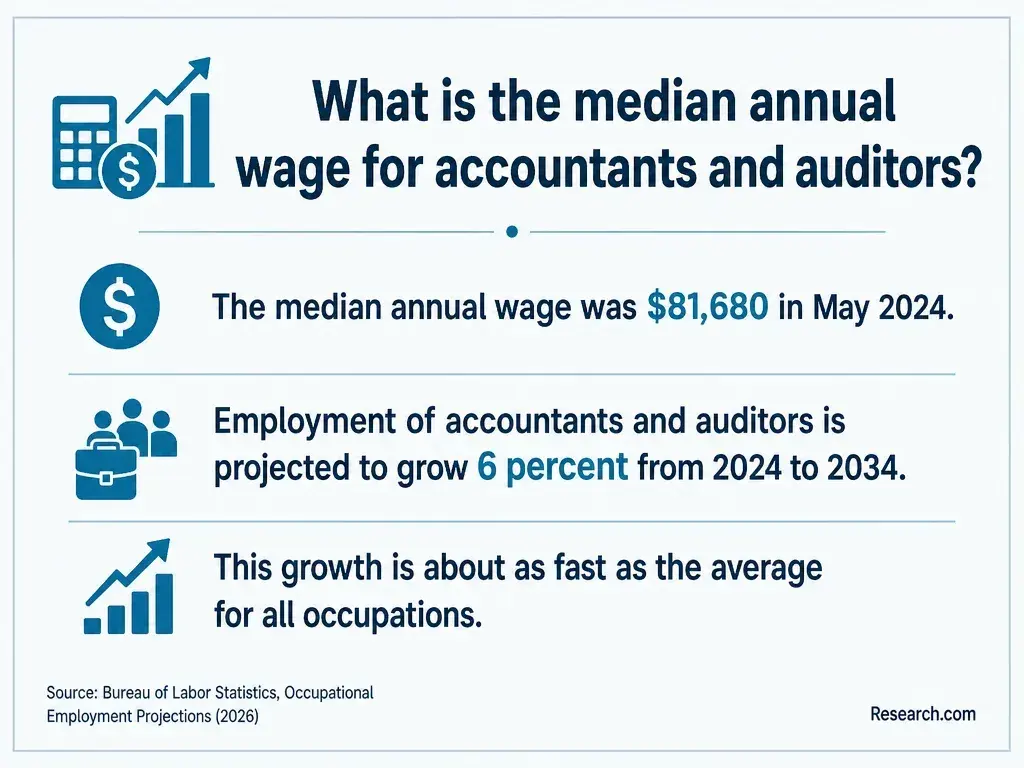
The relevant benchmark depends on the job you obtain, not the name of your degree. For U.S. accountants and auditors, the Bureau of Labor Statistics reports a $83,680 median annual wage in May 2025 and projects 5% employment growth from 2025 to 2035. These figures cover workers across experience levels and employers; they do not predict what a newly qualified applicant or current bookkeeper will earn.
Use local postings to test whether your experience and proposed courses meet the requirements for the next role. A move from routine bookkeeping to accounting analysis may depend on reporting responsibility, software proficiency, and supervision as much as the degree. If you instead want to lead people or improve organization-wide processes, compare that objective with completion times for organizational leadership degrees; management work generally requires demonstrated responsibility, not simply a different concentration.
How can bookkeepers choose an accredited and reputable degree program?
First, verify the institution's current accreditation with its recognized accreditor and confirm that the exact BS in Business Administration and accounting focus are offered in your intended format. If a school cites AACSB, ACBSP, or IACBE accreditation, check its scope rather than assuming every degree or concentration is covered. Accreditation is an important quality check, not proof of career placement or CPA eligibility.
Next, obtain the current catalog, a written transfer evaluation, a degree audit, and a term-by-term course plan. Ask who teaches upper-level accounting, how often required courses run, whether career services support working students, and what happens if a course is unavailable. For affordability comparisons, business administration tuition budgets using federal student aid can provide a starting point; confirm each school's current charges and your own aid eligibility directly.
The strongest choice is the program whose remaining courses prepare you for a clearly identified next responsibility at a cost and pace you can sustain. If no accounting focus does that, finish the broader degree without one - or choose a more direct accounting pathway.
Other Things You Should Know About Business Administration
Not automatically. A school may offer credit through a specific prior-learning or examination policy, but it must evaluate the credential and decide where any credit applies.
That depends on the school. It may appear on your transcript rather than your diploma; confirm how the institution officially records the focus before describing it on a résumé.
Only with appropriate employer permission and in accordance with school rules. Use approved, anonymized, or fictional data when confidential business or personal information cannot be shared.
Only if the program formally approves your role against its internship requirements. Existing employment alone does not award internship credit.
- CPA Certification - Texas State Board of Public Accountancy https://www.tsbpa.texas.gov/candidates/certification/
- CPA Exam Requirements | psu.edu https://harrisburg.psu.edu/business-administration/accounting-bs/cpa-exam-requirements
- Jobs you can get with a degree in Accounting | Monroe University https://www.monroeu.edu/academics/undergraduate-programs/school-business-and-accounting/jobs-with-degree-in-accounting
- Bookkeeper vs. Accountant: Comparing Careers and Growth | Franklin University https://www.franklin.edu/blog/accounting-mvp/bookkeeper-vs-accountant
- What Classes Can You Expect to Take For Your Accounting Degree? | Western Governors University https://www.wgu.edu/blog/what-classes-take-your-accounting-degree2204.html
- Accountant vs. Bookkeeper: What's the Difference? | CCI Training Center https://ccitraining.edu/blog/accountant-vs-bookkeeper-whats-the-difference/
- Becoming A CPA In Texas | University of Houston-Downtown https://www.uhd.edu/academics/business/graduate-programs/master-professional-accountancy/becoming-a-cpa-in-texas.html
- Bachelor's Degree in Business: Administration or Accounting? | Bay Path University https://www.baypath.edu/news/bay-path-university-blogs/post/bachelor-s-degree-in-business-administration-or-accounting/
- BBA vs. BS in Accounting: What's the Difference? - EOU Online https://online.eou.edu/resources/article/bba-vs-bs-accounting/
- Bookkeeping vs Accounting: Understanding the Differences | U.S. Career Institute https://www.uscareerinstitute.edu/blog/difference-between-bookkeeping-accounting