2027 BS in Business Administration: A Course Offered Only Once Per Year
Audited and Verified:
Our Editorial and Data Verification Process
Research.com uses government datasets, official education statistics and primary institutional information to support its career and degree guides. Our review process checks factual accuracy, occupational definitions, source dates and the requirements associated with the credentials discussed.
How This Article Was Fact-Checked
Our editorial team verifies salary estimates, employment projections, education requirements and program information against original data providers and official organizations. Salary figures are checked against the relevant occupational definitions and reporting periods. Information about licensure, accreditation and required in-person training is reviewed separately.
Fact-checked and verified on:

Co-Founder and Chief Data Scientist
A once-a-year course can determine when you finish a BS in Business Administration, even if the rest of the program offers flexible scheduling. This matters most to transfer students, returning students, and working adults whose remaining requirements must fit around a job or family responsibilities.
Learn how to distinguish an annual admission cycle from an annually offered course, identify a graduation bottleneck, and compare the cost of waiting with approved alternatives. The goal is a completion plan based on actual course availability - not an advertised degree timeline.
Key Things You Should Know
- "Offered only once per year" may describe admission to the program, a required course, or a concentration course; confirm which one the school means.
- A typical bachelor's degree requires about 120 semester credits and is often planned around four years of full-time study, but an annual course can delay graduation if it is missed or blocks later requirements.
- Before enrolling, obtain a written degree audit and a term-by-term schedule showing when every remaining required course is available.
What Is a BS in Business Administration?
A Bachelor of Science in Business Administration, or BSBA, is an undergraduate degree covering multiple business functions. Its requirements commonly include accounting, economics, finance, marketing, management, operations, and quantitative analysis. The exact mix depends on the institution; "BS" does not guarantee more analytics coursework than a BBA or BA in Business.
The once-per-year distinction is a scheduling policy, not a feature of the degree itself. A school might admit a new BSBA cohort annually, offer one required capstone annually, or rotate concentration electives on a yearly cycle. Ask which policy applies to your enrollment term and whether the course is required for your degree plan. If a broad business degree is not essential to your goal, compare its requirements with shorter online bachelor's pathways in organizational leadership; a different degree may fit, but its credits and career relevance need separate review.
What Can You Do With a BS in Business Administration?
A BSBA can support applications for business operations, sales support, marketing coordination, procurement, and administrative roles. The right starting point depends on your previous work and the tasks you can demonstrate. A graduate with purchasing experience may be better positioned for procurement work than for an unrelated marketing job; neither the degree nor a concentration automatically qualifies someone to manage a team.
If supply chain work is the goal, compare the BSBA's operations courses and project opportunities with fast undergraduate routes into supply chain management. A specialized route may be more direct, but only if its required courses are available when you need them. Before choosing either path, review entry-level postings for specific skills - such as spreadsheets, purchasing systems, or vendor communication - and plan how to document them through work or supervised projects.
How Long Does a BS in Business Administration Take?
A conventional full-time plan for a roughly 120-semester-credit bachelor's degree spans about four years. Transfer credit, part-time enrollment, prerequisite requirements, and course scheduling change the individual timeline. A course taught once annually does not necessarily add a year: the effect depends on when you enter, whether you secure a seat, and whether that course must precede another requirement.
Use the distinction below to find the actual bottleneck. The examples describe scheduling consequences, not guarantees about any particular school.
| Annual restriction | Potential effect on completion | Evidence to request |
| One admission or cohort start per year | Missing the start may postpone entry, even if later courses run frequently. | Next start date and rules for joining a later cohort |
| One required course offered per year | Missing it can postpone graduation, particularly if it is a prerequisite. | Published course rotation, prerequisites, and seat availability |
| One concentration elective offered per year | The delay may be avoidable if an approved alternative satisfies the concentration. | Approved elective choices and substitution policy |
Ask an adviser to place your remaining requirements into actual future terms, including a backup if an annual course fills or is canceled. Compare that schedule with shorter undergraduate business programs across the US, but do not assume an advertised faster format will accept the same credits or offer the courses you need sooner.
Most BSBA plans combine general education, a business core, electives, and sometimes a concentration or capstone. Introductory accounting, economics, and statistics may precede upper-level finance, analytics, or strategy. These dependencies matter more than the course count when a later class runs only once per year.
For a transfer or returning student, the crucial distinction is between credits accepted and requirements satisfied. A previously completed statistics course might transfer as elective credit without meeting the BSBA's statistics requirement. Request an official degree audit identifying each remaining prerequisite, core course, concentration course, and residency requirement. If you are considering HR-focused study, online HR bachelor's programs accepting transfer credits offer a useful comparison - but each institution must decide how your individual courses apply.
An online BSBA can provide the same named degree as a campus program, but delivery mode alone does not establish academic quality or career value. Compare the curriculum, institutional accreditation, access to instructors, applied assignments, and support available to online students. Employers may also care about the experience and work samples you bring to an application.
For a student working full time, the more immediate question is whether online delivery solves the annual-course bottleneck. An online course may still meet live, require group presentations, use scheduled exams, or have limited seats. Check whether required courses run every term, whether a capstone requires workplace access, and what happens if you need a leave of absence. Online business administration programs with work-compatible schedules can help frame the comparison, but confirm obligations in the current course schedule before committing.
Requirements vary by school and entry route. First-year applicants may need a high school credential and academic records; transfer applicants typically submit college transcripts. Some institutions admit students directly to the business major, while others require additional coursework or approval after admission to the university. An annual cohort start makes the application deadline especially consequential.
Before applying, ask admissions when you can enter, the business department whether prerequisites must be complete before that date, and the registrar or transfer office how prior courses will be evaluated. Keep copies of syllabi for disputed equivalencies. If a related project-focused degree is under consideration, explore transfer-friendly undergraduate project management schools without assuming their transfer decisions predict the BSBA school's decision.
There is no reliable universal BSBA price. Your cost depends on the school's tuition and fees, the credits that satisfy degree requirements, required materials, and the number of terms you remain enrolled. An annual course may create costs beyond its tuition if waiting requires another term of fees, changes your work schedule, or extends borrowing.
Compare schools using the same remaining-course plan, not their published price per credit alone. Request a term-by-term estimate, then ask financial aid how part-time enrollment or a gap between required courses could affect eligibility and satisfactory academic progress. An online project management undergraduate funding guide can introduce aid questions to raise, but only the BSBA school can estimate your aid package and charges.
First, confirm the institution's accreditation and current status through the accreditor or the U.S. Department of Education's recognized-accreditation records. Then check whether any claimed AACSB, ACBSP, or IACBE accreditation covers the business school or specific program you are considering. Institutional accreditation and business-program accreditation are distinct; neither proves that an annual course will be available when promised.
Ask the school to identify the exact degree and location or online offering covered by its claims. Apply the same check to alternatives, including lower-tuition online programs for project management. Lower tuition is useful only if the credential, applicable transfer credit, and course schedule meet your needs.
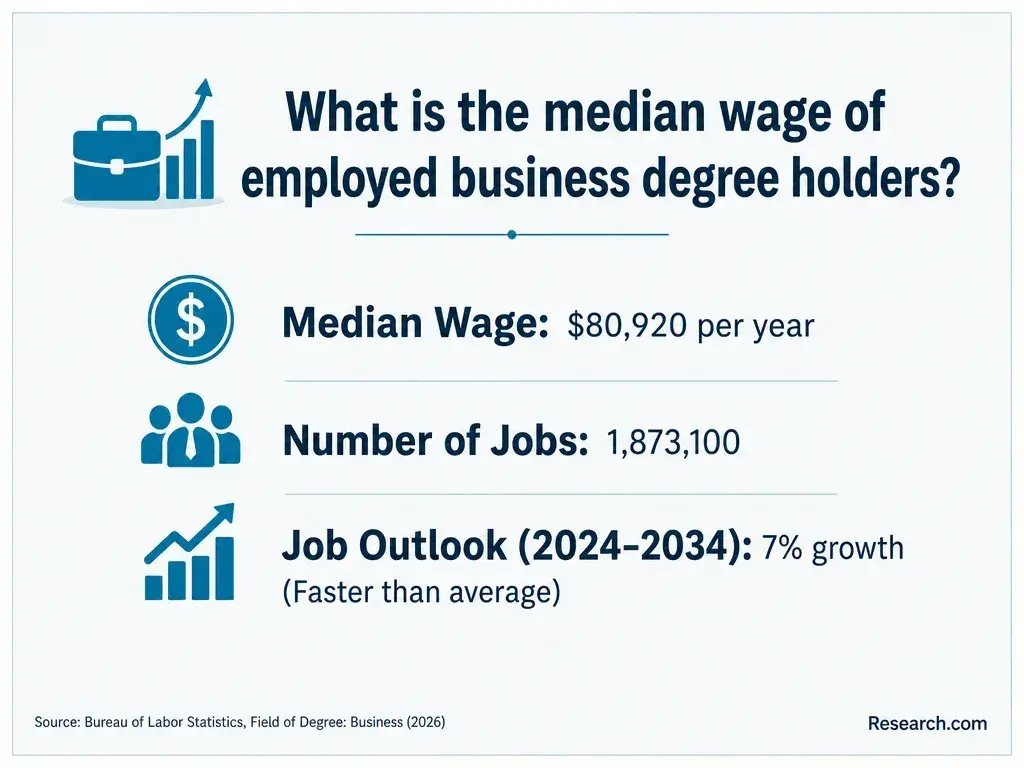
A BSBA has no single salary: pay is attached to an occupation, employer, location, and level of experience. For context, the U.S. Bureau of Labor Statistics reports a $75,940 median annual wage for human resources specialists in May 2025. That is an occupation-wide median, not a starting salary or an expected outcome for BSBA graduates. HR jobs may require relevant experience or skills beyond general business coursework.
When weighing an annual-course delay, avoid assuming that graduating earlier produces a particular salary increase. Instead, compare the added education cost and time against the entry-level roles for which you can realistically qualify. If supply chain is your intended field, compare supply chain degrees by cost and length alongside actual job requirements rather than treating occupation-wide wages as a return-on-investment promise.
Do Business Administration Careers Require Licenses or Certifications?
Many general business roles do not require an occupational license, but requirements depend on the work. A BSBA does not itself authorize CPA practice, confer a financial-services license, or award an HR or project-management certification. Those credentials have separate rules set by licensing boards or certifying organizations.
If a specific credential is your objective, verify its eligibility rules before choosing an annually scheduled degree. An HR-focused student, for example, can use a human resources program selection guide to compare academic preparation, then check the relevant certification body's current requirements. A targeted course, employer training, or relevant work may be more direct than waiting for a BSBA course - unless the bachelor's degree is itself required for your intended job or advancement.
Other Things You Should Know About Business Administration
Often, but a waitlist is not a seat. Ask the department when enrollment decisions are final and what approved option exists if no place opens.
Check the repeat policy immediately. Ask when the next attempt is available, whether another approved course can satisfy the requirement, and how a repeat affects academic standing.
Yes. Published rotations may change with staffing or enrollment. Request the current schedule and ask how the department helps students who cannot take a required course as planned.
It may. Ask the registrar whether a leave or lapse in enrollment changes your catalog year, readmission status, or eligibility to use previously approved substitutions.
- Cost of Attendance (Budget) | 2025-2026 Federal Student Aid Handbook https://fsapartners.ed.gov/knowledge-center/fsa-handbook/2025-2026/vol3/ch2-cost-attendance-budget
- Courses: Sequencing | Trinity College of Arts & Sciences https://trinity.duke.edu/undergraduate/academic-policies/courses-sequencing
- General Course Information - UWF Catalog https://catalog.uwf.edu/courseinformation/generalinformation/
- Degree Requirements | Paul Merage School of Business https://merage.uci.edu/programs/undergraduate/degree-requirements.html
- Business Administration Requirements | uoregon.edu https://business.uoregon.edu/programs/undergraduate/majors/business-administration/courses-requirements
- Bachelor of Science in Business Administration | unomaha.edu https://catalog.unomaha.edu/undergraduate/college-business-administration/bs-business-administration/
- Business Administration Major - UCR School of Business https://business.ucr.edu/undergraduate/major
- How to Understand Course Modality | utoledo.edu https://www.utoledo.edu/success/how-to/course-modality.html
- UofM Online Catalog - MGMT | The University of Memphis https://www.memphis.edu/management/programs/catalog.php
- Prerequisites/Corequisites | Office of Technology and Digital Innovation https://it.osu.edu/student-information-system-sis/sis-curriculum-program-course-request/prerequisites-corequisites