2027 From Insurance Customer Service to Operations Leadership: When Does a BS in Business Administration Make Sense?
Audited and Verified:
Our Editorial and Data Verification Process
Research.com uses government datasets, official education statistics and primary institutional information to support its career and degree guides. Our review process checks factual accuracy, occupational definitions, source dates and the requirements associated with the credentials discussed.
How This Article Was Fact-Checked
Our editorial team verifies salary estimates, employment projections, education requirements and program information against original data providers and official organizations. Salary figures are checked against the relevant occupational definitions and reporting periods. Information about licensure, accreditation and required in-person training is reviewed separately.
Fact-checked and verified on:

Co-Founder and Chief Data Scientist
Insurance customer service can teach you how policies, claims, systems, and frustrated customers intersect. Moving into operations leadership requires a different kind of evidence: that you can improve a process, interpret performance data, coordinate teams, and make sound decisions beyond your own caseload.
This guide is for insurance professionals weighing a BS in Business Administration against shorter training and workplace advancement. It explains what the degree can add, where experience matters more, and how to judge whether the time and cost fit your next role.
Key Things You Should Know
- A BS in Business Administration makes the most sense when a target operations role requires or prefers a bachelor's degree and you need broader skills in finance, analytics, and management, not just another customer service credential.
- Before enrolling, compare actual job postings with your experience. A degree can help close an education gap, but documented process improvements and leadership responsibility remain essential.
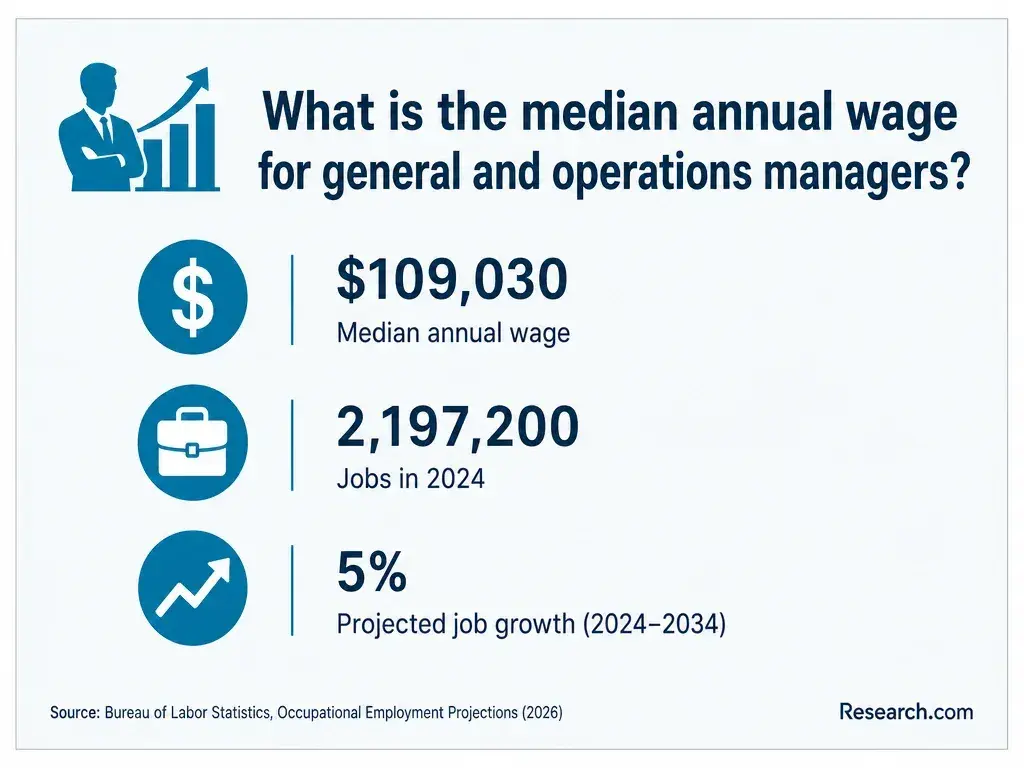
- The Bureau of Labor Statistics reports a $105,770 median annual wage for general and operations managers in May 2025; that occupation-wide figure is not an expected starting salary for a new graduate.
What Is a BS in Business Administration, and Who Is It For?
A BS in Business Administration is an undergraduate degree covering several business functions rather than training for one insurance job. Its courses may include accounting, finance, management, operations, statistics, and information systems. The exact mix depends on the school; a BBA or BS in Management may overlap substantially but have different requirements.
For an insurance service representative, claims support employee, or team lead, the degree is most useful when the next role spans departments, budgets, workflows, or staff. It does not confer an insurance license or make a graduate a manager. If you are comparing programs, explore online business degree school rankings in America as a starting point, then check each school's current curriculum against the work you want to do.
When Does a BS in Business Administration Make Sense for Insurance Professionals?
Start with the position you want, not the degree title. Insurance operations can mean overseeing service capacity, coordinating policy-administration work, improving claims handoffs, monitoring quality, or managing a team.
Experience with customers and internal systems gives you useful context, but employers may also expect budgeting, analysis, change management, and demonstrated responsibility for other people's work.
The comparison below separates an education gap from a skill or experience gap. That distinction can prevent you from paying for a degree when a more direct route would serve you better.
| Situation | More sensible starting point | What could change the decision |
| Target postings require a bachelor's degree, and you do not have one | Evaluate a BS in Business Administration and the credits you have left to complete | An employer may accept equivalent experience, or a more specialized degree may fit the role better |
| You have a degree but need stronger supervisory or process skills | Seek stretch assignments, mentoring, and targeted training | A second bachelor's may be worthwhile only if its distinct coursework meets a clear hiring requirement |
| You want a narrow technical role in underwriting, analytics, or systems | Compare function-specific training and job requirements first | A business degree may help if the intended role also demands broad operational judgment |
Ask your manager which qualifications have mattered in recent internal promotions and which responsibilities you can take on now. If your main gap is leadership practice rather than a bachelor's credential, explore shorter organizational leadership bachelor's programs only if you still need a degree; otherwise, employer training may be the lower-cost move.
What Careers Can You Pursue After Moving Into Operations Leadership?
The most realistic next step is often an adjacent role where you can apply insurance knowledge while gaining responsibility beyond individual customer interactions. Job titles vary by carrier, agency, and third-party administrator, so compare duties rather than titles alone.
These paths call for different evidence of readiness. None follows automatically from earning a business degree.
- Operations or service coordinator: Tracks workflow, exceptions, and handoffs; useful evidence includes accurate reporting and a documented process improvement.
- Quality or training specialist: Reviews service practices and helps colleagues improve; employers may value coaching, clear documentation, and knowledge of policy or claims procedures.
- Project coordinator: Supports schedules, stakeholders, and implementation; a supervised system rollout or workflow project can demonstrate relevant experience.
- Operations supervisor or manager: Owns team performance, staffing decisions, escalations, and controls; employers generally look for proven leadership as well as business knowledge.
A move into procurement or supply chain is a larger functional switch, even when the title includes "operations." If that is your goal, compare specialist preparation, including faster-paced online supply chain college study, with a general business degree and look for an entry route that builds relevant experience.
For insurance operations, the most valuable courses are those you can connect to recurring decisions at work. Managerial accounting can help you understand service costs; statistics and spreadsheets can help you interpret workload and quality measures; operations and project courses can help you map handoffs and plan changes. Management and business law add context for staffing, compliance, and responsible decisions.
Look beyond course names for assignments that produce usable evidence of learning: a process map, a clearly labeled hypothetical staffing analysis, or a presentation defending a recommendation.
If you want to use workplace information, obtain employer and faculty approval first. Customer records, employee data, and proprietary performance reports should not become class or portfolio material without permission.
Check prerequisites and course sequencing before choosing an accelerated schedule. Accelerated degree options for working adults may shorten the calendar, but they do not eliminate quantitative coursework or make a demanding term easier to fit around an insurance shift.
Completion time depends chiefly on credits that apply to the degree, remaining required courses, their availability, and how many you can manage while working. A school may accept prior credits as electives without using them to satisfy its business core. Request an official degree audit before relying on an advertised completion timeline.
Compare total remaining cost, not tuition alone: required courses, mandatory fees, books, software, possible travel or proctoring, financing costs, and income you might forgo. Ask whether your employer reimburses tuition, when payment arrives, and what grades or continued employment the benefit requires. Budget-friendly online business schools are worth comparing, but the least expensive advertised rate may not produce the lowest cost for your particular degree audit.
Choose the format that lets you complete required work consistently alongside your insurance schedule. Online courses may still require live meetings, group projects, timed exams, and fixed weekly deadlines. Campus courses add travel but may provide easier access to classmates, faculty, and local recruiting.
Ask each program for a recent syllabus from required courses, its exam and attendance policies, and the schedule for courses you still need. Then test those obligations against peak service periods, shift changes, and any caregiving commitments. Online undergraduate business rankings for shorter study paths can help identify options to investigate, but verify that the advertised pace is possible with your remaining requirements.
Requirements vary by institution and by whether you apply as a first-time or transfer student. Schools commonly review prior academic records; some also set separate standards for entry to the business major or require foundational coursework before upper-level classes. Insurance work experience can strengthen your application, but it does not automatically replace academic prerequisites or earn credit.
Send transcripts from every previous college and ask for separate answers about admission, transfer-credit acceptance, and application of those credits to the degree. Confirm mathematics and accounting prerequisites, application deadlines, and whether any prior-learning assessment is available.
Admission and financing are separate decisions: if you are considering aid, financial aid packages for online project management bachelor's students illustrate aid categories to investigate, but your business program and aid office must determine your actual eligibility and package.
First, confirm the institution's accreditation with its accreditor and the U.S. Department of Education's recognition information. Then check whether any claimed AACSB, ACBSP, or IACBE business accreditation covers the specific school and program you are considering. Institutional accreditation and business accreditation have different scopes; neither alone proves that a program will lead to promotion.
For an insurance operations goal, quality also means reliable access to required courses, advising for working students, relevant applied assignments, and credible outcome information. Ask how outcomes were measured and whether they describe graduates from your program and delivery format.
When comparing a business degree with a narrower project-management option, tuition budgeting for an accredited project management degree can prompt useful cost questions; verify each institution's accreditation scope independently.
There is no single salary or job-growth rate for BS in Business Administration graduates. Pay depends on the occupation, location, employer, and level of responsibility.
For context, the U.S. Bureau of Labor Statistics reports a May 2025 median annual wage of $105,770 for general and operations managers and projects 5% employment growth for that occupation from 2025 to 2035. The median includes experienced workers across industries; it is not a starting offer or a forecast of your earnings in insurance.
For a useful return-on-investment comparison, identify a realistic next job at your employer or in your local market, review its posted qualifications and pay range, and weigh that opportunity against your remaining education cost. Online business administration school cost comparisons can inform the expense side, but a potential wage increase should not be counted as certain income.
Which Certifications Help Advance Insurance and Operations Careers?
A credential is most useful when it addresses a gap in the job you want. Insurance designations can deepen knowledge of coverage, claims, or industry operations.
Project-management or process-improvement training may help if you are being asked to coordinate changes. Each credential has its own eligibility, assessment, and maintenance rules; a business degree does not award it automatically.
Review internal postings and ask the intended hiring manager which credentials they recognize before paying for one. If you need broad undergraduate education and a bachelor's requirement is blocking advancement, shorter pathways to an online business degree may be relevant. If the requirement is a specific insurance designation or demonstrated project work, that targeted route may be faster and more persuasive.
Other Things You Should Know About Business Administration Programs
Possibly. Some schools offer prior-learning assessment, but they decide what evidence qualifies and where any awarded credit applies. Ask for the policy and fees before assuming your work will reduce degree requirements.
Yes, if you can explain your own role accurately without disclosing customer information or confidential company data. Use approved, non-sensitive examples and distinguish a proposal from an implemented result.
Ask to help with coaching, quality reviews, workflow documentation, or a supervised improvement project. Agree on the scope and how your contribution will be assessed.
Not necessarily. Check the roles you want: employers may place more weight on a bachelor's degree, insurance expertise, and demonstrated leadership. Consider an MBA only when its additional study addresses a specific career requirement or goal.
- General Schedule Qualification Policies | U.S. Office of Personnel Management https://www.opm.gov/policy-data-oversight/classification-qualifications/general-schedule-qualification-policies/
- Top Business Operations Manager Skills Needed in 2026 | Edgewood College https://online.edgewood.edu/blog/business-operations-manager-skills/
- 6 Types of Business Degrees and Career Paths | UMass Global https://www.umassglobal.edu/blog-news/6-types-business-degrees-and-career-paths
- How to Become an Operations Manager | St. Catherine University https://www.stkate.edu/academics/women-in-leadership-degrees/how-to-become-an-operations-manager
- Calculating MBA ROI: Everything You Need to Know | Rollins College https://crummer.rollins.edu/resources/whats-the-roi-of-an-mba/
- Business Administration vs. Management: Key Differences and Career Fit | post.edu https://post.edu/blog/business-administration-vs-management/
- Skills for Business Managers That Can Lead to Promotion | Webster University https://enroll.webster.edu/skills-for-business-managers/
- What Does an Operations Manager Do? | snhu.edu https://www.snhu.edu/about-us/newsroom/business/what-does-an-operations-manager-do
- 11 Types of Business Degrees and Career Pathways | National University https://www.nu.edu/blog/types-of-business-degrees/