2027 Choosing Public Health BS Coursework for Public Transportation Accessibility Initiatives

Co-Founder and Chief Data Scientist
A transit route can exist on a map and still be unusable for someone who cannot reach its stop, board its vehicle, or rely on it for a medical appointment. If you are choosing public health BS coursework to improve transportation accessibility, the strongest plan combines population-health methods with disability-informed policy and practical transit experience.
This guide identifies the courses and projects worth prioritizing, explains what a public health graduate can contribute alongside transportation specialists, and shows how to judge programs without paying for coursework that does not serve your goal.
Key Things You Should Know
- Prioritize epidemiology, statistics, GIS or spatial analysis, program evaluation, disability policy, and community-engaged methods; verify which are required, elective, or available outside the major.
- Study the entire trip, not just the vehicle: under federal ADA rules, complementary paratransit service areas generally extend within 3/4 mile of eligible fixed routes, but reaching and using a stop presents separate accessibility questions.
- A public health BS commonly takes about four years of full-time study, but neither the degree nor one transit elective qualifies a graduate to certify ADA compliance or guarantees a transportation job. Supervised, relevant work is the stronger differentiator.
What is public health's role in improving public transportation accessibility?
Public health examines whether people can reliably reach the places and services that support health: clinics, pharmacies, food stores, jobs, schools, and social connections. Transportation accessibility means more than a nearby bus line. It includes the ability to get to a stop, obtain usable information, board and ride, transfer, afford the trip, and arrive when a service is available.
A public health team might compare missed-appointment patterns with travel times, interview riders about barriers, or evaluate a reduced-fare outreach program. Its contribution is to identify who faces barriers and whether an intervention improves access without overlooking unintended effects.
Transit agencies, riders, disability advocates, planners, engineers, and ADA specialists bring different authority and expertise; a public health graduate should not present a health-impact analysis as an accessibility compliance determination.
For students contemplating leadership or research later, comparing DrPH and PhD program goals can clarify why implementing a transit-health partnership differs from conducting original transportation-health research. Neither advanced degree is necessary to begin contributing to a local initiative.
Which public health BS coursework prepares students for transportation accessibility initiatives?
Choose courses by the decisions you want to support, not by whether a catalog mentions transportation. The table distinguishes foundational public health preparation from specialized skills that may require electives in geography, urban planning, or disability studies.
| Coursework | What it contributes | What to check in the catalog |
| Epidemiology and biostatistics | Define populations and outcomes, compare access patterns, and interpret uncertainty. | Whether students analyze data rather than only read published studies. |
| GIS or spatial analysis | Map travel times, service areas, destinations, and geographic gaps. | Prerequisites, software access, and whether a suitable course is open to public health majors. |
| Program planning and evaluation | Set measurable objectives and assess an outreach, route-change, or referral initiative. | Opportunities to work with a real partner and document limitations. |
| Health policy and disability studies | Understand governance, disability rights, and the difference between access goals and legal requirements. | Whether the course addresses transportation or permits a relevant project. |
| Qualitative methods and community health | Learn from riders whose experiences are poorly captured by route maps or administrative records. | Training in accessible engagement, consent, and interpretation. |
A workable sequence is introductory statistics and public health first, epidemiology and research methods next, then GIS and evaluation once you can define a useful question. Seek a supervised project after acquiring those foundations. If advanced modeling becomes your goal, a BS survey course is unlikely to be enough; an online biostatistics master's flexibility guide can help you assess later training, though targeted methods courses may be sufficient for many entry-level tasks.

How can a public health degree lead to transportation accessibility careers?
A BS can support applications for community health, program assistant, outreach, or junior evaluation roles in health departments, health systems, nonprofits, and transit-related partnerships. Graduates may coordinate rider engagement, maintain referral data, help evaluate appointment-transportation programs, or prepare accessible health communications. Job titles vary; the duties and employer requirements matter more than the word "transportation" in a posting.
Build evidence of those duties while enrolled. A useful supervised project could define a clinic population, document how travel barriers will be measured, summarize rider feedback with permission, and present feasible recommendations to a partner. Obtain site approval before using operational data, and remove identifiable information from any portfolio version. Planning, engineering, ADA compliance, and independent research roles may require other qualifications or substantial experience.
For an eventual move into more specialized public health work, public health graduate entry without reference letters is one application consideration - not a substitute for demonstrated transit or community experience. If your immediate goal is route design rather than population-health evaluation, compare urban planning or transportation coursework before committing to a public health degree.
Start with the door-to-door journey. A study limited to distance from home to a bus stop can miss inaccessible sidewalks, unreliable lifts, difficult transfers, language barriers, fare costs, and the mismatch between transit schedules and clinic hours. Also distinguish fixed-route service from complementary paratransit; eligibility, service boundaries, and booking practices affect different riders in different ways.
Strong student questions include whether a proposed change improves travel time to essential services, whether information is usable by riders with different disabilities, and whose experiences are missing from an agency dataset. Pair quantitative measures with appropriately designed rider input. A mapped gap does not prove a health effect, and a small interview project should not be treated as representative of every rider.
Students who discover that they want to develop original evidence on transportation and health can investigate research training and public health PhD costs and program choices. For a BS-level accessibility initiative, however, a carefully scoped evaluation with a community or agency partner is usually more immediately useful than doctoral preparation.
Either format can teach epidemiology, policy, and evaluation. The decisive difference for this goal is whether you can access spatial-analysis instruction, faculty feedback, and a suitable transit or community partner. An online program may let you study near a local transit agency; a campus program may provide easier access to planning electives, GIS facilities, and in-person projects. Neither advantage is automatic.
Before choosing, ask whether GIS courses are available remotely, whether classes meet live, who secures field sites, and whether travel or campus visits are required. Compare the full schedule if you work or have caregiving responsibilities: an asynchronous lecture can still accompany fixed-time group meetings or daytime fieldwork.
For a broader comparison of completion speed and expenses, use public health degree timelines and salary considerations, then check the actual requirements of each program on your shortlist.
Check that the university holds recognized institutional accreditation. Then verify any claimed public health-specific accreditation through the Council on Education for Public Health (CEPH): confirm the accredited school, unit, or standalone program and whether the BS you would enter falls within its scope. Institutional accreditation alone does not establish CEPH coverage, and CEPH coverage does not mean a program offers GIS, transit partnerships, or a transportation concentration.
For this particular coursework choice, request a degree map and ask who teaches the relevant electives and how often they run. Accreditation is an important quality check, but course access determines whether you can execute your plan. The same scope-checking principle matters if you later examine online doctoral public health entry pathways; verify the exact credential rather than assuming an institution-wide claim covers every degree.
Requirements depend on whether you are entering as a first-year student, transferring, or applying separately to a public health major after enrollment. Schools may request transcripts and completion of particular general-education or introductory courses. A program with GIS or quantitative electives may also have prerequisites for those courses even when they are not prerequisites for BS admission.
If you are transferring, obtain a written degree audit showing not merely which credits are accepted, but which satisfy major, statistics, general-education, and residency requirements. Ask the receiving institution to evaluate any prior methods or geography course before assuming it will shorten your path.
Students worried about earlier grades should use the school's undergraduate admission and repeat-course rules; building an MPH application with weaker grades addresses a different, later admissions decision.
A conventional full-time bachelor's pathway is about four years, but transfers, part-time enrollment, prerequisite sequencing, and infrequently offered electives can change the timeline. Do not assume that an accepted transfer course fulfills a particular requirement until the school applies it to your degree audit.
Compare written estimates for tuition and mandatory fees, then add the costs that affect this goal: GIS materials or software if charged separately, travel to a field site, and time away from paid work for an internship. Ask whether a relevant elective is included in standard tuition and whether the field experience is paid.
If graduate study is a possibility, public health graduate scholarship eligibility guide is a separate study; prospective graduate aid should not be counted as a reduction in today's BS cost.
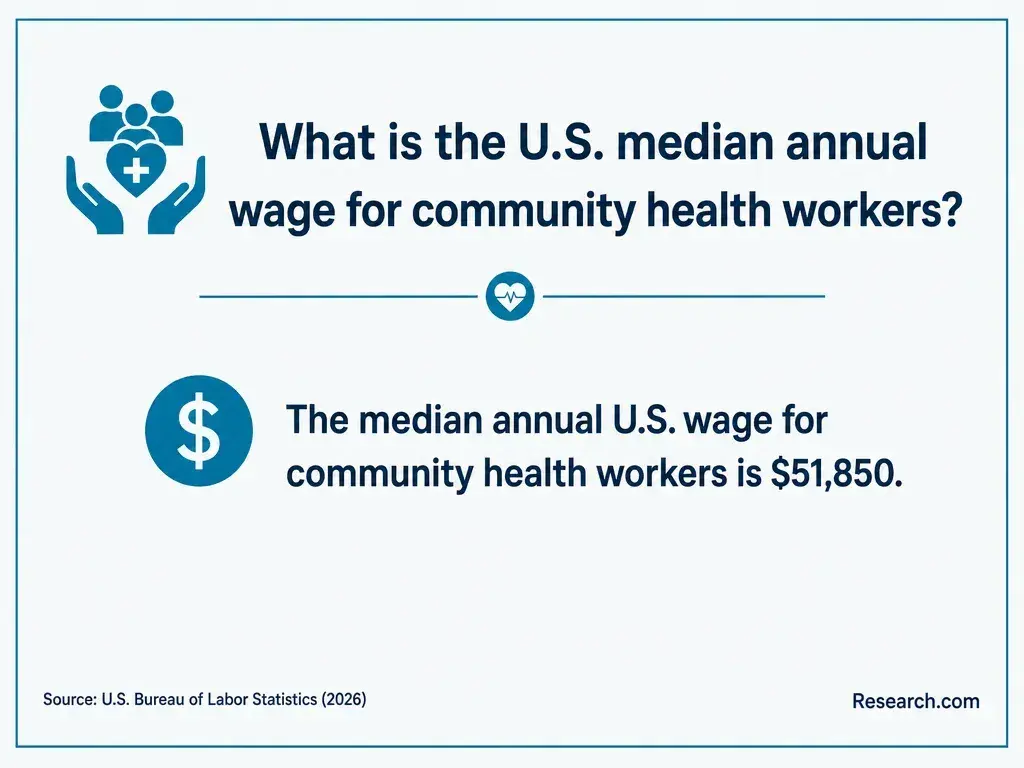
There is no single Bureau of Labor Statistics occupation for "public health transportation accessibility specialist." A graduate doing rider outreach may fit a community health worker or health education specialist occupation; someone focused on route planning may fall within a different occupation with different educational expectations. Compare the duties, location, and entry requirements of actual openings before using an occupational wage as a salary target.
The Bureau of Labor Statistics Occupational Outlook Handbook publishes wages and employment projections by occupation, not by public health degree or transportation initiative. Its figures can help compare career directions, but they cannot predict a particular BS graduate's offer. For a later graduate-school decision, MPH education and long-term earnings should likewise be weighed against tuition, experience requirements, and the specific roles available locally.
Which certifications support public health transportation accessibility careers?
No single certification is required for every public health transportation accessibility role. Depending on the work, employers may value GIS training, accessible-communication skills, or documented preparation in health education.
The Certified Health Education Specialist (CHES) credential is relevant to qualifying health education work, but candidates must check the National Commission for Health Education Credentialing's current eligibility and exam rules. The Certified in Public Health (CPH) credential has separate eligibility rules; a BS alone should not be assumed to confer eligibility.
Choose a credential only after reviewing job postings and identifying a skill it will demonstrate. For a student helping evaluate access to clinics, supervised GIS and evaluation work may be more useful than an unrelated certification. If a future MPH is the actual requirement for your target job, review public health graduate bridge and entry pathways rather than treating a short credential as equivalent to the degree.
Other Things You Should Know About Public Health
Yes, for suitably scoped class projects, but app travel times are estimates. Record the query date, time, and assumptions, and check whether sidewalks, boarding, transfers, and service reliability are represented.
Include riders with relevant lived experience and the organizations responsible for the service. Ask what decision the project will inform before selecting a dataset or measure.
Not automatically. Consult your instructor and institution before recruitment; the project's purpose, methods, and intended use determine what review, consent, and partner permissions may be needed.
Include your question, methods, limitations, and a shareable deliverable. Get permission before publishing partner materials, and remove confidential or identifiable information.
- Transport | who.int https://www.who.int/teams/environment-climate-change-and-health/healthy-urban-environments/transport
- Frequently Asked Questions on Incorporating Accessibility in Transportation Projects | US Department of Transportation https://www.transportation.gov/grants/dot-navigator/frequently-asked-questions-incorporating-accessibility-transportation-projects
- Measuring, Monitoring, and Evaluating the Health of a... - PMC https://pmc.ncbi.nlm.nih.gov/articles/PMC7171905/
- Measuring Access to Improve Public Health Study | mass.gov https://www.mass.gov/info-details/measuring-access-to-improve-public-health-study
- Social Determinants of Health and Health Equity - NCBI - NIH https://www.ncbi.nlm.nih.gov/books/NBK573923/
- Undergraduate Student Short-Term Opportunities | cdc.gov https://www.cdc.gov/fellowships/php/opportunities/applying-for-undergraduate-students-opportunities.html
- Introduction to the Americans with Disabilities Act | ADA.gov https://www.ada.gov/topics/intro-to-ada/
- Disability Studies Requirements | UW College of Arts and Sciences https://indiv.washington.edu/content/disability-studies-requirements
- Practicum and Capstone: COPHP MPH | Health Systems and Population Health https://hspop.uw.edu/cophpmph/program-experience/practicum-capstone/
- Improve Transportation By Engaging Diverse Communities | ucdavis.edu https://fri.ucdavis.edu/news/improve-transportation-engaging-diverse-communities