2027 From International Development to Public Health: Choosing a Graduate Pathway

Co-Founder and Chief Data Scientist
International development experience can be a strong foundation for public health work, but the best graduate pathway depends on the job you want next. Managing a health program, analyzing disease patterns, and leading health policy work require different preparation. For development professionals considering a US-focused career transition, this guide compares degrees, specializations, practical experience, costs, and employment prospects. It will help you decide whether an MPH, a more specialized degree, or targeted training is the most direct next step.
Key Things You Should Know
- An MPH usually fits a move into population-health program design, implementation, or evaluation; a research-focused MS better fits a substantial shift toward epidemiology or quantitative analysis.
- Development experience transfers best when you can show specific health-related work, such as community partnership, monitoring and evaluation, policy implementation, or responsible use of program data.
- Compare the full cost and required fieldwork - not just tuition or delivery format. An MPH alone does not confer clinical licensure, guarantee a public health job, or replace specialized technical experience.
What Is the Best Graduate Degree for a Career in Public Health?
For an international development professional moving into public health program work, an MPH is often the most direct graduate route. Its professional focus connects population health, prevention, policy, data interpretation, and applied practice. That recommendation changes if your target job primarily requires advanced research, clinical authority, or general organizational management.
The comparison below starts with the work you want to do rather than a degree's prestige.
| Target work | Potentially suitable pathway | Important limitation |
| Design, implement, or evaluate population-health programs | MPH with relevant methods and applied experience | A concentration cannot substitute for demonstrated work with partners or data. |
| Conduct specialized epidemiologic or quantitative research | Research-oriented MS; potentially a PhD later | Check mathematics, methods, thesis, and research-supervision expectations. |
| Manage an organization, public agency, or service operation | MPA, MHA, or MPH, depending on the employer and role | Healthcare operations and population-health practice are not identical. |
| Provide regulated clinical care | The applicable clinical qualification and license | A public health degree does not confer clinical licensure. |
Experienced professionals considering a practice-focused DrPH should first establish that their next step requires advanced public health leadership, not simply a stronger résumé. A research-focused PhD serves a different purpose.
For those weighing that later option, comparing online doctorate admission routes in public health is useful only after checking whether each degree's work and experience expectations match the intended role.
How Do International Development and Public Health Career Paths Compare?
International development often organizes work around development priorities, funders, governments, and communities across sectors. Public health focuses more specifically on preventing illness and improving health at the population level.
The two intersect in areas such as health systems, maternal and child health, infectious disease prevention, and program evaluation, but employers may expect different technical evidence.
A development program officer might already manage budgets, partners, reporting, and implementation risks. To move into a public health evaluation role, that person may need stronger epidemiology, indicator selection, data-quality assessment, and interpretation skills. Someone whose development work has primarily involved education or livelihoods may also need to demonstrate why a particular health problem and population are central to their next role.
Adjacent transitions are usually easier than functional reinventions. Moving from managing a health-related development program to managing a domestic community-health program may require context and network building.
Moving from general program management to epidemiologist positions is a larger technical shift. Salary comparisons can help frame the trade-off, but MPH career pay comparisons should be checked against the specific occupation, location, and experience level - not treated as a return promised by the degree.
What Public Health Graduate Programs and Specializations Are Available?
An MPH may offer a generalist curriculum or a formally designated concentration. Relevant options for development professionals commonly include global health, community health, health policy, epidemiology, and program evaluation. Names do not establish depth: compare required courses, elective access, faculty expertise, and the applied work you can actually complete.
Choose a specialization by identifying the skill employers would not already infer from your experience. A program manager with extensive community partnerships might gain more from rigorous evaluation coursework than from another broad leadership credential.
Conversely, an analyst with strong methods skills may need policy implementation or community-engagement experience. A related elective is not necessarily a formal concentration or a separately awarded credential.
Research-intensive epidemiology study may lead some applicants toward an MS and, eventually, doctoral work. That is a substantial change in training and funding needs. If that is your goal, examine research opportunities and epidemiology doctoral scholarships and employer benefits separately from MPH financing; availability and eligibility must be confirmed with each program and funder.
An MPH typically builds a foundation in population health, epidemiology, biostatistics, health systems, and the social conditions that shape health. Depending on the program, students may also study environmental health, communication, policy, ethics, and program planning. Applied experiences ask students to use those skills in an approved setting; they should not be confused with an MS thesis or doctoral dissertation.
Development professionals should scrutinize methods depth and applied-project fit. Monitoring a grant's outputs is useful experience, but estimating a program's effects, interpreting surveillance data, or designing an ethical community evaluation can require additional training.
Ask to see the course sequence and examples of permitted project types. If you hope to use data from a current employer, confirm site approval, supervision, privacy requirements, and any institutional review obligations before relying on that plan.
Doctoral curricula diverge further: a DrPH generally emphasizes advanced practice and leadership, while a PhD centers original research. When comparing online public health doctoral programs, inspect research or applied-project supervision and required in-person work rather than assuming the same expectations apply to every doctorate.
Neither format is inherently better for a career changer. Online study may let a development professional remain employed and apply coursework to ongoing work. Campus study may offer easier access to local field partners, research teams, and recruiting events. Either format can involve scheduled classes, group projects, site-based practice, or required visits.
Compare programs against your likely fieldwork location and target job market. A student seeking US public health work may benefit from a program with established US agency or community partnerships; a student remaining abroad needs explicit confirmation that the program permits an approved placement there.
For applicants outside the United States, verify overseas enrollment rules and live-session time zones. An online US degree does not itself provide a visa or US work authorization.
Format also affects total expense. Lower-cost routes through online public health study are worth exploring, but a short advertised timeline is valuable only if the course schedule, fieldwork arrangements, and workload are feasible for you.
MPH programs generally assess prior academic work, a statement of purpose, recommendations where required, and evidence that an applicant can succeed in graduate study. Requirements vary: an unrelated undergraduate major does not automatically disqualify a development professional, while a methods-intensive MS may expect more specific quantitative preparation.
Present development experience in terms an admissions committee can evaluate. Describe the health problem addressed, your responsibilities, the methods or evidence you used, and what you learned about working with communities.
Distinguish managing a reporting process from independently conducting statistical analysis. If your GPA is a concern, review low-GPA eligibility for public health graduate programs, then ask each institution which academic record it reviews and what additional evidence it considers.
Applicants educated outside the United States should check whether a program requires a particular credential evaluation and, where applicable, English-language test results. Ask whether prerequisites must be completed before applying or before enrollment; admission eligibility, competitiveness, and permission to begin with outstanding coursework are separate decisions.
Full-time MPH study commonly spans roughly two academic years, but accelerated, part-time, and online schedules differ. A research MS may add thesis work, while doctoral study involves substantially different milestones. Use each program's published credit requirements and course rotation to estimate a realistic finish date, especially if you will keep working.
Total cost is more informative than tuition alone. Add mandatory fees, fieldwork-related travel, any required campus visits, materials, and income you might forgo. Then compare that amount with the skills and access you need for your target role. If your employer offers education assistance, obtain its eligibility and repayment conditions in writing.
Low-tuition online MPH options can provide a starting shortlist, not a final cost comparison. Request a program-specific estimate based on your enrollment pace and residency or international-student classification, where applicable; confirm which charges and aid opportunities actually apply to you.
Relevant jobs may include public health program coordinator, health policy analyst, evaluation specialist, health education specialist, and - in appropriately technical pathways - epidemiologist. Responsibilities vary considerably across employers.
A program coordinator may manage partners and implementation; an evaluation specialist may define indicators, assess data quality, and explain findings; an epidemiologist may investigate patterns of disease or exposure.
Start with postings for the roles you want and separate existing strengths from missing requirements. Development experience can demonstrate grant management, cross-sector coordination, communication, and contextual judgment.
Build proof of new public health skills through an approved practicum, supervised project, or portfolio product that can be shared without exposing confidential information. Research and technical roles may require methods experience beyond a general MPH.
If you are close to qualifying for an entry-level health program role, gaining supervised experience may be faster and less costly than another degree. If the degree is necessary but you have an outstanding course, examine applying to an MPH with incomplete prerequisites before postponing your entire career plan; only the institution can confirm whether that route is available.
There is no single public health graduate salary. Compensation depends on the occupation, employer, location, responsibilities, and prior experience. US Bureau of Labor Statistics occupation-specific wage information can provide a benchmark for defined roles such as epidemiologist or health education specialist, but an occupational median covers workers with varied backgrounds; it is not an MPH graduate salary or an offer you should expect.
For a useful comparison, match a current wage benchmark to the actual job titles you would pursue, then examine local postings and public-sector pay scales. Consider whether the degree would help you qualify for different work, advance in your present organization, or mainly deepen skills you already use.
When estimating your own net cost, investigate university scholarship options for MPH applicants, but do not subtract an award from your budget until its eligibility, amount, and renewal terms are confirmed.
How Do You Choose an Accredited Public Health Program?
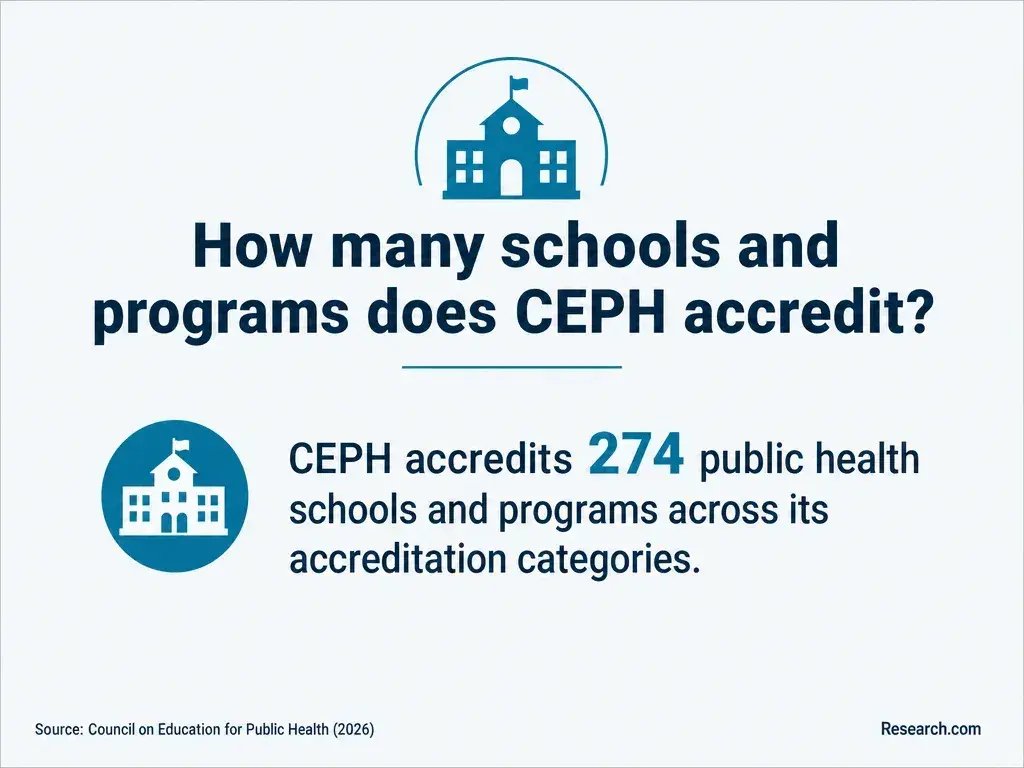
First confirm that the university has recognized institutional accreditation. Then check the Council on Education for Public Health's listing for the specific school, unit, or program and determine whether the degree you intend to earn is within its accreditation scope. University accreditation and CEPH accreditation answer different questions; neither establishes that a particular concentration, placement, or career outcome is available.
Build a shortlist around evidence of fit: required methods courses, fieldwork approval and placement support, relevant faculty or partners, scheduling, total cost, and outcomes reported with clear definitions.
Ask who approves projects at a current employer and whether career services connect students with the kind of US public health employer you are targeting. Request policies that apply to your intended entry term rather than relying on a broad program description.
Finally, test whether each application is feasible. For example, comparing online MPH reference letter policies can help if former supervisors are difficult to reach after international assignments. Check the actual program's current requirements before ruling it in or out; application convenience should not outweigh curriculum and career fit.
Other Things You Should Know About Public Health
It can be relevant, particularly when it involved health outcomes or services. Describe the population, measures, data responsibilities, and decisions your work supported. A school or employer decides how that experience meets its requirements.
Possibly. Obtain approval from the academic program and employer before committing to it. The project must meet learning and supervision requirements, and permission to use organizational data is a separate issue.
No. Admission and degree completion are separate from immigration status and employment authorization. International applicants should check the rules relevant to their circumstances with the institution and appropriate immigration authorities.
Choose by job function first. Compare programs' relevant coursework, language or regional strengths, field partnerships, and graduate outcomes. A "global health" label alone does not establish that a program will prepare you for a particular employer or location.
- Framework for Program Evaluation in Public Health | cdc.gov https://www.cdc.gov/mmwr/preview/mmwrhtml/rr4811a1.htm
- Graduate | EducationUSA https://educationusa.state.gov/your-5-steps-us-study/finance-your-studies/graduate
- Exploring the Benefits and Value of Public Health Department Internships for Environmental Health Students | cdc.gov https://stacks.cdc.gov/view/cdc/107366
- Health Systems Governance | who.int https://www.who.int/health-topics/health-systems-governance
- Student Practicum as a Bridge to Governmental Public Health Practice - Emily M. Burke, Dorothy A. Biberman, 2017 https://journals.sagepub.com/doi/10.1177/0033354916680610
- MPH Career Pathways & Outcomes - Tufts School of Medicine https://medicine.tufts.edu/academics/public-health/mph-career-pathways-outcomes
- MPH Program Skills: What You Learn and Where They Lead | NMSU Global Campus https://global.nmsu.edu/blog/healthcare/mph-program-skills-what-you-learn-and-where-they-lead/
- Public Health Employment Outcomes | Columbia University Mailman School of Public Health https://www.publichealth.columbia.edu/become-student/career-services/public-health-employment-outcomes
- MPH vs MS vs MHA: Which Public Health Master's Degree Is Right for You? | Tulane WSPH https://sph.tulane.edu/mph-vs-ms-vs-mha
- Master of Public Health - Global Health | Harvard T.H. Chan School of Public Health https://hsph.harvard.edu/program/mph-global-health/