2027 Best Online Non-Degree Programs With Year-Round Enrollment

Co-Founder and Chief Data Scientist
Choosing training that starts when you are ready - not only in fall or spring - can shorten a career transition. Online non-degree programs include college certificates, workforce certificates, continuing-education courses, and provider-issued credentials; they are not all equivalent to professional certifications or licenses.
The U.S. Bureau of Labor Statistics projects overall employment growth of 3% from 2024 to 2034, but growth varies sharply by occupation. This guide helps career changers, working adults, and skill builders compare year-round options, verify quality, estimate total costs, and choose training that fits a specific job goal.
Key Things You Should Know
- Year-round enrollment usually means multiple start dates or self-paced entry, not guaranteed immediate admission; confirm cohort dates, course availability, and required live sessions before paying.
- A college certificate, noncredit workforce program, and industry certification serve different purposes: only an approved program or qualifying experience may meet eligibility rules for a separate certification or state license.
- Cost and payoff depend on the target role: College Board reported average 2024-25 in-district tuition and fees of $4,050 at public two-year colleges, while shorter noncredit options may cost less but often do not transfer for academic credit.
Top 10 Best Online Non-Degree Programs With Year-Round Enrollment
Popular Trade School Programs
Year-round online trade options commonly include HVAC fundamentals, electrical theory, construction management, welding safety, industrial maintenance, and CAD certificates. They suit learners seeking technical vocabulary, blueprint reading, estimating, or exam preparation.
Hands-on trades usually require campus labs, employer training, apprenticeships, or supervised fieldwork; a fully online certificate alone rarely establishes journeyworker eligibility. Choose a credit-bearing certificate when future associate-degree transfer matters. Choose focused noncredit training when an employer recognizes the provider and you need a narrow skill quickly. Ask whether tools, lab intensives, safety training, and licensing exam preparation are included.
Healthcare Programs
Common options include medical billing and coding, medical assisting theory, pharmacy technician preparation, health information, patient care support, and medical terminology certificates. Online study works well for terminology, records systems, coding rules, and administrative workflows.
Programs involving clinical care typically require in-person practicum hours at approved sites. A school certificate is not the same as a national certification, and it may not meet state requirements for roles such as nursing assistant, practical nurse, or radiologic technologist. Confirm clinical-placement responsibility, background-check costs, immunization requirements, and whether graduates may sit for the relevant certification examination.
Criminal Justice / Law Programs
Online legal studies, paralegal, criminal justice, court reporting, legal research, and compliance certificates can build knowledge of procedures, writing, ethics, and records management. They fit aspiring legal support staff and working professionals who need focused training.
Paralegal education requirements vary by employer; some prefer programs approved by the American Bar Association, while many online programs are not. No certificate authorizes someone to practice law, provide legal advice independently, or become a police officer. Check state-specific requirements for court reporting, private investigation, corrections, and law-enforcement roles before selecting a program.
Arts & Design Programs
Digital design, graphic design, UX basics, photography, video editing, animation, web design, and interior-design coursework often allow frequent starts because software-based projects can be taught remotely. These programs are best for learners who can build a portfolio while studying.
Compare the curriculum's software access, instructor critique, portfolio review, and ownership of completed work. A short certificate can demonstrate skills, but employers may weigh portfolio quality and practical experience more heavily than the credential title. Regulated design fields can have separate education and examination standards, so verify requirements before relying on online coursework.
What types of online non-degree programs offer year-round enrollment?
Online non-degree programs with year-round enrollment are usually designed around workforce skills rather than a traditional semester calendar. The most flexible choices are often asynchronous noncredit courses and self-paced provider programs, while credit-bearing certificates, clinical programs, and cohort-based bootcamps may have scheduled starts despite advertising several entry points.
The comparison below separates common formats so you can match flexibility with the recognition your intended employer, certification body, or licensing board expects.
| Program type | Typical enrollment pattern | Credential outcome | Best fit |
| College credit certificate | Multiple terms; some rolling starts | Academic certificate and college credits | Learners who may pursue an associate degree |
| Noncredit workforce certificate | Frequent cohorts or rolling enrollment | Institution or continuing-education certificate | Job-focused skill development |
| Professional certificate program | Often monthly or self-paced | Provider-issued completion credential | Digital, business, and software skills |
| Certification exam preparation | Often on demand | Training completion; separate exam may be required | People already eligible for an industry credential |
| Hybrid clinical or lab program | Set cohorts plus placement windows | Certificate or diploma | Roles requiring supervised practice |
"Year-round" is valuable when timing is the main barrier, but it is not automatically better. Choose a cohort when you need instructor deadlines, peer accountability, labs, or clinical coordination; choose asynchronous delivery when work schedules are unpredictable and the target occupation does not require supervised practice.
How do online non-degree programs compare to campus options for flexibility and quality?
Online non-degree programs can be as rigorous as campus options when they use qualified instructors, current curriculum, assessed work, accessible student support, and required in-person components for practical skills. Their main flexibility advantage is reduced commuting and, in asynchronous courses, the ability to complete readings and assignments around work.
Quality is weaker when a program offers only videos and quizzes without feedback, projects, practice tools, or a clear assessment standard.
For learners who need maximum scheduling control, compare online self-paced colleges with term-based certificate programs. Self-paced study can accelerate completion, but it demands reliable time management and may provide less structured support.
This comparison highlights the trade-off that matters most: flexibility should not eliminate the learning experiences your field requires.
| Factor | Online option | Campus or hybrid option |
| Schedule | Often asynchronous or frequent starts | Usually fixed meeting times |
| Practical training | Strong for software and theory; may need local placement | Better access to labs, equipment, and supervised practice |
| Networking | Virtual advising, employer events, and peer groups vary | More informal face-to-face contact |
| Cost considerations | May reduce travel and relocation costs | May include campus fees but provide facilities |
| Best use | Working adults and remote-friendly skills | Hands-on, clinical, and equipment-intensive training |
What accreditation and institutional quality standards should these programs meet?
Quality review should match the provider and the outcome. For a credit-bearing college certificate, verify that the institution holds recognized institutional accreditation and that the specific program meets any field-level approval requirement.
For a noncredit or private-provider program, examine instructor qualifications, employer partnerships, assessment methods, refund policies, and whether the credential has value with local employers. A reputable school does not automatically make every certificate licensure-qualifying.
A useful starting point is to compare institutions included among the top 10 online colleges, then verify the exact program rather than relying on the institutional name alone.
Watch for red flags: vague claims that a course is "accredited" without naming the accreditor, pressure to enroll immediately, no written total-cost disclosure, promises of guaranteed employment, and no explanation of labs, externships, or certification eligibility. Request these items in writing before enrollment:
- The credential awarded and whether it carries academic credit
- The institution's accreditor or the program's applicable approval status
- All tuition, fees, software, exam, equipment, and practicum expenses
- Required live sessions, clinical hours, lab visits, and placement policies
- Completion, withdrawal, refund, and career-support policies
What admission requirements and prior education do online non-degree programs expect?
Admissions requirements range from open enrollment to selective screening. Many short noncredit programs require only identity verification, payment arrangements, basic computer access, and readiness for the material.
Credit-bearing undergraduate certificates commonly require a high school diploma or equivalent and an application; some may request transcripts or placement information. Healthcare programs can add drug screening, immunizations, CPR training, background checks, or clinical-site approval. Advanced technical certificates may require prior coursework or work experience.
Do not assume that FAFSA eligibility applies to every short program. Students considering eligible credit-bearing study can compare cheapest online colleges that accept FAFSA in USA options, but should confirm the certificate's enrollment status and federal aid eligibility directly with the financial-aid office.
Prior college credit may help only in credit-bearing programs with a published transfer policy. Noncredit certificates generally do not create transferable academic credit, though they can still document job-relevant learning. Ask admissions whether prerequisites can be met through prior learning, industry experience, placement testing, or transfer coursework.
How long do online non-degree programs take, and what do they cost?
Completion time can range from a few weeks for a self-paced software course to roughly one year for many college certificates; programs with clinicals, labs, or required externships often take longer because placement capacity controls the pace. A faster start is not necessarily a faster finish: check weekly workload, course sequence, and whether a missed class delays the next requirement.
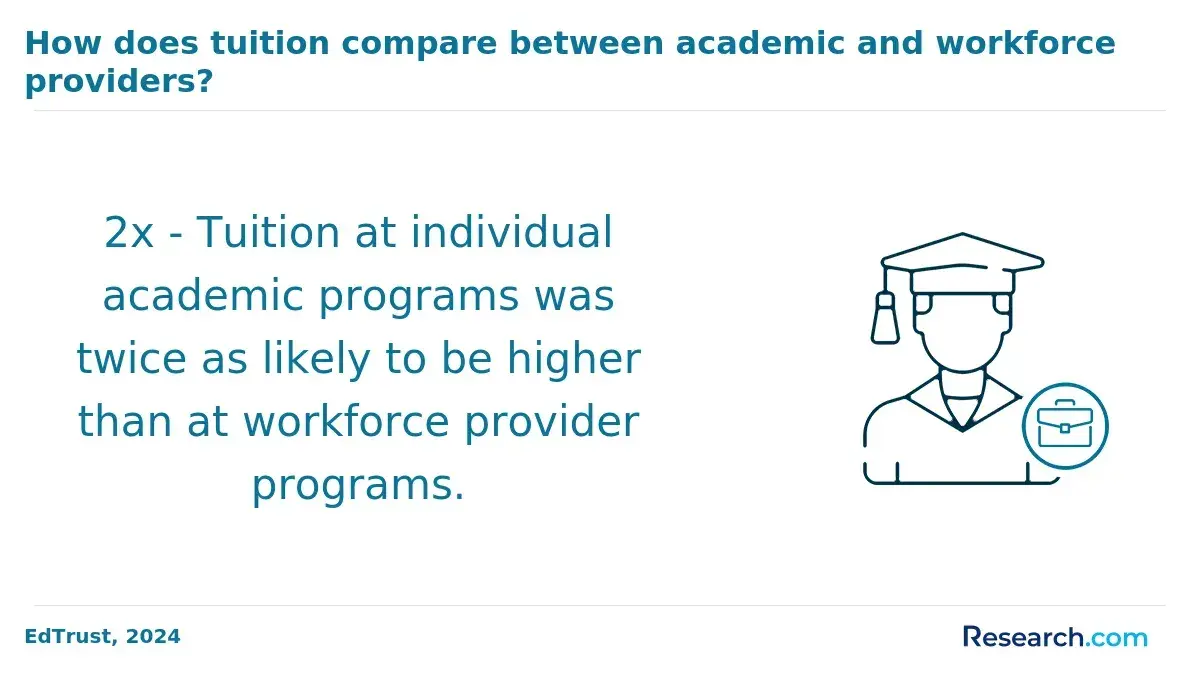
Tuition is only one part of the investment. College Board reported average 2024-25 published tuition and fees of $4,050 for in-district students at public two-year institutions. That benchmark does not represent the price of every certificate, and it excludes expenses such as books, software, testing, equipment, transportation, and clinical compliance.
To compare affordability, calculate the full out-of-pocket amount after grants, employer assistance, and approved benefits - not just the advertised monthly payment. Learners who may later need a bachelor's degree should also review a cheapest online university pathway and ask whether certificate credits can apply to that future degree.
Before signing an agreement, use this sequence to avoid an expensive mismatch:
- Name the exact job, certification, or skill outcome you want.
- Confirm that the program's curriculum and delivery format meet that outcome's requirements.
- Add every required expense, including exam fees, supplies, travel, and unpaid practicum time.
- Compare completion pace with your work and caregiving schedule.
- Read refund and withdrawal terms before making a deposit.
What coursework, skills, and learning outcomes do these online programs provide?
Coursework should lead to observable skills, not merely attendance. Good online non-degree programs use demonstrations, graded projects, simulations, case studies, portfolio work, or supervised practical assessments.
The core content differs by field. Trade programs may teach safety, measurement, schematics, and codes. Healthcare programs may cover terminology, privacy, documentation, and workflow. Legal programs often emphasize research, writing, and ethics. Design programs require software practice and portfolio development.
AI tools are increasingly part of workplace workflows, especially in administrative, design, and technology-related roles. A strong program teaches learners to use tools responsibly, verify output, protect confidential information, and demonstrate their own competence rather than submit unexamined automated work.
Ask for a course outline and sample assessment. The best fit has outcomes you can show to an employer - such as an accurate coding exercise, a completed CAD drawing, a legal research memo, or a reviewed design portfolio - and not just broad claims about being "career ready."
What careers and job roles can online non-degree programs help you pursue?
Online non-degree training can help people qualify for entry-level support roles, strengthen an existing application, prepare for an industry examination, or move into a more specialized task area. It is usually most useful when the employer recognizes the skill, the role does not require a degree or license beyond the program, and you can demonstrate competence through experience, a portfolio, or an exam.
It is less suitable as a stand-alone path for occupations with mandatory degrees, extensive supervised training, or state licensing rules.
Possible directions depend on the program's scope and local hiring practices:
- Trade and technical training may support apprenticeships, maintenance helper roles, CAD technician work, estimating support, or equipment-service pathways.
- Healthcare administration training may support medical records, scheduling, billing, coding support, or patient-access roles; clinical roles may require additional approval or certification.
- Legal and criminal justice training may support legal assistant, records, compliance support, victim-services, or administrative roles, not independent legal practice.
- Arts and design training may support junior design, content production, digital asset, web-content, or freelance portfolio work.
Review job postings in your intended city before enrolling. If most listings request a particular certification, software platform, portfolio standard, degree, or years of experience, select training that addresses that stated requirement rather than a broad credential with an appealing title.
What salary ranges and earning potential are realistic after completing these programs?
Salary data describes occupations, not what certificate completers automatically earn. Pay varies by location, employer, experience, schedule, licensure, and whether a role requires education beyond a non-degree program. The following U.S. Bureau of Labor Statistics May 2024 median annual wage figures provide context for occupations related to common program areas; entry-level pay can be lower, and a certificate alone may not qualify a candidate for every role shown.
| Related occupation | Median annual wage | 2024-2034 employment outlook | Credential caution |
| HVAC mechanics and installers | $59,810 | 8% growth | Typically requires hands-on training; licensing rules vary by state. |
| Electricians | $62,350 | 9% growth | Usually requires an apprenticeship and state or local licensing. |
| Medical assistants | $44,200 | 12% growth | Employers may prefer certification; clinical preparation is often needed. |
| Paralegals and legal assistants | $61,010 | 0% growth | Employer expectations vary; the role does not permit practicing law. |
| Graphic designers | $61,300 | 2% growth | Portfolio quality and experience remain important. |
Use wage information as a market check, not a return-on-investment promise. Compare local job ads, likely starting pay, total training cost, and the time you may spend building experience before deciding whether a short program is sufficient or whether a degree, apprenticeship, or additional certification is the better route.
How can students verify licensing, certification eligibility, and professional recognition?
Verify professional recognition before enrollment, especially in healthcare, skilled trades, legal support, and regulated design fields. Start with the state licensing board or the certifying organization - not the school's marketing page - and confirm whether the occupation is regulated where you plan to work. Then compare the program's written curriculum, clinical or lab hours, accreditation or approval, and graduation requirements with the published eligibility criteria.
Use these checks to reduce the risk of completing training that does not lead to the outcome you expected:
- Identify the exact license or certification required or preferred in your target job postings.
- Read the issuing board's current eligibility rules, including education, examination, experience, background, and residency requirements.
- Ask the program for written confirmation of what it prepares students to do and what it does not qualify them to do.
- Confirm whether online learners can complete required practical hours in their state and who arranges the site.
- Save written answers and verify them with the relevant board or certifying organization before paying tuition.
A common mistake is treating "exam preparation" as proof of exam eligibility. Another is assuming national recognition overrides state rules. Requirements can change, so verify them again near graduation and before scheduling an examination or accepting a job offer.
Other Things You Should Know About
Sometimes. Self-paced programs may allow rolling enrollment, while college certificates and clinical programs usually have multiple scheduled start dates. Confirm the next available course, not just the application deadline.
They can be worthwhile when they teach a skill employers request, fit a specific career goal, and have transparent costs. They are less valuable when the target role requires a license, degree, apprenticeship, or certification the program does not provide.
It may prepare you for an examination, but completing a certificate does not automatically grant professional certification. Check the certifying organization's education, examination, and experience requirements independently.
Eligibility depends on the school, program, credential level, enrollment status, and student circumstances. Credit-bearing programs at eligible institutions may offer aid, while many noncredit and third-party programs do not.
References
- Can I Take Prerequisites Online? https://www.straighterline.com/blog/can-i-take-prerequisites-online
- Department of Exploratory Studies https://www.utoledo.edu/uc/undecided/nondegreeseeking.html
- Non-Degree Programs: Declining Enrollments and Future Prospects https://wenr.wes.org/americas/non-degree-programs-in-the-u-s-declining-enrollments-and-future-prospects/
- Getting a job without a 4-year degree. Prospects increase with a certificate. https://www.luminafoundation.org/resource/non-degree-credentials-provide-value-for-adults-in-the-labor-market/
- Programs for Non-Degree Seeking Students | University of Phoenix https://www.phoenix.edu/blog/non-degree-seeking-student.html
- The Non-Degree Market: Oasis or Mirage? https://www.encoura.org/resources/wake-up-call/the-non-degree-market-oasis-or-mirage/
- Explore Your Bright Horizons Benefits https://www.brighthorizons.com/article/education/navigating-non-degree-landscape
- Nondegree providers face high costs, challenges standing out in a crowded space, report finds https://www.highereddive.com/news/non-degree-programs-high-costs-crowded-market/644054/
- Most Affordable Online Colleges & Universities | Learn How To Become https://www.learnhowtobecome.org/online-universities-and-colleges/most-affordable/