2027 Assessing Data Literacy Training for Public Health Managers: A DrPH Applied Project Planning Guide

Co-Founder and Chief Data Scientist
Public health managers make decisions from surveillance reports, dashboards, and program evaluations, but access to data does not ensure confident interpretation. For an experienced practitioner considering a DrPH applied project, the challenge is to assess whether training changes managerial decisions - not merely whether participants liked a workshop.
This guide explains how to scope a partner-approved project, select competencies and outcome measures, handle data responsibly, and judge whether a DrPH is the right route for the work.
Key Things You Should Know
- Assess managers' performance on realistic decisions before and after training; attendance and satisfaction alone cannot establish improved data literacy.
- Secure an organizational sponsor, data permissions, a feasible follow-up period, and academic approval before promising a training evaluation.
- Choose a DrPH when the project supports sustained practice leadership; a shorter course or employer-led evaluation may be enough for a single training need.
What Is Data Literacy Training for Public Health Managers?
Data literacy is the ability to ask an answerable question, judge whether available data fit it, interpret results and limitations, and communicate a defensible decision. For a health department manager, training might involve deciding whether an apparent change in service use warrants investigation before shifting staff or funding. It is not necessarily training to become a statistician or software developer.
Managers may bring different preparation to the same workshop. Someone reviewing online public health bachelor's curriculum and formats can see what foundational study may cover, but a degree title does not establish proficiency with an agency's reporting systems or decision rules. Assess the work managers actually perform before selecting lessons.
Why Does a DrPH Applied Project Assess Data Literacy?
A practice-focused DrPH project should address an organizational decision with an achievable improvement purpose. In this case, the problem might be that managers receive routine reports but lack a shared process for checking data quality and explaining uncertainty before allocating resources. That is a project hypothesis to investigate, not evidence that a particular agency or its staff have failed.
The project's value lies in connecting workforce development to management practice: who uses the reports, which decisions follow, and what would count as a safer or more equitable interpretation. An executive sponsor, participating managers, data stewards, and affected community representatives may have different priorities; their roles in selecting questions and reviewing outputs should be agreed upon early.
If the organization only needs a bounded workshop and already has evaluation support, a DrPH may be disproportionate. Compare the doctoral commitment with targeted training or an MPH using resources on online MPH programs by tuition affordability, while checking whether any option provides the needed supervision and project access.
What Data Literacy Competencies Should Public Health Managers Develop?
Choose competencies from the decisions managers control, not from a generic software syllabus. The table separates useful capabilities from the evidence an assessment could seek; the examples are planning options, not validated measures for every agency.
| Managerial competency | Observable evidence |
| Frame a decision and select an appropriate measure | States the population, time period, denominator, and decision the measure informs |
| Check data quality and fit | Identifies missing records, reporting delays, or changes in definitions |
| Interpret variation and uncertainty | Distinguishes a possible signal from an unsupported causal claim |
| Apply equity and data governance | Notes whose experiences may be missing and follows access and disclosure rules |
| Communicate a decision | Explains a recommendation, its limitations, and what additional information is needed |
A manager who must commission an analysis needs enough fluency to challenge assumptions and act responsibly, not necessarily advanced modeling skills. If the intended role involves designing statistical analyses, compare more specialized preparation, including biostatistics master's schedules for employed students.
A manageable project has a named decision-maker, a defined group of managers, a training approach the organization can deliver, and a product it will use. A practical output could be a revised training module, an assessment rubric, and a brief recommending whether to continue, revise, or stop the training.
Before implementation, establish the following sequence with the partner and faculty supervisor:
- Document the decisions and reports managers currently use; review existing materials without assuming access to restricted records.
- Agree on the sponsor's authority, participants' work time, community input, data stewardship, and the decisions the evaluation may inform.
- Specify competencies, training activities, assessment tasks, comparison approach, and a realistic follow-up point.
- Obtain required site, academic, data-use, and ethics determinations before collecting or sharing information.
- Deliver a usable product and review its limitations and proposed revisions with the partner.
This is principally a workforce-development and practice-evaluation project. A project designed to generate generalizable research questions may require different methods and oversight. Readers primarily seeking an epidemiology research doctorate rather than organizational change can compare lower-cost epidemiology research training and aid; the cheaper route is not automatically the better fit for a partner-led intervention.
Start with the decision the evaluation must support: whether to retain the training, revise it, or expand it. A pre-training scenario and a comparable post-training scenario can test whether managers identify an appropriate denominator, recognize missing data, and explain a cautious recommendation. A later review of authorized work products may show whether those behaviors carry into practice.
Use the same scoring rubric across assessments, record who completed each stage, and report missing follow-up. If managers self-select into training, their results may not represent colleagues who did not participate. Improved scores without a suitable comparison cannot by themselves establish that training caused better organizational decisions; staffing changes, new dashboards, or familiarity with the test may also matter.
Process measures such as attendance and usability feedback explain whether delivery worked, but they answer a different question from demonstrated skill. Promotions or pay are still less direct measures of a workshop's effect. An MPH salary and career earnings outlook may inform an individual education decision, not serve as evidence that this training improved managers' performance.
Look for coursework in program evaluation, applied epidemiology or biostatistics, data visualization and communication, leadership, organizational change, and ethics. The useful question is whether courses let a student design an assessment, interpret imperfect practice data, and negotiate a feasible change with a partner - not whether the catalog merely mentions analytics.
Ask prospective programs when methods courses occur relative to project proposal approval, whether an evaluation specialist can advise the work, and whether electives can address a specific technical gap. An applicant considering an MPH before doctoral study may also be weighing admissions logistics, such as finding MPH programs without recommendation letters. That policy should not outweigh evidence that the program builds the methods and practice skills the eventual project requires.
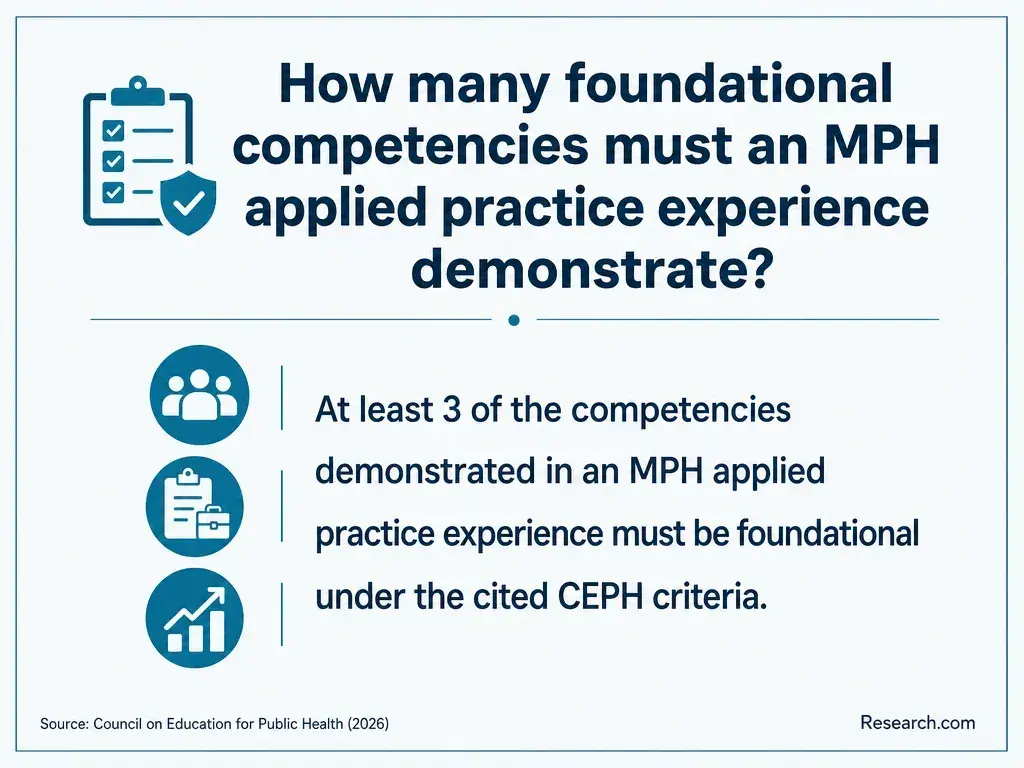
Requirements come from the student's program and its applicable accreditation standards, not from the project idea alone. Confirm the exact DrPH degree and its coverage under Council on Education for Public Health (CEPH) accreditation; institutional accreditation and a school's general public health reputation do not settle the scope. The program must explain its own applied practice, integrative, doctoral-project, supervision, and assessment rules.
Ask the program director whether an existing job can serve as the project setting, what distinct learning and deliverables are required, and who approves the site and supervisor. Employer permission to undertake the work is separate from permission to use identifiable records, publish results, or present a portfolio artifact. The same distinction matters when comparing online MPH program accreditation comparisons: verify coverage for the particular degree rather than transferring an MPH's status or requirements to a DrPH.
Online study can make coursework accessible to employed managers, but it does not remove live meetings, group work, campus visits, partner negotiations, or data-security obligations. Campus study may make faculty collaboration easier while adding travel or time away from work. In either format, project feasibility depends more on responsive supervision and a workable partner agreement than on the delivery label.
Request the actual term schedule and ask how often the student, faculty adviser, and site supervisor must meet; who helps resolve a lost project site; and whether the program permits secure remote access to approved data. A research-focused PhD may offer a different supervision model and funding structure. Public health PhD tuition comparisons can help frame that alternative, but tuition alone cannot show whether a PhD supports the intended practice-based training evaluation.
DrPH applicants should expect a program-specific review of academic preparation, relevant practice and leadership responsibilities, and readiness for doctoral work. An MPH, a particular job title, or a fixed number of years is not a universal requirement. If a prospective student first needs master's-level preparation, guidance on applying to an MPH with a lower GPA addresses a separate admissions decision; it should not be mistaken for a DrPH admissions policy.
For costs and timing, request a written estimate covering tuition, required fees, travel or residencies, software, project expenses, and any continuation charges. Then map the published course sequence against the time needed for partner approval, assessment, training delivery, and follow-up. Employer education assistance is valuable only if its eligibility and repayment conditions work for the applicant.
What Careers and Salaries Follow Advanced Public Health Data Training?
This project can provide evidence of readiness for responsibilities such as public health program management, workforce development, evaluation leadership, or agency performance improvement. Its strongest career artifact is a shareable, permission-cleared account of the decision, methods, limitations, and organizational product. A DrPH does not itself confer a promotion, clinical license, or entitlement to lead an agency's data systems.
Salary comparisons require a defined occupation, location, employer type, and level of responsibility. For US market context, check the most recent Bureau of Labor Statistics Occupational Outlook Handbook entry for the specific role under consideration and its stated wage reference year and employment projections. An occupation-wide median is not a DrPH graduate salary; public-sector pay bands and the applicant's existing seniority may be more useful for an individual decision. If the goal is simply to help current managers read reports better, employer-sponsored training and supervised evaluation may offer a more direct route than doctoral enrollment. Use doctoral public health tuition versus career outcomes as a comparison starting point, not a promise of a specific completion date or return.
Other Things You Should Know About Public Health
Participation rules depend on the employer, project design, and applicable review requirements. Clarify what is expected as part of the job, whether assessment information affects employment decisions, and how results will be reported before recruitment.
Use clearly defined task rubrics and cautious descriptive summaries, supplemented by feedback on how decisions are made. Do not present a small team's results as precise evidence of impact across other agencies.
Possibly, if the owner approves its use and access controls are appropriate. A simulated or properly deidentified example may be safer when real reports contain restricted information.
Ownership depends on university, employer, and partner agreements. Set expectations for reuse, attribution, confidential content, and public presentation before creating the materials.
- Designing an Assessment Strategy | U.S. Office of Personnel Management https://www.opm.gov/policy-data-oversight/assessment-and-selection/assessment-strategy/
- Developing Your Evaluation Plans: A Critical Component of Public Health Program Infrastructure - PMC https://pmc.ncbi.nlm.nih.gov/articles/PMC4592485/
- Data Sharing and Collection Principles and Standards | cdc.gov https://www.cdc.gov/program-collaboration-service-integration/php/data-security/principles.html
- Summary of the HIPAA Security Rule | hhs.gov https://www.hhs.gov/hipaa/for-professionals/security/laws-regulations/index.html
- Public health intelligence curriculum | who.int https://iris.who.int/server/api/core/bitstreams/46e1c51b-c1c4-49fe-8f8d-2f3709a7e758/content
- Data management competency framework | who.int https://www.who.int/publications/i/item/9789290620099
- Elements of an Evaluation Plan | Agency for Healthcare Research and Quality https://www.ahrq.gov/talkingquality/assess/evaluation-plan.html
- Privacy & Security - Health IT Playbook - HealthIT.gov https://playbook.healthit.gov/playbook/privacy-and-security/
- What is a DrPH and what can you do with it? | Capella University https://www.capella.edu/blog/health-sciences/what-is-a-drph-and-what-can-you-do-with-it/
- Guidance: Data Security and Privacy | lehigh.edu https://research.lehigh.edu/policies-guidance-forms/guidance-data-security-and-privacy