2027 MPH vs MS in Environmental Health for Exposure Assessment Work

Co-Founder and Chief Data Scientist
Exposure assessment jobs require more than an interest in environmental health: workers must identify hazards, collect defensible measurements, and explain what the results mean. An MPH and an MS can both lead toward this work, but they may provide different amounts of field, laboratory, and research training.
For prospective students and career changers, the better choice depends on the tasks they want to perform and the preparation they already have. This guide compares the degrees against actual exposure assessment responsibilities so you can evaluate programs before committing time and money.
Key Things You Should Know
- Choose an MPH when exposure assessment will support public health practice, prevention, or community decisions; favor a technically intensive MS when you want to design measurements or lead specialized research.
- Neither degree title proves readiness to collect samples: examine instrument training, statistics, supervised fieldwork, and access to appropriate laboratory or research facilities.
- Compare total program cost with the experience you still need. A degree alone does not confer professional certification or qualify someone for every industrial hygiene or environmental scientist position.
Is an MPH or MS better for exposure assessment careers?
Neither degree is universally better. An environmental health MPH is often the stronger fit when the goal is to use exposure evidence in health department investigations, prevention programs, policy, or communication with affected communities. An environmental health, industrial hygiene, or related MS may be the stronger fit when the goal is to develop sampling protocols, analyze measurement error, or conduct sustained laboratory or research work. Actual coursework matters more than the letters on the diploma.
Use the intended job, rather than the program label, as the starting point for comparison.
| Decision factor | MPH may fit better | MS may fit better |
| Primary output | Population-health recommendations and prevention activities | Technical measurements, models, or research findings |
| Typical culminating work | Applied practice experience or practice-oriented project | Thesis, research project, or specialist technical work, where required |
| Main limitation to investigate | Whether technical sampling goes beyond an introductory course | Whether community practice and public health communication are adequately covered |
A technically strong MPH can beat a generalist MS for a specific job, and the reverse is also true. Review the graduate public health degree and concentration options, then compare individual course lists, project requirements, and employers' job descriptions. If you already have substantial field training, a targeted methods course and supervised work may offer more value than another degree.
What does exposure assessment work involve in environmental health?
Exposure assessment estimates who encounters a hazard, through which route, how much, and for how long. The hazard might be airborne particles, a workplace chemical, contaminated drinking water, or noise. Workers may define a population or job task, select a sampling strategy, calibrate instruments, document collection conditions, evaluate laboratory results, and communicate uncertainty. Environmental monitoring measures conditions in a setting; personal sampling and other evidence may be needed to estimate an individual's exposure. Neither is automatically a measure of health effects.
A workplace hygienist might compare task-based measurements with an applicable occupational exposure limit. A health department analyst might examine drinking-water results alongside where and when residents could have encountered a contaminant. Both need sound data, but the relevant standards, sampling design, and audiences differ.
Early-career workers commonly assist with sampling, records, quality checks, and reporting under supervision before designing an entire assessment. A relevant bachelor's degree plus field experience may suffice for some assistant or technician openings; a master's degree is not the default entry ticket. Someone still completing undergraduate study can consider accelerated online coursework for public health undergraduates, but should check separately whether required science laboratories and hands-on training are available.
Which degree requirements prepare graduates for exposure assessment jobs?
The most useful requirements produce evidence of technical judgment, not simply credit for an environmental health survey course. Look for instruction in exposure pathways, toxicology, sampling design, analytical methods, statistics, data quality, and interpreting measurements against an appropriate comparison value. Field methods should address calibration, chain of custody when applicable, detection limits, and what a non-detect result can - and cannot - establish.
Before applying, ask each program for examples of assessed student work and answers to these questions:
- Do students collect and interpret real measurements, or only review published datasets?
- Who supervises field or laboratory work, and can students access the instruments and facilities described?
- Does the culminating project require an exposure question, defensible methods, and a discussion of uncertainty?
Statistical fluency is especially useful when exposure varies across people, locations, and time. Students who want substantially more quantitative depth can compare biostatistics graduate programs for busy professionals, though biostatistics alone does not replace sampling instruction. Prior chemistry, biology, engineering, or data experience may narrow the gap; a career changer without it should budget time for foundations and supervised practice.
An MPH generally combines environmental health with broader public health preparation, such as epidemiology, population health, policy, and communicating findings to decision-makers. Its applied experience may let a student turn exposure data into a prevention recommendation. An MS may devote more room to advanced science, instrumentation, modeling, or a faculty-supervised research project. These are common orientations, not universal degree requirements.
The decisive comparison is the sequence of courses and projects. Check whether foundational chemistry or statistics must be completed before advanced exposure courses, whether desired electives run during your enrollment, and whether a thesis advisor or field site is available. An MS thesis involving existing data may provide excellent analysis training but little hands-on sampling; an MPH placement at an industrial hygiene unit could provide the opposite.
If the long-term aim is independently directed academic research, compare thesis supervision and future doctoral preparation rather than assuming an MS automatically leads to a PhD. Investigating low-cost PhD study in public health can help frame that longer route, but a doctorate is generally unnecessary for routine exposure assessment work.
Online study can work well for toxicology, study design, data analysis, and other coursework that does not require an on-site instrument. It is a weaker standalone choice if students never practice sampling, calibration, laboratory procedures, or field documentation. A credible online pathway should specify how those competencies are taught and assessed - for example, through approved local placements, scheduled campus sessions, or documented employer-supervised work.
Ask about required travel, instrument access, placement approval, and whether field hours can occur outside a standard workday. Recorded lectures do not necessarily make a practicum flexible. Compare these obligations alongside lower-cost routes through online public health study; the least expensive advertised tuition may not be the lowest-cost route if travel or an unpaid placement is required.
Both routes typically require a bachelor's degree and an application documenting academic preparation, but prerequisites vary by institution and specialization. An MPH may accept a wider range of prior majors while expecting readiness for graduate statistics and public health coursework. A technical MS may specify or strongly prefer chemistry, biology, mathematics, engineering, environmental science, or research preparation. Neither pattern should be treated as a rule for every program.
Applicants should distinguish a published prerequisite from a course that merely makes an application more competitive. Send admissions staff a transcript and ask whether missing science or quantitative courses must be finished before enrollment, can be completed afterward, or have an approved equivalent. If grades are a concern, comparing public health graduate programs with GPA flexibility can inform a shortlist; evidence of recent quantitative success is still particularly relevant to a measurement-heavy MS.
Completion time and price depend on required credits, course availability, enrollment pace, residency rules, and whether fieldwork or a thesis can be completed on schedule. A thesis can take longer if a suitable advisor, project, or data access is not in place; an applied placement can create a similar delay if a site is difficult to secure. Published tuition alone cannot establish total cost.
To compare offers, request a term-by-term plan and an itemized estimate for tuition, mandatory fees, travel, equipment, placement expenses, and any additional term needed to finish the project. Ask whether assistantships or employer support are actually available to students in the degree and delivery format you intend to use. Missing prerequisites can add courses before or during enrollment; guidance on public health graduate applications with outstanding requirements is useful, but only the admitting program can confirm how those courses affect your timeline and bill.
Relevant openings may include environmental health specialist, exposure assessment analyst, industrial hygiene assistant or specialist, occupational health and safety specialist, environmental scientist, or research associate. Job titles overlap: one "environmental health specialist" may inspect facilities, while another analyzes contaminant data. Read duties and required qualifications rather than assuming the title describes a sampling position.
An MPH graduate with field experience may be well positioned for agency work that combines exposure evidence, prevention, and public communication. An MS graduate with strong measurement and analytical work may fit a technical consulting, laboratory-linked, or research role. Either may need additional supervised experience before independently leading complex investigations. Some government positions have specific education rules, and employers may prefer particular science credits or industry experience.
For students ultimately interested in leading an independent research program, public health doctoral admissions comparison is a separate decision. A doctorate is not a substitute for field competence, nor is it a routine requirement for entry-level assessment work.
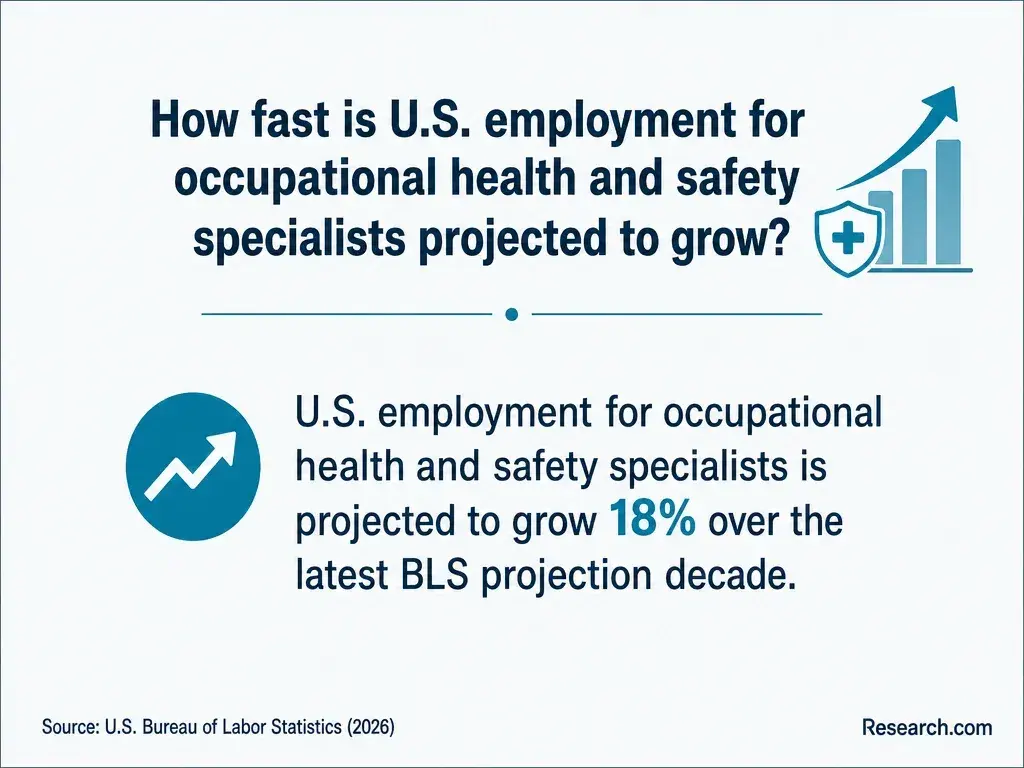
There is no single US wage or growth figure for "exposure assessor": the work spans several occupations. For a defensible comparison, use the US Bureau of Labor Statistics Occupational Outlook Handbook entry matching the actual duties - such as occupational health and safety specialist or environmental scientist - and note its wage reference year, projection period, and typical entry requirements. An occupation-wide median is not a starting offer or an MPH-versus-MS earnings estimate.
Location, employer type, technical specialization, and experience can matter more to an offer than the degree label. Compare local postings for the same role and seniority, then check whether the extra cost of a degree buys a required qualification or a skill you cannot obtain through supervised work. Broad career salary ranges for MPH degree holders can provide context, but should not be treated as exposure assessment pay data.
Which certifications and accreditations matter for exposure assessment careers?
Check accreditation at two levels: the institution's recognized accreditation and, when an MPH advertises public health accreditation, whether the Council on Education for Public Health (CEPH) covers the exact school, program, and degree under consideration. Institutional accreditation does not establish CEPH coverage; an environmental health MS is not automatically within the scope of an MPH program's accreditation.
For industrial hygiene work, the Certified Industrial Hygienist (CIH) credential can be relevant later in a career. Its certifying body sets education, science-coursework, experience, examination, and other eligibility rules; a master's degree alone does not confer it. Other credentials serve different roles, so check the credential named in target job postings rather than collecting certificates indiscriminately. If undergraduate science preparation is incomplete, even an online public health bachelor's degree or program should be evaluated course by course against the certifier's requirements, especially for laboratory sciences.
Before enrolling, confirm the degree's accreditation scope with the accreditor, credential eligibility with the certifying organization, and hiring requirements with prospective employers. Those three checks answer different questions.
Other Things You Should Know About Public Health
No. Limits have defined substances, averaging periods, settings, and purposes. Confirm that the right limit applies, then consider measurement uncertainty and people who may be especially susceptible.
Usually not by itself. A sensor may indicate conditions at its location, while personal dose also depends on where the person goes, how long they stay, and the exposure route.
That depends on who collected and controls the data and any agreements governing it. Obtain the relevant site, organization, or community permissions and check privacy and institutional review requirements before analysis or publication.
No. It means the laboratory did not detect the substance under the method's stated conditions. Review the reporting or detection limit before deciding what the result supports.
- Certified Industrial Hygienist (CIH) | osd.mil https://www.cool.osd.mil/dciv/credential/index.html
- Master of Public Health in Environmental Health Sciences | Rutgers School of Public Health https://sph.rutgers.edu/academics/degree-programs/master-public-health-mph-degrees/master-public-health-environmental
- MPH vs MS vs MHA: Which Public Health Master's Degree Is Right for You? | Tulane WSPH https://sph.tulane.edu/mph-vs-ms-vs-mha
- Master of Science Degree in Environmental Health Sciences | umich.edu https://sph.umich.edu/ehs/programs/ms.html
- MS, Environmental Health - UGA Graduate School https://grad.uga.edu/degree/ms-environmental-health/
- MPH in Environmental Health Sciences | Yale School of Public Health https://ysph.yale.edu/school-of-public-health/graduate-programs/master-of-public-health-mph-degree/environmental-health-sciences/
- MS in Industrial Hygiene & Environmental Health Sciences | ouhsc.edu https://publichealth.ouhsc.edu/academics/degree-programs/master-of-science/ms-in-industrial-hygiene-environmental-health-sciences
- MPH in Environmental and Occupational Health Sciences | CUNY Graduate School of Public Health & Health Policy https://sph.cuny.edu/academics/degrees-and-programs/masters-programs/mph-in-environmental-and-occupational-health-sciences/
- What Is the Difference Between an MPH and MSPH Degree? | Emory University https://sph.emory.edu/degrees-programs/faq/mph-msph
- Master of Public Health - Epidemiology Concentration, (MPH) https://catalog.memphis.edu/preview_program.php