2027 Graduate Public Health Preparation for Maternal and Child Health Program Manager Roles

Co-Founder and Chief Data Scientist
Maternal and child health (MCH) program managers turn community needs, funding requirements, and evidence into services that can be delivered and evaluated. Graduate study can build those skills, but an MPH alone rarely substitutes for experience managing partners, budgets, and staff.
This guide is for early-career practitioners and professionals moving into MCH from clinical, nonprofit, or other fields. It explains which educational routes fit the work, what practical evidence to build while studying, and how to judge whether another degree is worth the time and cost.
Key Things You Should Know
- An MPH with relevant MCH coursework and supervised program work is a strong preparation route, but manager hiring usually also depends on demonstrated implementation, partnership, and budget experience.
- Choose applied projects that produce usable evidence - such as an evaluation plan or partner-approved needs assessment - rather than relying on the concentration name alone.
- There is no single federal salary category for MCH program managers. The Bureau of Labor Statistics reported a $62,860 median annual wage for health education specialists in May 2023, but that occupation-wide figure is not a manager salary or a graduate earnings estimate.
What education is required for maternal and child health program manager roles?
There is no universal degree or license for an MCH program manager. Requirements depend on the employer and the work: a health department coordinating family health initiatives, for example, may value public health practice and grant administration; a health system may prioritize experience with its operations and reporting requirements. Read job postings for responsibilities and required experience, not just degree preferences.
A bachelor's degree plus substantial relevant experience can be sufficient for some roles. An MPH or related master's degree may improve preparation or meet a particular employer's requirements, especially when the position involves population-level planning and evaluation. Neither route automatically qualifies someone to supervise clinical care. If you are still building an undergraduate foundation, public health undergraduate study with intensive terms is one scheduling option to examine; confirm that its pace leaves room for relevant work experience.
For applicants coming from nursing, social work, education, or nonprofit services, the immediate gap may be budget ownership or program evaluation rather than another general degree. Compare target postings with work you can document before committing to graduate tuition.
Which public health degrees prepare you for maternal and child health management?
The best degree depends on whether you need broad practice skills, specialized analysis, or advanced leadership development. These routes are not interchangeable simply because each can address maternal and child health.
| Route | Best fit for an MCH goal | Important limitation |
| MPH, with MCH coursework when available | Program planning, population health, partnerships, and applied evaluation | An MCH concentration does not itself confer management experience |
| Research-oriented MS | Deeper preparation for a defined research or analytic function | May offer less training in operations and community program delivery |
| DrPH | Experienced practitioners seeking advanced practice leadership | Usually an inefficient first step into management |
| MPA or MHA | Public administration or healthcare operations when those dominate the target job | May require separate MCH population-health preparation |
For most aspiring MCH program managers who lack graduate practice training, an applied MPH is the clearest starting point. Compare actual course and placement options - not labels alone - when comparing public health master's career directions. An experienced manager who mainly needs one missing skill may get more value from employer-supported training or a focused course.
What accreditation should you look for in a public health program?
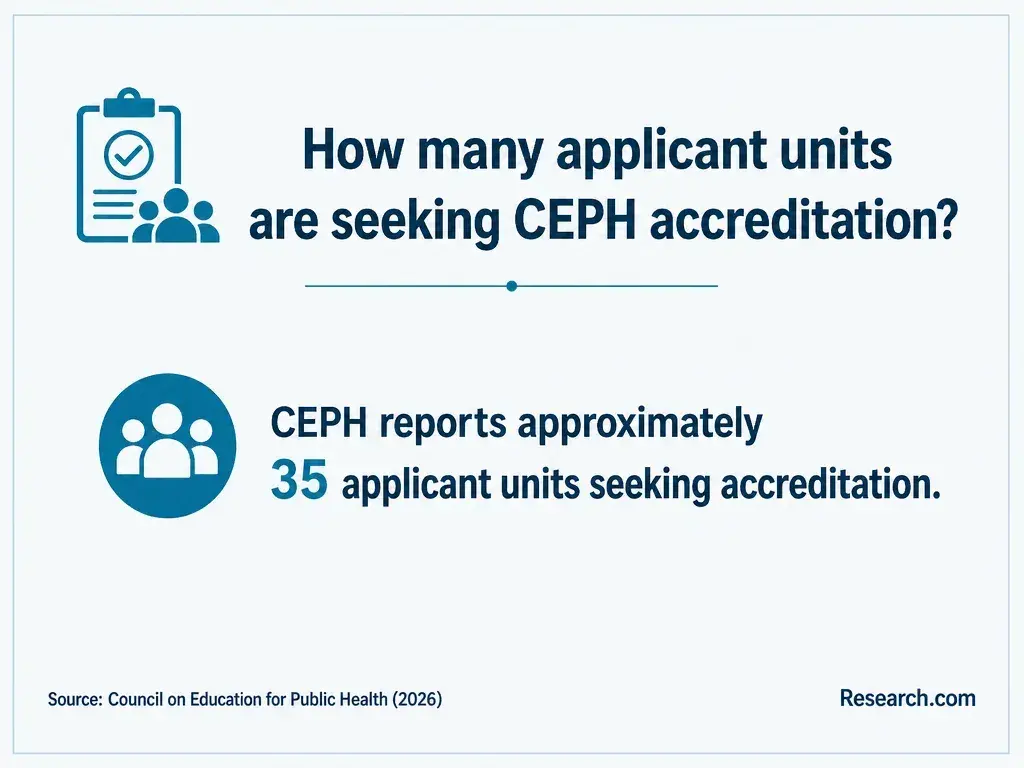
First, confirm that the university has recognized institutional accreditation. Then check the Council on Education for Public Health (CEPH) listing for the specific school, unit, or program and whether the degree you intend to earn falls within its accredited scope. Institutional accreditation and CEPH public health accreditation answer different questions; neither establishes that an MCH concentration, placement, or job outcome is available.
Ask the program to identify the credential awarded, its current accreditation coverage, and any relevant policies for your entry term. This matters particularly when comparing degrees with similar titles: public health doctoral programs with broader entry options, for instance, still need to be evaluated by their actual degree requirements and accreditation scope. Do not treat easier admission as evidence of a better route to MCH management.
Useful preparation connects the health of pregnant people, infants, children, and families to the systems and conditions that shape it. For management, prioritize courses in epidemiology and data interpretation, program planning and evaluation, health policy, community engagement, and budgeting or leadership. MCH-specific study should help you understand life-course approaches, family partnership, and how to interpret disparities without treating a population as uniform.
Course titles are less informative than the work they require. A strong applied sequence lets you define a community-identified problem, select feasible measures, develop an implementation plan, and explain its limits to a partner. Seek supervised opportunities to draft a logic model, monitor a grant-funded activity, or assess whether services are reaching the intended population. Confirm site approval and data permissions before proposing any project involving identifiable information.
Research training can be valuable for an analytic MCH career, but a dissertation is not a prerequisite for running a program. If your goal shifts toward independent research, comparing affordable public health PhD pathways becomes a separate decision involving research supervision and funding - not a substitute for management practice.
Yes, an online program can prepare you for MCH work if it provides substantive instruction, feedback, and access to approved applied experience. Delivery mode matters less than whether you can practice with an appropriate community organization, health department, or health system and receive qualified supervision.
Before enrolling, ask who finds placements, whether an existing job can qualify, which activities require live attendance, and whether travel or campus visits are mandatory. An online course can still involve fixed-time meetings and group work. When finding a lower-cost online MPH program, compare total tuition and fees alongside placement support and any unpaid fieldwork time; a lower advertised price may not mean a more feasible path.
Requirements are set by each program, not by the MCH field as a whole. MPH applicants commonly need an eligible bachelor's degree, transcripts, and materials explaining their goals; programs may also request recommendations, a résumé, an interview, or specified prerequisite work. A non-public-health major does not automatically rule you out. Check the exact program's policy on statistics preparation, GPA, tests, professional experience, and any prerequisite that must be completed before enrollment.
Build an application around evidence of readiness: describe the population you have served, the decisions you helped make, and the skills you still need. A nonprofit applicant might document partner coordination and grant reporting; a clinician might explain the move from individual care to population-level program design. If references are a constraint, comparing online MPH reference letter policies can help narrow programs, but verify each current application checklist before applying.
Completion time depends on required credits, course sequencing, enrollment pace, and applied-experience rules. Full-time graduate study may fit someone able to step away from work; part-time study may let a practitioner apply lessons immediately but extend tuition payments and delay completion. A thesis, limited elective availability, or a placement that requires daytime hours can change either plan.
Request a term-by-term schedule for your intended pace, including MCH electives and fieldwork - not just the school's advertised minimum time. Shorter public health study formats and career prospects are worth comparing only after checking whether the schedule permits the supervised work needed for your target role. Finishing faster is of limited benefit if you graduate without evidence that you can help run a program.
MCH work spans state and local health departments, community organizations, health systems, and research or service partnerships. Titles can include program coordinator, family health specialist, evaluation associate, program manager, and MCH director, but the authority attached to each title varies. Early-career staff may track activities and support partners; managers may oversee budgets, staff, contracts, implementation, and reporting.
A practical progression is to gain responsibility for a defined program component, document its measures and budget, then seek broader oversight. In applications, show what you personally did and what required supervisor or community-partner approval. Experienced practitioners considering doctoral study should first test whether it addresses a real leadership gap: online public health doctorate investment planning is more relevant after comparing that cost with advancement available through work experience or employer training.
No Bureau of Labor Statistics occupation isolates MCH program managers, so there is no defensible national median specifically for that title. For context, BLS reported a $62,860 median annual wage for health education specialists in May 2023. Some MCH positions involve health education, but the figure covers that whole occupation, not managers, MPH holders, or MCH specialists. A management title may also be classified differently depending on its actual duties.
For a useful pay comparison, collect salary ranges from current postings in your location and sector, then compare them with the program's full cost and earnings you might give up during study. Public-sector pay grades and nonprofit grant budgets can constrain compensation regardless of degree. Check institutional aid pathways for public health master's students, but count an award in your decision only after confirming eligibility, amount, and renewal conditions with the school.
What is the job outlook for maternal and child health program managers?
There is no BLS projection for MCH program managers as a distinct occupation. Broader health education or healthcare management projections cannot tell you how many MCH manager openings will exist in a particular community. Hiring depends on agency budgets, funded programs, retirements, and the experience an employer requires.
Use the local market as your guide: review recent postings across health departments, nonprofits, and health systems; note recurring duties; and look for coordinator roles that provide a route to budget or staff responsibility. For someone at the beginning of the pathway, cost-conscious online public health undergraduate study may be preferable to planning immediately for graduate school. The stronger long-term choice is the one that lets you build relevant, documented experience without taking on unnecessary education costs.
Other Things You Should Know About Public Health
Title V is a federal-state maternal and child health funding framework. If a target job works with Title V activities, learn how its state identifies priorities, engages families, and reports progress; responsibilities differ by position.
Not for every role. Population-health program management is distinct from licensed clinical practice. A position that includes regulated clinical duties may require a particular license, so check the posting and applicable state rules.
Usually, you can show work you are authorized to share. Remove confidential information, identify your own contribution, and obtain any required school or partner permission before displaying an organizational deliverable.
It may address a specific knowledge gap for someone who already manages programs. If you lack implementation, budget, or supervisory experience, pair targeted study with opportunities to demonstrate those responsibilities rather than assuming the certificate will replace them.
- General Grant Writing Tips | nih.gov https://grants.nih.gov/grants-process/write-application/general-grant-writing-tips
- Building leadership and managerial capacity for maternal and newborn health services - PMC https://pmc.ncbi.nlm.nih.gov/articles/PMC9450380/
- Training Needs Assessment - Planning & Evaluating | U.S. Office of Personnel Management https://www.opm.gov/policy-data-oversight/training-and-development/planning-evaluating/
- MCH Job Opportunities | University of Illinois Chicago https://maternalchild.uic.edu/careers/new-job-postings/
- Practicums, Internships and Projects What's the Difference? | Oregon State University https://health.oregonstate.edu/internships/types-of-experiential-learning
- Public Health Accreditation and Competencies | Arcadia University https://www.arcadia.edu/majors-and-programs/public-health-mph/accreditation-competencies/
- How to Become a Healthcare Program Manager | SPH | Boston University https://www.bu.edu/sph/blog/how-to-become-a-healthcare-program-manager/