2027 MPH vs MS in Biostatistics for a Career Changer

Co-Founder and Chief Data Scientist
If you are changing careers, an MPH and an MS in Biostatistics can lead toward very different work. The MPH generally combines statistical analysis with broader public health practice; the MS usually devotes more time to statistical methods and research. That distinction matters when employers need evidence of specific technical skills, not just a graduate credential.
This guide helps you connect your existing experience to a target role, identify preparation gaps, and compare programs on the coursework, projects, time, and cost that will affect your transition.
Key Things You Should Know
- Choose an MPH in biostatistics when you want to use data alongside epidemiology, program evaluation, and public health practice; favor an MS when your target job requires deeper statistical theory and methods.
- For a substantial switch into statistical work, check calculus, linear algebra, programming, and project expectations before applying. A degree title alone does not establish technical readiness.
- Compare the full cost and evidence of graduate outcomes, not advertised tuition or occupation-wide wages. The U.S. Bureau of Labor Statistics reported a $103,300 median annual wage for statisticians in May 2024, not a starting salary for either degree's graduates.
What is the difference between an MPH and an MS in Biostatistics?
An MPH in biostatistics is a professional public health degree that teaches quantitative analysis in the context of population health. An MS in Biostatistics generally concentrates more heavily on statistical methods, computing, and research. Neither label guarantees a particular course sequence or level of mathematical depth.
The comparison below describes common emphases, not universal requirements. Use it to decide which program features deserve closer inspection.
| Decision factor | MPH in biostatistics | MS in Biostatistics |
| Primary emphasis | Applying data to public health decisions | Developing and applying statistical methods in research |
| Typical breadth | Public health foundations plus quantitative courses | More concentrated statistics and computing coursework |
| Experiential work | Often an approved applied practice experience and integrative project | May include a thesis, research project, internship, or other program-specific requirement |
| Best fit when | The target role combines analysis with public health programs or stakeholders | The target role centers on study analysis, statistical methodology, or research collaboration |
Program names can obscure these differences: a quantitatively rigorous MPH may suit some analyst jobs better than a lightly technical MS. If your interests extend beyond biostatistics, comparing specialization fit across public health master's degrees can help clarify whether statistics should be the center of your degree.
Which degree is better for career changers: an MPH or MS in Biostatistics?
Start with the work you want to do, then assess the distance from your current skills. A clinician moving into outcomes evaluation may already understand health settings but need stronger analysis and programming. A software developer moving into statistical research may have computing skills but need probability, inference, and study-design training. Neither should assume their existing expertise covers the missing half of the job.
Choose an MPH when your goal is to analyze data while helping design, evaluate, or communicate public health programs. Choose an MS when job descriptions repeatedly call for advanced regression, statistical theory, clinical-trial analysis, or substantial research programming - and the particular MS teaches those skills. An MPH can still work for a technical transition if its advanced electives and supervised projects are strong enough; an MS can support public health work if you deliberately build domain knowledge.
Before committing to either degree, compare target job postings with your transcript and work samples. If you need one prerequisite or a small portfolio of analysis projects rather than a wholesale career reset, targeted coursework or supervised experience may be a better first investment. For an exploratory step, short online public health degree options provide context, but a shorter program should not be mistaken for equivalent biostatistics training.
What careers can you pursue with an MPH or MS in Biostatistics?
Both degrees can support applications for health data analyst, research analyst, or program evaluation roles. MPH graduates may be particularly well positioned for work that combines analysis with surveillance, community programs, or communication with public health partners. MS graduates may be better prepared for biostatistician or statistical programmer positions when their coursework and projects match the employer's methods and software needs.
Titles are not reliable shortcuts: one employer's "biostatistician" primarily prepares analyses under senior supervision, while another expects independent study design and complex modeling. Clinical research organizations, universities, government agencies, health systems, and nonprofits also differ in their experience requirements. An epidemiologist role may require substantial study-design and epidemiology preparation beyond statistical coursework.
For a career changer, the strongest bridge is often a supervised project using appropriately authorized data: document the question, analysis choices, checks, limitations, and a clear explanation for a nontechnical audience. Seek internships, research assistantships, or internal projects with real feedback rather than assuming the degree alone will secure a specialist position. Independent research leadership may call for additional experience or doctoral training; weigh that longer path against public health doctoral program cost-benefit considerations only if it matches your eventual responsibilities.
An MPH typically allocates coursework to public health foundations, epidemiology, and applying evidence in practice, leaving fewer credits for advanced statistics. An MS commonly devotes more of the curriculum to probability, inference, regression, study design, computing, and specialized methods. Actual depth depends on prerequisites, elective availability, and whether advanced courses run often enough to fit your schedule.
Inspect course descriptions rather than counting courses with "statistics" in the title. For a technical role, look for repeated opportunities to write code, handle missing data, assess model assumptions, and explain uncertainty. For a practice-facing role, look for opportunities to translate analyses into decisions with public health partners. An MPH applied practice experience is not automatically interchangeable with an MS thesis or research internship.
If you will keep working, ask when required methods courses meet and whether they must be taken in sequence. Comparisons of flexible routes to a biostatistics master's degree are most useful when checked against the actual advanced courses and project supervision available to part-time students.
Requirements vary by school. Both pathways generally require a qualifying undergraduate degree and application materials, but an MPH may accept a wider range of academic backgrounds while an MS may specify more mathematics or computing preparation. Neither an unrelated major nor prior public health experience alone determines eligibility.
For each shortlisted program, separate required prerequisites from recommended preparation. Ask whether it requires calculus, linear algebra, statistics, programming, or specific grades; whether coursework may be completed before enrollment; and whether professional or prior academic work can be evaluated as an alternative. A strong statement of purpose should connect your previous work to a specific analytical goal, while projects or transcripts should substantiate the skills you claim.
Application logistics also differ. Some schools request recommendations or tests and others do not; online graduate public health options without letters may be relevant if that is an obstacle, but confirm the policy for the exact biostatistics degree and entry term.
Completion time depends less on the degree label than on credits, enrollment pace, course sequencing, and the final project or fieldwork requirement. A full-time plan may be substantially shorter than a part-time plan, especially if an advanced course is offered only at certain times. Working career changers should ask for a term-by-term plan that includes prerequisites, required experiences, and the earliest realistic graduation date.
Preparation can extend the timeline before the graduate program even starts. If your target MS requires mathematics you have not taken, compare the time to complete those courses with the time needed to enter an MPH and build comparable technical skills through electives. Policies on applying to an MPH with incomplete prerequisites may offer another route, but admission with outstanding work is a school-specific decision, not permission to skip it.
Yes, an online program can be credible when its institution is appropriately accredited and its curriculum, assessment, and student support fit the target job. Delivery format alone does not establish rigor. For an MS, ask how students receive feedback on code and methods and access research supervision. For an MPH, ask how required applied experiences are approved and supported.
Confirm whether courses are asynchronous, whether live sessions or campus visits are required, and whether remote students can take the same advanced electives as campus students. These details matter more to a working career changer than an "online" label. Likewise, public health graduate programs with accessible entry should be assessed for curriculum and student outcomes, not judged credible or weak solely by admissions selectivity.
There is no reliable degree-wide price: tuition may be charged per credit or term, and credit totals and fees vary by institution. Request an estimate for your enrollment plan covering required credits, mandatory fees, prerequisite courses, software or computing costs, travel, and any project-related expense. If you reduce work hours or complete an unpaid experience, include that lost income in the decision.
Compare the estimated total for an MPH and an MS at the pace you can sustain, then subtract only funding you have been awarded or can reasonably confirm. Ask whether scholarships or assistantships apply to your degree, online format, and part-time status. For a closer look at charges beyond the advertised rate, use budget planning for online MPH study as a starting point, then obtain a written estimate from each school. If your goal is one technical skill rather than a new occupation, compare that total with the cost and limitations of a targeted course.
The U.S. Bureau of Labor Statistics reported a $103,300 median annual wage for statisticians in May 2024. That occupation-wide figure includes workers at different career stages and employers; it is not the expected starting salary for an MPH or MS graduate. BLS occupational projections can indicate demand for statisticians or epidemiologists, but they do not predict how many openings will be accessible to a new career changer in a particular region.
For a useful return-on-investment comparison, match actual job postings to your likely first role, required skills, location, and prior experience. Then compare plausible compensation with total education cost and earnings you may forgo. Where available, assess a program's reported outcomes by cohort, job type, and response rate rather than relying on a single headline figure. Public health graduate tuition after institutional funding is relevant to this calculation, but any award must be verified for your circumstances.
How can you choose an accredited biostatistics graduate program?
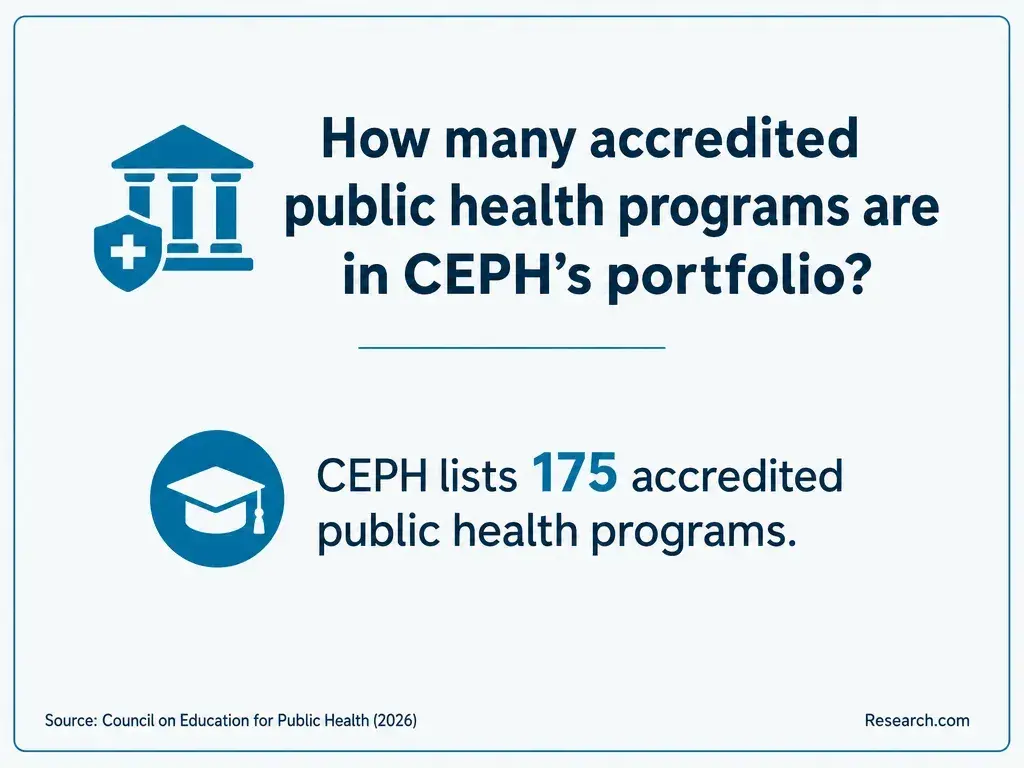
First verify the institution's accreditation and, for an MPH, check the Council on Education for Public Health's directory to confirm the accredited school, unit, or program and whether the particular degree is covered. Do not assume an MS has CEPH coverage because it sits in the same school as an accredited MPH. Accreditation is a baseline check, not evidence that a program teaches the methods or provides the experience your target employer wants.
Use the following sequence to make a decision you can defend:
- Collect several target job descriptions and identify the statistical methods, software, public health knowledge, and experience they require.
- Compare required courses, available advanced electives, prerequisites, and recent student projects against those requirements.
- Ask who supervises projects or placements, what remote and part-time students can access, and how graduates enter the roles you want.
- Obtain program-specific estimates of time, total cost, and confirmed funding before comparing likely career benefits.
If research doctoral study is a serious later goal, ask whether an MS offers appropriate thesis supervision and research opportunities rather than assuming any master's degree is sufficient. Also compare the prospective cost of that later step; finding affordable public health PhD study is a separate decision from choosing the best master's program for your immediate career change.
Other Things You Should Know About Public Health
Yes. Programs may accept applicants from other disciplines. The decisive questions are whether you meet their specific prerequisites and can demonstrate readiness for quantitative graduate work.
Not universally. Check each program's stated expectations, but learning to write, check, and explain reproducible analyses before enrollment can make the transition easier.
No. An MPH or MS in Biostatistics does not itself provide a clinical license. Clinical roles have separate education and licensing requirements.
Only with the necessary employer, program, and data-use permissions. Ask about privacy, security, and any required review before accessing data or including results in a portfolio.
- Graduate | EducationUSA https://educationusa.state.gov/your-5-steps-us-study/finance-your-studies/graduate
- Graduate Scholarships and Financial Aid Guide | FIU College of Business https://business.fiu.edu/academics/graduate/insights/posts/graduate-scholarships-and-financial-aid-guide.html
- Choosing Your Path in Public Health - Biostatistics | Columbia MSPH https://apply.publichealth.columbia.edu/choosing-your-path-in-public-health-chapter-1
- Master of Science (MS) vs. Master of Public Health (MPH) | Enrollment Services https://www.utmb.edu/spph/department/of-biostatistics-data-science/programs-training/graduate-programs/mph-vs-ms
- Funding Your Degree - The Graduate School https://gradschool.uky.edu/funding-your-degree
- MPH Biostatistics | ufl.edu https://phhp.ufl.edu/academics/masters-programs/mph/mph-concentrations/mph-biostatistics/
- MPH vs MS vs MHA: Which Public Health Master's Degree Is Right for You? | Tulane WSPH https://sph.tulane.edu/mph-vs-ms-vs-mha
- Differences Between MPH and MS Degrees | Yale School of Public Health https://ysph.yale.edu/school-of-public-health/graduate-programs/mph-degree-and-ms-degree/
- Admissions FAQs | Biostatistics https://sph.umich.edu/biostat/programs/faq.html
- M.S. in Biostatistics | Graduate Programs - Public Health https://graduatestudies.publichealth.med.miami.edu/academic-programs/masters-degrees/ms-biostatistics-program-plan/index.html