2027 Best Value Online SLP Programs (Cost vs ROI)

Co-Founder and Chief Data Scientist

Reviewed by Rhea Paul, PhD
SLP Education & Research Expert
Choosing an online master’s in speech-language pathology is a high-stakes decision: you are comparing tuition, accreditation, clinical placement support, licensure eligibility, and future earnings at the same time. A low-cost program can be a poor investment if it does not lead to certification, while a higher-priced program may be worthwhile if it has strong outcomes and helps you graduate on time.
This guide is for future speech-language pathologists, including recent graduates, working adults, and career-changers comparing online SLP programs. It explains what “best value” really means, how to evaluate total cost and return on investment, why ASHA-CAA accreditation matters, and how to choose a program that fits your goals without taking on unnecessary risk.
Key Things You Should Know About Best Value Online SLP Programs
- The median annual salary for speech-language pathologists was $97,870 in May 2026, highlighting the career's strong earning potential.
- With a projected 13,300 job openings each year, the field offers excellent stability and opportunities for new graduates.
- A master's degree from a program accredited by the American Speech-Language-Hearing Association (ASHA) is the mandatory requirement for licensure.
- The total cost for an online SLP master's program can range from under $30,000 to over $100,000, making careful selection essential.
- The profession is predominantly comprised of women, who make up 95.3% of all SLPs in the United States.
What makes an online SLP program a "best value" choice?
A best-value online SLP program is not simply the cheapest option. It is the program that gives you the strongest path to licensure, clinical competence, graduation, and employment for a cost you can reasonably manage.
Before comparing tuition, start with the factors that determine whether the degree will actually move you toward becoming a speech-language pathologist.
- ASHA-CAA accreditation: This is the first requirement to verify. Accreditation from the Council on Academic Accreditation in Audiology and Speech-Language Pathology shows that the program meets national standards for academic and clinical preparation.
- Licensure and certification alignment: A valuable program should prepare graduates for state licensure requirements and professional certification. If you plan to work in a specific state, confirm that the curriculum and clinical hours align with that state’s rules.
- Strong student outcomes: Look for Praxis exam pass rates, completion rates, employment outcomes, and evidence that graduates move into SLP roles. A program with low tuition but weak outcomes may cost more in the long run.
- Clinical placement support: Online students still need supervised clinical experiences. Ask whether the school helps secure placements or expects you to find them independently.
- Transparent total cost: The best-value choice clearly discloses tuition, fees, technology charges, clinical expenses, travel requirements, and any on-campus residency costs.
Why the cheapest program can become the most expensive option
Price is the advertised amount you pay. Value is what that payment helps you achieve. A low-tuition program that delays graduation, offers limited placement support, or does not meet licensure expectations can lead to extra semesters, additional fees, lost income, or an unusable credential.
The safest order of evaluation is simple: confirm accreditation first, review outcomes second, examine clinical support third, and then compare cost. That sequence protects your time, money, and career eligibility.
How much do online SLP programs typically cost in 2027?
The total investment for an online SLP master's degree typically ranges from $30,000 to over $100,000. That wide range is why applicants should compare the full cost of attendance rather than relying on a per-credit tuition figure alone.
An online format can reduce relocation or commuting costs, but it does not automatically make a program inexpensive. Clinical requirements, university fees, and residency-based tuition policies can change the final amount substantially.
Costs to include in your comparison
- Tuition: Compare the total number of required credits, not just the cost per credit.
- Residency-based pricing: Some public universities charge different rates for in-state and out-of-state online students.
- Mandatory fees: Technology fees, student services fees, clinical tracking fees, and graduation fees can add to the total.
- Clinical expenses: Background checks, immunizations, liability insurance, testing, travel, and placement-related costs may not be included in tuition.
- Campus visits or intensives: Some online programs require short in-person residencies, which may add travel and lodging expenses.
- Opportunity cost: If the program requires full-time study, consider the income you may lose by reducing work hours.
How to calculate the real price
Ask each school for the estimated total program cost through graduation. Then compare programs using the same categories: tuition, fees, clinical costs, travel, books or materials, and expected time to completion. This gives you a realistic “apples-to-apples” view of affordability.
A program at the higher end of the price range may still be a reasonable investment if it has strong outcomes and excellent clinical support. A program at the lower end may be the better value if it is accredited, transparent, and aligned with your licensure goals.
What is the return on investment for an SLP degree?
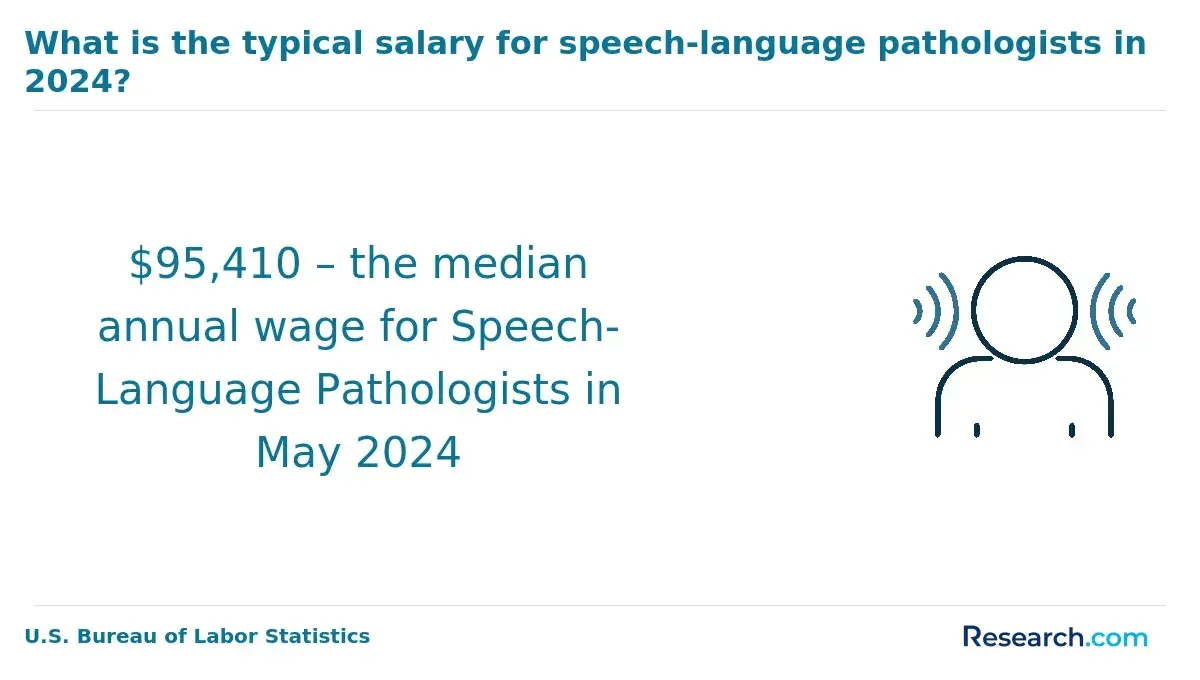
The return on investment for an SLP degree can be strong because the field combines professional licensure, steady demand, and a median annual wage of $95,410. However, ROI depends on how much you borrow, how quickly you graduate, where you work, and whether your program leads smoothly to licensure.
Demand is supported by a clear public need. Nearly 8% of children in the U.S. have a communication disorder, and SLPs also serve adults with speech, language, cognitive-communication, voice, and swallowing needs. This gives graduates access to multiple employment settings rather than a single narrow job market.
Financial ROI: what to compare
- Total debt at graduation: Include tuition, fees, living expenses, and interest if you borrow.
- Expected salary in your region: The median annual wage is $95,410, but actual pay varies by state, setting, experience, and employer.
- Time to licensure: A program that helps you complete clinical requirements efficiently can improve your return by getting you into the workforce sooner.
- Employment flexibility: Schools, hospitals, rehabilitation centers, clinics, private practices, and long-term care settings may offer different salary structures and schedules.
Professional ROI: stability and advancement
The speech therapist salary is only one part of the value. Many students choose SLP because it offers meaningful client work, a defined professional credential, and the ability to specialize over time.
Credential maintenance also matters. ASHA requires certified SLPs to complete 30 hours of professional development every three years. That ongoing education helps clinicians keep skills current and can support long-term career mobility.
Several programs stand out as useful starting points for students looking for the best value online SLP programs for 2025. The right choice still depends on your state, budget, schedule, clinical placement needs, and career interests, so use this list as a research shortlist rather than a final ranking.
- Texas Woman's University. This program is often considered a strong value option for students focused on affordability and practical clinical preparation. It may be especially appealing if your priority is limiting debt while pursuing a licensure-focused pathway.
- University of Wisconsin-Eau Claire. This option is known for academic rigor and strong student outcomes. It can be a good fit for applicants who want a public university option with a reputation for quality and structured preparation.
- University of Northern Colorado. This established online format may work well for students balancing graduate study with employment, caregiving, or other responsibilities while still seeking an ASHA-accredited education.
How to use this list wisely
Do not choose a program based on name recognition alone. For each option, confirm current accreditation status, total cost, required campus visits, clinical placement process, Praxis outcomes, graduation rates, and whether the program meets licensure requirements in the state where you plan to work.
If two programs appear similar, prioritize the one that offers clearer clinical support, stronger advising, and more transparent cost information. Those factors can have a direct effect on whether you graduate on time and enter the workforce without avoidable delays.
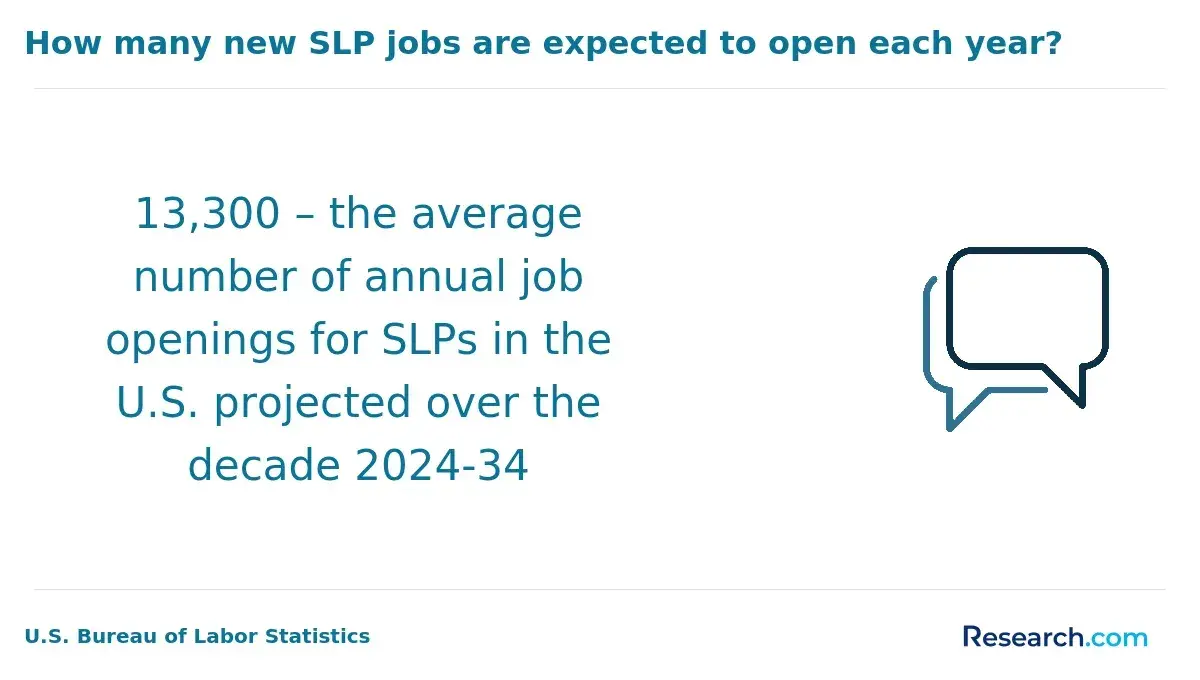
The job outlook for speech-language pathology graduates is strong. The U.S. Bureau of Labor Statistics projects about 13,300 openings for SLPs each year over the next decade.
That demand is significant when compared with the roughly 6,775 SLP master's degrees awarded in a recent year. While local job markets vary, the national picture suggests that qualified graduates are entering a field with steady need across age groups and care settings.
Where speech-language pathologists work
SLP graduates are not limited to one career path. Your preferred population, schedule, salary goals, and clinical interests can shape where you work.
- Schools: Many SLPs support children with speech, language, fluency, and communication needs in public or private education settings.
- Hospitals: Medical SLPs may work with patients recovering from stroke, brain injury, surgery, or other conditions affecting communication and swallowing.
- Outpatient clinics: These settings often serve children and adults who need ongoing therapy but do not require inpatient care.
- Rehabilitation centers: SLPs may help patients regain communication, cognitive-communication, or swallowing abilities after illness or injury.
- Private practice: Some SLPs join or build practices serving specific populations, such as children with language delays or adults with voice disorders.
- Long-term care: Skilled nursing facilities and residential care settings rely on SLPs for swallowing, cognition, and communication support.
- Universities: Experienced clinicians may move into teaching, supervision, research, or clinical education roles.
What this means for students
A strong job outlook does not remove the need for careful planning. Before enrolling, think about the settings where you want to work and whether the program offers relevant clinical experiences. A student interested in medical SLP, for example, should ask about adult neurogenic disorders, dysphagia preparation, and medical placement opportunities.
ASHA accreditation is one of the most important indicators of long-term value because it affects licensure eligibility, certification preparation, employer confidence, and the credibility of your degree. For an SLP master’s program, accreditation from the American Speech-Language-Hearing Association’s Council on Academic Accreditation is not a minor detail; it is a core requirement to verify before applying.
If a program is not ASHA-CAA accredited, you may not be eligible to practice as an SLP. That makes accreditation the first filter in your search, ahead of tuition, format, rankings, or application convenience.
What accreditation protects
- Your licensure pathway: Accredited programs are designed around national standards for SLP preparation.
- Your clinical training: Accreditation helps ensure that supervised practice is built into the program.
- Your financial investment: It reduces the risk of spending money on a degree that does not support professional entry.
- Your future mobility: A recognized credential can matter if you later move states or change employers.
How to verify accreditation
Check the program’s status through ASHA’s official directory, not only through marketing pages or admissions materials. Confirm whether accreditation is current, whether the online format is included, and whether there are any conditions or warnings that applicants should understand.
Accreditation is also connected to professional accountability after graduation. ASHA requires certified professionals to complete 30 hours of continuing education every three years, helping maintain the value of the credential throughout a clinician’s career.
Top online SLP programs generally look for evidence that applicants can handle graduate-level science, clinical reasoning, writing, and professional communication. Requirements vary by school, but most programs ask for a similar set of materials.
- A completed bachelor's degree from an accredited institution.
- A minimum GPA, typically 3.0 or higher on a 4.0 scale.
- Official transcripts from previous colleges or universities.
- Two to three letters of recommendation from professors, supervisors, or professionals who can speak to your readiness.
- A personal statement explaining your interest in speech-language pathology and your preparation for the field.
- GRE scores, although many programs have become test-optional in recent years.
- Prerequisite coursework in communication sciences and disorders or related foundational areas, if required by the program.
If you do not have a CSD background
You do not always need an undergraduate degree in Communication Sciences and Disorders to apply to an SLP master’s program. Many career-changers enter the field after studying education, psychology, linguistics, health sciences, or other disciplines.
If you lack the required background, you may need prerequisite or leveling courses before beginning the full graduate curriculum. These courses help build the foundation needed for graduate study in speech, language, hearing, anatomy, development, and clinical methods.
While data shows that 51.2% of professionals in the field hold a bachelor's degree, this should not be confused with the requirement for independent SLP practice. To practice as a licensed SLP, a master's degree is the required standard. Students exploring different entry points can compare options for completing a speech language pathologist degree.
How to strengthen your application
- Show informed motivation: Explain why SLP fits your skills and goals, not just why it sounds meaningful.
- Document relevant experience: Volunteer work, classroom experience, caregiving, research, healthcare exposure, or work with children and adults can help.
- Choose recommenders carefully: Strong, specific letters are more persuasive than generic letters from high-status contacts.
- Address weaknesses directly: If your GPA is uneven, use the application to show academic growth and readiness.
An online SLP program teaches the clinical, scientific, and interpersonal skills needed to assess and treat communication and swallowing disorders. Although coursework may be delivered online, accredited programs include supervised clinical practice so students can develop hands-on competence.
Students should expect a blend of theory, applied clinical decision-making, documentation, ethics, and supervised work with clients. The online format changes how courses are delivered, but it does not remove the clinical expectations required for professional preparation.
Core clinical skills
- Assessment: Learning how to gather case history, select appropriate tools, interpret results, and identify client needs.
- Diagnosis: Building the reasoning skills needed to distinguish among speech, language, cognitive-communication, voice, fluency, and swallowing concerns.
- Treatment planning: Creating goals and intervention plans based on evidence, client needs, and clinical judgment.
- Therapy delivery: Practicing strategies for working with children, adults, families, caregivers, and interdisciplinary teams.
- Documentation: Writing clear clinical notes, progress reports, treatment plans, and professional recommendations.
- Ethics and compliance: Understanding professional standards, confidentiality, scope of practice, and responsible care.
Professional skills
- Communication: Explaining clinical findings in plain language to clients, families, teachers, and healthcare providers.
- Empathy: Supporting people who may feel frustrated, vulnerable, or misunderstood because of communication barriers.
- Collaboration: Working with educators, physicians, occupational therapists, physical therapists, psychologists, and caregivers.
- Cultural responsiveness: Adapting assessment and intervention to each client’s language, background, and lived experience.
- Time management: Balancing coursework, clinical hours, documentation, and professional responsibilities.
Workforce data shows that 95.3% of practitioners are women, but effective SLP practice depends on training, clinical judgment, cultural competence, and communication skills rather than demographics. Students from varied backgrounds can bring valuable perspectives to the profession.
Choosing the right online SLP program means matching the program’s structure, cost, clinical model, and outcomes to your career goals. A highly regarded program may still be a poor fit if it does not support placements in your area, meet your state’s licensure needs, or work with your schedule.
Use a structured comparison process instead of relying on a single ranking or tuition number.
Questions to ask before applying
- Is the program ASHA-CAA accredited? Verify this first through an official source.
- Does it meet licensure requirements where I plan to work? State requirements can matter, especially for online students living outside the university’s state.
- How are clinical placements handled? Ask whether the school arranges placements, provides leads, approves sites, or expects students to secure their own opportunities.
- What is the program format? Determine whether classes are synchronous, asynchronous, hybrid, cohort-based, full-time, or part-time.
- Are campus visits required? If so, include travel, lodging, and missed work in your cost estimate.
- What are the student outcomes? Review Praxis pass rates, completion rates, employment data, and student support resources.
- Do faculty strengths match your interests? If you are interested in pediatrics, dysphagia, autism, voice, fluency, or neurogenic communication disorders, look for related coursework and clinical opportunities.
Considering your timeline: standard vs. accelerated paths
Most online master’s programs take about two years to complete, but timelines vary by enrollment status, prerequisites, clinical placement availability, and program design. Some students want to finish quickly; others need a slower pace to keep working or manage family responsibilities.
Your timeline is key. Some students thrive in accelerated SLP programs that can be completed more quickly, while others are better served by part-time programs that reduce academic pressure and allow continued income.
Common mistakes to avoid
- Choosing the lowest tuition without confirming total cost and accreditation.
- Assuming online means flexible; some programs require live attendance at fixed times.
- Ignoring clinical placement logistics until after admission.
- Applying only to highly selective programs without a balanced list.
- Failing to check whether the program supports licensure in your state.
The main alternative to earning a master’s degree in SLP is becoming a Speech-Language Pathology Assistant, often called an SLPA. This path may appeal to students who want to work in the field sooner, reduce education costs, or support therapy services without becoming an independent clinician.
However, the difference between SLP and SLPA is substantial. A master’s degree is the standard path to becoming a licensed, independent speech-language pathologist. An SLPA is a supervised support role with a different scope of practice and different long-term earning potential.
SLP vs. SLPA
- Education: SLPs must earn a master’s degree. SLPAs typically need an associate's or bachelor's degree with a specific clinical focus, depending on state requirements.
- Licensure and supervision: SLPs can qualify for independent clinical practice after meeting licensure and certification requirements. SLPAs work under the supervision of licensed SLPs.
- Scope of practice: SLPs assess, diagnose, create treatment plans, modify intervention plans, and make clinical decisions. SLPAs help implement services within the limits set by their supervising SLP and state rules.
- Responsibility: SLPs carry greater clinical, documentation, and decision-making responsibility. SLPAs provide essential support but do not replace the role of the SLP.
- Salary potential: SLPs generally have significantly higher earning potential because of their graduate education, licensure, and broader scope of practice.
The 51.2% of professionals in the field with only a bachelor's degree includes many people in assistant or related support roles. If your goal is independent diagnosis and treatment, the master’s degree remains the required route. If your goal is to enter the field in a support capacity, the SLPA path may be worth exploring.
Is an online SLP program worth the investment in 2027?
Yes, an online SLP program can be worth the investment in 2025 if it is accredited, affordable for your situation, and structured to help you complete clinical requirements and qualify for licensure. The strongest case for the degree is the combination of professional demand, meaningful work, and a median salary of $95,410.
The projected 13,300 new job openings every year also support the long-term value of the field. Still, the degree is not automatically a good investment for every student. The outcome depends on choosing carefully, borrowing responsibly, and confirming that the program fits your state, schedule, and career goals.
When an online SLP program is likely worth it
- The program is ASHA-CAA accredited.
- You understand the total cost before enrolling.
- The school provides clear clinical placement support.
- The curriculum aligns with your preferred work setting and state licensure needs.
- You are prepared for the academic and clinical intensity of graduate training.
- Your expected career path can reasonably support your education costs.
When to pause before enrolling
- The program’s accreditation status is unclear.
- The school cannot explain how online students complete clinical placements.
- You would need to borrow more than you are comfortable repaying.
- The format conflicts with your work, caregiving, or time-zone needs.
- You are interested in the field but not sure whether you want independent clinical responsibility.
The best value online SLP programs do more than deliver coursework remotely. They prepare you for licensure, support your clinical development, and help you enter a stable profession with confidence. If those pieces are in place, an online SLP master’s degree can be a practical foundation for a durable and rewarding career.
Other Things You Should Know About Best Value Online SLP Programs
In 2027, best value online SLP programs typically require 375 clinical hours, complemented by 25 observation hours. These hours must be completed in diverse real-world settings, often arranged through partnerships between the program and local healthcare or educational facilities.
Yes, you can typically get licensed in any state after graduating from an accredited online program. Licensure is granted by individual state boards, not the university. As long as your program is ASHA-CAA accredited and you meet the specific licensure requirements of the state where you want to practice, the physical location of your online university does not matter.
Many online SLP programs in 2027 do not require GRE scores for admission, but some still use them as an optional or conditional factor. Applicants should check each program’s published admission policy, because requirements can differ by university, and waived GRE policies are common in cost-focused programs.
- U.S. Bureau of Labor Statistics - Speech-Language Pathologists https://www.bls.gov/ooh/healthcare/speech-language-pathologists.htm
- ASHA EdFind - Accredited Speech-Language Pathology Programs https://find.asha.org/ed/
- ETS Praxis - Speech-Language Pathology (5331) https://praxis.ets.org/test/speech-language-pathology-5331.html
- University of Nebraska at Kearney - Speech-Language Pathology, Master of Science in Education (Online Track) https://www.unk.edu/online/degrees-programs/speech-language-pathology-online.php
- Emerson College - Master of Science (M.S.) in Communication Disorders (Speech@Emerson, online) https://speech.emerson.edu/
- New England Institute of Technology - Master of Science in Speech Language Pathology https://www.neit.edu/academics/graduate-degrees/speech-language-pathology-ms
- Pepperdine University - Master of Science in Speech-Language Pathology https://healthscience.pepperdine.edu/online-masters-in-speech-language-pathology/
- California State University-San Marcos - Online MS in Speech-Language Pathology https://www.csusm.edu/slp/programs/mastersonline/index.html