# 1 position


Audited and Verified:
Our Editorial and Data Verification Process
Research.com uses government datasets, official education statistics and primary institutional information to support its career and degree guides. Our review process checks factual accuracy, occupational definitions, source dates and the requirements associated with the credentials discussed.
How This Article Was Fact-Checked
Our editorial team verifies salary estimates, employment projections, education requirements and program information against original data providers and official organizations. Salary figures are checked against the relevant occupational definitions and reporting periods. Information about licensure, accreditation and required in-person training is reviewed separately.
Fact-checked and verified on:

Co-Founder and Chief Data Scientist

Reviewed by Karolina Broda
Fact-Checker and Data Verification
Choosing affordable interior design training in Fort Pierce means checking more than tuition: a short certificate and an associate degree can lead to different work. The Research.com team of data scientists created a Most Affordable Interior Design Trade Schools in Fort Pierce for 2027 ranking to help students identify programs worth considering. The U.S. Bureau of Labor Statistics reports a $67,190 national median annual wage for interior designers in May 2025 - but that is not a starting-pay estimate. This guide helps you compare credentials, practical training, costs, and Florida career requirements before enrolling.
Interior design training connects visual decisions with measurable constraints: room dimensions, circulation, materials, lighting, accessibility, budgets, and client needs. An occupationally useful program should produce drawings and a portfolio, not just teach decorating preferences. Ask to see the actual course sequence before assuming a program covers technical design.
Fort Pierce students should first confirm which interior design or closely related drafting credentials are currently offered at Indian River State College, at which campus or online, and on what schedule. A nearby public option can reduce travel costs, but a course labeled "design" may prepare students for a different occupation. Employer-supervised work in a showroom, design office, cabinetry business, or construction-related firm can complement classroom practice; it is not automatically a registered apprenticeship or a substitute for a credential required for a particular professional goal.
Use the credential comparison below to match training depth to the work you want to do. These are pathway descriptions, not claims that every option is currently offered in Fort Pierce.
| Pathway | Typical emphasis | Best fit and main limitation |
| Short certificate or focused training | Drafting, design software, materials, or showroom skills | Useful for testing the field or adding a specific skill; may offer limited studio depth |
| Interior design associate degree | Broader studio projects, technical drawing, and general coursework | Fits students seeking a fuller portfolio; requires a larger time and cost commitment |
| Employer-sponsored training | Product knowledge, client service, estimating, and workplace processes | Can provide earnings and experience sooner; training breadth and portability vary by employer |
Potential workplaces include residential design firms, furniture and finish showrooms, kitchen and bath businesses, and firms serving commercial construction or renovation projects. The distinction matters: a showroom job may prioritize product specifications and sales, while a design-office role may require measured drawings, construction documents, and coordination with other professionals.
Fort Pierce applicants can search across the broader Treasure Coast when judging whether a credential is worth its commute and cost. Ask local employers which software, portfolio pieces, and entry-level titles they actually hire for. Do not treat every design-related posting as an "interior designer" role: duties, supervision, and eligibility to submit commercial plans can differ substantially under Florida rules.
The U.S. Bureau of Labor Statistics reports a $67,190 national median annual wage for interior designers in May 2025. This is the midpoint for employed workers across experience levels and locations - not a Fort Pierce wage, a new graduate's expected pay, or an estimate for showroom sales and drafting jobs. Use the occupation named in a job posting when comparing wages, because related roles can have different pay structures.
For a local return-on-investment estimate, collect recent Fort Pierce and nearby job postings with stated pay, then compare realistic entry-level earnings with what you could earn without enrolling. Include the time spent training, grants, likely borrowing, and the possibility of not completing. A program is a stronger financial choice when its portfolio and technical training qualify you for jobs you could not credibly pursue otherwise.
Length depends on the credential and course schedule. A focused certificate may require substantially less study than an associate degree, while part-time enrollment can extend either route. Request the published credit or clock-hour requirement, required course sequence, studio hours, and expected completion time for your intended enrollment pattern. There is no single Florida training-hour requirement that makes every interior design program interchangeable.
If speed matters, compare an accelerated schedule with the time needed to complete credible drawing and portfolio projects. A quickest associates degree search may help frame scheduling questions, but the fastest option is not necessarily the one with the right interior design curriculum. Ask whether prior coursework or documented learning can count toward the credential; obtain the college's written evaluation before relying on a shorter timeline.
Online delivery can work for design history, research, software demonstrations, and some critiques. In-person instruction can make it easier to assess material samples, measure spaces, receive direct feedback on drawings, and collaborate on projects. A strong hybrid program states exactly how students complete those practical tasks and how their work is assessed.
Remote access matters if travel from Fort Pierce would add substantial cost, but "online" does not mean equipment-free: check computer specifications, software access, sample kits, and any required site visits. If you are comparing regionally accredited non profit online colleges, verify the specific interior design credential and its practical requirements rather than relying on institutional accreditation or delivery format alone. Neither one establishes eligibility for Florida professional registration.
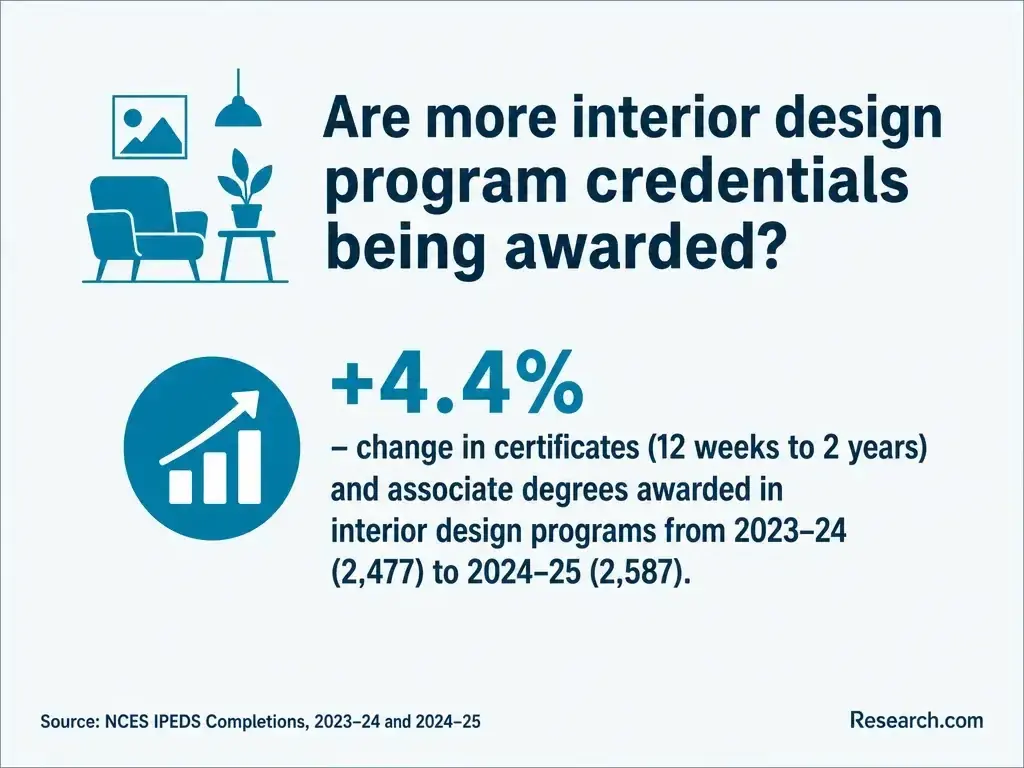
There is no reliable single average that describes every Fort Pierce pathway: a short course, an associate degree, and employer training have different pricing structures, and quoted tuition may omit essential supplies. Get a current 2026-27 written estimate for the specific program and your residency status. At Indian River State College, confirm applicable tuition and mandatory fees directly rather than assuming a published college-wide figure is your program's total.
Build a job-ready budget from these items, then subtract aid only after confirming eligibility and conditions:
Ask the financial aid office whether the exact credential qualifies for federal aid and which Florida aid or workforce programs you may be eligible for. Federal Student Aid eligibility depends on the student, institution, and program; an employer-paid training route may lower direct costs but offer a narrower curriculum. Compare net cost and likely debt, not advertised tuition alone.
The award may be a certificate or an associate degree, depending on the program you enroll in; employer training may instead provide a record of workplace competencies. Request the credential's exact title in writing. Similar-sounding awards can include very different amounts of studio instruction, technical drawing, and work suitable for a portfolio.
Institutional accreditation concerns the school. State authorization concerns permission to operate. Programmatic accreditation, where applicable, concerns a particular program; professional certification and Florida registration have their own requirements. None should be treated as a substitute for the others. Searches for online accelerated bachelors address a different credential decision: for this trade-school comparison, first verify what the certificate or associate program actually awards and whether it supports your intended work.
Requirements depend on the provider and credential. Ask admissions for the current application steps, academic prerequisites, placement rules, software or computer requirements, portfolio expectations, and any separate application needed for a selective program. Do not assume that admission to a college means admission to a particular interior design course sequence.
Working adults should also check whether studios are offered at times they can attend and whether prior coursework can be evaluated for credit. Confirm transfer or prior-learning decisions with the receiving program before enrolling elsewhere; a course that transfers as general credit may not replace a required design studio.
Look for a curriculum that makes students apply design decisions through measured plans, drafting or computer-aided design, materials selection, lighting concepts, presentation, and client communication. Depending on the program's scope, it may also introduce accessibility and building-code considerations. The decisive evidence is what students produce: ask to see recent project briefs and portfolios, including revisions made after critique.
Digital tools can speed up visualization and drafting, including AI-assisted concept work, but a convincing image is not proof that dimensions, materials, accessibility, or a budget work in a real space. A useful program teaches students to check those constraints and communicate corrections. Before choosing extra coursework such as dual major programs, establish whether the interior design training itself provides enough supervised practice for your target entry-level role.
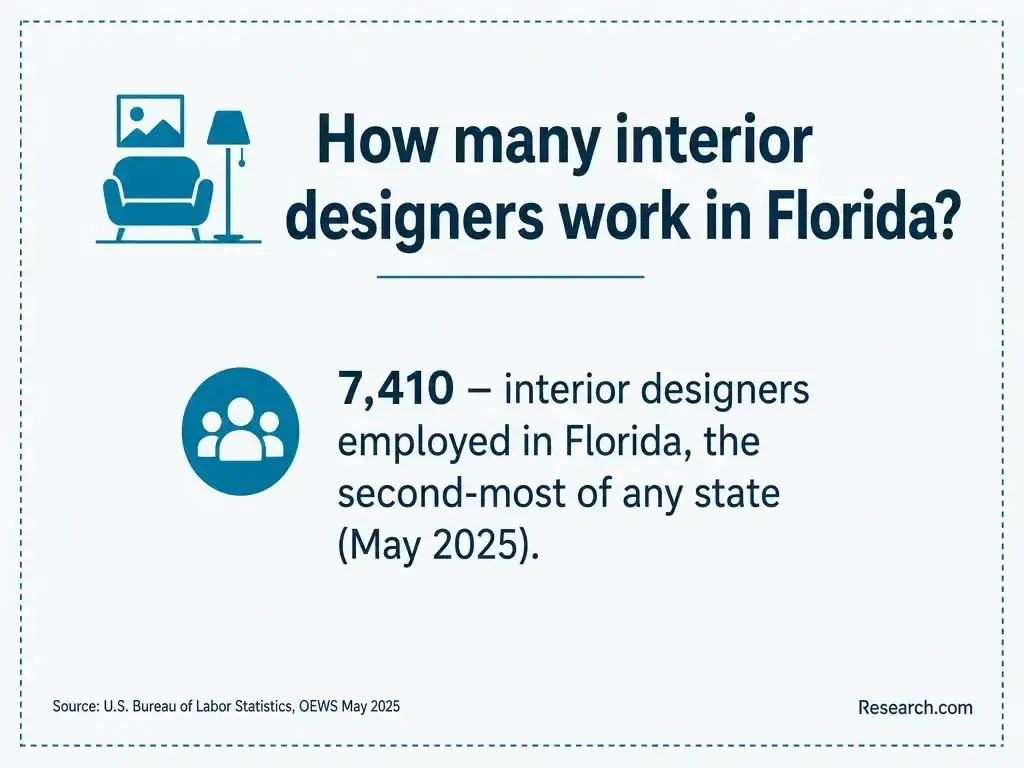
Not every interior design job in Florida requires professional registration. The important distinction is the work you intend to perform, particularly whether you want the authority associated with a Florida registered interior designer to submit qualifying commercial interior plans. Florida's Board of Architecture and Interior Design sets registration rules; completing a trade-school credential does not itself confer registration or establish eligibility. Check the board's current education, experience, and examination requirements before choosing a program for that goal (Florida Board of Architecture and Interior Design).
The Council for Interior Design Qualification administers the NCIDQ examination and publishes eligibility pathways involving education and work experience (Council for Interior Design Qualification). Its examination is distinct from school accreditation and Florida registration. If your aim is an entry-level showroom or support role, ask employers what they require rather than paying for a credential on the unsupported assumption that it is legally mandatory for every position.
Start with the job, then work backward to the credential. An affordable program is worthwhile if its training, schedule, and achievable cost fit the role you want; the ranking alone cannot answer that question. Use these checks before paying an enrollment deposit:
A common mistake is choosing the shortest or cheapest listing without checking portfolio quality or regulatory fit. Another is following unrelated searches - such as what's the easiest phd to get - instead of evaluating entry-level interior design work. For a residential showroom goal, a focused credential paired with paid experience may make more sense than a longer program; for a technical design goal, examine the depth of studio and drawing instruction before prioritizing speed.
A graduate's first role might involve design assistance, drafting support, product or finish selection, showroom sales, or kitchen and bath project support. These are related pathways, not identical job titles with identical pay or legal authority. Match applications to the portfolio you can show: measured plans support different opportunities from product presentations alone.
Experience can lead to larger client projects, a specialty, supervisory responsibilities, or independent work. The next step may be employer training in specifications and project coordination, or further education and supervised experience if Florida registration becomes a goal. Before paying for another credential, identify the particular work it would let you pursue and whether employers or the Florida board recognize that pathway.
The U.S. Bureau of Labor Statistics projects 2.7% national employment growth for interior designers from 2025 to 2035. That is a national occupation forecast, not a count of openings in Fort Pierce or a guarantee of a local job. Students should therefore test local demand through current postings across the Treasure Coast and distinguish openings for designers from sales, drafting, and installation-related work.
For a smaller local market, willingness to commute or take a related entry-level role can materially change the opportunities available after training. Compare each program's employer connections and the kinds of projects in student portfolios with the work employers advertise; that is more useful for an enrollment decision than applying a national growth figure directly to the city.
Investing in training is a consequential decision. Research.com created its ranking to make local program costs easier to compare, using reported data and a consistent scoring method rather than assuming the lowest advertised tuition is the lowest overall cost. Programs are compared with other interior design programs in the same geographic market, and only programs reporting completions to IPEDS are eligible. That means a provider's absence does not establish that its training is unavailable or poor quality.
The most affordable ranking scores tuition, cost of attendance, median student debt, and the federal loan default rate. Indicator weights are assigned through an entropy-based method, which gives more weight to measures that vary more across eligible programs. Accreditation and other quality indicators are not part of this affordability score; readers should check them separately. Research.com's best-program rankings use a different model that also considers completion, retention, earnings, accreditation or industry recognition, and student support.
The team uses the following sources across its trade-program ranking work. Some are relevant to other occupations rather than interior design; their inclusion here does not imply that they accredit interior design programs.
Use the ranking as a cost-screening tool, then confirm the current program, credential, schedule, and complete price directly with the provider. More detail on the approach appears in Research.com's methodology.
# 1 position
# 2 position
Compare a focused credential with paid entry-level work, then request complete, current prices for each available program. The lowest tuition may not be cheapest after software, materials, travel, and lost earnings.
Check its current program catalog and ask an advisor for the exact award, course sequence, campus or online availability, and requirements. Do not infer an interior design credential from the availability of a related design course.
A certificate may help with particular entry-level skills, but its value depends on its projects and employer expectations. It does not automatically qualify you for Florida professional registration.
It may teach concepts and software, but ask how it assesses measured spaces, materials, drawings, and a finished portfolio. Verify any separate Florida registration requirements for your intended work.
It can be if the credential builds skills and a portfolio needed for jobs you want at a manageable net cost. Compare realistic entry-level pay, completion time, debt, and alternatives such as employer training before deciding.