# 1 position


Audited and Verified:
Our Editorial and Data Verification Process
Research.com uses government datasets, official education statistics and primary institutional information to support its career and degree guides. Our review process checks factual accuracy, occupational definitions, source dates and the requirements associated with the credentials discussed.
How This Article Was Fact-Checked
Our editorial team verifies salary estimates, employment projections, education requirements and program information against original data providers and official organizations. Salary figures are checked against the relevant occupational definitions and reporting periods. Information about licensure, accreditation and required in-person training is reviewed separately.
Fact-checked and verified on:

Co-Founder and Chief Data Scientist

Reviewed by Karolina Broda
Fact-Checker and Data Verification
Choosing an affordable interior design program in Jacksonville means comparing more than tuition: the credential, portfolio work, and eligibility for the work you want all matter. The U.S. Bureau of Labor Statistics reports a $67,190 national median annual wage for interior designers in May 2025, but that is not a starting-pay estimate. This guide accompanies the Most Affordable Interior Design Trade Schools in Jacksonville for 2027 ranking, created by the Research.com team of data scientists to help students identify training worth considering and make an informed choice.
Expect a mix of design decisions and technical communication: developing a brief, planning space, choosing materials, preparing drawings, and presenting a workable proposal. Interior design differs from decoration because projects may require attention to accessibility, building codes, and coordination with architects or contractors. The U.S. Bureau of Labor Statistics describes these duties for the occupation.
Florida State College at Jacksonville is a local public-college option to investigate for interior design training. Compare its current curriculum with any certificate or private career-school course you consider: similarly named programs can differ substantially in studio time, drafting practice, software access, and portfolio feedback. Ask for a current course sequence and examples of student projects rather than relying on a program title.
Possible settings include residential design firms, furniture and kitchen-and-bath showrooms, commercial design teams, and firms serving hospitality, healthcare, or office clients. In Jacksonville, choosing between showroom sales and commercial project work matters: a showroom may prioritize product knowledge and client service, while commercial teams are more likely to seek technical drawings, documentation, and code awareness. The U.S. Bureau of Labor Statistics identifies design firms, architectural services, and furniture retailers among employers of interior designers nationally.
A portfolio and relevant experience may also support assistant or drafting roles. Ask prospective employers which software and drawing standards they use before paying for a specialized course; completing training does not by itself secure a design position.
A reliable Jacksonville-specific interior designer wage should be checked in the latest U.S. Bureau of Labor Statistics metropolitan occupational wage release before making a pay projection. The national median was $67,190 in May 2025, according to the Bureau of Labor Statistics. That figure covers employed designers across experience levels; it is not a forecast for a newly trained Jacksonville applicant or a showroom sales position.
When estimating whether training will pay off, compare pay for the job you could realistically enter with what you earn now. Ask programs for documented, occupation-specific placement and earnings information, including how many graduates were counted. Treat any unsupported "graduate salary" claim as a reason to ask follow-up questions.
Length depends on the credential and schedule. A focused certificate may fit around work and cover selected skills; an associate degree generally requires a longer sequence of studio, technical, and general-education courses. Part-time study can extend either route. There is no single Jacksonville-wide clock-hour requirement for every interior design training program; request each provider's published credits or contact hours, course schedule, and expected completion time.
Speed is useful only if the program reaches your target role. For a narrow software or showroom skill, compare targeted training with 6 month certificate programs for high paying jobs; the short timeline alone does not establish that a course prepares you for technical interior design work. A longer studio sequence may be worth the time if it produces stronger drawings and a reviewed portfolio.
Online courses can work well for design history, software instruction, and some digital presentations. On-campus or hybrid study can make it easier to use material libraries, produce physical samples, get live studio critiques, and collaborate on measured-space projects. The meaningful distinction is what you will make and receive feedback on, not whether lectures appear on a screen.
Check how an online program handles field measurements, studio critiques, software licenses, and access to local projects. If you hope to pursue Florida registration for commercial work, do not assume that an online credential - or an in-person one - meets the Florida Board of Architecture and Interior Design's education and experience criteria. Obtain written clarification before enrolling.
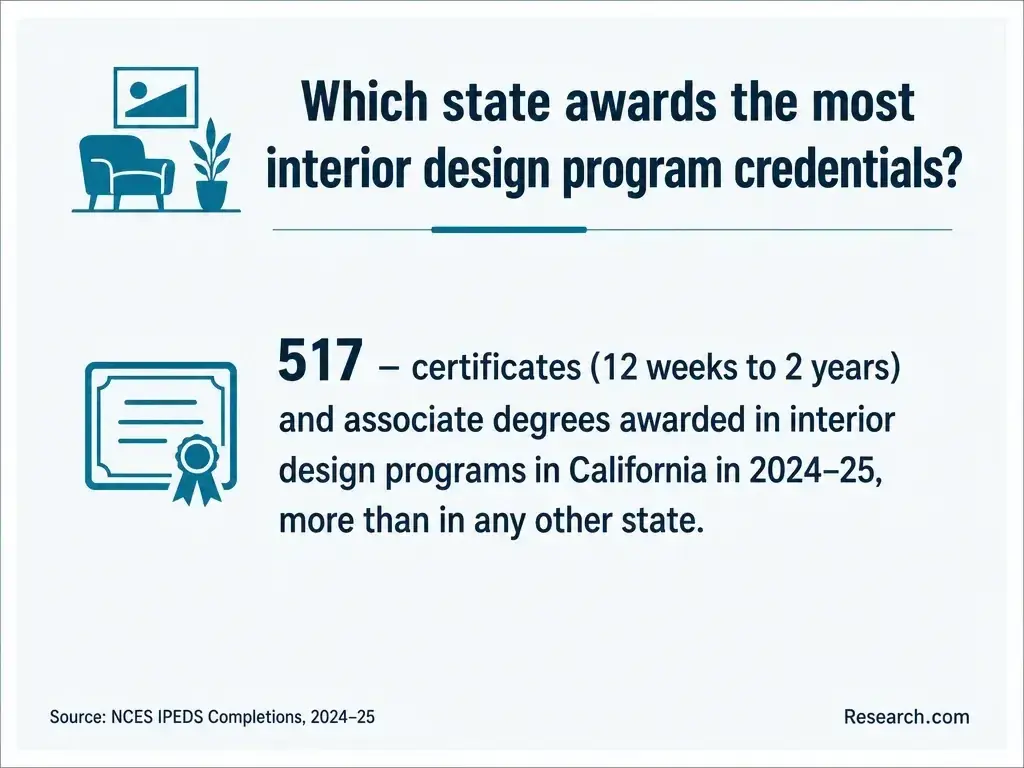
There is no defensible single average for all Jacksonville interior design training: a short course, a public-college associate degree, and private instruction are different products, and the ranking covers only IPEDS-reporting programs. Compare each option using a written total-to-completion estimate, not a per-course or per-credit headline.
Request an itemized estimate covering tuition, mandatory fees, textbooks, design supplies, drawing or rendering software, computer requirements, portfolio production, and travel to campus or project sites. Add income you may forgo while studying. Then subtract grants or scholarships you are actually eligible to receive; a loan reduces upfront payment but not the underlying price. Federal Student Aid determines eligibility for federal assistance by institution and program, so verify eligibility rather than assuming every course qualifies.
For return on investment, consider completion likelihood, debt, current earnings, plausible post-training work, and how long you expect to use the skills. A cheaper course can be poor value if it omits the technical work your target employer expects. If you are weighing interior design against other occupations, best trade school jobs offers a broader career comparison; compare entry requirements as carefully as prices.
The credential is whatever the specific program formally awards: potentially a course-completion certificate, occupational certificate, diploma, or associate degree. These are not interchangeable. A certificate may document a limited set of skills; an associate degree includes a broader academic course of study. Neither is the same as professional certification or Florida occupational registration.
Before enrolling, ask for the exact credential name on the transcript, whether credits transfer or apply toward another credential, and which portfolio pieces students complete. If your goal is commercial design practice, check the Florida Board of Architecture and Interior Design's current registration requirements against that exact program - not against the word "design" in its title.
Requirements vary by provider and credential. A college program may have general admission steps and course prerequisites, while a short noncredit course may permit direct enrollment. Confirm application deadlines, placement or prerequisite rules, computer specifications, and whether prior coursework or relevant experience can earn credit or advanced standing. Florida State College at Jacksonville's current admissions and program materials are the appropriate sources for its requirements.
Do not confuse admission with career eligibility: a school may admit you to a program that does not match your intended commercial practice. Ask the program director where recent students completed technical projects or gained work experience, and ask the Florida licensing board separately about registration criteria.
Useful curricula connect visual design with buildable plans. Look for measured drawings, space planning, color and materials, lighting, computer-aided drafting or modeling, presentation, and portfolio development. For commercial ambitions, examine the depth of instruction in accessibility, applicable building and fire codes, specifications, and coordination with other construction professionals. The U.S. Bureau of Labor Statistics identifies space planning, materials, drawings, and code-related considerations as parts of interior designers' work.
Software skill alone is not a substitute for evaluating circulation, dimensions, and material suitability. Ask how many projects receive individual critique and whether students produce a complete set of drawings; those answers reveal more about practical preparation than a course catalog's list of topics.
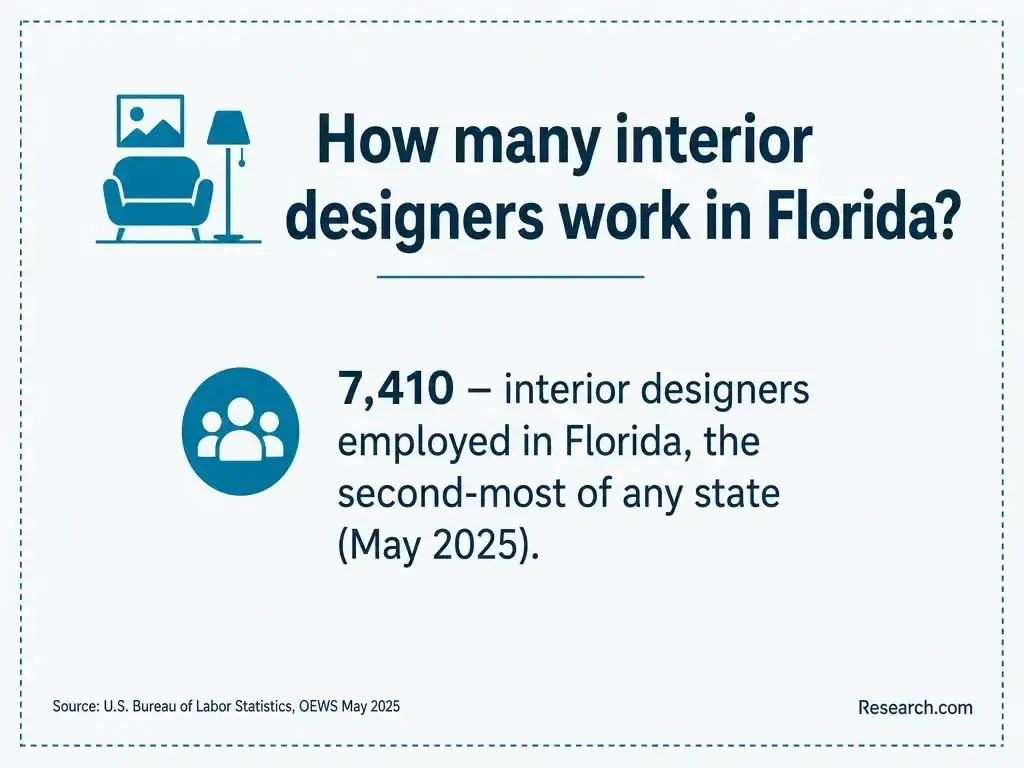
Not every interior design-related job requires Florida registration. The rules depend on the work performed, particularly whether you intend to practice within the scope reserved for a Florida registered interior designer on commercial projects. The Florida Department of Business and Professional Regulation and its Board of Architecture and Interior Design administer that registration. Residential decorating, retail consultation, and commercial work should not be treated as having identical regulatory requirements.
For a registration goal, verify the board's current education, experience, examination, and application requirements before choosing a credential. The NCIDQ examination is administered by the Council for Interior Design Qualification; passing an examination, holding a school certificate, and obtaining state registration are distinct steps. Institutional accreditation concerns the school, while specialized program accreditation concerns a particular curriculum. Neither automatically confers registration or permission to perform regulated work.
Choose backward from the work you want: residential consultations, showroom sales, technical design assistance, or eventual commercial practice. A short, affordable course may suit the first two; a more comprehensive technical program may be a better fit for the latter goals. A ranking can identify lower-cost candidates, but it cannot replace checking curriculum and regulatory fit.
Use these questions when comparing your shortlist; each should produce a specific answer you can verify.
Check institutional accreditation through the U.S. Department of Education, any claimed programmatic accreditation with its named accreditor, and state authorization with the appropriate Florida regulator. These are separate checks. A red flag is a provider promising registration or a particular salary solely because you complete its course.
Entry routes can include design assistant, showroom consultant, kitchen-and-bath design support, or drafting and presentation support. With stronger technical work and experience, a person may pursue broader project responsibilities or specialized commercial work, subject to employer expectations and Florida's rules for regulated practice. Self-employment is another possibility, but it adds client acquisition, contracts, and scope-of-practice decisions.
An employer-supported entry route may be better than paying for a broad program if you already have relevant drawing or sales skills and need experience with products and clients. Conversely, on-the-job instruction may not provide the structured technical coursework needed for your longer-term goal. Compare what a prospective employer will teach with what a program demonstrably assesses.
The U.S. Bureau of Labor Statistics projects 2.7% growth nationally for interior designers from 2025 to 2035. This is a national occupational projection, not a count of Jacksonville vacancies or a promise of placement. It suggests that applicants should prepare for competition by showing credible project work, technical competence, and an ability to communicate with clients and construction teams.
Before committing to a program, review current Jacksonville postings for the role you want and note their software, portfolio, experience, and credential requirements. Separate designer positions from retail sales listings: combining them can give a misleading picture of either demand or pay. Recheck postings near graduation, because a useful portfolio should respond to the work employers are actually hiring for.
Investing in training is a consequential decision, so Research.com evaluates affordability using comparable, documented measures rather than advertised tuition alone. For this ranking, programs are compared with other interior design programs in the same location, and only programs with completions reported to IPEDS are eligible. The most affordable ranking scores tuition, cost of attendance, median student debt, and federal loan default rate; an entropy-based method gives more weight to measures that vary more across eligible programs. Accreditation and other quality indicators are not part of this affordability score.
Research.com also publishes separate best-program rankings. Those consider student outcomes; earnings and return on investment; costs and debt; and quality and recognition. In that separate model, relevant programmatic recognition receives 20%, institutional accreditation 10%, student support 10%, and the remaining outcomes, earnings, and cost measures collectively receive 60%, distributed using an entropy-based method. Readers should not mistake an affordability position for a judgment that a program meets a particular career or registration requirement.
The team draws on the following sources across its trade-program ranking work. Several occupation-specific sources below concern other trades, not interior design; their inclusion does not imply that they accredit or approve Jacksonville interior design programs.
These checks make the ranking a useful shortlist, not an exhaustive directory. IPEDS does not cover every private training provider, employer course, or apprenticeship, and available debt measures may describe an institution rather than a specific interior design program. Use the ranking to narrow options, then verify the current program price, curriculum, and credential directly. More detail is available in Research.com's methodology.
# 1 position
# 2 position
Not necessarily. Compare total cost with the credential, supervised project work, portfolio, and suitability for your target job. The affordability ranking does not score those qualities.
A certificate may support some entry-level design-related work, but its value depends on its content and employer expectations. It does not automatically qualify you for Florida registration or commercial practice.
Some coursework can be completed online. Check how the program provides measured-space practice, project critiques, and portfolio development, and independently verify any claimed connection to Florida registration eligibility.
Yes. Review its current interior design program information for the credential, course sequence, costs, and admission requirements; confirm details directly before applying.
There is no single apprenticeship requirement for every interior design-related job. Supervised experience may matter for a particular registration pathway, so check the Florida Board of Architecture and Interior Design's current criteria for your intended scope of work.