# 1 position


Audited and Verified:
Our Editorial and Data Verification Process
Research.com uses government datasets, official education statistics and primary institutional information to support its career and degree guides. Our review process checks factual accuracy, occupational definitions, source dates and the requirements associated with the credentials discussed.
How This Article Was Fact-Checked
Our editorial team verifies salary estimates, employment projections, education requirements and program information against original data providers and official organizations. Salary figures are checked against the relevant occupational definitions and reporting periods. Information about licensure, accreditation and required in-person training is reviewed separately.
Fact-checked and verified on:

Co-Founder and Chief Data Scientist

Reviewed by Karolina Broda
Fact-Checker and Data Verification
Choosing an affordable interior design program in Sanford means looking beyond tuition: a short course may cost less but leave you without the portfolio or technical skills employers expect. The Research.com team of data scientists created the Most Affordable Interior Design Trade Schools in Sanford for 2027 ranking to help students make an informed choice about programs worth considering. Interior designers earned a national median of $67,190 in May 2025, according to the U.S. Bureau of Labor Statistics (BLS). This guide explains costs, credentials, Florida rules, and career trade-offs before you enroll.
Expect a mix of design work and technical problem-solving: space planning, drawings, materials, lighting, computer-aided drafting, and presentations. A useful program lets you build and revise a portfolio from assignments with instructor feedback. Software demonstrations alone are weak preparation for work involving client needs, measurements, budgets, and construction documents.
The right amount of training depends on your target role. Short, skills-focused instruction can help someone already working in a furniture showroom add drafting or presentation skills. Someone seeking broader interior design responsibilities should look for sustained studio work, technical coursework, and opportunities to show completed projects. An internship or employer project can help, but availability varies; ask whether it is required, arranged by the school, paid, and accessible from Sanford.
Seminole State College of Florida is a local public-college option to investigate. Confirm its current interior-design-related offerings, delivery location, credential, and course sequence directly in the catalog; do not assume every design course leads to the same occupation or is offered every term.
Possible workplaces include residential design businesses, furniture and kitchen-and-bath showrooms, architectural or design firms, and commercial-interiors suppliers. The Sanford location matters because students may need to search across the wider Orlando-area labor market rather than restrict applications to city limits. That can increase the range of potential workplaces, but commuting time and transportation costs belong in the training and job-search budget.
Match the program to the workplace. Showrooms may value product knowledge, customer service, and visual presentations; firms producing construction documents may expect stronger drafting, code awareness, and coordination with other professionals. Ask local employers which software and portfolio examples they expect before choosing electives.
The BLS reports a $67,190 national median annual wage for interior designers in May 2025. That is the midpoint for employed workers across experience levels, not a Sanford wage estimate or an expected first salary. Pay for showroom sales, drafting support, or self-employed design work may differ because those roles have different duties and compensation structures.
For a useful local comparison, ask programs for recent, occupation-specific placement information and review current openings within a commute you would actually accept. Compare the duties and required experience in those postings with your intended credential; do not use the national median as the sole basis for borrowing.
A focused software or design certificate may take months, while an associate-degree program typically requires a substantially longer sequence of general and occupational coursework. Actual completion time depends on course availability, prerequisites, studio scheduling, and whether you attend full-time or part-time. Request a term-by-term plan rather than relying on a program's shortest advertised timeline.
Interior design does not have one universal clock-hour requirement for every entry-level job. What matters is whether a program gives you enough supervised studio practice to produce credible work - and, if you eventually seek a regulated credential, whether your education and experience meet that credential's specific rules. Claims about a 6 month associate degree online should not be taken to mean that Sanford-area interior design studio and technical requirements can automatically be completed on that schedule.
Online study can reduce travel for design history, software tutorials, and some drawing or presentation assignments. Campus-based and hybrid instruction can make it easier to receive live critique, examine materials and lighting, and collaborate on studio projects. Even an online student may need access to physical samples, measurement exercises, printing, a suitable computer, and opportunities to build work for a portfolio.
Compare the format against the skills you need, not just the convenience of the timetable. Ask how many assignments receive individual critique, whether any meetings or internships require travel, and what equipment you must supply. Lists of cheap accredited online colleges can help start a cost search, but an institution's accreditation does not establish that a particular online design course provides the practical preparation or Florida registration eligibility you want.
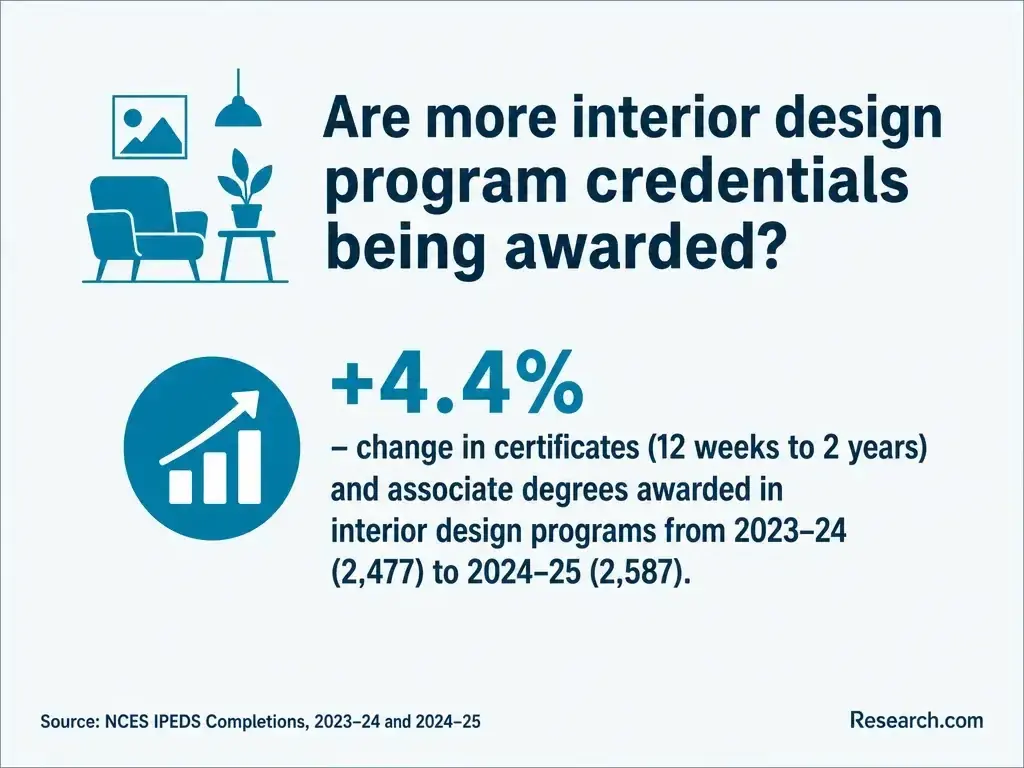
There is no reliable single average for every Sanford interior design training route: a standalone course, a certificate, and an associate-degree program differ in length and what their published prices include. Obtain a written estimate for your specific credential and enrollment status. At a public college, confirm whether you qualify for Florida resident tuition; residency rules and documentation can materially change the bill.
The categories below help turn a tuition quote into a job-readiness budget. Amounts vary by program and student, so request actual charges rather than applying a generic estimate.
| Cost category | What to check |
| School charges | Tuition by credit or course, mandatory fees, and the full required course sequence |
| Design supplies | Computer and software requirements, printing, samples, books, and project materials |
| Participation | Travel to campus or worksites and income forgone if class hours displace paid work |
| Career entry | Portfolio preparation and any optional examination or registration expenses relevant to your goal |
Check eligibility for federal aid only if the institution and specific program qualify; also ask about school scholarships and assistance through CareerSource Central Florida. A shorter, lower-priced option is not automatically cheaper if it leaves you needing additional training. Conversely, a longer program has to justify its added time and expense. Comparing cheapest bachelors degree online prices will not answer what it costs to become job-ready through the trade-school pathway considered here.
The award depends on the program: it might be a course-completion certificate, an occupational certificate, or an associate degree. These labels do not establish equivalent skills. Examine required studio courses, software work, portfolio expectations, and whether credits can apply to another credential at the same institution. Ask for any transfer or prior-learning policy in writing before assuming completed courses will shorten a later program.
An interior design school award is not the same as professional certification or Florida registration. If you are weighing the fastest way to get an associate's degree, verify that an accelerated schedule still includes the design courses you need and that they are offered when you can attend. Speed is useful only if the resulting work and credential fit your intended job.
Requirements vary by provider and credential. A college program may require an application, proof of prior schooling, placement information, and documentation for Florida residency-based tuition. An individual continuing-education course may have fewer entry steps but may not award college credit. Some advanced classes require earlier drafting or design coursework; confirm prerequisites before budgeting for the final course rather than the full sequence.
Also check the practical entry requirements: access to a computer capable of running required software, attendance at scheduled studio sessions, and a realistic way to reach any in-person site. Ask whether a portfolio is needed for admission or built during training; these are different barriers for a career changer.
Strong occupational instruction connects concept to execution. Students may learn to interview clients, measure and plan spaces, produce scaled drawings and digital models, select finishes and furnishings, consider lighting and accessibility, estimate materials, and present choices within a budget. The BLS describes interior designers as working with space requirements, materials, drawings, and building-code considerations; the exact depth of each topic depends on the curriculum.
Look closely at the finished-work requirements. A program focused on decorating and product selection can be a sensible route into showroom work, but it should not be mistaken for extensive construction-document preparation. Ask to see the kinds of projects students complete and how instructors assess technical accuracy as well as appearance.
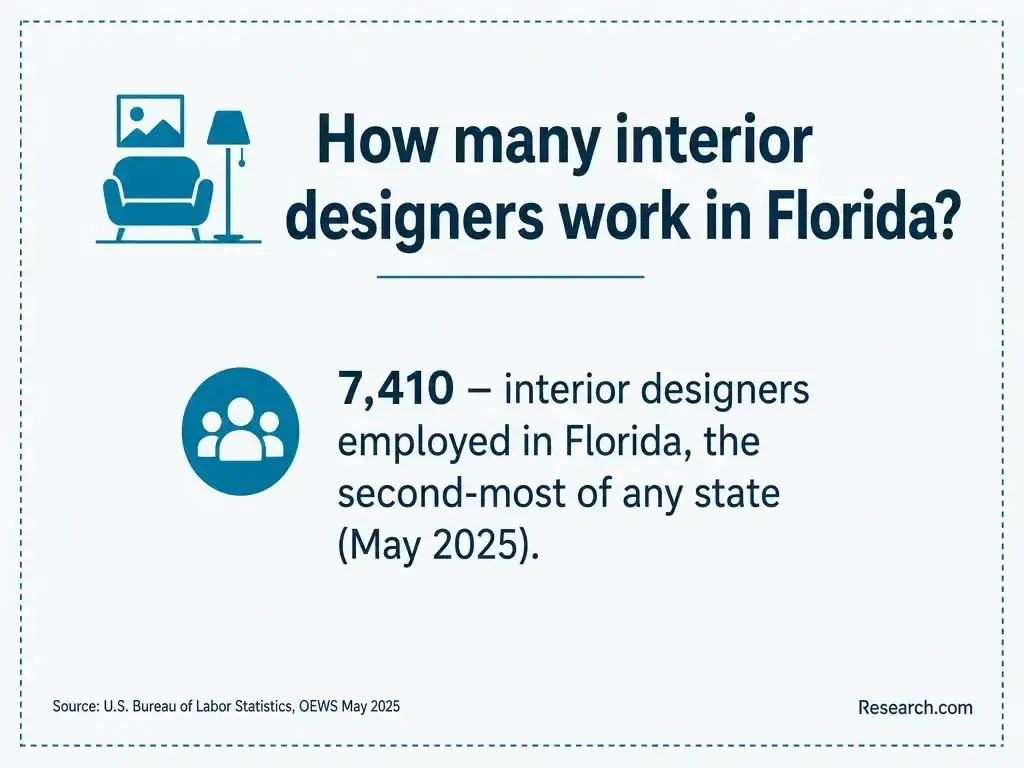
Not for every interior design role. Florida distinguishes general interior design work from the activities available to a registered interior designer, including signing and sealing qualifying interior design documents. The Florida Board of Architecture and Interior Design sets the registration requirements; finishing a school program does not itself confer registration or permission to sign and seal documents.
If registration is part of your career plan, check the board's current education, experience, and examination requirements before enrolling, and ask the program how its coursework aligns. The NCIDQ examination is administered by the Council for Interior Design Qualification and has its own eligibility rules. Institutional accreditation, a course certificate, professional examination eligibility, and Florida registration are distinct checks. If your goal is an unregistered showroom or design-support role, do not pay for a longer route solely because it is described as "license preparation."
Start with the work you want to perform, then compare programs on the evidence most likely to affect entry into that work. An affordability ranking narrows the search; it cannot tell you whether the cheapest option teaches the drafting, studio, or client-facing skills your target role requires.
Before paying an enrollment deposit, get answers to these questions from each provider:
Then compare the expected benefit with the full investment: completion likelihood, aid, debt, income you give up while studying, your current earnings, and realistic post-training opportunities. Be wary of guaranteed-job language, salary claims without an occupation and reference year, or a program that cannot provide a complete course-and-cost breakdown.
Possible starting points include showroom design or sales support, design-assistant work, drafting support, and roles helping clients select finishes or furnishings. With experience and a stronger portfolio, a worker may take on more complex projects, specialize in areas such as kitchens and baths or commercial interiors, or pursue independent work. Duties - not the word "designer" in a job title - determine the technical preparation and any regulatory limits that matter.
A short course can be worthwhile for a worker adding one skill to an existing job; it is a weaker substitute for broad studio training if the goal is technical design work. Likewise, lists of certificate courses that pay well should not be read as evidence of likely starting pay in interior design. Employer recognition, demonstrated work, experience, and the specific role all matter. Formal registered apprenticeships are not a standard requirement for entering this occupation; paid work or employer training may instead provide a practical alternative or complement to school.
The BLS projects 2.7% national employment growth for interior designers from 2025 to 2035. This indicates modest growth for the occupation nationally, not a forecast of Sanford vacancies. It also excludes the full picture of adjacent showroom and drafting jobs, which may be classified under other occupations.
For a Sanford decision, search openings across the commuting area and separate entry-level postings from jobs requiring substantial experience. Note whether employers ask for construction-document skills, sales ability, a portfolio, or particular software. That evidence is more useful for selecting a course sequence than assuming every interior-design-related opening is accessible with any certificate.
Education is a substantial investment, so the Research.com team evaluates programs using documented data rather than treating a low advertised tuition price as proof of value. For this most-affordable ranking, programs are compared with other interior design programs in the same geographic market, and only programs with completions reported to the Integrated Postsecondary Education Data System (IPEDS) are included.
The affordability score uses tuition, cost of attendance, median student debt, and federal loan default rate. An entropy-based method gives more weight to measures that differ more across programs. Accreditation and other quality indicators are not part of the affordability score. The separate best-programs methodology considers student outcomes, earnings, costs, support, accreditation, and relevant industry recognition. Readers should therefore use this ranking to identify options for closer review - not as a substitute for checking curriculum, current prices, and career fit.
The team draws on the following data sources in its ranking research. Some occupation-specific sources in this broader source set do not establish interior design program quality or eligibility.
IPEDS and College Scorecard do not cover every private training provider, employer-run course, or work-based route. A provider's absence is not evidence that it is unapproved or unsuitable. Readers can review the broader approach on the Research.com methodology page.
# 1 position
# 2 position
A focused course may have a smaller initial bill than a full credential. It is the better value only if it teaches the skills needed for your target job; compare its total cost with any additional training you would need.
Check its current catalog for the exact interior-design-related credential, required courses, campus or online availability, and tuition classification. Do not assume that taking an individual design course earns a full occupational credential.
Some coursework can be remote, but verify how the program handles critiques, physical materials, measurement exercises, portfolio development, and any required in-person activities. Online delivery alone establishes neither job readiness nor Florida registration eligibility.
It may support entry into some showroom or assistant roles, especially alongside relevant experience. Technical roles may require stronger drafting skills and a substantial portfolio. Check actual job requirements before choosing a short certificate.
Not necessarily. Federal aid depends on the institution, program, and your eligibility. Ask the provider whether the specific course or credential qualifies, then check scholarships and local workforce assistance.