# 1 position


Audited and Verified:
Our Editorial and Data Verification Process
Research.com uses government datasets, official education statistics and primary institutional information to support its career and degree guides. Our review process checks factual accuracy, occupational definitions, source dates and the requirements associated with the credentials discussed.
How This Article Was Fact-Checked
Our editorial team verifies salary estimates, employment projections, education requirements and program information against original data providers and official organizations. Salary figures are checked against the relevant occupational definitions and reporting periods. Information about licensure, accreditation and required in-person training is reviewed separately.
Fact-checked and verified on:

Co-Founder and Chief Data Scientist

Reviewed by Karolina Broda
Fact-Checker and Data Verification
Choosing affordable interior design training in Lawrenceville means looking beyond tuition: a short certificate and a longer studio-based program may prepare you for different jobs. The U.S. Bureau of Labor Statistics reports a $67,190 national median annual wage for interior designers in May 2025, but that is not a starting-pay estimate. This guide explains costs, credentials, practical training, and Georgia's registration rules. It accompanies the Most Affordable Interior Design Trade Schools in Lawrenceville for 2027 ranking, created by the Research.com team of data scientists to help you identify programs worth considering.
Expect a mix of design work and technical communication, not just decorating. A suitable program may teach measurement, space planning, drawing, computer-aided design, materials, lighting, and how to present a proposal to a client. Studio assignments should produce drawings and a portfolio that a potential employer can review. The U.S. Bureau of Labor Statistics distinguishes interior designers' planning and technical responsibilities from selecting furnishings alone.
The first decision is your target role. A shorter training program may fit someone seeking retail showroom, drafting-support, or design-assistant work. Someone aiming to pursue Georgia's registered-interior-designer title should examine the state board's education, experience, and examination rules before selecting a credential. Ask Gwinnett Technical College which relevant offerings are active for your intended start term; do not assume a program or particular studio sequence is available without checking its current catalog.
Possible workplaces include residential design businesses, furniture and kitchen-and-bath showrooms, architectural or construction-related teams, and firms supporting commercial interiors. The appropriate entry point depends on your portfolio and technical skills: a showroom role may emphasize products and clients, while a drafting-support role may emphasize accurate plans and software.
Lawrenceville students can consider employers across the wider Atlanta-area labor market rather than restricting a search to city limits. That expands the types of projects to investigate, but commuting costs and the ability to attend site visits may change which job or training placement is practical. An employer's use of "designer" in a job title does not establish eligibility to use Georgia's protected registered title; confirm the distinction with the Georgia State Board of Architects and Interior Designers.
The U.S. Bureau of Labor Statistics reports a $67,190 national median annual wage for interior designers in May 2025. This is a benchmark for the occupation nationwide - not a Lawrenceville wage, a salary offer, or a typical first-year outcome for someone completing a short program. Support roles may also fall under different occupational categories.
For a useful local estimate, compare current Atlanta-area postings for the specific title you seek and note required experience, software, portfolio quality, and registration status. If a school quotes graduate earnings, ask which graduates and jobs were counted and whether the figure is a median. Use likely entry-level pay, rather than the national occupational median, in your personal return-on-investment calculation.
Duration depends on the credential, course sequence, and your schedule. A focused certificate generally covers fewer subjects than an associate-degree program, while part-time attendance can extend either path. Do not infer a completion date from a program label: request the current course map, term-by-term availability, total credits or required contact hours, and any studio prerequisites.
Unlike trades with a single universal apprenticeship-hour requirement, interior design training is not defined by one standard clock-hour total. The Georgia board's requirements for registration are a separate consideration from the hours needed to finish a school credential. If speed is your priority, compare the actual studio sequence with a fastest associate degree search, then check whether an accelerated timetable still leaves room to build a credible portfolio.
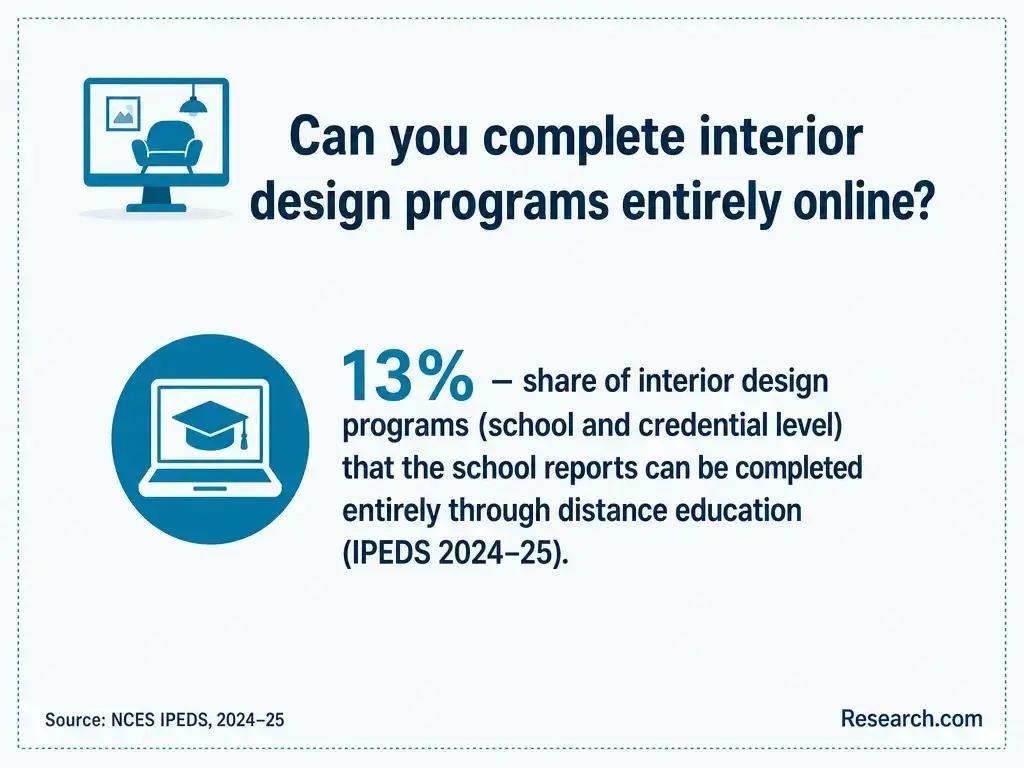
Online coursework can make lectures, design history, software demonstrations, and some critiques easier to fit around work. On-campus or hybrid study can offer more direct access to studio equipment, material samples, peer critique, and instructors checking drawings at scale. Neither format is automatically better; the decisive question is how you will practice and receive feedback on the work employers expect to see.
Ask an online provider whether assignments require site measurements, physical models, proctored assessments, or in-person studio sessions - and where you would complete them from Lawrenceville. Verify any claimed connection to Georgia registration directly with the state board. For working adults, cheap online schools for working adults can provide a cost-comparison starting point, but a low online price does not establish equivalent practical training.
There is no defensible single Lawrenceville average to apply to every interior design pathway: providers package credentials differently, and a published tuition figure may omit substantial expenses. Obtain a written, current estimate for your enrollment status and start term. Public-college resident eligibility, course load, and fees can affect the amount you actually pay.
The comparison below separates school charges from the other costs that determine whether a program is affordable through job entry.
| Cost component | What to confirm | Why it matters |
| Tuition and mandatory fees | Full-program amount, not only a per-term rate | A shorter schedule may still carry substantial fees. |
| Software, computer, and materials | Required specifications, licenses, printing, and model supplies | Technical studio work can add costs outside tuition. |
| Attendance and career-entry costs | Travel to campus or sites, portfolio production, and any relevant examination fees | These affect the cash needed to finish and seek work. |
| Financing and lost earnings | Eligible aid, expected borrowing, and work hours forgone | The least expensive tuition may not yield the lowest overall cost. |
Check federal-aid eligibility for the specific program through Federal Student Aid and ask about eligible Georgia assistance or workforce funding; eligibility is not automatic. If you need a flexible start while exploring prerequisites, open enrollment college courses online may be worth comparing, but confirm that any credits will actually transfer into your chosen credential before paying for them.
The award could be a certificate, diploma, or associate degree, depending on the program - not a professional license simply because its name includes "interior design." A certificate may be enough to demonstrate targeted software or showroom skills; a broader studio-based associate program may provide more time for technical coursework and a portfolio. Compare actual required courses and completed projects, not credential names alone.
Institutional accreditation concerns the school, while programmatic accreditation concerns a particular program; neither is the same as Georgia occupational registration. Ask the school to identify its institutional accreditor, whether its specific program holds any relevant programmatic accreditation, and what evidence supports its claims about employer recognition or registration preparation. A search for cheap one year master's programs online addresses a different education decision and should not be used to judge an entry-level trade credential.
Requirements vary by credential and provider. Ask for the current application checklist, prior-education requirements, placement or prerequisite rules, software and computer specifications, and deadlines for the particular start term. A school may admit you to the institution before you can begin every course in a sequenced program.
If you already have relevant coursework or workplace experience, request a written evaluation of transfer credit or prior-learning credit before committing to a schedule. Credit toward graduation does not necessarily establish eligibility for Georgia registration. Likewise, an interest in what is the shortest phd program does not answer the practical entry question here: whether this training supplies the drawing, studio, and experience requirements for your intended interior design role.
Look for instruction that connects visual decisions to usable plans: measuring spaces, drafting layouts, specifying materials, evaluating lighting, documenting changes, and presenting choices within a client's budget. Digital drawing and visualization matter, but so do communicating with clients and coordinating with the people who build or install a design. Program descriptions should identify which of these tasks students actually practice.
Ask to see recent student portfolio examples and a syllabus showing how instructors assess drawings and revisions. Software-only training may suit someone adding a specific skill; it is a weaker substitute for a broad studio sequence if the intended job requires independently developing and documenting spaces. Site observation, a supervised project, or employer feedback can strengthen a portfolio, but verify that such opportunities are included rather than advertised as possibilities.
Do not assume every interiors job requires an occupational license. Georgia regulates use of the registered interior designer designation through the Georgia State Board of Architects and Interior Designers; the rules for that registration are not the same as a school's graduation requirements. Before choosing a program with registration as your goal, confirm the board's current education, supervised-experience, and examination requirements and whether your proposed credential fits them.
Professional examination or certification, state registration, school accreditation, and a program's authorization to operate are separate matters. A certificate of completion does not itself grant a protected title. If your goal is showroom sales or design support rather than registration, ask prospective employers what portfolio, software skills, and experience they require instead of paying for a credential on an unverified licensing claim.
Start with the job you want, then compare programs that can plausibly prepare you for it. A lower-cost, shorter credential may be sensible for design support; it may be a poor bargain if you later need to repeat substantial coursework for a different goal. The affordability ranking is a shortlist, not proof of fit.
Before enrolling, get answers to these questions in writing so you can compare like with like:
Then compare likely entry pay against total cost, borrowing, time out of work, your probability of finishing, and the years over which training might pay off. A common mistake is treating the lowest tuition - or the national median designer wage - as a complete return-on-investment calculation.
Training can support different starting points: showroom or furnishings work, design-assistant tasks, drafting support, or a longer-term interior design practice. These paths are not interchangeable. Client-facing retail work may reward product knowledge; technical design roles may demand stronger drawings, documentation, and coordination with construction teams.
Experience and a stronger portfolio can expand responsibilities over time. Some workers may pursue optional professional credentials or, if eligible, Georgia registration; others may specialize in a product or project type. Employer training can be a lower-cost route into a showroom role, while a structured studio program may better fit someone who needs broad technical foundations. Ask employers about their actual entry requirements before assuming additional schooling is necessary.
The U.S. Bureau of Labor Statistics projects 2.7% national employment growth for interior designers from 2025 to 2035. That is a national occupational projection, not a forecast of openings in Lawrenceville, and it should not be read as a promise of work after training. Competition for a particular job will also depend on portfolio quality, experience, and the employer's project mix.
For a local decision, review current opportunities across Lawrenceville and the wider Atlanta area, separating registered-designer positions from assistant, showroom, and drafting-support jobs. Note recurring software and experience requirements before choosing courses. This gives you a more useful test of program fit than applying a national growth rate to one city.
Education is a significant investment, so Research.com's data-science team evaluates programs against others in the same occupation and location rather than treating every trade-school option as interchangeable. Only programs with completions reported to IPEDS can enter the ranking. That makes the results useful for comparing included programs, but it also means an unlisted apprenticeship, employer program, or training provider should not be assumed to be unavailable or poor quality.
The most affordable ranking scores tuition, cost of attendance, median student debt, and federal loan default rate. Indicator weights are assigned using an entropy-based method, which gives more weight to measures that vary more across programs. Accreditation and other quality indicators are not part of this affordability score. Research.com's separate best programs rankings also consider completion, retention, earnings, support services, and relevant recognition; readers should not mistake an affordability position for an overall-quality judgment.
The ranking process draws on the following sources. Some are relevant across Research.com's trade-school rankings rather than being interior-design accreditors or credentials; their inclusion does not imply that an interior design program needs approval from them.
This approach helps readers narrow a cost-conscious shortlist, not substitute a score for checking current program offerings, hands-on instruction, and Georgia registration eligibility. Research.com explains its broader ranking approach on its methodology page.
# 1 position
# 2 position
Not necessarily. Compare total costs, required studio work, the credential awarded, and whether it prepares you for your intended role. A low tuition figure can exclude software, materials, and commuting.
Online study can cover substantial coursework, but check how you will complete measured projects, receive drawing feedback, and build a portfolio. Do not assume an online credential meets Georgia registration requirements.
No. Graduation and state registration are separate. Check your planned education and experience against the Georgia State Board of Architects and Interior Designers' current requirements.
Choose based on the work you want. A focused certificate may suit a specific support skill; an associate program may offer a broader studio sequence. Verify the courses and portfolio requirements rather than relying on the award name.
Ask local employers about paid assistant or employer-sponsored training, particularly for showroom work. Do not assume such a position is a registered apprenticeship or that its experience counts toward Georgia registration; verify both claims separately.