# 1 position
College of DuPage - Interior Design.
associate

Audited and Verified:
Our Editorial and Data Verification Process
Research.com uses government datasets, official education statistics and primary institutional information to support its career and degree guides. Our review process checks factual accuracy, occupational definitions, source dates and the requirements associated with the credentials discussed.
How This Article Was Fact-Checked
Our editorial team verifies salary estimates, employment projections, education requirements and program information against original data providers and official organizations. Salary figures are checked against the relevant occupational definitions and reporting periods. Information about licensure, accreditation and required in-person training is reviewed separately.
Fact-checked and verified on:

Co-Founder and Chief Data Scientist

Reviewed by Karolina Broda
Fact-Checker and Data Verification
Choosing an affordable interior design program in Glen Ellyn means looking beyond tuition: the credential, studio work, and path to employment must fit your goal. The U.S. Bureau of Labor Statistics reports a $67,190 national median annual wage for interior designers in May 2025, but that is not a starting-pay estimate. This guide explains costs, training routes, career prospects, and Illinois credential rules. It also accompanies the Most Affordable Interior Design Trade Schools in Glen Ellyn for 2027 ranking, created by the Research.com team of data scientists to help students make an informed choice about programs worth considering.
Expect a mix of design studio, technical drawing, digital drafting, materials selection, and project presentation - not simply decorating practice. Interior designers plan usable interior spaces while accounting for client needs, budgets, building constraints, and applicable codes (U.S. Bureau of Labor Statistics). A worthwhile program should make students produce drawings and a portfolio that a prospective employer can review.
The available routes serve different goals. The comparison below helps distinguish a shorter entry route from a broader academic credential; exact courses and scheduling must be checked in the current College of DuPage catalog.
| Training route | Likely credential or outcome | Best fit and main limitation |
| Community-college certificate | College-awarded certificate | Focused skills or a portfolio refresh; confirm whether it covers drafting, codes, and the requirements of your intended role. |
| Community-college associate program | Academic associate degree | Broader studio and technical preparation; more time and expense than a focused certificate. |
| Employer-supported entry | Work experience, sometimes paired with short training | Useful for showroom, sales, or design-assistant work; the employer may not teach a complete technical design curriculum. |
Interior design does not have a standard registered-apprenticeship route comparable to some construction trades. Paid showroom or design-assistant work can still provide valuable client and product experience, but ask who will supervise drawings and whether the work counts toward any professional experience requirement you may later pursue. Readers comparing short credentials across occupations can explore 1 year certificate programs that pay well; the right choice here depends on the interior design role, not the shortest advertised duration.
Glen Ellyn residents can look beyond the village to DuPage County and the wider Chicago metropolitan market. Potential settings include residential design firms, furniture and kitchen-and-bath showrooms, commercial design teams, and businesses supplying finishes or furnishings. That wider commute matters: a local program may be convenient to attend, while a first job, client visit, or site-measurement assignment may be elsewhere in the metro area.
A certificate may be most immediately useful for showroom, product-specification, drafting-support, or design-assistant applications. More independent space-planning and documentation work generally calls for a stronger portfolio and experience. Compare job postings by actual duties and software requirements rather than assuming every position labeled "designer" has the same entry requirements.
The latest national figure supplied by the U.S. Bureau of Labor Statistics is a $67,190 median annual wage for interior designers in May 2025. That median covers workers across experience levels and locations; it is not a Glen Ellyn wage or a forecast for a new certificate holder. Pay for a showroom associate or drafting assistant may also differ because those jobs are not necessarily classified as interior designers.
For a local decision, compare current Chicago-area postings for the role you could realistically enter, including pay structure, portfolio requirements, and commute. If a position relies on commission, distinguish its stated base pay from potential sales earnings before using it in a training-cost calculation.
A focused certificate usually takes less study than an associate program, but a reliable completion estimate depends on required credits, course sequencing, and whether studios run every term. Part-time students should ask how often required drawing and studio courses are offered; a missed prerequisite can extend the calendar even when the total credit requirement does not change.
Interior design programs typically specify academic credits and studio courses rather than one universal occupational clock-hour requirement. Ask College of DuPage for the current program map, in-person studio expectations, and a term-by-term schedule for your enrollment pace. A general guide to how long does it take to get a associate degree can explain scheduling concepts, but the current interior design course sequence - not a generic accelerated timeline - determines your finish date.
Online study can suit design history, some software instruction, and critique conducted through shared files. On-campus or scheduled in-person work may be better for material samples, equipment access, measured site work, and live feedback on drawings and presentations. A hybrid label alone does not tell you how often you must travel to a studio or complete field assignments.
Ask for the delivery format of each required course, the software and computer specifications, access to instructors, and how students build a portfolio. Lists of best nationally accredited online colleges are not substitutes for checking an interior design program's studio instruction or Illinois credential relevance. Institutional accreditation, program-specific recognition, and professional eligibility answer different questions; none should be inferred from "online" or "hybrid."
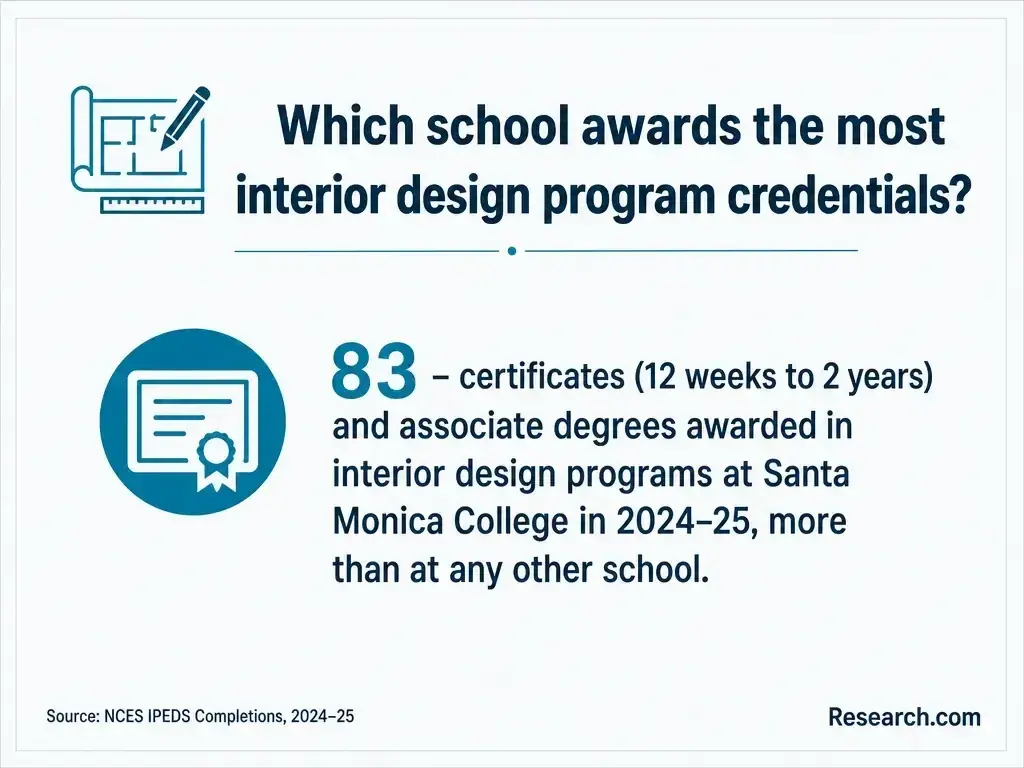
There is no defensible single Glen Ellyn average without a defined set of comparable programs and current price schedules. For College of DuPage, the relevant starting point is the current tuition rate that applies to your address, multiplied by the required credits for the specific credential. Then add mandatory fees, software or computer needs, drawing and model-making materials, books, printing, and travel to campus or project sites. A shorter certificate is not automatically cheaper per useful skill if it omits courses you later need.
Calculate an estimated job-ready cost, then subtract grants or scholarships you are actually eligible to receive - not aid you merely hope to obtain. Federal aid eligibility depends on the institution, program, and student circumstances (Federal Student Aid). Ask about Illinois aid and workforce funding, but confirm that the particular program qualifies. Include foregone earnings if studio scheduling reduces your work hours, and compare the resulting cost with a lower-cost employer-supported entry route.
The credential depends on the program: a certificate awards a focused college credential, while an associate program awards an academic degree. Neither is the same as professional certification or Illinois registration. Verify the exact award in the current College of DuPage catalog, particularly if you plan to use completed courses toward another credential later.
Before enrolling, request written answers about whether certificate courses apply to the associate program, whether prior coursework or documented experience can receive credit, and whether the curriculum supports any future professional exam pathway. Credit transfer and exam eligibility are separate decisions made under different rules; a school's accreditation alone establishes neither.
Ask College of DuPage which application steps apply to the specific interior design credential, whether drawing or software courses have prerequisites, and whether studio seats or course sequences limit when you can begin. Also check residency documentation for the tuition rate, placement requirements, and whether a portfolio is required at entry or developed during study. Do not assume general college admission reserves a place in every required course.
Students returning to school should have previous transcripts evaluated before paying for overlapping classes. Direct employer entry may instead emphasize customer service, a sample portfolio, or familiarity with design software. Directories of online colleges with open admissions cannot establish a particular studio course's capacity, prerequisites, or suitability for your goal.
Relevant training connects visual decisions to drawings that other people can use. Look for instruction in space planning, measured drawings, computer-aided design, finishes and materials, lighting concepts, client presentations, and project budgeting. Code awareness and accessibility are especially important when work moves beyond furnishing selections into commercial interiors (U.S. Bureau of Labor Statistics).
Judge the hands-on component by its outputs: Can students document an existing space, develop alternatives, revise a plan after critique, and assemble a coherent portfolio? Ask to see course assignments and required studio hours. Two programs with similarly named credentials may offer substantially different opportunities to practice these tasks.
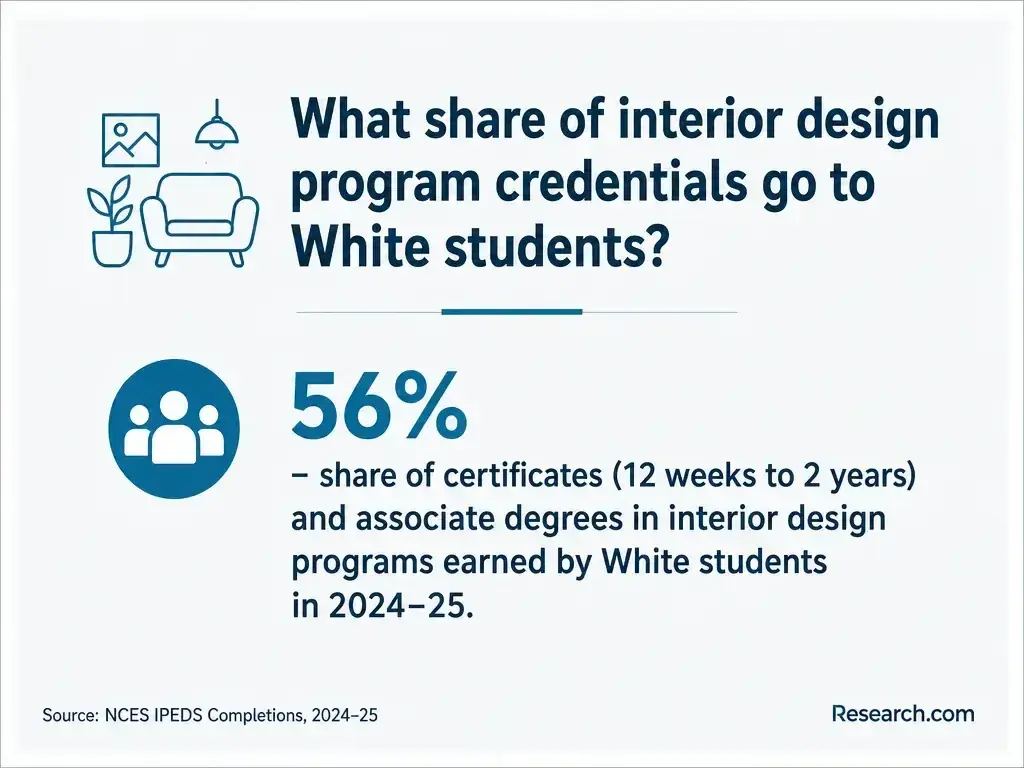
Do not confuse employment in design-related work with permission to use a regulated title. Illinois regulates the registered interior designer designation through the Illinois Department of Financial and Professional Regulation (IDFPR). Someone seeking that designation should verify the department's current education, examination, experience, and application rules before selecting a program. Completing a certificate or associate program does not, by itself, confer registration.
For showroom, design-support, or other intended work, check the employer's requirements and the scope of the duties rather than assuming every job requires the registered title. The Council for Interior Design Qualification's NCIDQ credential may matter to a longer-term professional plan, but certification eligibility and Illinois registration are distinct. Institutional accreditation, any programmatic recognition, an exam credential, and state registration each serve a different purpose.
Start with the job you want, then test whether the credential gets you closer to it at a cost you can sustain. The affordability ranking can narrow candidates, but it cannot establish portfolio quality or eligibility for a regulated title. Use these checks before committing:
A common mistake is choosing the lowest advertised tuition while overlooking missing technical courses or a costly commute. Another is treating an occupational median as a personal earnings promise. For a useful return-on-investment comparison, consider debt, your current earnings, the likelihood of completing the program, plausible post-training roles, and how long it may take for any earnings change to offset both direct costs and lost income.
Possible starting points include design assistant, showroom specialist, kitchen-and-bath sales support, materials specialist, and drafting support. With stronger project documentation, a portfolio, and experience, a worker may pursue interior designer roles, a specialization, client management, or independent work. These are potential paths, not automatic promotions attached to a credential.
Someone who mainly wants product sales or client-facing showroom work may benefit more from paid entry and targeted software training than a longer program. Someone aiming to prepare technical drawings or eventually pursue Illinois registration should examine the broader curriculum and professional requirements first. Articles about quickest degrees that make the most money cannot replace that occupation-specific comparison: the relevant question is which training changes your access to the work you want.
The U.S. Bureau of Labor Statistics projects 2.7% growth in U.S. interior designer employment from 2025 to 2035. This is a national occupational projection, not a forecast of Glen Ellyn vacancies. It suggests evaluating a program on the breadth and quality of work it prepares you to show employers, rather than assuming rapid job growth will make a weak portfolio sufficient.
For local planning, search across the Chicago metropolitan area and separate true interior design openings from sales and drafting positions. Compare each posting's technical requirements with the courses you would take, and consider whether commuting for work is practical. Digital drafting and presentation skills are worth checking carefully in current curricula because employers can assess them through actual project samples.
Investing in training is a consequential financial decision. Research.com created this ranking to help readers compare affordable programs against other programs in the same occupation and location - not against unrelated schools. The team checks source data for credibility and consistency; only programs with completions reported to IPEDS can appear. That coverage limit matters: a missing apprenticeship, employer training option, or other provider is not necessarily a poor option.
This is an affordability ranking, not an overall-quality score. It evaluates tuition, cost of attendance, median student debt, and federal loan default rate, with weights distributed through an entropy-based method. Accreditation, student support, and other quality indicators are not included in this affordability score. Research.com's separate best-program rankings also evaluate completion, retention, earnings, recognition, and support. Readers should therefore use the affordable-program ranking to identify cost candidates, then independently check curriculum, practical work, and career fit.
The ranking draws on the following data sources. Several cover other occupations in Research.com's broader ranking work; their inclusion does not make them interior design accreditors or licensing authorities.
For further detail on the ranking process, see Research.com's methodology. Because costs and program offerings change, confirm current figures and credential details directly before enrolling.
# 1 position
# 2 position
It is the local public-college provider to investigate, but compare its current offerings with relevant employer training and any other program you can realistically attend. Choose by credential, practical work, total cost, and target job - not proximity alone.
It can support applications for some design-assistant or showroom roles, especially with a strong portfolio. It does not guarantee employment or establish eligibility for Illinois registration.
Some coursework may be remote. Confirm required studio sessions, materials work, site assignments, and portfolio critique course by course; an online format alone says nothing about professional eligibility.
No single rule should be assumed for every design-related job. Illinois regulates the registered interior designer designation; check IDFPR's current rules if you intend to use it, and check employer requirements for other roles.
Request the current credential requirements, a term-by-term schedule, the full estimated cost, details of practical assignments, and written clarification of any claimed certification or registration pathway.