# 1 position


Audited and Verified:
Our Editorial and Data Verification Process
Research.com uses government datasets, official education statistics and primary institutional information to support its career and degree guides. Our review process checks factual accuracy, occupational definitions, source dates and the requirements associated with the credentials discussed.
How This Article Was Fact-Checked
Our editorial team verifies salary estimates, employment projections, education requirements and program information against original data providers and official organizations. Salary figures are checked against the relevant occupational definitions and reporting periods. Information about licensure, accreditation and required in-person training is reviewed separately.
Fact-checked and verified on:

Co-Founder and Chief Data Scientist

Reviewed by Karolina Broda
Fact-Checker and Data Verification
An affordable interior design program is only a good investment if it builds the skills employers want without leaving you with unnecessary debt. The U.S. Bureau of Labor Statistics reports a $67,190 national median annual wage for interior designers in May 2025, but that is not a starting-pay promise. This guide compares Indiana training pathways, costs, practical experience, and career requirements. It also accompanies the Most Affordable Interior Design Trade Schools in Indiana for 2027 ranking, created by the Research.com team of data scientists to help students identify programs worth considering.
Expect a mix of creative work and technical problem-solving: measuring spaces, developing layouts, selecting materials, producing drawings, and presenting solutions to a client. Interior design goes beyond decorating because project work can involve accessibility, building systems, and code-related coordination; the U.S. Bureau of Labor Statistics describes these as part of designers' work. The depth of that preparation varies substantially by credential.
The comparison below separates training routes by their likely purpose. Program titles alone cannot tell you how much studio instruction or employer-facing experience you will receive.
| Pathway | Typical emphasis | Best fit | Key limitation to check |
| Focused certificate or diploma | CAD, drafting, decorating, or selected design skills | Someone entering a support role or adding a defined skill | May omit substantial design studio work or broader technical preparation |
| Associate degree program | Broader coursework and a sustained portfolio | Someone seeking structured preparation for design-assistant or related roles | Costs more time than a focused certificate; compare actual projects and outcomes |
| Employer-sponsored or direct-entry training | Company tools, products, and client workflows | Someone able to enter through a showroom, furniture business, or design firm | Training may be narrower and may not award a portable credential |
Indiana applicants considering quick associate degree programs should compare the proposed schedule with the time available for studio projects and portfolio development. An accelerated calendar has less value if it leaves you without work samples relevant to the jobs you want.
Potential workplaces include residential design firms, furniture and kitchen-and-bath showrooms, architecture or commercial design firms, and businesses that plan workplace, hospitality, or retail interiors. A focused training program may be enough to compete for showroom, sales, drafting-support, or design-assistant openings; more technically demanding roles may call for a stronger portfolio and additional experience. These are possible routes, not guaranteed placements (U.S. Bureau of Labor Statistics).
Location affects which work samples are most useful. Someone targeting commercial projects in the Indianapolis area should ask whether a program teaches construction documentation and coordination with other project professionals. Someone seeking work with a local residential business should look for client presentations, finish specifications, and a practical path to internships or part-time work within commuting distance.
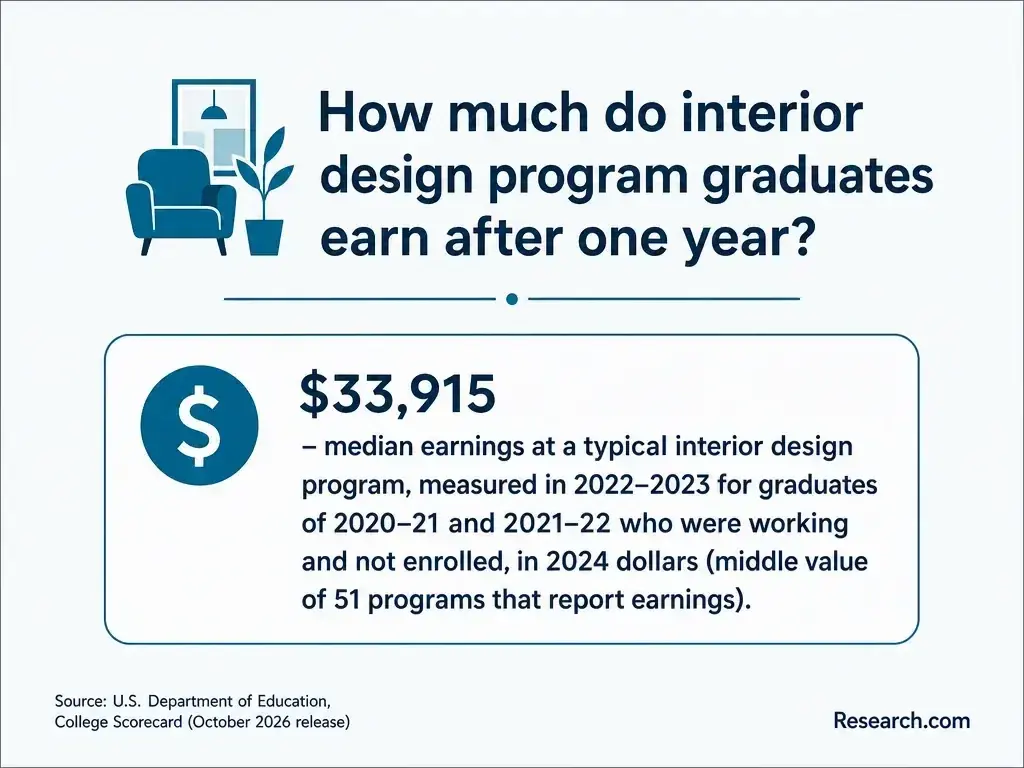
An Indiana-specific wage should be checked in the latest state occupational wage release before you budget around it. As a national benchmark, the median annual wage for interior designers was $67,190 in May 2025 (U.S. Bureau of Labor Statistics). That figure covers experienced workers as well as newer ones and does not establish what an Indiana certificate or associate-program graduate will earn.
Ask prospective employers what they pay for the specific entry role you are pursuing - such as design assistant, showroom consultant, or CAD technician - and whether compensation includes sales commissions. Compare that realistic offer with your existing earnings, not with the occupation-wide median, when estimating whether training will pay off.
A focused certificate can be shorter than an associate degree, while part-time enrollment or limited studio-course availability can extend either route. There is no single Indiana-wide clock-hour requirement for every interior design training program. Ask for the published course sequence, total credits or contact hours, expected weekly project time, and whether required courses run every term.
For working adults, schedule reliability matters as much as advertised speed. If you are comparing fast adult degree programs online, check whether an interior design option actually includes the software practice, feedback, and portfolio work your target job requires. Employer training can get you into a related workplace sooner, but progression to independent design responsibilities depends on the work you are allowed to do and the experience you build.
Online instruction can work well for design history, specifications, software demonstrations, and some digital critiques. Campus or hybrid study can make it easier to get immediate feedback on drawings, examine physical materials, and complete collaborative studio projects. Neither format is automatically stronger: compare the required assignments, instructor access, software, and resulting portfolio.
Before choosing a remote option, ask how you will complete site measurements, material evaluation, client presentations, and any internship. An "online" label does not establish that a program meets a professional credential's education rules. Institutional accreditation is also a separate question from curriculum quality; use resources on best non profit accredited colleges as a starting point for understanding provider types, then verify the particular institution and program. A nonprofit provider can be private, and its ownership does not by itself establish value.
There is no single reliable statewide price that covers Indiana interior design certificates, associate programs, and employer training on comparable terms. Treat any advertised tuition as a starting figure, not the cost of becoming job-ready. Public-college resident pricing may differ from nonresident pricing; ask the school which rate applies to you and request a written estimate for your full enrollment period.
Build a budget that includes mandatory fees, a computer capable of running required software, software subscriptions, drawing or model-making materials, books, portfolio production, and travel to classes or worksites. Add foregone earnings if the timetable reduces your paid hours. Then subtract only aid you are actually eligible to receive. Federal aid depends on the institution and eligible program (Federal Student Aid); Indiana's Workforce Ready Grant supports qualifying programs, but applicants must verify whether a particular design-related credential qualifies (Indiana Next Level Jobs).
A useful affordability test is to compare expected debt payments and lost earnings with a conservative entry-level pay estimate over a time horizon you choose. Include your chance of finishing and the value of skills you can use even if you do not obtain a designer job. A lower tuition bill is not a bargain if the program lacks the portfolio work needed for your intended role.
The award may be a certificate, diploma, or associate degree, depending on the program. A course-completion document from an employer or short training provider is not necessarily an academic credential. Ask for the award's exact name and a course list before enrolling, particularly if you may later seek credit for previous study or pursue professional certification.
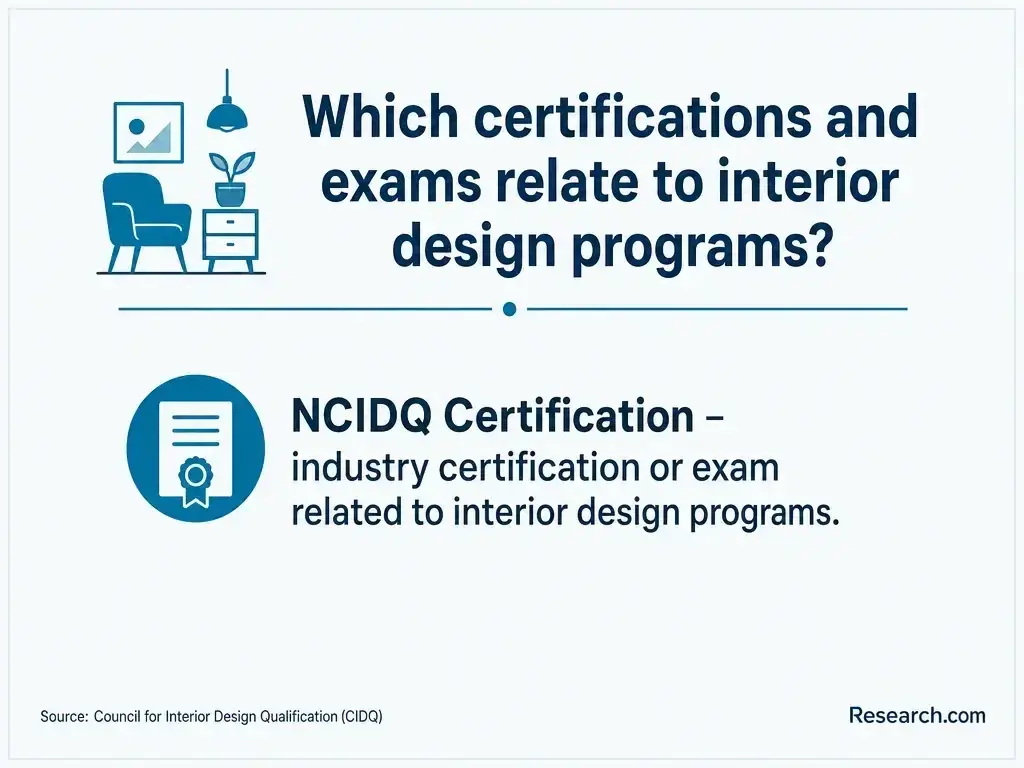
Institutional accreditation concerns the school; programmatic accreditation concerns a particular program; state authorization concerns permission to operate; and professional certification recognizes an individual who meets a certifying body's rules. None automatically substitutes for the others. The Council for Interior Design Accreditation evaluates eligible interior design programs, while the Council for Interior Design Qualification sets requirements for its NCIDQ credential. Verify each independently with the relevant organization.
Requirements vary by provider and credential. Ask whether admission calls for a secondary-school credential, placement assessment, portfolio, prior coursework, or a computer meeting software specifications. An introductory certificate may have different entry requirements from an associate program, and admission to a school does not always mean immediate entry into every required studio course.
If you already have drafting or design experience, request a written evaluation of transfer credit or prior learning before paying a deposit. Ask which required courses the credit replaces and whether accepting it changes financial-aid eligibility or your completion schedule. For an employer-sponsored route, confirm the hiring requirements, paid hours, supervision, and whether training leads to a credential you can use elsewhere.
A job-focused curriculum may cover spatial planning, hand and digital drawing, CAD or building-modeling tools, lighting, textiles and finishes, accessibility, client communication, and project documentation. The U.S. Bureau of Labor Statistics notes that interior designers must consider how spaces function and comply with relevant requirements. A decorating-focused course may emphasize color and furnishings instead; that can be useful, but it is not equivalent preparation for technical design work.
Judge practical instruction by its outputs. Ask to see the required portfolio projects, how many receive instructor critique, whether students work from actual site dimensions, and whether they produce drawings and specifications for more than one type of space. An internship or employer project can help, but confirm whether the provider arranges it, whether it is required, and what you would do there.
Do not assume every Indiana design or decorating job requires a state-issued occupational license. Also do not assume a training credential authorizes you to perform work reserved for another regulated professional. Before selecting a program for a particular title or type of project, check current Indiana Professional Licensing Agency information and the applicable building authority's rules on scope and permit submissions.
NCIDQ certification is a separate, voluntary professional credential, not something automatically awarded at graduation. Its education, experience, and examination requirements are set by the Council for Interior Design Qualification and must be checked against your exact program and intended route. If a school says its graduates "qualify," ask it to identify the applicable eligibility pathway in writing.
Start with the work you want to do, then compare programs that teach and assess those skills. A low-cost CAD certificate could be sensible for a drafting-support goal but a poor substitute for sustained design-studio work if you want to develop full client projects. Likewise, choosing a credential because it appears among the easiest degrees to get misses the central question: will it produce a credible portfolio at a cost you can manage?
Use the following checks with each provider so the answers are comparable:
Red flags include a price that excludes mandatory software, vague promises of certification, and salary claims based on occupation-wide wages rather than new-hire outcomes. Use the affordability ranking as a shortlist, not a substitute for these checks.
A focused credential can support applications for showroom, product-selection, or drafting-assistant work. Broader training and a stronger portfolio may support design-assistant roles; responsibility for complex projects generally develops with experience. Later options can include a residential or commercial specialty, project coordination, supervision, or self-employment, subject to the work you are qualified and permitted to undertake.
Interior design is not necessarily the right trade path if your main goal is the highest possible immediate wage. Compare entry requirements, local openings, and realistic starting pay - not just occupation medians - with other highest paying jobs trade school training can lead to. If you already work in furniture sales or construction documentation, targeted design training may offer more value than starting a longer program from scratch.
The U.S. Bureau of Labor Statistics projects 2.7% national employment growth for interior designers from 2025 to 2035. This is a national occupational projection, not an Indiana forecast or a prediction of vacancies for new program completers. It suggests that applicants should plan to compete on relevant skills, work samples, and experience rather than assume training alone will lead to an opening.
For a local decision, review Indiana's current occupational projections and compare postings in the area where you can work. Check the tasks employers actually list: a residential showroom may prioritize client service and product knowledge, while a commercial firm may emphasize drawings and project coordination. Use those differences to select portfolio projects and, if possible, relevant part-time work while training.
Education is a consequential investment. Research.com created this ranking to help readers compare interior design programs against other options in Indiana, using published education and cost data rather than price claims alone. The team reviews available records for credibility and consistency, but readers should still confirm current charges and program details directly with each provider.
For most affordable rankings, the score considers tuition, cost of attendance, median student debt, and federal loan default rate. Indicator weights are assigned using an entropy-based method, which gives more weight to measures that differ more across included programs. Accreditation and other quality measures are not part of this affordability score. Only programs with completions reported to IPEDS are eligible; a training provider's absence does not mean it is unapproved or poor quality.
The ranking process draws on the following data sources. Some support Research.com's broader trade-program research and are not interior design accreditors or endorsements of a listed program:
Use the ranking to narrow a shortlist, then verify each program's curriculum, total price, and employment fit. More detail on Research.com's approach is available on its methodology page.
# 1 position
# 2 position
# 3 position

# 4 position
It can be if it teaches a skill your target entry role uses and its total cost is manageable. Ask to see the required projects and compare them with local job descriptions before enrolling.
Online coursework can teach substantial design and software skills. Verify how the program assesses measurements, materials, critiques, and portfolio work, and check any separate professional credential requirements yourself.
No. Entry requirements vary by employer and role. A focused credential or relevant work experience may fit some support jobs, while a broader program may provide more substantial preparation for technical design tasks.
No. Eligibility depends on the student, provider, and specific program. Ask the financial-aid office to identify the aid available for your exact credential and enrollment schedule.
Ask for the reporting period, number of completers counted, definition of "placed," and types of jobs obtained. A school-wide rate may not describe outcomes for interior design trainees.