# 1 position


Audited and Verified:
Our Editorial and Data Verification Process
Research.com uses government datasets, official education statistics and primary institutional information to support its career and degree guides. Our review process checks factual accuracy, occupational definitions, source dates and the requirements associated with the credentials discussed.
How This Article Was Fact-Checked
Our editorial team verifies salary estimates, employment projections, education requirements and program information against original data providers and official organizations. Salary figures are checked against the relevant occupational definitions and reporting periods. Information about licensure, accreditation and required in-person training is reviewed separately.
Fact-checked and verified on:

Co-Founder and Chief Data Scientist

Reviewed by Karolina Broda
Fact-Checker and Data Verification
Choosing an affordable interior design program means looking beyond tuition: will it teach you to draft, specify materials, build a portfolio, and qualify for the work you want? The U.S. Bureau of Labor Statistics reports a May 2025 national median annual wage of $67,190 for interior designers, but that is not a starting-pay estimate. This guide pairs practical cost and career comparisons with the Most Affordable Interior Design Trade Schools in Iowa for 2027 ranking, created by the Research.com team of data scientists to help students identify programs worth considering.
Expect a combination of design concepts and production work: measuring rooms, developing layouts, drafting plans, selecting finishes, explaining choices to clients, and revising a project to fit a budget or building constraints. Interior design is not simply decorating. The U.S. Bureau of Labor Statistics describes designers as planning interior spaces for function, safety, and appearance, often coordinating with architects and contractors.
For an Iowa student, the decisive question is how much supervised practice the program provides. Ask to see assignments that progress from a design brief to drawings, specifications, and a finished portfolio. Des Moines Area Community College and Kirkwood Community College are Iowa providers to investigate, but compare their current catalogs and course schedules rather than assuming similarly named credentials teach the same software or offer the same project experience.
A supervised internship or employer project can help you test your skills with real deadlines and clients. Unlike trades with a standard registered-apprenticeship route, interior design does not have a universal paid apprenticeship that substitutes for a program. An entry-level showroom or design-assistant job may be another way to build experience, although the training and advancement opportunities depend on the employer.
Potential settings include residential design studios, furniture and kitchen-and-bath showrooms, architecture firms, commercial interiors teams, and suppliers of flooring, cabinetry, or finishes. The U.S. Bureau of Labor Statistics identifies specialized design services, architectural and engineering services, and furniture retailers among employers of interior designers. An employer may hire a new program completer first as a design assistant, drafter, showroom specialist, or project coordinator rather than as an independent designer.
Location affects the search. In a larger Iowa metro area, a student may be able to compare several studios and commercial-project employers; in a smaller community, showroom work or a broader mix of residential projects may be more accessible. Before enrolling, review actual openings within commuting distance and note their software, portfolio, travel, and experience requirements. That is a stronger test of local fit than assuming every design occupation is available near campus.
There is no single reliable wage for a newly trained Iowa interior designer. For context, the U.S. Bureau of Labor Statistics reports a $67,190 national median annual wage in May 2025 for the interior designer occupation. The median includes experienced workers and should not be used as a first-job salary or an Iowa-specific offer.
For a local estimate, compare the latest Iowa occupational wage figures for interior designers with posted pay for the actual entry-level titles you could qualify for, such as design assistant or showroom specialist. Check whether a posting is salaried, hourly, or partly commission-based. A program is harder to justify financially if its debt assumes experienced-designer pay while its likely first job is an assistant role. Iowa workforce labor-market information and the U.S. Bureau of Labor Statistics are the appropriate sources for occupational comparisons.
An associate-degree pathway is commonly planned around two academic years of full-time study; a focused certificate may take less time. Actual completion depends on course sequencing, enrollment intensity, and whether required classes are offered when you need them. Request the program's current credit requirements and a term-by-term schedule before relying on an advertised finish date.
Be particularly cautious about treating an online associate degree in 6 months as a realistic substitute for an interior design program without comparing its required credits, studio work, and portfolio expectations. Iowa interior design programs do not share a universal state-mandated number of training hours; the school's curriculum and your intended work determine which practical experiences matter.
Online coursework can be useful for design history, presentations, digital drafting instruction, and feedback on submitted work. Campus instruction makes it easier to work directly with material samples, measure spaces with an instructor, use equipment, and get immediate critique. A hybrid program may offer both, but its in-person requirements can still make a long commute expensive.
Format should follow the skills you need to demonstrate, not just the convenience of attending remotely. Ask how students receive critique, access design software, produce physical samples when required, and complete any employer-facing project or internship. A non profit accredited online university comparison may help you assess an institution, but institutional accreditation alone does not establish that a particular interior design curriculum supplies the practical training you need.
No single statewide average accurately represents every interior design certificate and associate-degree program, and an institution-wide cost figure may differ substantially from the cost of this particular program. To compare Iowa options, obtain a written estimate based on your residency, enrollment plan, and required courses. Tuition is only the starting point.
The following cost categories show why a lower advertised price may not produce a lower job-entry cost. Ask each provider which items are included and which you must purchase separately.
| Cost category | What to check |
| School charges | Tuition by residency, mandatory fees, and charges for studios or online courses |
| Design materials | Software access, computer specifications, printing, model-making supplies, and portfolio production |
| Practical experience | Travel to campus, project sites, or an internship; whether the placement is paid |
| Financing and time | Grants, scholarships, expected borrowing, and earnings forgone while studying |
For eligible students, federal aid may reduce upfront costs at a participating institution; eligibility depends on the student and program, according to Federal Student Aid. Ask about Iowa-based aid and workforce assistance as well, then compare the amount you would actually pay. An affordable bachelor's degree online list uses a different educational pathway and is not a substitute for pricing the interior design training and materials required for your goal.
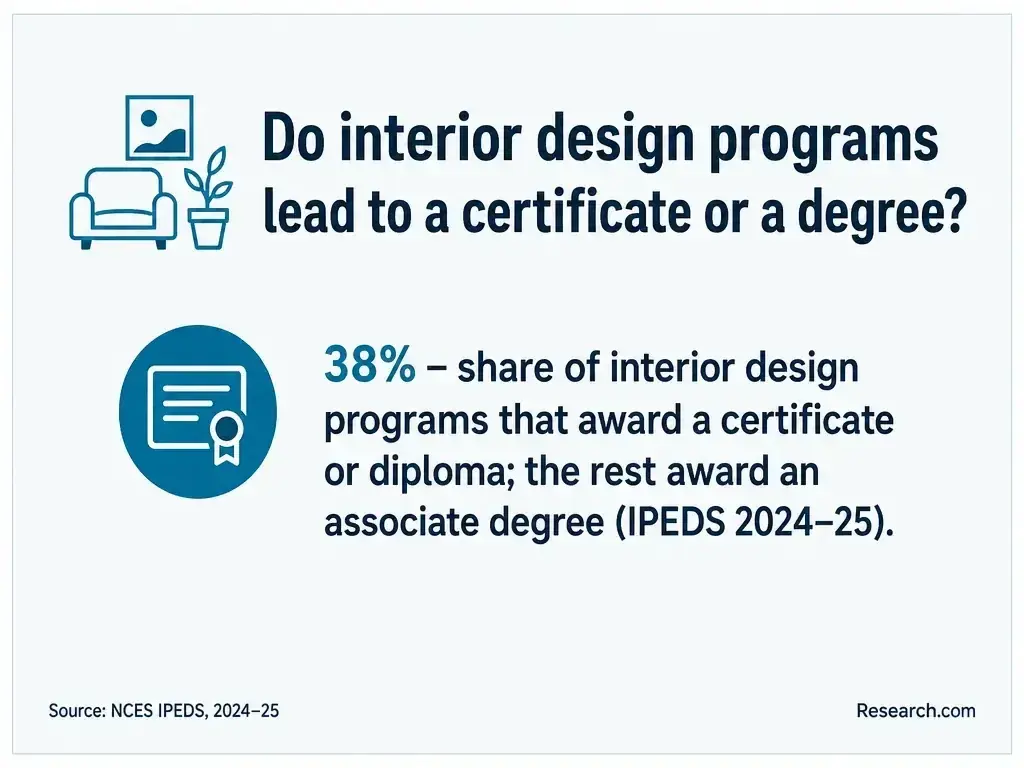
The credential depends on the provider: a shorter program may award a certificate or diploma, while a community college program may award an associate degree. These labels describe education completed, not a professional license. Confirm the exact award on the current catalog and ask whether its credits can transfer if you later change plans.
The pathways below differ most in breadth of instruction and the evidence of skill you can take to an employer. Compare actual course lists and portfolios before deciding that the shorter credential is the better bargain.
| Pathway | Likely fit | Key limitation to check |
| Focused certificate or diploma | Someone adding drafting, software, or showroom skills to existing experience | May offer limited design-studio work or transfer credit |
| Associate-degree program | Someone seeking broader technical instruction and a developed portfolio | Requires more study time and potentially more total expense |
| Employer-sponsored entry training | Someone who can obtain a relevant assistant or showroom position | May not cover the range of technical work expected in other roles |
Do not choose solely by whether a credential appears among easy associate degrees online. For interior design hiring, the useful question is whether you can show accurate plans, sound material choices, and a portfolio matched to the jobs you want.
Requirements vary by provider and credential. Ask about the general college or school application, placement or prerequisite courses, computer specifications, and whether a portfolio is needed for admission or developed during the program. Do not assume that a program open to beginners will provide every technical skill an employer expects by graduation.
If you have previous coursework or work experience, request a written review of transfer or prior-learning credit before enrolling. Credit that reduces your course load can also reduce cost, but only if it applies to required courses and does not disrupt their sequence. For an internship, ask separately about any employer screening or scheduling conditions; admission to a program does not itself secure a placement.
A strong occupational curriculum connects visual decisions to buildable documentation. Look for instruction in space planning, hand or digital drafting, computer-aided design, materials and finishes, lighting, presentations, client communication, and the codes or accessibility considerations relevant to projects. The U.S. Bureau of Labor Statistics identifies drawings, material selection, budgeting, and coordination with other building professionals as part of interior designers' work.
Ask a program to show completed student projects - not just a list of software names. Can students explain why a layout works, document dimensions and specifications, and revise a proposal after critique? Software and AI-assisted visualization can speed up presentation, but attractive images are not a replacement for accurate measurements, practical specifications, or judgment about how a space will be used.
Do not assume that completing a program grants professional status. Iowa's rules concerning regulated professional titles and practice should be checked with the Iowa Professional Licensing Bureau before you enroll for a specific title or career goal. Ask the agency - and the program - to distinguish work you may perform in a design-assistant or showroom role from any requirements associated with a protected title. Rules in another state should not be assumed to apply in Iowa.
Keep separate what each form of recognition means: institutional accreditation concerns the school; programmatic accreditation concerns a specific curriculum; professional certification is awarded under a certifier's rules; and state registration or licensure, where applicable, is granted under state requirements. None automatically confers another. If future certification or registration matters to you, obtain the current education, examination, and experience criteria from the relevant organization or Iowa regulator, then have the school explain in writing how its curriculum aligns.
Start with the job, not the ranking. An affordable program is worthwhile when its training and likely first-job opportunities justify your total expense and time commitment. Institutional accreditation, completion outcomes, and price are useful checks, but an affordability score cannot tell you whether the portfolio work matches a commercial studio or a residential showroom.
Use these steps to turn a shortlist into a decision:
A common mistake is choosing the lowest tuition without checking whether required software, studio access, or portfolio development costs extra. Another is assuming that an attractive credential name guarantees a designer job. If you already have substantial design experience and need only one technical skill, a focused course or employer training may be a better investment than a full program.
A realistic progression might begin in a showroom, drafting, or design-assistant role, then move toward greater responsibility for client projects as your portfolio and experience develop. Other directions include kitchen-and-bath work, furniture and finish selection, commercial interiors support, or project coordination. Self-employment is possible later, but it also requires finding clients, pricing work, and managing business risk; training alone does not establish a client base.
Match the pathway to the work. Someone aiming to support technical plans should prioritize drafting and documentation, while a prospective showroom specialist may value product knowledge and customer communication. Further credentials should be considered for a defined career need - not simply because they are available. Even a list of the cheapest online master's programs addresses a different educational investment and cannot replace assessing the practical interior design skills an Iowa entry-level employer requests.
The U.S. Bureau of Labor Statistics projects 2.7% national employment growth for interior designers from 2025 to 2035. That projection describes the United States, not a guaranteed number of Iowa openings. It suggests students should prepare for a competitive search and consider adjacent entry roles rather than counting on a single job title immediately after training.
For a more useful local forecast, check Iowa's latest state occupational projections alongside current vacancies in the area where you can work. Compare openings' experience requirements with your prospective program's projects and employer connections. If local postings are scarce for your preferred specialty, consider whether you are willing to commute, relocate within Iowa, or begin in a related showroom or assistant role.
Investing in training is an important decision, so Research.com evaluates affordability using comparable, documented measures rather than advertised tuition alone. For this ranking, programs are compared with others in the same occupation and location; only programs with completions reported to IPEDS are eligible. That means a provider absent from the ranking is not necessarily unavailable or unsuitable.
Most-affordable rankings use tuition, cost of attendance, median student debt, and the federal loan default rate. Weights are assigned through an entropy-based method, under which indicators that differ more across programs receive more weight. Accreditation and other quality measures do not enter the affordability score. Research.com's separate best-program rankings also consider student outcomes, earnings, support, and recognition; their weights should not be mistaken for the method used here. Readers can use this ranking to narrow a cost-conscious shortlist, then verify curriculum, practical training, and career fit themselves.
The ranking draws on the following data sources. Some cover broad categories of trade education and should not be interpreted as interior-design-specific accreditors or certifiers:
More detail on Research.com's approach is available on its methodology page. Because this is an affordability ranking - not a determination of professional eligibility - check each shortlisted program's current catalog and ask how its graduates prepare for the work you intend to pursue.
# 1 position
# 2 position
# 3 position

# 4 position
There is no universally cheapest program. Compare your personalized tuition and fees after aid, then add software, materials, travel, and lost earnings. If you need only a specific skill, employer training or a focused course may cost less than a full credential.
Not for every role. Employers set different requirements, and showroom or assistant positions may provide another entry point. An associate-degree program may be more useful when you need sustained drafting practice and a broader portfolio.
Some coursework can be remote, but you still need a credible way to practice measuring, producing accurate drawings, working with materials, and receiving project critique. Confirm any required campus meetings or internship before enrolling.
Not automatically. Check current Iowa rules and any applicable certifier's education, examination, and experience requirements for the specific title you seek. Ask the school how it documents alignment.
No. The affordability ranking measures cost and debt indicators, not whether a curriculum meets your particular career goal. Compare practical training, portfolio quality, completion plans, and total personal cost before deciding.