# 1 position
Highline College - Interior Design.
associate

Audited and Verified:
Our Editorial and Data Verification Process
Research.com uses government datasets, official education statistics and primary institutional information to support its career and degree guides. Our review process checks factual accuracy, occupational definitions, source dates and the requirements associated with the credentials discussed.
How This Article Was Fact-Checked
Our editorial team verifies salary estimates, employment projections, education requirements and program information against original data providers and official organizations. Salary figures are checked against the relevant occupational definitions and reporting periods. Information about licensure, accreditation and required in-person training is reviewed separately.
Fact-checked and verified on:

Co-Founder and Chief Data Scientist

Reviewed by Karolina Broda
Fact-Checker and Data Verification
An inexpensive interior design program is only a bargain if it builds the portfolio and technical skills employers expect. The U.S. Bureau of Labor Statistics reports a $67,190 national median annual wage for interior designers in May 2025, but that is not a starting salary. For prospective students and career changers, this guide explains Washington training routes, costs, credentials, and career prospects. It will feature a Most Affordable Interior Design Trade Schools in Washington for 2027 ranking, created by the Research.com team of data scientists to help you identify programs worth considering.
Expect a mix of design projects and technical production. Interior design goes beyond selecting finishes: students may learn to measure spaces, develop layouts, specify materials, prepare drawings, and present solutions within accessibility, safety, and budget constraints. A strong program lets you revise work after critique and leave with a portfolio you can show an employer (U.S. Bureau of Labor Statistics; O*NET).
These pathways serve different goals. Confirm the actual award and course requirements at each provider rather than relying on a program's name.
| Pathway | Best fit | Key limitation to check |
| Focused certificate | Someone seeking drafting, CAD, or decorating skills, or adding a skill to existing work | May offer too little studio work or technical breadth for an interior designer role |
| Interior design associate degree | Someone seeking a structured sequence of studios, technical courses, and portfolio development | Requires more time and total spending; check course availability and transferability |
| Employer training or entry-level design support work | Someone who can build skills while earning and obtain supervised project experience | Training may be narrow and may not meet an optional certification's education rules |
Apprenticeship-style learning can occur through employment, but do not assume interior design has the same widely available registered-apprenticeship route as construction trades. Ask a prospective employer what work you will perform, who reviews it, and whether it develops the experience needed for your longer-term goal (Apprenticeship.gov; Council for Interior Design Qualification).
Potential settings include interior design and architecture practices, furniture and kitchen-and-bath businesses, commercial workplace teams, residential remodeling firms, and suppliers. The work available depends on your portfolio: a retail-focused course may prepare you for product selection and client service, while commercial projects often call for stronger drawing, specifications, and code-related skills (U.S. Bureau of Labor Statistics; O*NET).
Location changes the practical search. Students near the Seattle-area market may have more types of firms to approach but should weigh commuting against studio schedules and entry-level pay. Elsewhere in the state, ask programs which nearby employers review portfolios or host projects; remote coursework alone does not create a local professional network. Seek an informational interview or a supervised project before paying for training built around a specialization that has few openings where you plan to live.
A verified Washington wage figure is not available in this article, so the $67,190 national median annual wage in May 2025 is a benchmark, not a Washington salary estimate or an expected first offer (U.S. Bureau of Labor Statistics, Occupational Outlook Handbook). The median covers working interior designers at different experience levels. Before enrolling, compare current Washington postings for the exact role you want - such as design assistant, CAD drafter, or interior designer - and note their experience and software requirements.
Lists of lucrative college majors are not a useful substitute for occupation- and location-specific pay research. For a training investment, compare realistic starting offers with your current earnings, not with an established professional's median.
A focused certificate may take less time than an associate degree, but there is no single statewide interior design training-hour requirement that makes programs equivalent. Duration depends on credits, studio sequencing, course availability, and whether you attend full- or part-time. Ask for a term-by-term plan that includes required software courses, portfolio work, and any internship or project placement; a course offered infrequently can extend the actual finish date.
Guides to the fastest associate's degree online can help you think about scheduling, but speed alone is a poor test for a studio-based occupation. An accelerated schedule makes sense if you can still complete substantial projects and obtain feedback. If you must keep working, a slower plan with predictable studio access may cost less in lost earnings.
Online delivery can work well for design history, research, presentations, and some drafting instruction. Campus studios can make it easier to receive live critiques, handle material samples, measure spaces, and collaborate on projects. A hybrid option may reduce travel without sacrificing those activities - but ask exactly which meetings, critiques, and field projects require attendance.
Career changers browsing top degrees for seniors online should judge an interior design program by its actual studio experience, not its online label. Before enrolling, request examples of student portfolios, software and computer specifications, feedback frequency, and access to instructors. Do not assume that completing online coursework alone satisfies a professional certification's education and experience criteria (Council for Interior Design Qualification).
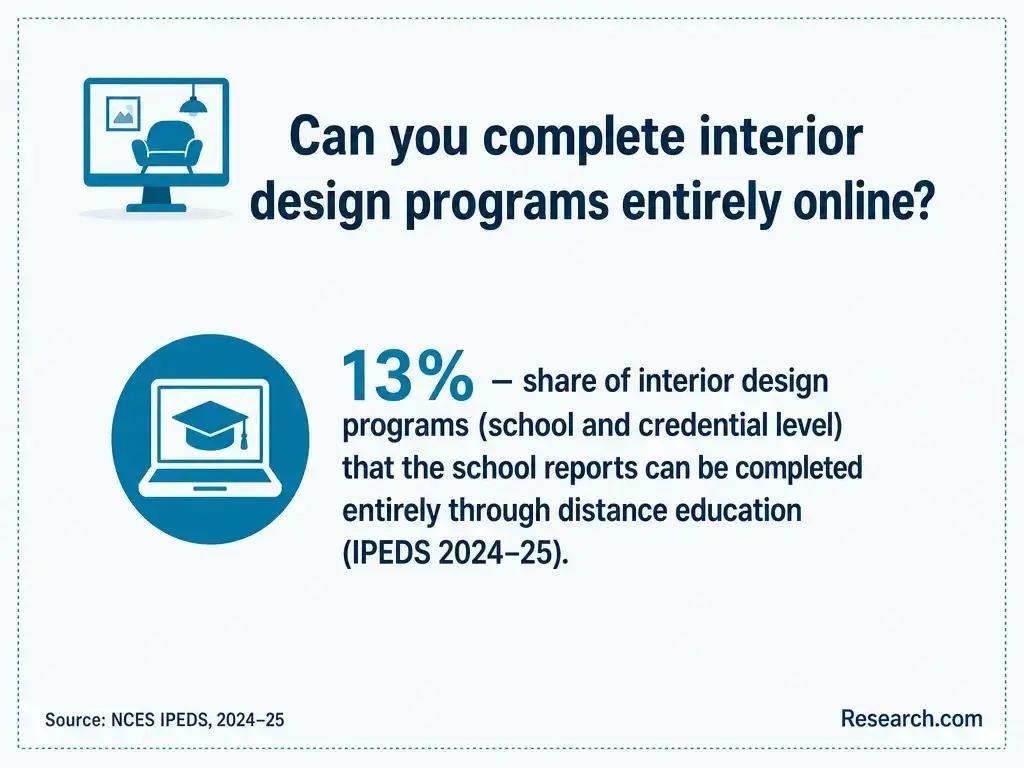
There is no defensible single average for all Washington interior design training routes: providers award different credentials, and published tuition may omit substantial expenses. For a 2027 comparison, obtain a written, current cost estimate for your residency status and planned course load. Public-college resident and nonresident charges can differ; verify how the school determines residency (Washington State Board for Community and Technical Colleges).
A useful price comparison includes the following categories. Their relevance and amount depend on the program, so request an itemized estimate rather than assuming each is included in tuition.
| Cost category | What to verify |
| School charges | Tuition by term, mandatory fees, and charges for repeat or additional courses |
| Project and technology costs | Computer specifications, design software, printing, models, materials, and textbooks |
| Attendance costs | Travel to studios or project sites and earnings forgone because of the schedule |
| Career-entry costs | Portfolio production and any optional certification application or examination fees |
Eligible students should check the Washington College Grant and federal aid, while working adults can ask WorkSource about applicable workforce-training support; eligibility depends on the student and program (Washington Student Achievement Council; Federal Student Aid; Washington State Employment Security Department). For return on investment, weigh aid and likely debt alongside completion probability, time out of work, current earnings, plausible post-training pay, and how long you expect to use the skills. The lowest tuition does not automatically produce the best return.
The award could be a college certificate, a specialized occupational credential, or an associate degree; finishing an employer's training may instead document work experience without a school award. Ask for the precise credential printed on the completion record and a list of courses and portfolio projects. A certificate in decorating, for example, should not be assumed to cover the technical work taught in an interior design program.
If a dual degree university option appears in your search, keep the comparison focused on the trade credential and skills your intended job requires. Institutional accreditation concerns the school; programmatic accreditation, where present, concerns a particular program. Neither automatically establishes eligibility for optional professional certification or substitutes for demonstrated project skills. Check the school's accreditation with the accreditor and any claimed interior design program accreditation with the accrediting body (U.S. Department of Education; Council for Interior Design Accreditation).
Requirements vary by provider and credential. Ask whether you need a high school credential, placement assessment, introductory courses, portfolio, or particular computer before applying; also ask whether courses taken elsewhere or documented prior learning can count toward the award. Credit acceptance is the receiving school's decision, so obtain an evaluation before budgeting for a shortened program.
Listings of accredited online colleges with no-fee applications can help reduce application costs, but an application-fee policy says nothing about interior design studio access or award fit. For a private career school, verify applicable Washington authorization; for any provider, separately verify accreditation, aid eligibility, and the status of the specific program (Washington Student Achievement Council; U.S. Department of Education).
Look for a progression from spatial planning and color and materials to computer-aided drawings, presentations, specifications, and projects constrained by accessibility, building conditions, and client budgets. Programs may teach different software, so compare the tools used in coursework with Washington job postings rather than assuming one application is universal (U.S. Bureau of Labor Statistics; O*NET).
Hands-on quality is visible in the work students produce. Ask how often instructors critique drawings, whether students measure real spaces and work with physical samples, and whether a final portfolio shows both design reasoning and technical documentation. A polished rendering without plans or specifications may be less useful for a technically focused job; a technical portfolio without client-facing communication may be limiting in residential work.
Washington does not require a general occupational license simply to work as an interior designer; do not confuse that with authority to perform work reserved for another regulated profession (Washington State Department of Licensing). Before selecting a program, check the scope of the job you want and how the employer handles drawings, permits, and professional oversight.
The National Council for Interior Design Qualification credential is an optional professional certification, not the same thing as a Washington license. Its eligibility rules address education and work experience, followed by examinations; a program's graduation certificate alone does not establish eligibility (Council for Interior Design Qualification). If certification is a long-term goal, ask the certifying organization how your proposed coursework and supervised experience would be evaluated before you enroll.
Start with the role you want, then test each program against the work that role requires. An affordability ranking is a screening tool, not a substitute for confirming whether you can finish the credential and produce a competitive portfolio.
Use this sequence when contacting providers; it catches the most expensive mismatches before you commit.
If you need only one software skill for an existing job, a focused course may be a better investment than a longer credential. If your goal is technical interior design work, be wary of a bargain program that teaches styling but provides little drafting, critique, or portfolio development.
A training credential can support applications for design assistant, showroom specialist, kitchen-and-bath design support, or drafting-focused roles, depending on its curriculum and your portfolio. Progression toward broader interior designer responsibilities generally depends on demonstrated project work, employer needs, and experience - not a credential title alone (U.S. Bureau of Labor Statistics; O*NET).
After entering the field, you might specialize in residential interiors, commercial spaces, materials, or technical documentation, or eventually serve clients independently. Optional certification may help with particular career goals, but first determine whether local employers value it for the positions you seek (Council for Interior Design Qualification). Someone aiming primarily for retail sales should compare a shorter, employer-supported route with a full studio program; someone seeking detailed commercial project work should prioritize technical instruction and supervised experience.
A comparable Washington-specific projection is not established here. Nationally, employment of interior designers is projected to grow 2.7% from 2025 to 2035 (U.S. Bureau of Labor Statistics, Employment Projections). That modest growth is a reason to plan for competition, not a reason to rule out training: openings and employer requirements can differ substantially by specialty and locality.
Technology also affects the skills worth buying. Employers can evaluate digital drawings and visualizations alongside design judgment, coordination, and client communication; ask programs how their projects teach both rather than treating software proficiency as a complete qualification (U.S. Bureau of Labor Statistics; O*NET). Before enrolling, review openings within a realistic commute and compare their requested skills with the program's final portfolio requirements.
Investing in training is a consequential decision. Research.com designed this ranking to help readers compare affordable interior design programs with other programs in the same occupation and location, rather than with unrelated schools. Its team examines reported data and applies a consistent scoring method, while recognizing that a low-cost ranking cannot establish whether a program fits a particular career goal.
The most affordable ranking scores tuition, cost of attendance, median student debt, and federal loan default rate. Indicator weights are distributed using an entropy-based method, which gives more weight to measures that vary more across programs. Unlike Research.com's best-program rankings, this affordability score does not include accreditation or other quality indicators. Only programs with completions reported to IPEDS are eligible; the absence of an apprenticeship, employer-sponsored course, or other provider from the ranking does not establish that it is unavailable or unsuitable.
Research.com uses the following sources in creating its trade-program rankings. Some cover other occupations and may not supply an interior-design-specific measure; readers should not mistake their inclusion here for an endorsement of a particular program.
Use the ranking to narrow a cost-conscious shortlist, then confirm each program's current award, curriculum, hands-on work, aid eligibility, and complete price directly with the provider. More detail about Research.com's approach appears on its methodology page.
# 1 position
# 2 position
# 3 position

# 4 position

# 5 position
# 6 position

# 7 position
If you need a specific skill, compare a focused public-college course or certificate with employer-supported training. If you want a broader design role, compare the full cost of programs that include technical projects and portfolio feedback; the cheapest tuition may not meet that goal.
An associate degree can provide relevant training, but hiring depends on the role, portfolio, and experience. Check each employer's requirements and any optional certification rules separately (U.S. Bureau of Labor Statistics; Council for Interior Design Qualification).
Some coursework can be remote. Ask how you will complete measured-space projects, materials work, critiques, and a reviewed portfolio, and check any certification goal directly with the certifying organization.
There is no general Washington occupational license required simply to work as an interior designer. Optional professional certification has separate education, experience, and examination rules (Washington State Department of Licensing; Council for Interior Design Qualification).
Get an itemized total price and realistic completion plan, then compare the portfolio you will produce with nearby job requirements. Account for aid, debt, lost earnings while studying, and likely entry-level pay - not just the occupation's national median.