# 1 position


Audited and Verified:
Our Editorial and Data Verification Process
Research.com uses government datasets, official education statistics and primary institutional information to support its career and degree guides. Our review process checks factual accuracy, occupational definitions, source dates and the requirements associated with the credentials discussed.
How This Article Was Fact-Checked
Our editorial team verifies salary estimates, employment projections, education requirements and program information against original data providers and official organizations. Salary figures are checked against the relevant occupational definitions and reporting periods. Information about licensure, accreditation and required in-person training is reviewed separately.
Fact-checked and verified on:

Co-Founder and Chief Data Scientist

Reviewed by Karolina Broda
Fact-Checker and Data Verification
The cheapest interior design program is not necessarily the cheapest route into the work: software, materials, travel, and the time needed to build a portfolio all matter. The U.S. Bureau of Labor Statistics (BLS) reports a $67,190 national median annual wage for interior designers in May 2025, but that is not a starting-pay estimate. For prospective students and career changers, this guide compares Texas training costs, credentials, practical experience, and registration rules. It also features a Most Affordable Interior Design Trade Schools in Texas for 2027 ranking created by the Research.com team of data scientists to help you identify programs worth considering.
Expect training in how interior spaces function as well as how they look. A career-oriented program should teach measured drawings, space planning, materials, lighting, computer-aided drafting, presentations, and the coordination needed to turn a client brief into buildable documents. Ask to see student projects: a portfolio showing plans, specifications, and revisions is more informative than a list of software names.
Texas community colleges and career schools may offer short certificates or occupational associate degrees. A short certificate can suit someone targeting showroom, styling, or drafting-support work; a more extensive program may better suit someone seeking commercial design responsibilities or a future path to registration. Do not infer duration from advertising about best 6-month associate degree programs online: verify the actual interior design program's credits, course sequence, and in-person requirements.
Unlike trades built around a standard apprenticeship, interior design generally develops through studio assignments, portfolios, internships, and supervised workplace experience. Paid entry-level work at a design firm or furnishings business can complement school, but employer training alone may leave gaps in technical drawing or code knowledge.
Potential workplaces include residential design firms, commercial interiors teams, furniture and kitchen-and-bath showrooms, builders, and businesses that prepare drawings or specifications for projects. Houston and Dallas-Fort Worth offer different mixes of corporate, hospitality, healthcare, and residential work; a student elsewhere in Texas should check whether nearby employers hire junior designers or mainly sales and installation staff.
Job titles matter. A showroom design consultant may emphasize product knowledge and sales, while a commercial design assistant may need stronger drafting, accessibility, and construction-document skills. Compare local job postings with a program's project work before paying for training.
Do not treat a national occupational median as a Texas offer. BLS reports a $67,190 U.S. median annual wage for interior designers in May 2025; that figure includes experienced workers and does not isolate newly trained designers, showroom employees, or freelancers. For a local decision, compare current Texas wage estimates from the Texas Workforce Commission or BLS with actual postings for the job title and metro area you want.
Compensation can also depend on whether a position pays a salary, commissions, or project fees. When weighing training cost against possible earnings, use conservative entry-level offers rather than the occupational median, and account for the time it may take to build a portfolio and client base.
A focused certificate may take a few terms; an occupational associate degree commonly follows a roughly two-year full-time course sequence. Actual time depends on prerequisites, whether studio courses run every term, and whether you attend part time. Check the current catalog rather than relying on a program's advertised minimum.
Texas does not impose one universal clock-hour requirement for entry into unregistered interior design work, according to the Texas Board of Architectural Examiners (TBAE). That does not make a short course equivalent to extensive studio training, nor does it establish eligibility for the Registered Interior Designer title. Ask how many scheduled hours involve supervised drawing, software, critique, and client-style projects - not just how many credits appear on the transcript.
Online study can work well for design history, product research, and some drafting instruction. Campus or hybrid study can make it easier to use materials libraries, practice measuring spaces, receive live critiques, and complete team projects. Neither format substitutes for a strong portfolio.
Before enrolling online, confirm how students obtain required software, receive drawing feedback, complete site-based work, and meet any internship expectations. Institutional accreditation and financial-aid eligibility are separate checks; a list of accredited online schools that accept financial aid does not establish that a particular interior design program provides the practical training or future registration eligibility you need. Texas residents far from a campus should also price travel for any required in-person sessions.
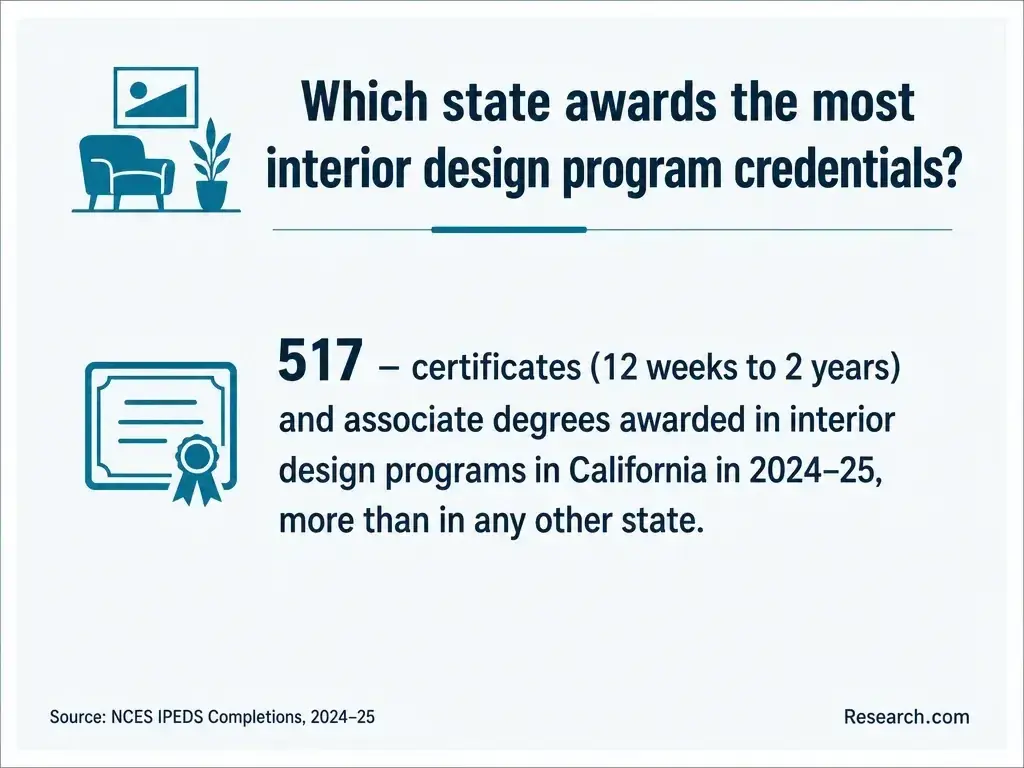
There is no single reliable price for every Texas interior design pathway: certificates and associate degrees differ in length, and public-college charges can vary by residency and district. Compare each school's current program estimate rather than applying an institution-wide tuition figure to an interior design credential.
The costs below form a practical job-readiness budget. Request an itemized estimate so that an apparently inexpensive program does not become costly after enrollment.
Ask the financial-aid office whether the specific program qualifies for federal aid and whether you qualify for Texas or local assistance. Texas Workforce Commission and local Workforce Solutions funding may support eligible training, but availability and student eligibility must be confirmed. A shorter program is not automatically cheaper if it leaves you needing substantial additional instruction.
The award might be a certificate or an occupational associate degree; a short, noncredit course may instead provide only a record of completion. These are school credentials, not Texas occupational registrations. Ask whether credits from a certificate apply to a longer interior design program and obtain any transfer agreement in writing.
For this career decision, the useful question is whether the credential comes with the technical work and portfolio expected by your target employers. General discussions of dual-degree programs do not answer whether a specific occupational curriculum teaches drafting, codes, materials, and client presentation. If registration is your long-term goal, check education eligibility directly with the Council for Interior Design Qualification (CIDQ) and TBAE before enrolling.
Requirements vary by provider and credential. Community-college applicants generally follow the institution's admissions and placement process; a program may also specify course prerequisites, software, or a computer capable of running design applications. A private career school may use different entry criteria and payment terms. Ask for written requirements for the specific interior design program, not just general school admission.
If you already have drafting or construction experience, ask whether prior coursework or documented learning can reduce required classes without removing portfolio-building opportunities. Also check who arranges internships and whether participating employers impose their own conditions. Entry into a program is not the same as eligibility for professional registration or a job offer.
Strong occupational training connects design choices to dimensions, budgets, and real building constraints. Look for practice in plans and elevations, CAD or building-information tools, materials and finishes, lighting, furniture specification, accessibility, applicable building and fire codes, and presenting revisions to a client. BLS identifies creativity, technical drawing, and coordination with other construction professionals as important to interior designers' work.
For a commercial-design goal, ask whether students produce a complete project set rather than only mood boards. For residential or showroom work, check for measuring, product specification, customer interviewing, and estimating. Software changes; the transferable skill is explaining and documenting a design accurately.
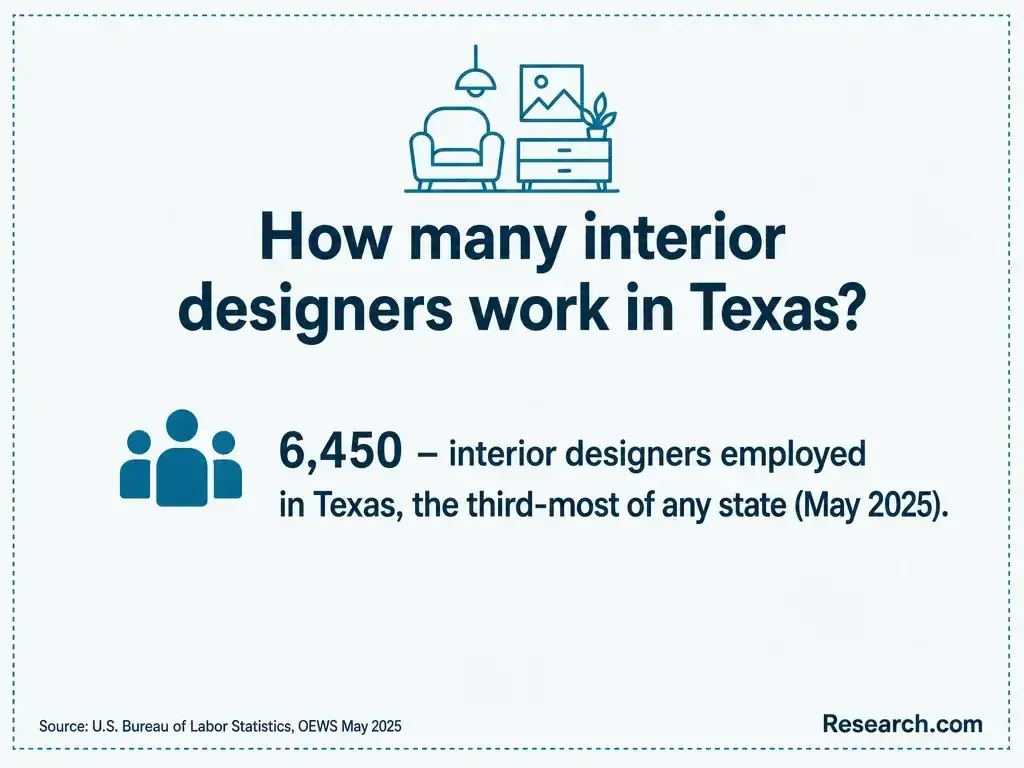
Texas does not require everyone doing interior design work to hold an occupational license. It does restrict use of the Registered Interior Designer title. TBAE administers registration, and its requirements are distinct from a school's accreditation or certificate. CIDQ sets eligibility rules for its professional examination; passing a course does not automatically qualify someone for that exam or for Texas registration (TBAE; CIDQ).
If that title is your goal, review the current education, experience, examination, and application requirements with TBAE and CIDQ before choosing a program. If you want an unregistered showroom or design-support role, ask employers which skills and portfolio pieces they require instead of paying for a credential solely because it sounds like a license.
Start with the job you want, then work backward to the training it requires. An affordability ranking helps identify candidates, but it does not score studio quality or guarantee registration eligibility. Broad lists of easy bachelor degrees are not a substitute for comparing the occupational programs relevant to this decision.
Use these checks when speaking with admissions staff; they expose common gaps that a tuition figure alone cannot show.
Compare return on investment using expected completion time, aid, debt, lost work hours, your current earnings, plausible local entry pay, and the time you expect to work after training. Discount future gains rather than assuming every later paycheck offsets today's cost equally. A lower-priced program is a poor bargain if it cannot help you produce the work your intended employer expects.
A graduate might begin in showroom sales, design assistance, drafting support, or residential project coordination, then develop a specialty or take on more independent client work. Commercial interiors can demand deeper experience with documentation, accessibility, and coordination. Registration is an optional professional path for those who want the protected Texas title, not a universal entry requirement (TBAE).
Choose training for the actual role rather than assuming an interior design credential leads directly to the earnings highlighted in lists of high paying 4 year degrees. For someone already employed by a furnishings business, supervised projects and targeted technical courses may be more useful than restarting a full program. For a newcomer seeking technical design work, sustained studio practice may be worth the additional time.
BLS projects 2.7% growth nationally for interior designers over 2025-2035. That is an occupation-wide projection, not a forecast of openings for graduates of a particular Texas program. It points to a field where portfolio quality, technical competence, and experience deserve as much attention as the credential name.
Texas job prospects can differ substantially by metro area and specialty. Check current Texas Workforce Commission projections and local postings for the work you want, then note how often employers request drafting software, construction documents, sales experience, or registration. That comparison tells you whether a nearby program prepares you for available roles - or whether you would need to commute, relocate, or build experience in a related job first.
Education is a consequential investment, so the Research.com team designed this ranking to help readers compare interior design programs against other programs in the same occupation and location. The team uses established education and outcomes sources and checks the indicators used for consistency and credibility. Only programs with completions reported to IPEDS are eligible; an unlisted training provider is not necessarily unapproved or low quality.
The most affordable ranking evaluates tuition, cost of attendance, median student debt, and federal loan default rate. It uses an entropy-based weighting method, which gives more weight to indicators that distinguish programs more clearly. Accreditation and other quality indicators do not contribute to this affordability score. By contrast, Research.com's best programs rankings consider outcomes, earnings and return on investment, costs and debt, and quality and recognition. Their weights assign 20% to occupation-relevant programmatic accreditation or industry recognition, 10% to institutional accreditation, 10% to student support, and 60% to outcomes, earnings, and costs, with entropy-based weights within that last group.
The following data sources inform Research.com's trade-school rankings. Some cover occupations other than interior design; their inclusion as ranking sources does not imply that their approvals or certifications apply to this field.
Use the ranking to narrow your search, then confirm each program's current price, portfolio instruction, and fit for your career goal. More detail on the ranking approach appears in Research.com's methodology.
# 1 position
# 2 position
# 3 position

# 4 position
# 5 position

# 6 position
# 7 position

# 8 position
# 9 position

# 10 position
# 11 position

# 12 position

# 13 position
# 14 position

# 15 position

Compare in-district community-college certificates with targeted courses and paid design-support work. Include fees, software, supplies, and travel; the lowest tuition is not necessarily the lowest job-ready cost.
A certificate can help with entry-level work if its projects develop the skills local employers request. It does not itself grant the Texas Registered Interior Designer title or establish CIDQ exam eligibility.
They can teach theory and software, but check how you will complete measured projects, receive critiques, and build a portfolio. Verify any registration-related education claims with TBAE and CIDQ.
Check institutional accreditation, state authorization, and any claimed programmatic recognition separately. None alone guarantees employment or Texas registration.
It can be if the total cost is manageable and the program produces a portfolio suited to your target jobs. Compare that outcome with shorter courses or paid entry-level work, using realistic local starting pay rather than a national median.