# 1 position


Audited and Verified:
Our Editorial and Data Verification Process
Research.com uses government datasets, official education statistics and primary institutional information to support its career and degree guides. Our review process checks factual accuracy, occupational definitions, source dates and the requirements associated with the credentials discussed.
How This Article Was Fact-Checked
Our editorial team verifies salary estimates, employment projections, education requirements and program information against original data providers and official organizations. Salary figures are checked against the relevant occupational definitions and reporting periods. Information about licensure, accreditation and required in-person training is reviewed separately.
Fact-checked and verified on:

Co-Founder and Chief Data Scientist

Reviewed by Karolina Broda
Fact-Checker and Data Verification
Choosing an affordable interior design program in Florida means looking beyond tuition: a low-cost credential may not provide the portfolio, technical training, or experience your intended job requires. The U.S. Bureau of Labor Statistics reports a $67,190 national median annual wage for interior designers in May 2025, but that is not starting pay. This guide helps prospective students compare costs, credentials, career routes, and Florida's rules. It will also feature a Most Affordable Interior Design Trade Schools in Florida for 2027 ranking created by the Research.com team of data scientists to help students make an informed choice about programs worth considering.
Expect a mix of design studio projects and technical instruction - not just decorating. Students may develop space plans, drawings, material selections, presentations, and a portfolio using design software. Before enrolling, request the curriculum and examples of completed student work: the quality and frequency of critique matter more than a course title alone.
Programs can serve different goals. A short certificate may help a working professional add drafting or visualization skills; a broader associate-degree program may offer more sustained studio practice and preparation for junior design roles. A showroom or design-assistant job with employer training can be a lower-cost route into residential sales and project support, but it may not provide the same technical curriculum. Lists of fast track college programs online are not evidence that an accelerated option includes the studio practice needed for a particular interior design job.
Potential workplaces include residential design businesses, furniture and kitchen-and-bath showrooms, architecture and design firms, hospitality projects, and commercial interiors teams. A showroom role may emphasize product knowledge and customer service; a commercial project-support role is more likely to require coordinated drawings, specifications, and familiarity with building requirements (U.S. Bureau of Labor Statistics; O*NET).
Location changes the practical choice. If an internship or job requires regular site visits or client meetings, compare opportunities within commuting distance of the campus - not just statewide listings. Ask each program which local employers review portfolios or host students, and whether those connections match residential, hospitality, or commercial work.
The U.S. median annual wage for interior designers was $67,190 in May 2025 (U.S. Bureau of Labor Statistics). It covers workers at different experience levels nationwide; it is neither a Florida wage nor a reasonable promise of first-job earnings. Compare a Florida wage estimate for the specific occupation and metro area with local postings for the roles you could enter after training. A showroom sales role, drafting-support job, and established interior designer position should not be treated as the same pay category.
For a personal return-on-investment estimate, compare likely entry pay with what you earn now, then account for aid, borrowing, completion prospects, and time spent training. A higher potential wage matters less if the program's cost or schedule makes completion unlikely.
A focused software or design certificate may take a few months; a broader associate-degree program usually requires multiple academic terms. Part-time attendance extends the calendar, while a compressed schedule can reduce time away from work but leave less time to build and revise a portfolio. Duration is set by the actual catalog requirements, not the credential name alone.
Unlike a trade with a single statewide training-hour requirement for every entrant, interior design has different routes depending on the work sought. Ask for the program's required credits or contact hours, scheduled studio time, any internship expectations, and whether its coursework and documented experience could support a future professional examination or Florida registration application. Do not assume classroom completion replaces required work experience (Florida Board of Architecture and Interior Design; Council for Interior Design Qualification).
Online instruction can work well for design history, software demonstrations, and some drawing assignments. Campus or hybrid study may make it easier to access studio critique, material samples, shared equipment, and site-based projects. Neither format is automatically better: ask how often instructors review individual drawings and how students complete physical measurements, presentations, and any internship.
An online program's institutional accreditation and access to aid are separate questions from whether its training fits a job or Florida registration goal. Guides to accredited online schools that accept financial aid can help frame an aid search, but verify the specific interior design program, its delivery requirements, and its eligibility directly with the school and Federal Student Aid.
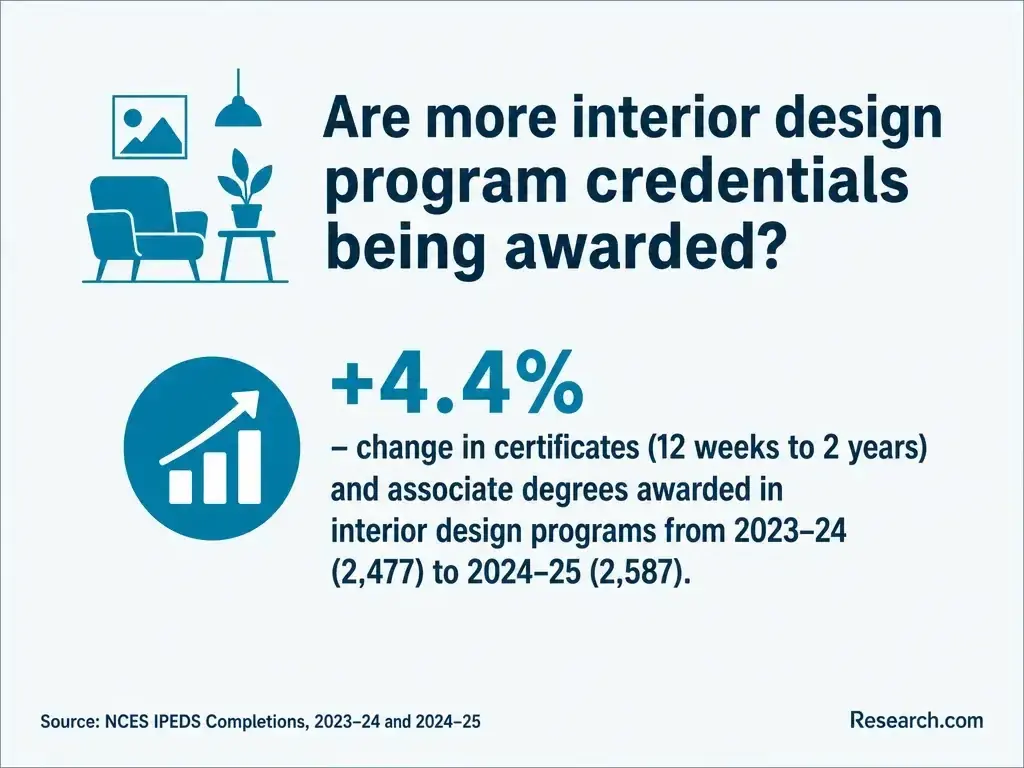
There is no defensible single average that covers Florida certificates, associate-degree programs, and employer training on the same basis. Published tuition may depend on residency and enrollment status, while a short program and a longer program deliver different amounts of instruction. Request a current, itemized total cost to become job-ready from each provider.
The comparison below separates school charges from costs that can make an apparently inexpensive program harder to afford.
| Cost category | What to compare |
| School charges | Tuition, mandatory fees, and resident or nonresident rates |
| Project expenses | Software access, computer specifications, printing, models, samples, and other studio materials |
| Career-entry expenses | Portfolio production, optional examination fees, and any later registration application costs |
| Time and travel | Campus or site-visit transportation and earnings forgone while studying |
| Offsets | Grants, scholarships, eligible aid, employer support, and wages from relevant work |
Compare the resulting net cost with the training and portfolio you receive. Even comparisons with the cheapest bachelor degree online cannot establish the price of a Florida trade program. Ask the financial aid office about eligibility before assuming a certificate qualifies for federal aid; ask a local workforce office whether your program qualifies for training assistance (Federal Student Aid; FloridaCommerce).
Depending on enrollment, the award may be a skills certificate, a career diploma, or an associate degree. These are school-awarded credentials, not a Florida occupational registration. An employer's software training may produce a vendor credential or no formal academic award at all. Ask what appears on the transcript and whether credits can transfer or stack into another program; get any transfer arrangement confirmed by the receiving school.
Optional credentials can demonstrate a particular skill, but they do not grant authority to submit regulated design documents. Lists of easy certifications that pay well should not replace checking what local interior design employers recognize or what the Council for Interior Design Qualification requires for its professional examination.
Admissions rules differ by provider and credential. A college program may ask for an application, proof of prior schooling, and placement or prerequisite information; a focused continuing-education course may have fewer entry requirements. Portfolio requirements, if any, should be stated in the current program catalog. Ask whether students must supply a computer capable of running assigned software before the first studio course.
Enrollment eligibility, federal-aid eligibility, and Florida professional-registration eligibility are separate decisions made under different rules (Federal Student Aid; Florida Board of Architecture and Interior Design). If registration is your long-term goal, ask the school to identify the coursework and records you would retain for an application rather than accepting a general assurance that graduates are "license-ready."
A career-focused curriculum should connect client needs to workable interiors. Look for space planning, measured drawings, drafting or computer-aided design, materials and finishes, lighting, accessibility, presentations, budgeting, and project documentation. Commercially oriented training should also introduce applicable codes and coordination with other building professionals (U.S. Bureau of Labor Statistics; O*NET).
Judge hands-on work by its outputs. Ask how many projects require students to measure a space, revise drawings after critique, specify products, and present a finished proposal. A program centered on attractive images but offering little documented planning practice may suit visual merchandising better than technical project support.
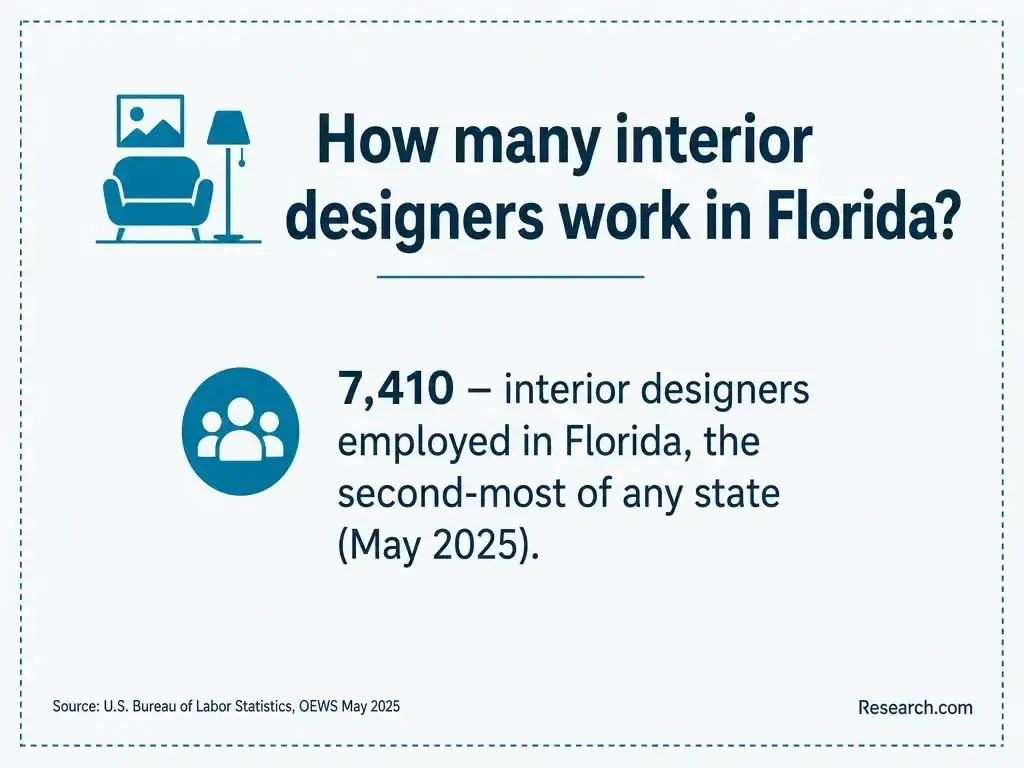
Not every interior design job requires Florida professional registration. The critical distinction is between providing design services within an unregistered role and seeking the authority associated with registered interior designer status, including applicable commercial permitting work. Florida's Board of Architecture and Interior Design sets the registration rules; the permitted scope of a project matters more than a job title (Florida Board of Architecture and Interior Design).
The NCIDQ examination is a professional credentialing route with education and experience eligibility requirements, not a certificate automatically awarded by a school. Institutional accreditation, interior-design programmatic accreditation, state school authorization, NCIDQ eligibility, and Florida registration each answer a different question (Council for Interior Design Qualification; Council for Interior Design Accreditation; Florida Board of Architecture and Interior Design). Before paying tuition for a commercial-practice goal, obtain the board's current requirements and ask how the program's curriculum fits them.
Start with the job you want, then compare the training needed to do it. Indian River State College, Daytona State College, Miami Dade College, Hillsborough Community College, and Seminole State College of Florida are examples of institutions whose current catalogs readers can check for relevant offerings; do not assume each offers the same credential, format, or courses in 2027. A ranking can narrow a search, but its affordability score does not evaluate studio fit or professional eligibility.
Use these questions when contacting programs so you can compare answers on the same terms:
Watch for a program that promises registration or earnings without explaining eligibility and evidence, or that advertises low tuition while leaving software and studio expenses unclear. Choose a shorter course for a defined skill gap; favor broader training when you need sustained technical practice and a portfolio to enter the field.
Entry routes can include showroom associate, design assistant, drafting or visualization support, and junior roles under experienced designers. With suitable experience and documented skills, a worker may move toward project coordination, a specialty such as kitchen-and-bath or hospitality interiors, or independent client work within the scope Florida permits. Regulated commercial documentation has a separate eligibility question; job experience alone should not be assumed to settle it (Florida Board of Architecture and Interior Design).
Choose training to match the first attainable role, not an eventual salary label. For example, a portfolio-heavy program may help with design-assistant applications, whereas paid showroom work can build product and client knowledge while reducing training costs. Broad comparisons such as highest paid bachelor's degree lists do not measure entry pay or return on investment for these trade-training routes.
National employment of interior designers is projected to grow 2.7% from 2025 to 2035 (U.S. Bureau of Labor Statistics, Employment Projections). That is a U.S. occupational projection, not a Florida forecast or a measure of openings for certificate holders. It suggests students should build a portfolio and software skills relevant to actual vacancies rather than assume that completing training will secure a design position.
For a Florida decision, review current state and local occupation data and nearby job descriptions alongside program outcomes. Check whether postings seek client-facing sales ability, technical drawings, commercial documentation, or a combination: those differences determine whether a short certificate, a longer college program, or paid entry-level work is the better next step (FloridaCommerce; U.S. Bureau of Labor Statistics).
Investing in education is a consequential decision. Research.com created its affordability ranking to help readers compare interior design programs with other reported programs in the same occupation and location, rather than with unrelated schools nationwide. The team uses multiple education and outcomes datasets to check the quality, credibility, and accuracy of its comparisons.
For the most affordable ranking, scores use tuition, cost of attendance, median student debt, and federal loan default rates. An entropy-based method assigns more weight to measures that vary more across programs. Accreditation and other quality indicators are not part of this affordability score; readers should verify them separately. Only programs with completions reported to IPEDS are eligible, so the ranking does not capture every career school, employer training option, or other available route.
The ranking draws on the following data sources. Some also cover other trades and health occupations; their inclusion as sources does not make their occupation-specific credentials relevant to interior design.
Use the ranking to identify programs for closer review, not as a substitute for comparing current program-level charges, studio work, and career fit. More detail about Research.com's approach is available on its methodology page.
# 1 position
# 2 position
# 3 position

# 4 position
# 5 position

# 6 position

# 7 position

# 8 position
# 9 position

# 10 position

# 11 position
# 12 position

Compare a focused public-college course or certificate with relevant paid showroom work, then add required software, materials, travel, and lost earnings. The cheapest tuition is not necessarily the cheapest route to the job you want.
A certificate may prepare you for certain support or residential design roles, depending on your skills and an employer's requirements. It does not, by itself, establish eligibility for Florida registered interior designer status (Florida Board of Architecture and Interior Design).
Some coursework can be remote. Check how the program handles measured spaces, materials, critique, presentations, and any field experience; do not assume online completion meets professional examination or Florida registration requirements.
It depends on the program and your goal. Ask whether field experience is required for graduation and separately verify any professional experience requirement for an examination or registration route (Council for Interior Design Qualification; Florida Board of Architecture and Interior Design).
No. Accreditation concerns an institution or program; authority to perform regulated work comes from applicable Florida rules and an individual's eligibility. Confirm the intended scope with the Florida Board of Architecture and Interior Design.