# 1 position


Audited and Verified:
Our Editorial and Data Verification Process
Research.com uses government datasets, official education statistics and primary institutional information to support its career and degree guides. Our review process checks factual accuracy, occupational definitions, source dates and the requirements associated with the credentials discussed.
How This Article Was Fact-Checked
Our editorial team verifies salary estimates, employment projections, education requirements and program information against original data providers and official organizations. Salary figures are checked against the relevant occupational definitions and reporting periods. Information about licensure, accreditation and required in-person training is reviewed separately.
Fact-checked and verified on:

Co-Founder and Chief Data Scientist

Reviewed by Karolina Broda
Fact-Checker and Data Verification
Choosing an affordable interior design program means looking beyond tuition: the least expensive option may not provide the portfolio work or technical training your intended job requires. The Research.com team of data scientists created the Most Affordable Interior Design Trade Schools in Virginia for 2027 ranking to help students identify programs worth considering. With national employment for interior designers projected to grow 2.7% from 2025 to 2035, according to the U.S. Bureau of Labor Statistics, this guide helps career starters and working professionals compare costs, credentials, training formats, and realistic career paths.
Expect a mix of visual design, technical drawing, materials selection, and client communication. Interior design extends beyond decorating: designers plan functional spaces and coordinate drawings, specifications, budgets, and work with other building professionals, according to the U.S. Bureau of Labor Statistics. A useful program should let you demonstrate those tasks through assessed projects, not just watch software tutorials.
These pathways lead to different credentials and different levels of preparation. Program titles alone do not establish that two options cover the same skills.
| Pathway | Typical credential or result | Best fit and key limitation |
| Focused career-school or continuing-education training | Certificate or completion record, depending on provider | Can build a specific skill, such as drafting or design software; check whether it includes a portfolio and substantive space-planning work. |
| Community college program | Certificate or associate degree, depending on program | Can combine design fundamentals with technical coursework; compare the curriculum, credit requirements, and available studio access. |
| Employer-based learning | Work experience; a credential is not automatic | Can suit showroom or design-support entrants who can learn on the job; may offer narrower training than a structured program. |
A conventional registered apprenticeship is not an assumed requirement for interior design. If a provider advertises one, verify its registration, paid-work terms, instruction, and resulting credential with the sponsor or Virginia's apprenticeship agency. Ask any school how many projects receive instructor critique and whether students complete drawings, specifications, and a portfolio they can show employers.
Potential workplaces include residential design firms, commercial interiors teams, furniture and kitchen-and-bath showrooms, and businesses supporting renovation projects. The U.S. Bureau of Labor Statistics identifies architectural and engineering services, specialized design services, and furniture retail among employers of interior designers. An initial role may be design assistant, showroom specialist, or drafting support rather than independent designer.
Location affects the search. In Northern Virginia, compare opportunities tied to offices, hospitality, and residential projects; in the Richmond and Hampton Roads areas, investigate local firms, retailers, and renovation businesses. These are job-search directions, not claims that every market has equal openings. Review actual local postings before enrolling: their software, portfolio, and experience requirements will tell you whether a prospective program prepares you for nearby work or whether commuting or relocation may be necessary.
A verified, comparable Virginia wage figure is needed to estimate state-specific pay; the national figure should not be presented as a Virginia salary. The latest national median annual wage specified here is $67,190 for interior designers in May 2025 (U.S. Bureau of Labor Statistics, Occupational Outlook Handbook). The median describes workers across experience levels and settings, not the likely offer to a new program completer.
For a personal earnings estimate, check current Virginia postings for the role you could realistically obtain first - such as design assistant or showroom specialist - and separate those wages from postings for experienced interior designers. Compare pay against your current earnings, expected training time, and any debt. A portfolio and relevant work experience may matter as much as the credential name when seeking an initial role.
Duration depends on the credential, credit load, and studio schedule. A focused certificate can require fewer courses than an associate degree; part-time study can extend either path. There is no single Virginia-required number of classroom or clock hours for entry into every interior design job. Request each program's published credits or contact hours, course rotation, and expected full-time and part-time completion schedules.
Speed has a trade-off: an accelerated course may teach software quickly but leave less time for drawing critique, revisions, and portfolio development. If you already work in a showroom or related setting, ask whether prior coursework or documented experience can reduce repeated training; obtain the credit decision in writing before budgeting for a shorter program. Search results for 1 year master programs online concern a different educational route and should not be used to estimate the length of trade training.
Online coursework can make design history, drawing concepts, software practice, and some critiques more accessible. Campus or hybrid study may provide scheduled studio feedback, material samples, equipment, and opportunities to collaborate on physical space-planning projects. Neither format is automatically better: judge the work students produce and the instruction available when they get stuck.
Ask an online provider which projects require site measurements, material evaluation, supervised studio work, or visits to an employer or project location. Confirm where and when those activities occur, especially if you live far from campus. A list of top online colleges with national accreditation does not, by itself, establish that a particular interior design program provides practical training or meets a professional credential's requirements.
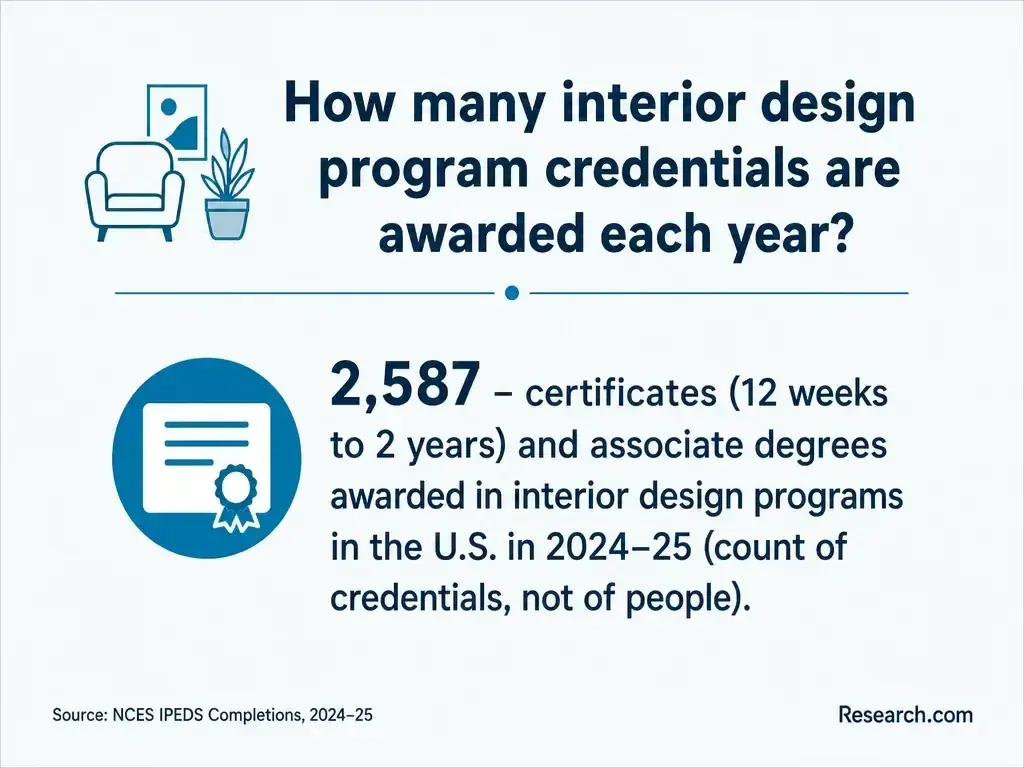
There is no defensible single average for every Virginia interior design training route: certificates, associate degree programs, and noncredit courses have different lengths and pricing structures, and college datasets do not capture every provider. Get a current, itemized quote rather than using one school's advertised tuition as a statewide benchmark. Virginia community colleges publish resident and nonresident rates, so confirm your residency classification before comparing a public option with a career school (Virginia Community College System).
This cost breakdown shows what to request from each provider. It helps turn an advertised price into an estimate of what it takes to complete training and pursue work.
| Cost component | What to verify |
| School charges | Tuition, mandatory fees, course-specific charges, and the cost of repeating a required course |
| Project supplies | Computer and software requirements, printing, samples, drafting supplies, and portfolio materials |
| Attendance and career entry | Travel to studios or sites, time away from paid work, and any optional examination or credential fees |
| Potential offsets | Grants, scholarships, eligible federal or state aid, and employer tuition assistance |
Federal aid eligibility depends on both the student and the eligible institution and program; a short course is not automatically aid-eligible (Federal Student Aid). For return on investment, compare the net cost and debt with your current earnings, plausible post-training work, time to completion, and likelihood of finishing - not the national occupational median alone.
The award might be a certificate, an associate degree, or a provider-issued record of completion. Ask for the credential's exact name and whether it is credit-bearing. A short software certificate is evidence of a narrower skill set, not necessarily the equivalent of a program covering design studios, building systems, and professional practice.
Keep four checks separate: institutional accreditation concerns the institution; programmatic accreditation concerns a specific program; state authorization concerns permission to operate; and professional certification concerns an individual's qualifications. None automatically substitutes for another. The Council for Interior Design Accreditation identifies accredited interior design programs, while Virginia's Department of Professional and Occupational Regulation administers the state's certified interior designer credential. Verify any claimed connection directly with the relevant organization. Lists of affordable phd programs address a different credential and do not answer these trade-program questions.
Requirements vary by provider and award. Ask whether admission requires a high school credential, placement assessment, prior coursework, or an application portfolio; then ask whether individual studio or software courses have prerequisites. Open admission to a college does not necessarily mean immediate admission to every course or guaranteed space in a limited-capacity program.
Before applying, request the program catalog and confirm the starting term, required equipment, course sequence, and any portfolio review. If minimizing upfront expense matters, a list of accredited us colleges online with no application fee can prompt an application-cost comparison, but verify the interior design program's own availability and charges directly. Admission to training is separate from eligibility for Virginia's optional professional certification.
A substantial curriculum may cover space planning, measured drawings, computer-aided drafting, three-dimensional visualization, color and materials, lighting, building systems, accessibility, specifications, and client presentations. The U.S. Bureau of Labor Statistics describes designers as considering how spaces function and working with other building professionals; technical accuracy and communication therefore matter alongside aesthetics.
Look for a sequence in which you measure an existing space, propose a layout, revise it after critique, specify products, and present a final portfolio piece. Check whether instructors assess those deliverables individually. Software changes, so the strongest reason to pay for training is not access to one application; it is guided practice solving design problems and explaining decisions to clients and collaborators.
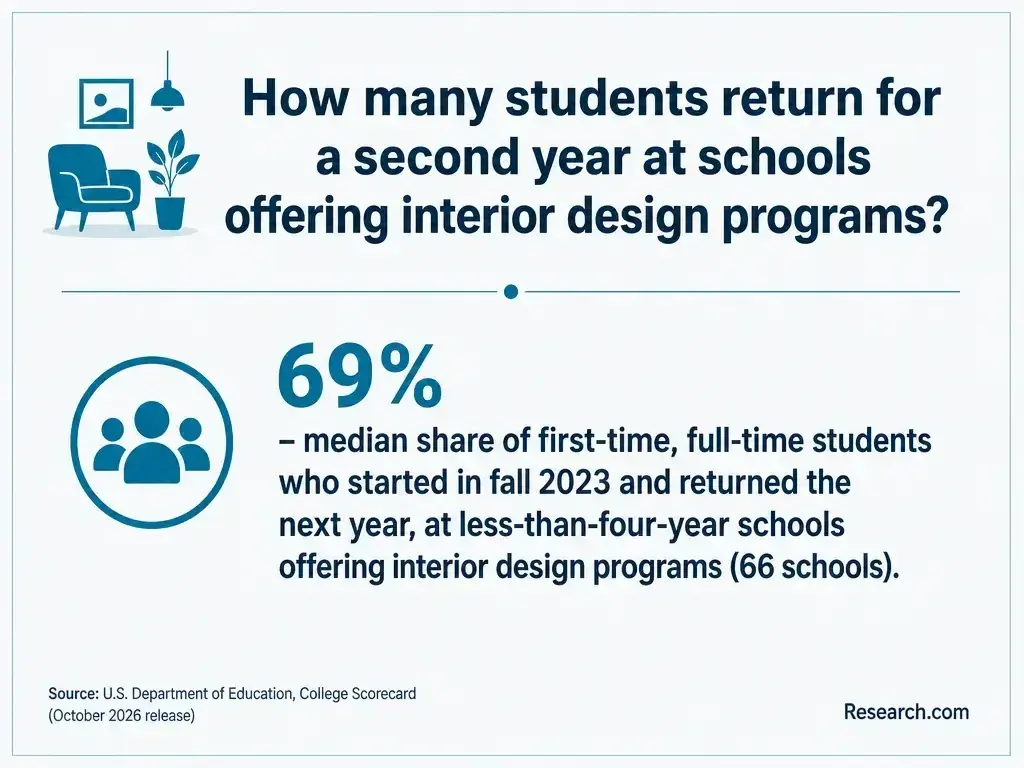
Do not assume that every interior design job requires an occupational license. Virginia regulates the certified interior designer credential through its Board for Architects, Professional Engineers, Land Surveyors, Certified Interior Designers and Landscape Architects; that credential is distinct from simply completing a school program (Virginia Department of Professional and Occupational Regulation). Check the board's current education, examination, and experience rules before choosing training specifically to pursue state certification.
Professional credentials may also have their own eligibility rules. The Council for Interior Design Qualification sets requirements for the NCIDQ examination, and a school's accreditation or course completion alone does not establish an individual's eligibility. If your target job does not require certification, prioritize its demonstrated skills and portfolio expectations; if certification is your goal, get written confirmation of how the proposed education fits the current route before paying a deposit.
Start with the job you want, then compare programs against that job - not just against a ranking position. For example, a short drafting course may be a sensible, lower-cost choice for someone already working in a showroom, but a poor substitute for broad design training if the intended role calls for space planning, specifications, and a developed portfolio. Listings of online universities with open admission can help frame questions about access, but open entry says little about interior design instruction or employer fit.
Ask each shortlisted provider the same questions so the answers are comparable:
A red flag is a promise that enrollment alone leads to a particular salary, job, or state certification. Also avoid choosing solely by low tuition, assuming similarly named certificates teach equivalent skills, or treating a school-wide outcome as an interior design program result. Compare the answers with current local job postings and your available study time.
An entry route may lead through design assistance, furniture or materials sales, showroom planning, or drafting support. With stronger project experience, workers may pursue residential or commercial design responsibilities, a specialty such as kitchen-and-bath work, or independent client work. These are possible paths, not automatic promotions or promises attached to a credential.
Match the pathway to the work: a focused course can be cost-effective when an employer will train you on its products and processes; a broader program may be worth the additional time if you need repeated studio practice and a portfolio to compete for design roles. Before planning self-employment or using a professional title, check applicable Virginia business and certified-interior-designer rules with the relevant state authorities.
A Virginia-specific projection should not be inferred from a national one. National employment of interior designers is projected to grow 2.7% from 2025 to 2035 (U.S. Bureau of Labor Statistics, Employment Projections). That suggests some continuing demand, but it does not predict the number of openings near a particular campus or the prospects of a newly trained applicant.
For a local decision, check Virginia labor-market information and current postings in the area where you can work. Note whether employers request portfolios, drafting and visualization tools, product knowledge, or prior project experience. If nearby entry-level postings are scarce, an employer-based support role or a program with stronger work connections may be less risky than borrowing heavily on the assumption that a design position will be available immediately.
Education is a consequential investment. Research.com created this ranking to help readers compare affordable programs with other reported options in the same occupation and location, rather than with unrelated schools. Its team examines multiple datasets and checks program information to improve the ranking's credibility and accuracy.
The most affordable ranking scores tuition, cost of attendance, median student debt, and federal loan default rate. Indicator weights are assigned through an entropy-based method, which gives more weight to measures that differ more across programs. Accreditation and other quality measures are not part of this affordability score. Research.com's separate best-program rankings also consider student outcomes, earnings, institutional accreditation, occupation-relevant recognition, and student support. Only programs with completions reported to IPEDS are eligible; an unlisted training provider is not necessarily unapproved or poor quality.
The ranking draws on the following sources. Some occupation-specific organizations inform Research.com's broader trade-school research but should not be mistaken for interior design accreditors or licensing authorities:
Use the ranking as a cost-focused shortlist, then verify the current credential, course requirements, practical work, and price directly with each provider. Research.com explains its broader approach on its methodology page.
# 1 position
# 2 position

# 3 position
# 4 position
Compare a resident-rate community college course or certificate with focused training and employer-based learning. The cheapest advertised tuition is not necessarily the lowest total cost once software, supplies, commuting, and time away from work are included.
A certificate can build relevant skills and may help with support roles, but employers decide what preparation they expect. Check the curriculum and portfolio work against actual job postings; do not assume that a short certificate qualifies you for Virginia's certified interior designer credential.
They can teach coursework and software, but verify how you will complete measured-space projects, material evaluation, critiques, and a portfolio. Confirm any separate professional certification requirements with the credentialing organization.
Neither provider type is automatically better. Compare the credential, current total price, instructor feedback, practical projects, schedule, and evidence of outcomes. Confirm accreditation and state authorization separately.
Do not assume either is a universal entry requirement. Employer expectations vary by role, while Virginia's certified interior designer credential has separate state requirements. Verify those rules if the credential is part of your career plan.