# 1 position


Audited and Verified:
Our Editorial and Data Verification Process
Research.com uses government datasets, official education statistics and primary institutional information to support its career and degree guides. Our review process checks factual accuracy, occupational definitions, source dates and the requirements associated with the credentials discussed.
How This Article Was Fact-Checked
Our editorial team verifies salary estimates, employment projections, education requirements and program information against original data providers and official organizations. Salary figures are checked against the relevant occupational definitions and reporting periods. Information about licensure, accreditation and required in-person training is reviewed separately.
Fact-checked and verified on:

Co-Founder and Chief Data Scientist

Reviewed by Karolina Broda
Fact-Checker and Data Verification
Choosing an affordable interior design program means comparing more than tuition: you need enough drafting, software, and studio practice to build a portfolio employers will recognize. The U.S. Bureau of Labor Statistics reports a $67,190 national median annual wage for interior designers in May 2025, but that is not a starting salary. This guide explains costs, credentials, career options, and New York's certification rules. It also accompanies the Most Affordable Interior Design Trade Schools in New York for 2027 ranking, created by the Research.com team of data scientists to help students identify programs worth considering.
Expect a mix of design decisions and technical execution: measuring spaces, developing layouts, selecting materials, producing drawings, presenting ideas, and revising work against a client brief. Interior design is not simply decorating. Commercial projects may also involve accessibility, building systems, and coordination with architects and contractors; a short styling course may not teach those competencies.
Community-college and specialized-college programs are useful when you want structured studios, instructor feedback, and a credential. A focused certificate may fit someone adding drafting or visualization skills to existing experience. An associate degree can provide a broader sequence of design and general education courses, but its extra time is worthwhile only if its curriculum serves your target role. Working as a showroom assistant or design-firm support staff while building a portfolio is another entry route; unlike a registered apprenticeship, such employment does not itself confer a standardized training credential.
Ask to see recent student projects, a studio schedule, and the software taught. Two programs with the same credential name can offer very different amounts of drawing critique, model-making, site observation, and client-facing practice.
Potential workplaces include residential design firms, commercial interiors practices, furniture and kitchen showrooms, workplace-design teams, hospitality businesses, and firms supplying finishes or furnishings. Entry roles may be titled design assistant, showroom consultant, CAD drafter, or materials coordinator rather than interior designer. The U.S. Bureau of Labor Statistics notes that interior designers work with clients, builders, and architects, so communication and accurate documentation matter alongside visual taste.
Location changes the practical choice. A student near New York City may have access to a wider range of specialist firms but face higher commuting and living costs. Elsewhere in the state, a program connected to local residential, retail, or renovation employers may be more useful than one whose projects and placements require an impractical commute. Request examples of recent internships and employers rather than assuming a school's location guarantees access to them.
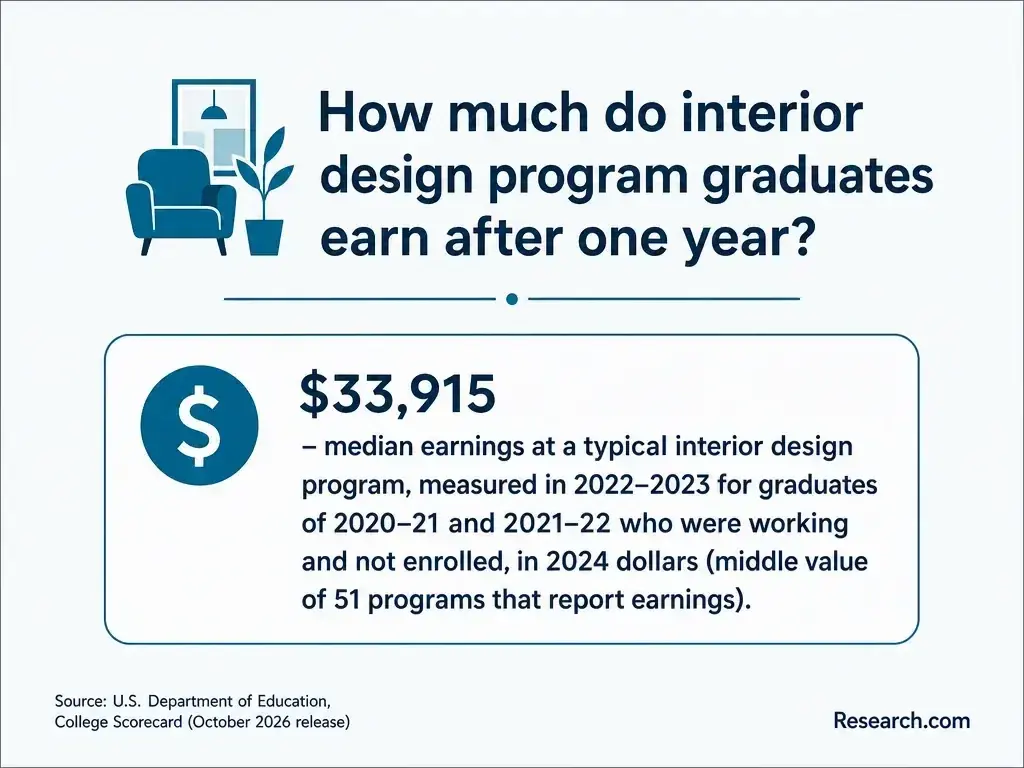
The U.S. Bureau of Labor Statistics reports a $67,190 national median annual wage for interior designers in May 2025. This is the midpoint for workers already in the occupation, not an expected salary for someone completing a certificate or associate degree. Design-assistant, drafting, and showroom positions may have different pay because they involve different duties and experience levels.
For a New York pay estimate, compare current state or metro-area BLS occupational wage data for the specific job title and work location you are pursuing. Then compare actual entry-level postings with your expected debt payments. A metropolitan median may be misleading if your realistic first job is outside that labor market - or if it requires experience your program cannot supply.
Length depends on the credential and course schedule. A focused certificate can take less time than an associate degree; full-time associate programs are commonly planned around two academic years, while part-time study takes longer. Do not infer a required statewide number of school clock hours: there is no universal hour requirement for entry-level interior design work in New York. Check each school's published credits, studio contact hours, course sequence, and whether required classes run every term.
An accelerated schedule saves calendar time only if you can complete portfolio work well. For working adults, compare the actual time to finish - not just the catalog's full-time plan - with the time needed for an accelerated associate's degree online. In either case, verify that design-specific studios and practical work remain accessible.
Online delivery can work for design history, some software demonstrations, and instructor feedback on digital drawings. Campus or hybrid delivery can make it easier to use material libraries, measure real spaces, build models, and receive live studio critique. Even in a remote program, a student may need to arrange local site visits, obtain materials, and document physical projects.
A useful comparison is what you will produce and how it will be reviewed, not simply how many classes are online. Ask whether assignments include measured drawings, construction details, accessible-space planning, and multiple rounds of critique. A listing among the best online universities with national accreditation does not establish that a particular interior design program offers these experiences or meets New York's certification requirements.
There is no single defensible statewide average for every New York interior design training route: certificates, associate programs, private career-school offerings, and employer training differ in what they include. IPEDS-reported college prices also do not cover every provider or every occupation-specific expense. For a usable estimate, obtain an itemized, current quote from each program and calculate the cost through completion, not just the first term's tuition.
The comparison below separates charges that schools commonly publish from costs students may have to estimate themselves. Confirm which supplies and software are included before comparing prices.
| Cost component | What to check | Why it affects the decision |
| Tuition and mandatory fees | Full-program price, residency rules, and likely future terms | A low first-term price may conceal a longer or more expensive sequence. |
| Project materials and software | Drawing supplies, samples, printing, computer specifications, and licenses | Studio work can create costs outside published tuition. |
| Attendance and lost earnings | Commute, site visits, schedule, and hours you cannot work | A nearby part-time option may cost less overall than a faster distant one. |
| Financing and aid | Grants, scholarships, eligible aid, borrowing, and repayment | Net cost and debt matter more than sticker price alone. |
New York residents should check eligibility with the New York State Higher Education Services Corporation and the school; aid rules depend on the student and program. Federal aid eligibility also varies by institution and credential (Federal Student Aid). Neither a program's presence in an online directory nor its low tuition proves that aid is available. If your goal is a studio-based occupation, broad comparisons such as what's the easiest bachelor's degree cannot replace an itemized quote for the actual training you would take.
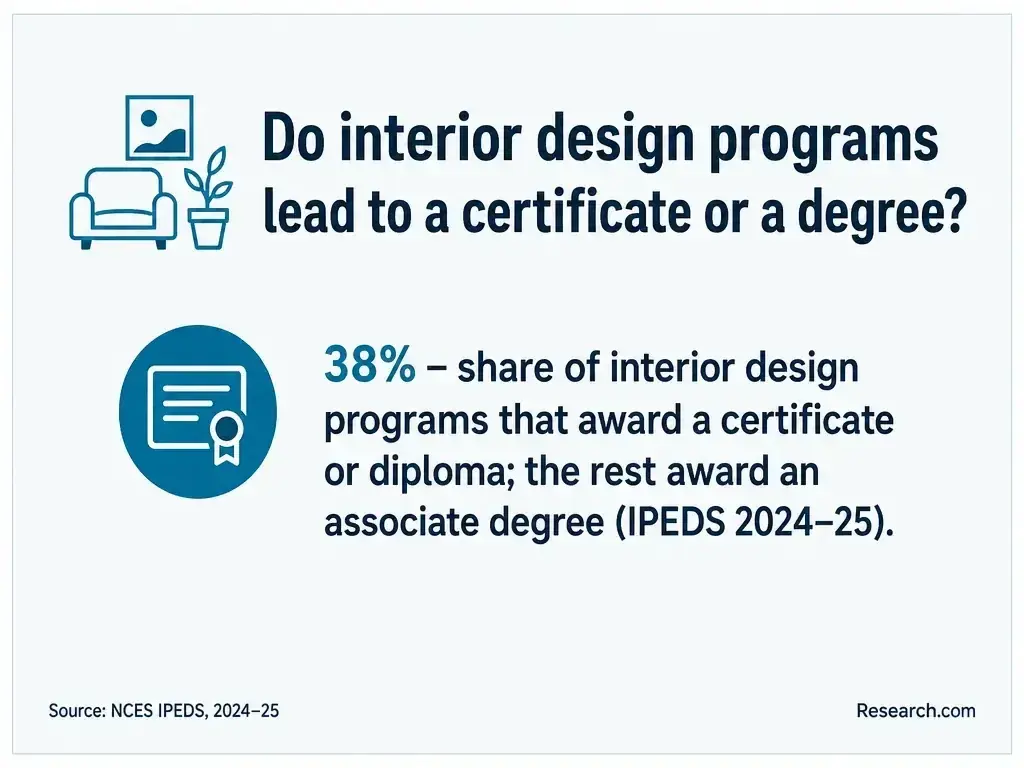
The award might be a school certificate, career-school diploma, or associate degree. These are educational credentials, not New York's Certified Interior Designer designation. A certificate can document targeted skills; an associate degree generally represents a broader academic and studio curriculum. Neither automatically establishes employment, examination eligibility, or state certification.
Read the exact award named in the catalog and ask whether credits can transfer if you later change programs. A noncredit workshop may help you develop a portfolio without granting transferable academic credit. Similarly, a resource about a fastest online masters degree addresses a different credential; assess an interior design training program on the credential and practical work it actually provides.
Requirements vary by provider and credential. An associate program may require a secondary-school credential and college application; a focused course may have fewer entry conditions but expect basic computer proficiency. Some programs request a portfolio or placement information, while others teach drawing and software from the beginning. Confirm prerequisites directly rather than buying a computer or paying an application fee based on assumptions.
Ask admissions whether prior coursework can earn transfer credit and whether professional design work can be assessed for prior-learning credit. Then ask the program director whether advanced standing would skip foundational studio projects you still need for your portfolio. School admission and state professional certification are separate decisions.
A job-oriented curriculum should connect space planning and visual communication with technical documentation. Look for measured drawings, plans and elevations, specifications, materials, lighting, presentation, and computer-aided drafting or modeling. For commercial work, ask how the program teaches accessibility, code research, and coordination with other project professionals. The U.S. Bureau of Labor Statistics describes these technical and collaborative duties as part of interior designers' work.
Software matters, but a portfolio of polished renderings alone may not show that you can translate an existing space into buildable documents. Before enrolling, ask for a sample assignment and its assessment rubric: it should reveal whether instructors evaluate dimensions, material choices, revisions, and the explanation behind a design - not only its appearance.
Not for every interior design job. New York regulates use of the Certified Interior Designer title through the New York State Education Department (NYSED); the title is not a blanket license required for all interior design work. NYSED sets separate education, experience, and examination requirements for certification. Completing a training program does not, by itself, award the title or establish eligibility.
If certification is your long-term goal, check NYSED's current requirements against the proposed program before enrolling. Request written details of the credential, relevant coursework, and any experience opportunities, then confirm how NYSED would evaluate your particular pathway. Institutional accreditation, school authorization, program-specific recognition, professional certification, and permission to use a protected state title serve different purposes; none should be treated as interchangeable. The National Council for Interior Design Qualification's examination requirements are another separate check if you plan to pursue that credential.
Start with the job you want: residential client work, commercial documentation, a showroom role, or drafting support. Then compare only programs that teach the relevant skills within a schedule and budget you can sustain. The affordability ranking is a shortlist, not a verdict on teaching quality or certification fit.
Use these checks when contacting programs; each one resolves a different enrollment risk:
A red flag is a promise that an online certificate automatically qualifies you for a protected title or a specific salary. Another is a low advertised price without a complete materials list. Broader education guides, including short phd programs, cannot answer whether this particular occupational program teaches the studio skills you need.
A training program can support entry into design assistance, drafting, materials coordination, retail or showroom consulting, and, with appropriate experience, broader interior design responsibilities. The best first role depends on the work your portfolio proves you can do. Someone targeting commercial interiors should prioritize technical drawings and coordination; someone targeting residential clients may benefit more immediately from measuring, specifications, and client presentations.
Experience can lead to project responsibility, specialization, supervision, or self-employment. Additional professional credentials may support advancement, but they are not universal entry requirements. If a school advertises an advanced job title as a typical immediate outcome, ask which recent graduates reached it, how long it took, and what prior experience they brought.
The U.S. Bureau of Labor Statistics projects 2.7% national employment growth for interior designers from 2025 to 2035. That is a national occupational projection, not a forecast of openings in New York or a guarantee of employment after training. It suggests that a student should evaluate the strength of a program's portfolio preparation and employer access rather than counting on rapid growth to overcome weak practical experience.
Before committing, review current New York State Department of Labor projections and job postings for the region where you can actually work. Search related entry titles as well as "interior designer": employers may advertise drafting, showroom, and design-support work separately. Compare the required software and portfolio examples in those postings with what the program teaches.
Investing in training is a consequential decision, so Research.com designed this ranking to help readers compare affordable programs against other options in the same occupation and location. The team checks multiple education datasets for credibility and accuracy. Only programs with completions reported to the Integrated Postsecondary Education Data System (IPEDS) can appear; an unlisted training provider is not necessarily unapproved or unsuitable.
Most-affordable rankings score costs and debt only: tuition, cost of attendance, median student debt, and federal loan default rate. Weights use an entropy-based method, giving more weight to measures that differ more across programs. Accreditation, student support, completion, and earnings are not part of the affordability score. Research.com's separate best-program rankings consider those quality and outcome measures; readers should not mistake an affordability position for an overall quality judgment.
The following sources inform Research.com's trade-program ranking methodology and data checks across occupations. Occupation-specific bodies in this list do not imply that they approve interior design programs or contribute to this affordability score:
Use the ranking to narrow a price comparison, then verify each program's current charges, curriculum, and outcomes directly. Read more about how Research.com creates its rankings.
# 1 position
# 2 position

# 3 position
# 4 position

# 5 position
# 6 position

# 7 position

# 8 position

# 9 position

# 10 position

# 11 position
# 12 position

Compare the full cost of a local public-college program with a focused certificate and any paid design-support work you can obtain. The lowest tuition is not the lowest cost if you must buy software, travel frequently, or repeat missing studio coursework.
Choose based on the intended job and curriculum. A certificate can efficiently add a specific skill; an associate degree may offer more extensive studio and technical training. Inspect projects and contact hours rather than relying on the award name.
Online coursework can teach some theory and software, but you still need credible practical projects involving spaces, measurements, materials, and critique. Check any in-person requirements and do not assume online completion establishes New York certification eligibility.
No. NYSED protects the Certified Interior Designer title, but not every interior design job requires that credential. If you want the title, verify NYSED's education, experience, and examination requirements for your pathway.
Possibly, but eligibility depends on the student, institution, and specific program. Ask the financial aid office to confirm available federal and New York aid for the exact credential before treating it as part of your budget.