
# 1 position
Most Affordable Interior Design Schools & Degrees in Kansas for 2027
Audited and Verified:
Our Editorial and Data Verification Process
Research.com uses government datasets, official education statistics and primary institutional information to support its career and degree guides. Our review process checks factual accuracy, occupational definitions, source dates and the requirements associated with the credentials discussed.
How This Article Was Fact-Checked
Our editorial team verifies salary estimates, employment projections, education requirements and program information against original data providers and official organizations. Salary figures are checked against the relevant occupational definitions and reporting periods. Information about licensure, accreditation and required in-person training is reviewed separately.
Fact-checked and verified on:

Co-Founder and Chief Data Scientist

Reviewed by Karolina Broda
Fact-Checker and Data Verification
Choosing an affordable interior design program means looking beyond tuition: the credential must also help you build the technical skills and portfolio employers expect. The Research.com team of data scientists created the Most Affordable Interior Design Trade Schools in Kansas for 2027 ranking to help students identify programs worth considering. Nationally, interior designers earned a median $67,190 in May 2025, according to the U.S. Bureau of Labor Statistics (BLS) - not a guaranteed starting wage. This guide helps Kansas students compare training, costs, career prospects, and entry requirements before enrolling.
Key findings about interior design degrees in Kansas
- An affordable interior design program is not necessarily the cheapest by tuition: compare fees, software, supplies, commuting, financial aid, and debt alongside portfolio-building opportunities.
- The BLS reports a $67,190 national median annual wage for interior designers in May 2025 and projects 2.7% U.S. employment growth from 2025 to 2035; neither figure predicts a Kansas graduate's starting pay or job offer.
- Kansas students should distinguish short design-skills certificates from broader associate-degree training, and verify whether a program's practical work matches their intended role; a school credential alone is not professional certification or permission to perform regulated architectural work.
Table of Contents
- Most Affordable Interior Design Schools & Degrees in Kansas for 2027
- What can I expect from an interior design trade school program in Kansas?
- Where can I work with an interior design trade school training in Kansas?
What can I expect from an interior design trade school program in Kansas?
Expect a mix of design fundamentals and production work: measuring spaces, preparing plans, selecting finishes, using drafting software, presenting proposals, and revising designs around a client's budget and building constraints. Interior design training is more than decorating. Commercial projects, in particular, can require attention to accessibility, materials, and coordination with construction professionals, according to the BLS.
The right pathway depends on the job you want. These options differ in depth, cost, and the evidence of skill you can show an employer.
| Pathway | Typical focus | Best fit |
| Focused certificate or employer training | Selected skills such as drafting, visualization, or showroom sales | Someone adding a skill or testing the field before making a larger investment |
| Interior design associate-degree program | Broader studio projects, technical coursework, and a developed portfolio | Someone seeking a structured route into design-assistant or related roles |
| Entry-level design-support job | Paid experience with products, clients, or project coordination; training varies by employer | Someone who needs earnings now and can build technical skills alongside work |
A certificate and an associate degree are not interchangeable simply because both mention interior design. Ask to see recent student projects, the software used, how work is critiqued, and whether students complete projects based on actual site measurements or client briefs. A paid job can reduce training costs, but it may not provide the systematic drafting and portfolio practice of a studio program.
Where can I work with an interior design trade school training in Kansas?
Possible settings include residential design firms, furniture and kitchen-and-bath showrooms, flooring and finish suppliers, and firms supporting commercial interiors. The BLS identifies specialized design services and architectural and engineering services among employers of interior designers. In Kansas, compare openings within commuting distance - especially in the Kansas City and Wichita areas - rather than assuming a statewide wage or vacancy figure describes your local market.
Job titles matter. A showroom consultant may concentrate on products and sales, while a design assistant may prepare drawings and presentations under an experienced designer. Before choosing training, read current Kansas postings for the title you want and record the requested software, portfolio examples, schedule, and experience. If local design openings are limited, product sales or project-support work may offer an entry point, but it is not the same job as independent design practice.
Do not use a national occupational median as an estimate of first-year Kansas pay. The BLS reports a $67,190 national median annual wage for interior designers in May 2025. This describes workers across experience levels and employers, not certificate holders or new graduates specifically. Pay for showroom sales, drafting, and design-support roles may also follow different occupational wage categories.
For a local comparison, check the latest Kansas Department of Labor occupational wage estimates and recent postings for the specific job title and metro area you plan to enter. Ask programs for outcomes broken down by job title and graduation cohort. Treat a salary claim without its occupation, location, reference year, and source as a warning sign.
Length depends on the credential and schedule: a focused certificate can take less time than a multi-term associate-degree program, while part-time study extends the calendar even when required credits stay the same. Interior design has no single Kansas-wide school clock-hour requirement that makes every program equivalent. Request each provider's credit or contact-hour total, course sequence, studio schedule, and projected completion date.
Acceleration is worthwhile only if it leaves enough time for software practice, revised projects, and a credible portfolio. If speed is your priority, a guide to six-month certificate programs that pay well can help frame the trade-off, but do not assume a short course prepares you for every interior design role. Part-time study may preserve earnings while you train, which can matter more to your total investment than the advertised completion time.
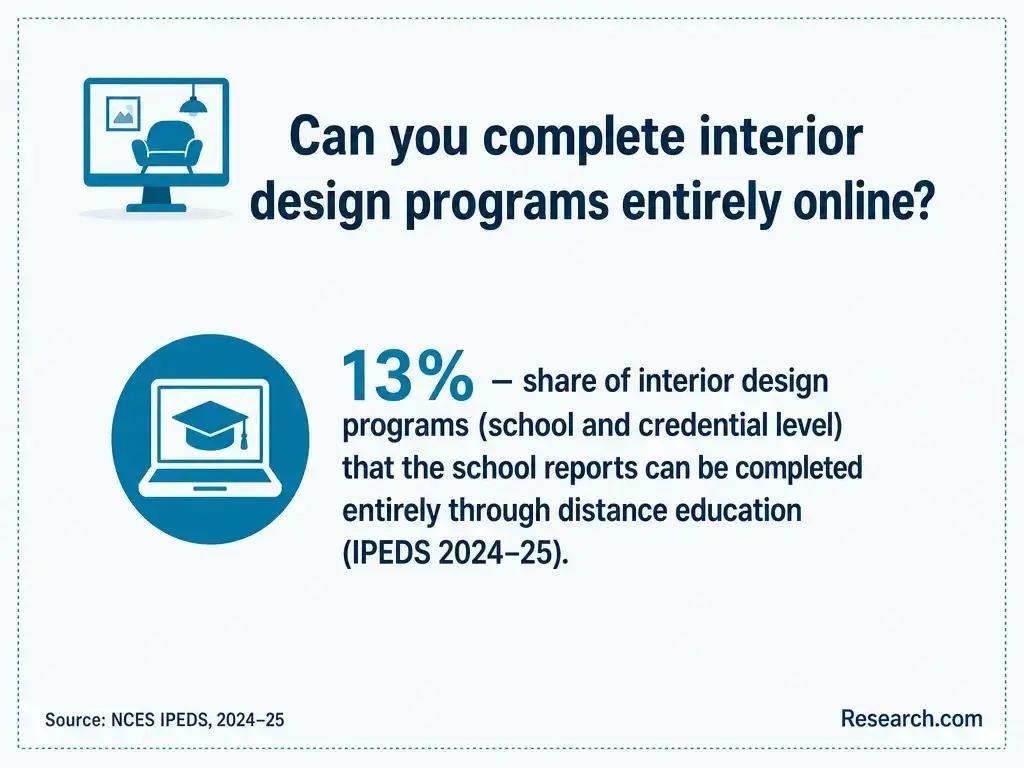
Online instruction can work well for design history, presentations, some drafting lessons, and software demonstrations. Campus studios can make it easier to receive immediate critiques, handle material samples, measure spaces, and collaborate on projects. A hybrid program may offer a useful middle ground for someone outside a training center or balancing work, provided its in-person requirements are feasible.
Ask exactly how students complete site measurements, studio critiques, portfolio reviews, and any internship or employer project. Confirm the computer specifications and software access required at home. An online credential should be judged by the quality of its supervised work and employer relevance - not by an assumption that remote coursework automatically satisfies professional certification eligibility.
There is no reliable single statewide price that describes every interior design certificate, associate-degree program, and employer-training route. Published tuition may be charged per credit or term, and the lowest tuition figure may exclude required fees. Request a written estimate for the entire credential, based on your residency status and expected course load, before deciding what is affordable.
A practical budget includes tuition, mandatory fees, a computer capable of running required software, software access, printing, models or samples, transportation, and earnings forgone while attending. Subtract only aid you are eligible to receive - not a school's maximum advertised award. Federal aid eligibility depends on both the student and program, according to Federal Student Aid; ask the provider whether the specific credential qualifies. Also ask about Kansas workforce funding, scholarships, payment plans, and paid entry-level work.
Compare the resulting net cost with your likely starting role, not the experienced-worker median. An inexpensive course that requires additional paid training before you can produce employer-ready drawings may cost more overall than a longer program with strong studio access. Readers weighing cheap master's degrees online should treat that as a separate educational decision, not as a requirement for entering this trade.
The award may be a certificate, diploma, or associate degree, depending on the provider and program. An employer-training route might offer work experience without a school credential. Check the exact award on the current catalog - not just the program's marketing name - and ask whether credits transfer if you later change programs. Transfer is subject to the receiving institution's policies.
An associate degree generally represents broader coursework than a narrowly focused certificate, but neither substitutes for evidence that you can produce plans, specify materials, and communicate design decisions. If you are comparing associate programs more generally, what is the easiest degree to get in two years? is less useful here than asking which curriculum develops the portfolio and technical skills your target employer requests.
Institutional accreditation concerns the school; programmatic accreditation concerns a specific program. State authorization addresses whether a provider may operate, while professional certification has its own eligibility rules. None of these labels automatically establishes that a graduate can perform every design or building-related task.
Requirements vary by provider and credential. A school may request a secondary-school credential, placement information, an application, or prior coursework; a focused course or employer role may have different entry standards. Some programs introduce design software from the beginning, while others expect basic computer proficiency. Confirm deadlines, residency documentation for tuition purposes, and whether there are separate requirements to enter studio courses.
Before applying, ask admissions staff whether the published schedule lets a working student complete required studios in sequence and whether prior learning or completed coursework can reduce the remaining credits. Verify institutional accreditation through a recognized accreditor and school authorization with the appropriate Kansas authority. A list of nationally accredited online colleges and universities is not a substitute for checking the particular provider, credential, and applicable design-program recognition.
Look for a curriculum that connects visual choices to usable spaces. Relevant work includes drawing and digital modeling, space planning, lighting, materials, color, furniture selection, client presentations, and estimates. Commercial-interiors interests call for particular attention to accessibility, applicable codes, specifications, and coordination with other building professionals; the precise scope should be evident in the course descriptions and student work.
A useful portfolio shows the process, not only polished images: the brief, measurements, options considered, revisions, and final drawings. Ask how many projects receive instructor critique and whether students present their decisions aloud. Because software and employer workflows change, compare the tools named in current Kansas job postings with those students actually use in class. A curriculum that teaches attractive images but little technical documentation may be a poor fit for a drafting-heavy role.
Kansas does not generally require an interior design occupational license simply to work in design. That does not authorize someone to practice architecture or submit documents reserved for licensed professionals. Confirm the scope of a planned service with the Kansas State Board of Technical Professions and the applicable local building authority before promising clients regulated building-design work.
Professional certification is a separate, potentially useful advancement choice - not an automatic result of finishing trade school. For example, the Council for Interior Design Qualification sets education and supervised-experience eligibility routes for its NCIDQ examination. If that credential is a long-term goal, ask the program and the certifying organization whether your specific coursework counts and what additional experience you would need. Do not pay for a program on the assumption that its name alone establishes exam eligibility.
Start with the work you want to do, then compare programs against that job - not against a ranking alone. A showroom-focused learner may value product knowledge and a flexible schedule; an aspiring design assistant should put more weight on technical drawings, repeated critiques, and portfolio quality. Compare Johnson County Community College and Wichita State University-Campus of Applied Sciences and Technology only after confirming each one's current interior-design-related offerings, credential, location, and schedule directly with the institution.
Use these questions to turn a shortlist into a decision:
- What is the complete net cost through completion, including fees, required software and equipment, travel, and aid I actually qualify for?
- Which supervised projects, site-based tasks, or employer experiences will I complete, and may I review recent student portfolios?
- What credential will appear on my record, and how does its coursework align with the jobs or optional certification I want?
- What are the current completion, debt, and job-outcome figures for this specific program, and how were they measured?
- Can I complete every required course on my schedule, and what happens financially if a course is unavailable or I need an extra term?
A red flag is a guaranteed-job or guaranteed-salary claim, particularly when the school supplies no cohort-specific evidence. Another is a low tuition quote that excludes necessary software or studio costs. If you are considering an advanced academic route such as a one-year PhD, keep that decision separate: it is not the entry credential for an interior design trade role.
Training can support applications for design-assistant, showroom, kitchen-and-bath sales, materials-selection, visualization, or project-support roles, depending on the curriculum and employer. These are different jobs with different pay structures: a sales position may reward product knowledge and client service, while a documentation role may require stronger drafting and specification skills. A credential can help you compete, but a portfolio and demonstrated competence remain important.
Progression often means taking on more complex projects, coordinating with contractors and clients, developing a specialty, or pursuing an optional professional credential after meeting its experience requirements. Self-employment is another possibility, but it adds business-development costs and responsibility for staying within the lawful scope of services. Ask prospective employers what work a new hire performs independently and what remains under supervision.
The BLS projects 2.7% national employment growth for interior designers from 2025 to 2035. That is a national occupational projection, not a forecast of openings in a particular Kansas city or of demand for every design-support job. It suggests students should plan for a competitive search and build work samples matched to actual vacancies rather than relying on the credential alone.
For a Kansas decision, review the latest state labor-market projections alongside current local postings, separating interior designer positions from retail sales and drafting roles. If the positions you want cluster outside commuting range, factor a longer commute or relocation into the program's return on investment. The better question is not simply whether the occupation is growing, but whether the training helps you qualify for accessible jobs at a cost you can reasonably recover.
Most Affordable Interior Design Schools & Degrees in Kansas for 2027
Education is a substantial investment. To make the ranking useful and credible, the Research.com team compares interior design programs with other programs in the same occupation and location, checks multiple established data sources, and limits the ranking to programs reporting completions to IPEDS. That limit means an unlisted apprenticeship, employer-training option, or other provider is not necessarily unavailable or low quality.
The most affordable ranking scores tuition, cost of attendance, median student debt, and federal loan default rate. It uses an entropy-based weighting method, which gives more weight to indicators that vary more across programs. Accreditation and other quality measures are not part of this affordability score. Separately, Research.com's best-program rankings assess student outcomes, earnings and return on investment, costs and debt, and quality and recognition; readers should not mistake those criteria for the affordability ranking's formula.
The following sources were used in creating the ranking. Some supply cross-occupation reference information rather than interior-design-specific accreditation or certification; their inclusion does not imply that they approve interior design programs.
- IPEDS database: reported completions and institutional education data.
- National Center for Education Statistics: federal education-data definitions and context.
- College Scorecard database: available institutional cost, debt, and outcomes data.
- Peterson's database: supplementary institutional information.
- Commission on Accreditation of Allied Health Education Programs (CAAHEP): occupation-specific accreditation reference where applicable.
- Accrediting Bureau of Health Education Schools (ABHES): occupation-specific accreditation reference where applicable.
- Commission on Dental Accreditation (CODA): occupation-specific accreditation reference where applicable.
- Dental Assisting National Board (DANB): occupation-specific credential reference where applicable.
- National Center for Construction Education and Research (NCCER): construction-training and industry-recognition reference where applicable.
- Apprenticeship.gov Partner Finder: registered-apprenticeship reference.
Use the ranking to identify lower-cost options, then confirm each program's current price, curriculum, practical work, and credential directly with the provider. More detail about the ranking process is available in Research.com's methodology.
# 2 position
Johnson County Community College - Interior Design.
certificate or diploma# 3 position

Frequently asked questions about interior design programs in Kansas
What is the cheapest way to start interior design training in Kansas?
A focused course or paid entry-level role may have a lower upfront cost than a full credential. Compare what each route actually teaches: inexpensive training is poor value if you must later pay for essential drafting, software, or portfolio experience.
Is a certificate enough to get an interior design job?
It can support applications for some entry-level or specialized roles, but employers may also expect a portfolio and specific software skills. Check current postings for your intended title before choosing a certificate over broader training.
Can I complete the training entirely online?
Some coursework can be remote. Confirm how the program handles measurements, material evaluation, project critiques, and any required in-person work; compare the resulting portfolio with what local employers request.
Does Kansas require an interior design license?
Kansas does not generally require a license simply to work in interior design. Regulated architectural services are different, so verify the lawful scope of any building-related work before offering it independently.
Will an affordable-program ranking tell me which program is best for my career?
No. It helps compare costs and debt among included programs, but its affordability score does not measure portfolio quality or include every training provider. Check curriculum, practical work, schedule, and outcomes before enrolling.
- U.S. Bureau of Labor Statistics - Interior Designers
Used to verify salary, employment outlook, and typical education requirements.
https://www.bls.gov/ooh/arts-and-design/interior-designers.htm - NCES College Navigator (IPEDS)
Used to verify programs offered and institutional accreditation.
https://nces.ed.gov/collegenavigator/ - CIDQ - NCIDQ Certification
Professional certification reference for graduates of this occupation.
https://www.cidq.org/ - Johnson County Community College - official website
Official school website (programs, tuition, admissions).
https://www.jccc.edu/ - Wichita State University-Campus of Applied Sciences and Technology - official website
Official school website (programs, tuition, admissions).
https://www.wsutech.edu/