# 1 position


Audited and Verified:
Our Editorial and Data Verification Process
Research.com uses government datasets, official education statistics and primary institutional information to support its career and degree guides. Our review process checks factual accuracy, occupational definitions, source dates and the requirements associated with the credentials discussed.
How This Article Was Fact-Checked
Our editorial team verifies salary estimates, employment projections, education requirements and program information against original data providers and official organizations. Salary figures are checked against the relevant occupational definitions and reporting periods. Information about licensure, accreditation and required in-person training is reviewed separately.
Fact-checked and verified on:

Co-Founder and Chief Data Scientist

Reviewed by Karolina Broda
Fact-Checker and Data Verification
Choosing an affordable interior design program means looking beyond tuition: the least expensive option may not provide the drafting skills, portfolio work, or workplace experience your target job requires. The U.S. Bureau of Labor Statistics reports a $67,190 national median annual wage for interior designers in May 2025, but that is not an entry-level pay estimate. This guide compares Oregon training pathways, costs, credentials, and career prospects. It also accompanies the Most Affordable Interior Design Trade Schools in Oregon for 2027 ranking, created by the Research.com team of data scientists to help students identify programs worth considering.
Expect applied training in space planning, drafting, materials, lighting, presentation, and client communication - not simply decorating. Interior designers develop functional interior layouts and coordinate selections with budgets, building requirements, and other project professionals. The U.S. Bureau of Labor Statistics distinguishes this work from purely aesthetic decoration.
Oregon applicants can compare a short, skills-focused certificate with a longer community-college program that awards an associate degree. Portland Community College is one public-college option to examine; confirm its current interior design credential, sequence, and fees in the catalog before applying. A short course may suit someone who already works in a design-adjacent role and needs software or portfolio skills. It is a weaker substitute for extensive studio work if the goal is an interior designer position.
Ask to see actual student projects. A useful program should make students measure spaces, revise drawings after critique, prepare material specifications, and present a coherent portfolio. If speed is your priority, compare the promised skills with those of a best 6 month course with high salary; a quick credential alone cannot establish what an interior design employer will pay.
Potential settings include interior design practices, architecture firms, residential remodeling businesses, furniture and finishes showrooms, and commercial project teams. Entry-level openings may be titled design assistant, showroom consultant, CAD drafter, or project coordinator rather than interior designer. The U.S. Bureau of Labor Statistics notes that interior designers work with architects, engineers, and builders, which makes communication across trades a practical hiring skill.
Location affects the search. Portland-area employers may offer more opportunities to work on larger commercial teams, while a student elsewhere in Oregon may need to consider residential firms, suppliers, remote drafting support, or a commute. Before choosing a campus or internship, search current local postings for the software, project types, and travel requirements attached to the roles you want. Those postings are more useful for choosing electives than a broad job title alone.
Use a current Oregon-specific wage estimate for your intended occupation and location, not a national figure presented as a local starting salary. The Oregon Employment Department's occupational wage data is the appropriate state source to check before enrollment. Compare the relevant statewide or metropolitan estimate with current job advertisements, which may distinguish junior drafting or showroom work from experienced designer roles.
For a national benchmark, the U.S. Bureau of Labor Statistics reports a $67,190 median annual wage for interior designers in May 2025. Half of workers in that occupation earned less and half earned more; the median includes experienced professionals. A certificate holder entering an assistant role should not assume that this figure describes the first job. Salary comparisons are most useful when the occupation, location, experience level, and reference period match.
There is no single Oregon-required number of classroom or clock hours for entry into interior design. Duration depends on the credential, course sequence, and whether you attend full- or part-time. A focused software or decorating certificate can be shorter than an associate-degree program with multiple design studios; prerequisites and courses offered only in certain terms can extend either route.
Request a term-by-term plan, including studio contact hours, software labs, required projects, and any internship or work-based component. Ask whether prior coursework can transfer or whether documented skills can earn credit under the provider's policy. Unlike a trade with a standard registered-apprenticeship route, interior design commonly relies on school projects and employer-supervised work; do not assume a paid apprenticeship is built into a program.
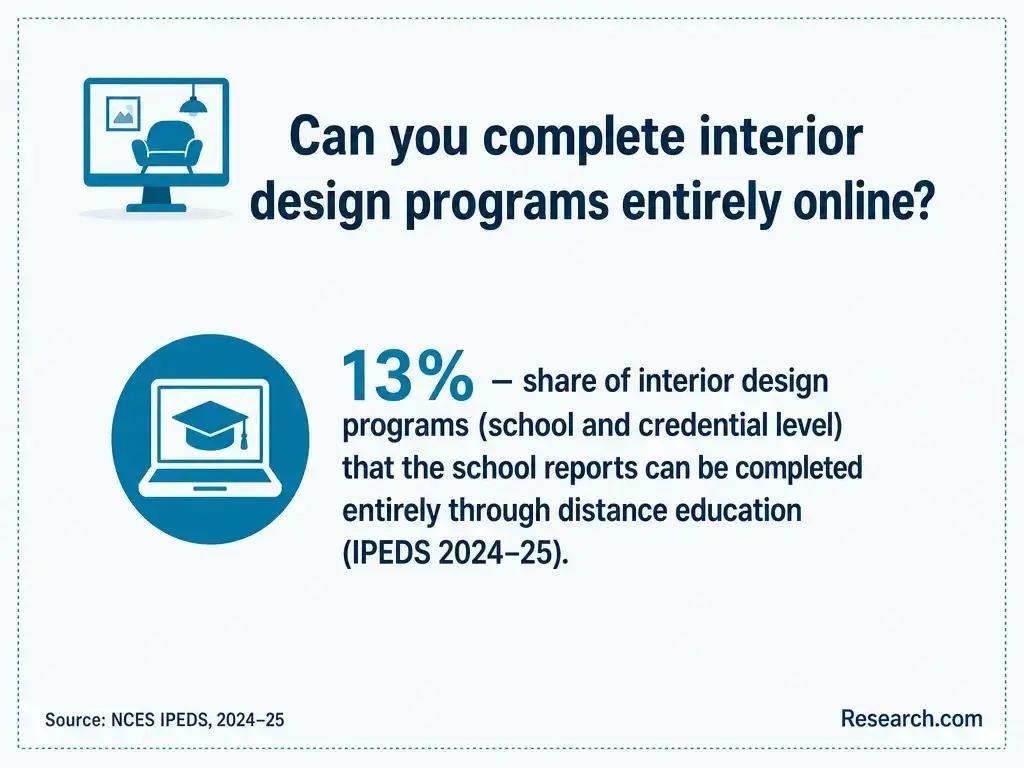
Online study can work well for design history, specifications, software demonstrations, and some drafting assignments. Campus studios make it easier to review physical samples, measure spaces together, receive live critiques, and use equipment the school supplies. A hybrid option can combine these strengths, but its travel requirements may erase the savings for a student far from campus.
The distinction is practical experience, not whether a course has a physical classroom. Ask how students obtain drawing feedback, complete site-measurement exercises, access current software, and build a reviewed portfolio. An entirely remote course may be useful for a specific skill; it should not be assumed equivalent to a studio-intensive credential or to preparation for any optional professional certification. Compare broader online degrees for high paying jobs cautiously: their advertised earnings do not describe outcomes for interior design trainees.
There is no reliable single average that captures Oregon's short courses, career-school programs, and community-college credentials on comparable terms. For a 2027 decision, request the applicable year's written cost of attendance from each provider rather than treating an earlier tuition listing as a current quote. Public-college charges may also depend on residency or district rules; confirm the rate for your circumstances.
These cost categories make two programs with similar advertised tuition easier to compare. Obtain a written estimate for each before considering aid.
| Cost category | What to check | Why it can change the decision |
| Tuition and mandatory fees | All required terms, labs, and enrollment charges | A longer program may require more terms than its headline rate suggests. |
| Materials and software | Computer specifications, drafting tools, samples, printing, and subscriptions | Access included at one school may be a separate purchase at another. |
| Attendance and career entry | Travel, parking, portfolio production, and optional certification costs | These expenses can differ sharply between online and studio-based study. |
| Time away from work | Schedule and earnings forgone during required classes or projects | A faster program is not necessarily cheaper if it prevents paid work. |
Eligible students can investigate federal aid through Federal Student Aid and state assistance through the Oregon Office of Student Access and Completion, including the Oregon Opportunity Grant. Eligibility depends on the student and program; not every short course qualifies. If comparing cheap associate degrees online, check whether the quoted price includes the hands-on work and software access needed for your design goal. For return on investment, weigh net cost and debt against completion likelihood, earnings you would otherwise have had, plausible post-training earnings, and how long it may take for added earnings to offset costs.
The award depends on the program: a noncredit course may provide a completion certificate, while a qualifying college program may award an academic certificate or associate degree. These are not interchangeable. Check the catalog for the exact award, whether credits transfer, and which classes build toward a later credential. A software badge may document a useful skill without providing the breadth of a design-studio program.
Institutional accreditation concerns the school; state authorization concerns permission to operate; programmatic accreditation concerns a particular program; and professional certification concerns an individual's qualifications. None automatically substitutes for another. The Council for Interior Design Accreditation evaluates interior design programs, while the Council for Interior Design Qualification administers the voluntary NCIDQ credential with its own education and experience eligibility rules. Verify a program's current status directly rather than assuming its school-level accreditation covers the design curriculum. If you are considering undergraduate dual degree programs, distinguish those credentials from the shorter occupational pathways compared here.
Requirements vary by provider and credential. A college may require an application, placement or prerequisite coursework, and readiness to use design software; a short noncredit course may have fewer formal barriers. Some programs request samples of creative work, but do not assume a polished portfolio is required for entry. Check the published admissions requirements and ask whether the program supplies necessary software or expects students to own a capable computer.
Ask about prerequisites before planning a start date. A required course offered infrequently can delay completion even when admission is open. If you have prior drafting or related work experience, obtain the school's written transfer-credit or prior-learning policy before assuming it will shorten the program.
A career-oriented curriculum should connect design ideas to drawings and decisions someone else can build or purchase. Look for instruction in measured plans, computer-aided drafting, three-dimensional visualization, materials and finishes, lighting, budgeting, accessibility concepts, and presentations to clients. The U.S. Bureau of Labor Statistics identifies CAD, building-code awareness, and coordination with construction professionals as part of interior designers' work.
Review the required projects, not only the course titles. A residential-focused course may emphasize furniture and finishes, while commercial-project preparation may demand more documentation, coordination, and familiarity with applicable building requirements. Ask how instructors evaluate revisions and whether graduates leave with work they have permission to show employers. Training should teach students to recognize when a project needs a licensed architect, engineer, or other qualified professional rather than suggesting that a school credential grants those authorities.
Oregon does not generally require an interior-design-specific occupational license simply to work as an interior designer. That does not authorize every activity associated with a building project: the scope of particular work, permits, and use of regulated professional titles are separate questions governed by Oregon law and the relevant authorities. Check the Oregon Board of Architect Examiners and Oregon Building Codes Division for the activities involved in the job you intend to pursue.
NCIDQ certification is a professional credential, not a substitute for state authorization where a regulated activity requires it. The Council for Interior Design Qualification sets education, experience, and examination eligibility; finishing a certificate or associate-degree program does not automatically confer the credential. If NCIDQ is a long-term goal, ask the provider to identify the current eligibility route its graduates may use, and verify that answer with the certifying organization before enrolling.
Start with the job, then work backward to the training it requires. The 2027 affordability ranking can identify programs to investigate, but it does not score studio quality, portfolio outcomes, or employer fit. A less expensive short course can be a sound choice for a showroom employee adding drafting skills and a poor choice for someone seeking extensive commercial-design preparation.
Before committing, ask each provider for answers to these questions. Written responses make differences in cost, training, and recognition easier to assess.
Confirm institutional accreditation with the accreditor, and check private career-school oversight with Oregon's Higher Education Coordinating Commission where applicable. Ask for the current catalog and a sample schedule, not just a sales estimate. Be wary of guaranteed salary claims or statements that accreditation alone grants certification. If your research has moved toward what's the easiest masters degree to get, clarify your career goal first; that is not the trade-school pathway evaluated here.
A first role may involve preparing drawings, researching finishes, handling product orders, or assisting with client presentations. With a stronger portfolio and experience, a worker may take on larger projects, specialize in residential or commercial interiors, supervise design work, or become self-employed. Advancement depends on demonstrated work and the scope of the role, not merely the name of the training credential.
These pathways illustrate why the right entry program depends on the work you want to do. Titles and duties vary by employer, so check actual postings before selecting a specialization.
| Target role | Training emphasis to look for | Important distinction |
| Showroom or materials consultant | Products, finishes, measurements, and customer communication | A focused course may be sufficient for some employers. |
| Design assistant or CAD drafter | Accurate plans, software, revisions, and a reviewed portfolio | Drawing proficiency may matter more than an attractive course title. |
| Interior designer on complex projects | Deeper studio work, documentation, collaboration, and experience | Entry-level support work may precede independent project responsibility. |
An employer-sponsored assistant position can be an alternative to paying for extensive training upfront, especially for someone who already has relevant software skills. Compare its pay, mentorship, and access to real projects with the structure a school provides; an assistant job is not automatically a registered apprenticeship or a substitute for every credential.
The U.S. Bureau of Labor Statistics projects 2.7% national employment growth for interior designers from 2025 to 2035. That is a national projection, not an Oregon hiring forecast or a promise of openings for new trainees. Consult the Oregon Employment Department's current occupational projections for the state, then compare them with recent vacancies in the area where you can realistically work.
For an applicant, the more immediate question is whether local employers seek the projects and tools a program teaches. Interior design positions can require a portfolio and experience even when a school credential is preferred. Build demonstrable drawing and presentation work during training, and consider assistant or supplier-side roles if direct designer openings are limited where you live.
Investing in training is a consequential decision, so Research.com evaluates affordable programs against other programs in the same occupation and location rather than against unrelated schools. The 2027 most-affordable ranking includes only programs with completions reported to the Integrated Postsecondary Education Data System (IPEDS). Its score uses tuition, cost of attendance, median student debt, and federal loan default rate; an entropy-based method assigns more weight to measures that differ more across included programs. Accreditation and other quality indicators do not contribute to the affordability score. Readers should therefore use the ranking to narrow a cost comparison, then independently check curriculum, recognition, and fit.
The Research.com team draws on the following sources in its ranking work. Some are relevant to other occupations rather than interior design; their inclusion here does not imply that they accredit interior design programs.
IPEDS and College Scorecard do not cover every career school, employer training option, or apprenticeship. An absent provider is not necessarily unapproved or unsuitable. For more detail on Research.com's approach, see its ranking methodology.
# 1 position
# 2 position
If you need one skill, compare a focused course with entry-level employer training before paying for a longer credential. If you need studio instruction and a portfolio, request complete cost estimates for eligible community-college and career-school programs. The lowest tuition is not necessarily the lowest cost to become job-ready.
It can support entry into some assistant, showroom, or drafting roles if you can demonstrate the required skills. It does not automatically qualify you for every designer position or optional professional certification. Check local job descriptions and the certificate's required projects.
Some coursework and software practice can be completed remotely. Before enrolling, confirm how the program handles measurements, physical materials, instructor critiques, and portfolio work, and whether any campus visits or placements are required.
NCIDQ is not a general Oregon entry license for interior design. It is an optional professional credential with eligibility rules set by the Council for Interior Design Qualification. Specific project activities may be subject to other Oregon regulations.
Not necessarily. The affordability ranking evaluates costs and debt, not the quality of design studios or portfolio preparation. Compare the ranked options against the job you want, your full cost, and the work you will be able to show employers.