# 1 position


Audited and Verified:
Our Editorial and Data Verification Process
Research.com uses government datasets, official education statistics and primary institutional information to support its career and degree guides. Our review process checks factual accuracy, occupational definitions, source dates and the requirements associated with the credentials discussed.
How This Article Was Fact-Checked
Our editorial team verifies salary estimates, employment projections, education requirements and program information against original data providers and official organizations. Salary figures are checked against the relevant occupational definitions and reporting periods. Information about licensure, accreditation and required in-person training is reviewed separately.
Fact-checked and verified on:

Co-Founder and Chief Data Scientist

Reviewed by Karolina Broda
Fact-Checker and Data Verification
Choosing an affordable interior design program in Athens, Georgia, means looking beyond tuition: will the training build a portfolio, teach technical skills, and fit the work you want to do? The U.S. Bureau of Labor Statistics reports a $67,190 national median annual wage for interior designers in May 2025 - not a starting salary. This guide explains local training options, costs, credentials, and career requirements. It also accompanies the Most Affordable Interior Design Trade Schools in Athens for 2027 ranking, created by the Research.com team of data scientists to help students make an informed choice about programs worth considering.
Expect a combination of design projects and technical instruction - not simply lessons in choosing finishes. Interior design training can involve measured drawings, computer-aided drafting, space planning, materials, lighting, accessibility, client presentations, and portfolio development. Program depth matters: a credential centered on residential styling is not necessarily preparation for commercial interiors or a professional registration pathway.
These pathways serve different goals. The credential and practical work you receive matter more than a provider's label.
| Pathway | Likely emphasis | Best fit |
| Short certificate or employer training | Product knowledge, presentations, or focused software skills | Retail, showroom, or assistant roles with a defined skill gap |
| Longer diploma or associate-degree program | Broader design projects, drafting, technical coursework, and portfolio work | Students seeking a wider range of entry-level design responsibilities |
| Work-based assistant route | Employer-specific workflows and supervised project experience | People who can secure an entry-level opening and learn while working |
Before comparing these routes, confirm what is actually available in the area. Ask Athens Technical College whether it currently offers an interior design credential or relevant coursework; do not assume that a general design or drafting offering is an interior design program. A commute or remote coursework may expand your choices, but in-person project work still needs a practical plan.
Potential workplaces include residential design businesses, furniture and kitchen-and-bath showrooms, renovation firms, and offices that support commercial design projects. Some entry roles emphasize sales and product specification; others require drawings, documentation, and coordination with contractors. Those distinctions should determine which projects you want in your portfolio.
Athens may offer fewer types of specialized design employers than a larger metro area, so ask programs where students complete site visits or work-based projects and where recent completers have found work. If you intend to seek jobs beyond Athens, check whether the curriculum prepares you to present technical work to those employers. The U.S. Bureau of Labor Statistics describes interior designers as working with clients and other building professionals; a training provider should be able to show how students practice that collaboration.
A reliable Athens-specific wage should be tied to the right occupation, geographic area, and reference year. Without that comparable local figure, the clearest benchmark is the U.S. Bureau of Labor Statistics' May 2025 national median of $67,190 for interior designers. It describes workers across experience levels nationwide, not pay promised to an Athens program completer or to someone entering a showroom assistant job.
When evaluating a program's return, compare the pay of jobs you can realistically pursue immediately with your current earnings - not just the national interior designer median. Ask employers or career staff which titles the credential prepares you for, then compare current postings for those titles. Portfolio quality, technical proficiency, experience, and willingness to commute can all affect the opportunities available.
There is no single required clock-hour total for all interior design training. A focused software or decorating certificate can be shorter than a diploma or associate-degree program with multiple design studios. Part-time scheduling extends calendar time even when the curriculum is unchanged. Request each provider's published credits or contact hours, course sequence, and expected full- and part-time completion schedules rather than relying on a general estimate.
Check how many projects include instructor critique, measured drawings, and revisions. Those activities take time but can produce stronger evidence of job readiness than a faster program built mainly around lectures. If you already have relevant work, ask whether documented prior learning or transferable coursework can reduce required classes without removing portfolio-building opportunities.
Online coursework can make design history, product research, drafting demonstrations, and some digital presentations easier to fit around work. On-campus or hybrid study may offer more direct access to studio critique, materials libraries, equipment, and collaborative projects. Either format can be useful if it produces work you can show an employer.
Ask how a remote student completes field measurements, material evaluations, site visits, and supervised critiques - and what travel those activities require from Athens. An online credential should not be assumed to meet any professional registration education requirement. Compare its specific curriculum and recognition with your intended career route. If location flexibility is the main concern, broader guides to most affordable online colleges can help frame a cost search, but verify that a particular offering actually teaches interior design.
A defensible Athens-wide average is not available here: offerings differ in credential, length, and what their published prices include. For a 2027 decision, obtain a current written estimate for each program you are considering rather than treating an earlier tuition figure as the total cost.
Compare estimates using the same cost categories. This matters especially when a low-tuition option requires students to supply their own design tools or travel to project sites.
| Cost category | What to verify |
| School charges | Tuition, mandatory fees, and any resident-rate eligibility |
| Design supplies | Computer specifications, software access, printing, samples, and project materials |
| Participation costs | Transportation to campus or sites and reduced earnings while studying |
| Financing | Grants, scholarships, eligible aid, borrowing, and repayment obligations |
Eligible Georgia residents may be able to use state assistance such as the HOPE Grant for an eligible certificate or diploma; eligibility depends on the student and program, according to the Georgia Student Finance Commission. Federal aid also depends on program and institutional eligibility, according to Federal Student Aid. Ask the financial aid office for a personalized estimate before assuming either will apply.
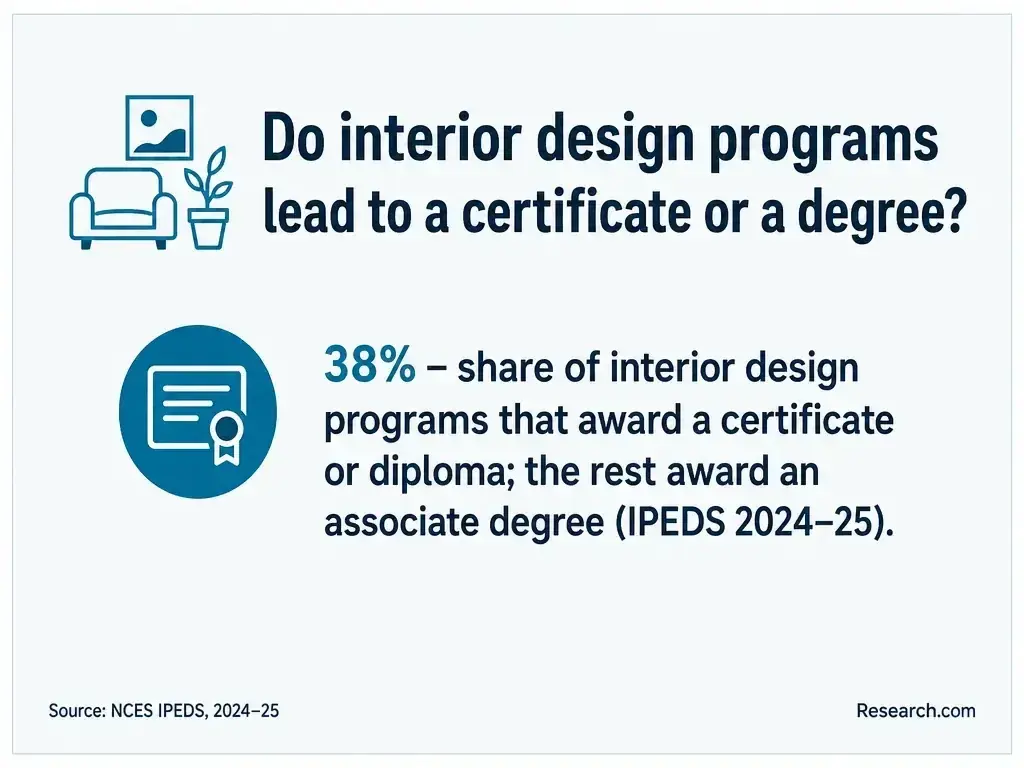
The award might be a certificate, diploma, or associate degree, depending on the specific offering. An employer training route may provide experience without an academic award. Verify the exact credential on the provider's current catalog, along with whether its coursework is transferable or can be applied toward a later credential.
A credential name alone does not establish that you can perform a particular job or qualify for Georgia registration as an interior designer. Ask for a course list and examples of graduating portfolios. If your goal is technical design work, look for evidence of documented space planning, drawings, and code-related instruction rather than relying on the word "design" in the award title.
Requirements vary by credential and provider. Ask whether applicants need a high school credential, placement assessment, prerequisite coursework, portfolio, or particular computer equipment. For an employer-sponsored assistant role, the employer may care more about customer service, software familiarity, and sample work than formal admission requirements.
Confirm requirements before paying an application fee, especially if you are changing careers or returning to school. A search such as what is the easiest phd to get addresses a different educational decision; it will not tell you whether an Athens trade program has the entry requirements or practical training needed for interior design work.
A job-focused curriculum should let you turn a client brief into a workable design proposal. Depending on program scope, that can mean interviewing a client, measuring a space, drafting plans, selecting appropriate materials, considering lighting and accessibility, estimating products, and explaining decisions visually. The U.S. Bureau of Labor Statistics identifies drawings, materials, building-code awareness, and coordination as parts of interior designers' work.
Ask to see the projects students complete, not just a list of software taught. For example, a polished rendering may demonstrate presentation skill but not whether a student can produce accurate dimensions or revise a plan after feedback. That difference is important when comparing a short course with a longer studio-based credential.
Do not assume every interior-related job requires the same credential. Retail design, decorating, and design-support roles differ from using a regulated professional title. The Georgia State Board of Architects and Interior Designers administers the state's registered interior designer requirements; confirm its current education, experience, examination, and application rules directly with the board if registration is your goal. Completing a trade program does not automatically establish eligibility.
Professional certification and state registration are separate from institutional accreditation and school authorization. Before enrolling, ask the provider to document how its specific curriculum aligns with your intended credential or job. A general list of certifications that make money cannot replace that occupation- and state-specific check.
Choose the least costly route that credibly prepares you for your target role, not automatically the lowest-priced course. First identify whether you want showroom work, residential decorating, technical design support, or eventual professional registration. Then compare providers on the same evidence.
These questions help expose gaps that a ranking or tuition quote may not show:
Check institutional claims with the accreditor and applicable state authority; accreditation alone does not establish registration eligibility or employment outcomes. Guides to nationally recognized online colleges can help you formulate questions about recognition, but verify the particular program and its practical components. A major red flag is a promise of professional eligibility without identifying the applicable Georgia requirements.
A focused credential may support entry into furniture sales, showroom assistance, or design support, while a more technically developed portfolio may help with drafting and project-assistant opportunities. With experience, workers may take on more responsibility for client coordination, specifications, or independent projects. Employers set their own hiring standards, and self-employment brings business responsibilities as well as design work.
Match training to the first job you intend to seek, then consider what experience would let you advance. If you are comparing education for earning potential across unrelated fields, a guide to bachelor's degree that pay well answers a different question; it should not substitute for checking interior design job requirements and the cost of this trade pathway.
The U.S. Bureau of Labor Statistics projects 2.7% national employment growth for interior designers from 2025 to 2035. That projection indicates modest growth for the occupation nationwide; it is not an Athens hiring forecast and does not count every showroom or design-support position a trainee might pursue.
For a local decision, review current openings by job title and required skills, then ask a provider which employers review student work or offer project experience. Do not take on substantial debt solely because a national projection is positive. The stronger investment is a program whose cost and completion schedule you can manage and whose portfolio work matches openings you can realistically access.
Education is a significant investment, so the Research.com team designed the accompanying ranking to help readers compare the cost of programs against other reported options in the same occupation and location. The team checks multiple education and occupational data sources to improve the ranking's credibility and accuracy. Only programs with completions reported to IPEDS are included; the absence of a provider does not establish that its training is unavailable or poor quality.
Most affordable program rankings use tuition, cost of attendance, median student debt, and federal loan default rates. Indicator weights are assigned through an entropy-based method, which gives more weight to measures that vary more across programs. Accreditation, earnings, completion, and student support are not part of the affordability score. A low rank-related cost therefore does not, by itself, establish that a program fits an interior design career goal.
The team uses the following data sources in its ranking work. Some sources cover other trades and may not supply an interior design-specific measure:
Use the ranking to narrow a cost comparison, then confirm the current credential, curriculum, total charges, and availability directly with the provider. More information about the ranking approach appears on Research.com's methodology page.
# 1 position
# 2 position
Confirm current offerings directly with Athens Technical College. Do not assume that a related drafting or design course awards an interior design credential.
It may help with a focused assistant, retail, or decorating role. For technical work or a registration goal, compare the curriculum and practical projects with the relevant employer or Georgia board requirements.
Some coursework and digital projects can be remote. Ask how the program handles measurements, materials, critique, and site-based work before treating it as equivalent to in-person training.
Not necessarily. Compare total cost, time away from work, completion prospects, and the portfolio and credential you will have when applying for jobs.
No single registration assumption fits every interior-related role. Check the Georgia State Board of Architects and Interior Designers if you intend to use a regulated professional title, and check employer requirements for your intended job.