# 1 position


Audited and Verified:
Our Editorial and Data Verification Process
Research.com uses government datasets, official education statistics and primary institutional information to support its career and degree guides. Our review process checks factual accuracy, occupational definitions, source dates and the requirements associated with the credentials discussed.
How This Article Was Fact-Checked
Our editorial team verifies salary estimates, employment projections, education requirements and program information against original data providers and official organizations. Salary figures are checked against the relevant occupational definitions and reporting periods. Information about licensure, accreditation and required in-person training is reviewed separately.
Fact-checked and verified on:

Co-Founder and Chief Data Scientist

Reviewed by Karolina Broda
Fact-Checker and Data Verification
Choosing an affordable interior design program near Westminster, Colorado, means weighing more than tuition: you need a credential, a portfolio, and practical skills that fit the work you want. The U.S. Bureau of Labor Statistics reports a May 2025 national median annual wage of $67,190 for interior designers, but that is not a starting-salary estimate. This guide explains costs, training routes, and career requirements. It also features a Most Affordable Interior Design Trade Schools in Westminster for 2027 ranking, created by the Research.com team of data scientists to help students identify programs worth considering.
Expect training in designing functional interior spaces, not just choosing finishes. A useful program combines client briefs, measured drawings, space planning, materials selection, digital drafting, and critiques that turn projects into portfolio pieces. Ask to see the equipment and software students use and how instructors assess completed designs.
Westminster students can investigate Front Range Community College as a local public-college option, while checking its current catalog for the specific interior design credential, campus, schedule, and course availability. Compare that route with a career-school certificate or supervised work in a design studio. A shorter certificate can suit someone adding drafting or visualization skills; a more extensive associate degree can make sense for someone seeking broader technical preparation. Neither credential, by itself, establishes experience or eligibility for a professional examination.
When comparing an associate route with the quickest associate degree online options, check whether interior design studios and portfolio reviews are actually included. Speed is of limited value if the program does not teach the work your target employers expect.
Westminster's access to the Denver-area job market broadens the search beyond the city itself. Potential settings include residential design studios, commercial interiors firms, furniture and kitchen-and-bath businesses, showrooms, and companies supporting renovations or tenant improvements. The practical implication is that students should evaluate commuting distance to both training and potential employers, rather than limiting their search to Westminster addresses.
Entry work may involve drafting, specifications, product research, or client coordination under an experienced designer. Ask programs whether portfolio critiques, employer projects, or internships are available and whether students must arrange placements themselves. A paid showroom or design-assistant position can also supply experience, although workplace training varies and does not automatically award an academic credential.
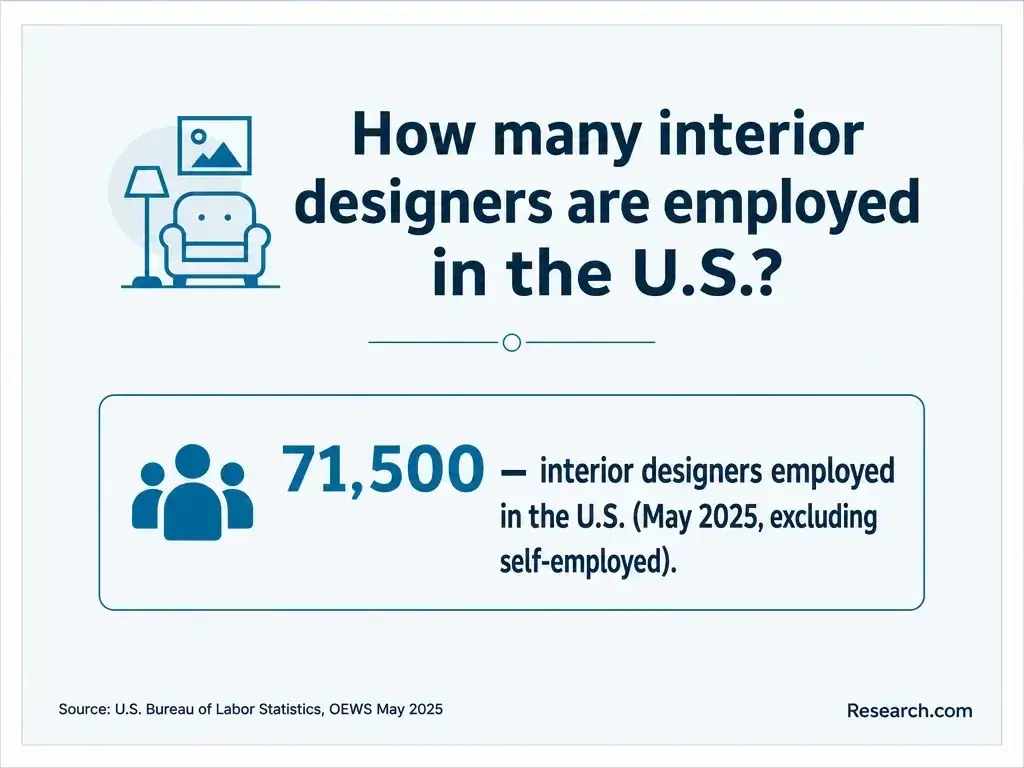
The U.S. Bureau of Labor Statistics (BLS) reports a $67,190 national median annual wage for interior designers in May 2025. This is the midpoint for workers in the occupation nationwide, not a Westminster wage, an entry-level offer, or a return promised by any program.
Pay depends on the role and how much responsibility it carries: a showroom sales position, drafting support role, and independently managed design project are not interchangeable. Before borrowing, compare current Denver-area postings for the exact entry role you want, noting requested software, experience, and compensation structure. Treat commission-based listings differently from salaried positions, and do not use the national median as your expected first-year income.
Duration depends on the credential and course sequence. A focused certificate usually requires fewer courses than an associate degree; part-time attendance or courses offered only in certain terms can extend either route. There is no universal Colorado clock-hour requirement for entering interior design practice, so ask for the actual credits, required studio contact time, and projected schedule rather than relying on a generic completion estimate.
An accelerated associates program may reduce calendar time if required design courses are available in sequence. For a working student, however, a slower schedule that permits paid work and enough time to develop a strong portfolio may be the better investment.
Online instruction can work for design history, presentations, some drafting assignments, and software demonstrations. In-person studios make it easier to critique physical samples, measure spaces, collaborate, and get immediate feedback on drawings. A hybrid option can preserve some flexibility while providing access to those activities. Ask whether required projects involve site visits, supervised studio sessions, or equipment that is available only on campus.
Remote access also changes the real price: check software licensing, computer specifications, printing, and travel for any required meetings. The low cost online colleges for working adults resource can help frame a flexible-program search, but verify that any interior design option includes the practical instruction and portfolio support you need. An online credential does not, by itself, establish eligibility for an optional certification.
There is no reliable Westminster-wide average here that would fairly combine public-college programs, private career training, and employer-sponsored learning. Published tuition alone is an incomplete comparison. Request a program-specific estimate covering the entire credential, not just one term.
The following cost categories are worth pricing together because two programs with similar tuition can require substantially different out-of-pocket spending.
| Cost or offset | What to verify |
| School charges | Total tuition, mandatory fees, and any resident-rate eligibility |
| Design work | Computer and software requirements, printing, materials, and portfolio supplies |
| Access and time | Travel to studios or worksites and earnings forgone while attending |
| Potential offsets | Grants, scholarships, eligible aid, employer reimbursement, and paid work |
Ask financial-aid staff which expenses are included in the official cost of attendance and which must be paid separately. Federal aid depends on both the student's eligibility and the program's eligibility; a low advertised price or an accredited online university offering a free application does not establish the total cost of interior design training (Federal Student Aid).
The award depends on the program: it may be a certificate, diploma, or associate degree. These are educational credentials, not an occupational license. A short credential may document specific skills, while an associate program generally includes a broader course sequence. Check the exact award name, transcripted credits, and whether completed courses can apply toward another credential at the same institution.
Institutional accreditation concerns the school; programmatic accreditation concerns a particular program; state authorization concerns permission to operate. None automatically confers professional certification or permission to perform work regulated under another profession. Ask admissions staff to identify each status separately and show how the curriculum aligns with the job or optional credential you intend to pursue.
Requirements vary by provider and credential. Check the current application instructions for academic records, placement or prerequisite courses, technology needs, and any portfolio submission. Do not assume a beginner certificate and an advanced studio course have the same entry rules. Front Range Community College applicants should confirm requirements for the particular program and courses, rather than treating general college admission as automatic admission to every class.
Open enrollment colleges online can be useful when flexibility is the immediate priority, but open enrollment does not remove course prerequisites or guarantee access to a particular interior design studio. Before applying, ask when required classes run and whether they can be completed in the format you need.
Training should connect design decisions to drawings and deliverables a client or colleague can use. Look for space planning, color and materials, lighting concepts, drafting or computer-aided design, presentation, budgeting, and communication. Courses may address accessibility and building-code concepts; students should learn when a project requires review by an appropriately licensed building professional rather than assuming design coursework grants that authority.
Request examples of final student projects. A useful portfolio shows the brief, measurements or constraints, design rationale, drawings, and revisions - not only polished images. Compare how much hands-on studio practice and instructor feedback each program provides, because similarly named credentials can offer very different practical preparation.
Colorado does not generally require an occupational license to work as an interior designer. That does not authorize an interior designer to perform work reserved for licensed architects or other regulated professionals; project scope matters (Colorado Department of Regulatory Agencies). If your goal involves preparing documents for regulated building work, ask employers and the relevant Colorado regulator what you may do and who must review or seal the work.
The National Council for Interior Design Qualification (NCIDQ) credential is a separate, voluntary professional qualification with education and work-experience eligibility routes and examinations; completing a program alone does not award it (Council for Interior Design Qualification). Check the current eligibility rules before enrolling if that credential is part of your long-term plan. Institutional accreditation, certification eligibility, and occupational licensure answer different questions.
Start with the job you want, then work backward to the training and evidence of skill it requires. An affordability ranking is a useful shortlist, not a substitute for checking curriculum and total cost. These questions help expose expensive mismatches before enrollment:
A common mistake is choosing the shortest or cheapest offer before checking its portfolio work. Another is treating a median occupational wage as a likely first salary. For return on investment, weigh aid, debt, completion likelihood, forgone earnings, your current pay, plausible post-training opportunities, and the time it may take to benefit - not institution type alone.
Interior design training can support several entry routes, but the credential must match the work. Drafting and production roles emphasize accurate drawings and software; showroom and product roles emphasize materials knowledge and customer communication; studio assistant roles may combine both. Reviewing actual Denver-area vacancies will tell you which skills to prioritize.
With experience, a worker may manage more of a client project, specialize in residential or commercial settings, supervise design support, or pursue independent work. Optional certification can support a longer-term professional goal but is not a substitute for the experience its eligibility rules require (Council for Interior Design Qualification). If you already have a relevant job, employer-supported software training or supervised project work may be a less costly next step than enrolling in an entire new credential.
BLS projects 2.7% growth in U.S. interior designer employment from 2025 to 2035. That national projection describes the occupation as a whole; it does not count Westminster openings or establish demand for every design-related entry role (U.S. Bureau of Labor Statistics, Employment Projections). For a local decision, inspect current Denver-area postings and ask programs about documented employer connections and graduate roles.
Software proficiency and a portfolio that demonstrates practical problem-solving can help an applicant show readiness, but neither guarantees a job. Compare the skills requested in postings with the projects you will finish during training. If they do not match, consider a more targeted course, supervised work, or a different program before committing to the full cost.
Investing in training is a consequential decision. Research.com created the affordability ranking to help readers compare programs with other options for the same occupation and location. Its team checks multiple education and outcomes sources for credibility and accuracy; only programs with completions reported to the Integrated Postsecondary Education Data System (IPEDS) are eligible. That means an omitted apprenticeship or employer training route should not be assumed to be unavailable or poor quality.
Most affordable rankings score costs and debt: tuition, cost of attendance, median student debt, and federal loan default rate. Indicator weights use an entropy-based method, which gives more weight to measures that differ more across programs. Accreditation and other quality measures are not part of this affordability score. Separately, Research.com's best programs rankings consider completion and full- and part-time retention; earnings one year after completion and earnings relative to annual attendance cost; costs and debt; and accreditation, relevant recognition, and student support. In those rankings, relevant programmatic accreditation or industry recognition carries 20%, institutional accreditation 10%, student support 10%, and the remaining outcomes, earnings, and cost indicators 60%, distributed using the entropy-based method.
The ranking draws on the following data sources. Some support Research.com's broader trade-program methodology rather than serving as interior design accreditors or certifiers:
Use the ranking to narrow a shortlist, then confirm each program's current price, interior design curriculum, campus availability, and outcomes directly. The Research.com methodology provides further details on how rankings are created.
# 1 position
# 2 position
Front Range Community College is a local public-college option to investigate. Confirm its current interior design offerings, credential, campus, and schedule directly before applying.
Choose by the job and skills you need. A focused certificate may suit someone adding a specific skill; an associate degree may offer broader preparation. Compare portfolio work and total cost, not just the award name.
Some coursework may be remote. Check whether the program requires in-person studios, site work, or portfolio reviews, and whether employers for your target role value its practical training.
Colorado does not generally license interior designers to practice interior design. Other regulated building-design work has separate limits, so verify your intended scope (Colorado Department of Regulatory Agencies).
Possibly. Eligibility depends on the student and the specific program. Ask the school's financial-aid office for an aid estimate and a complete list of expenses before enrolling (Federal Student Aid).