# 1 position
Daytona State College - Interior Design.
associate

Audited and Verified:
Our Editorial and Data Verification Process
Research.com uses government datasets, official education statistics and primary institutional information to support its career and degree guides. Our review process checks factual accuracy, occupational definitions, source dates and the requirements associated with the credentials discussed.
How This Article Was Fact-Checked
Our editorial team verifies salary estimates, employment projections, education requirements and program information against original data providers and official organizations. Salary figures are checked against the relevant occupational definitions and reporting periods. Information about licensure, accreditation and required in-person training is reviewed separately.
Fact-checked and verified on:

Co-Founder and Chief Data Scientist

Reviewed by Karolina Broda
Fact-Checker and Data Verification
Choosing an affordable interior design program means looking beyond tuition: a low-cost course may not provide the drafting skills, portfolio work, or credential your intended job requires. The U.S. Bureau of Labor Statistics reports a $67,190 national median annual wage for interior designers in May 2025, but that is not a starting-pay estimate. This guide explains local training options, costs, career paths, and Florida's rules. It also accompanies the Most Affordable Interior Design Trade Schools in Daytona Beach for 2027 ranking, created by the Research.com team of data scientists to help students make an informed choice.
Expect training in how spaces function, not just how they look. Interior designers develop layouts, select materials, communicate specifications, and coordinate with clients and other building professionals, according to the U.S. Bureau of Labor Statistics. A useful occupational program therefore combines design concepts with measured drawings, software, codes, and a portfolio that an employer can assess.
Program names can conceal important differences. A short decorating course may suit someone seeking retail or residential styling work, while an associate-degree program with drafting and technical coursework may better support design-assistant roles. Ask Daytona State College which interior-design-related credentials and courses are currently offered; do not assume a listing for a general design course represents a complete interior design program.
Interior design is generally a school-and-portfolio pathway, not a standard paid registered-apprenticeship trade. Working in a showroom or assisting a designer while taking targeted courses can be a practical alternative for someone who already has customer-service or drawing skills. It is less suitable if an intended employer expects a substantial technical portfolio or specific education.
Potential workplaces include residential design businesses, furniture and kitchen-and-bath showrooms, architecture and construction firms, and hospitality or commercial-property teams. In the Daytona Beach area, a student interested in hotels or other commercial spaces should prioritize documentation, durable materials, accessibility, and coordination skills; a showroom-focused student may get more immediate value from product knowledge and client presentations.
These settings do not all hire for the same role. A retailer may hire a sales or design assistant based on product knowledge and a modest portfolio, while a firm preparing construction documents may want stronger drafting skills and supervised experience. Review actual job descriptions before paying for specialized coursework, and be prepared to consider employers elsewhere in Volusia County or a wider commuting area.
The U.S. Bureau of Labor Statistics reports a $67,190 national median annual wage for interior designers in May 2025. That figure covers workers at different experience levels across the country; it is neither a Daytona Beach wage nor a reliable estimate for a new certificate holder.
Before calculating a training program's return, look up current wage data for the Deltona-Daytona Beach-Ormond Beach metropolitan area and compare postings for the specific entry role you want. Design-assistant, retail-sales, and established interior-designer jobs can have different duties and pay structures. If a school cites graduate earnings, ask which credential, graduating class, employment status, and job titles its figure includes.
Duration depends more on the credential and portfolio requirements than on the label "trade school." A focused certificate can cover a narrow set of skills more quickly than an associate-degree program, which includes broader coursework. Part-time attendance extends the calendar, and a student who must first learn drafting software may need additional practice before applying for technical roles.
Interior design does not have a single Florida-mandated classroom-hour requirement for ordinary entry-level work. Request the program's published credit or contact hours, course sequence, studio hours, and expected portfolio deliverables rather than relying on a claimed completion time. If speed is your main concern, compare the actual time to an employable portfolio - not just the graduation date. Readers comparing education timelines more broadly can explore 12 month master's programs, but those programs are not substitutes for interior design training.
Online study can work well for design history, introductory codes, software demonstrations, and digital critiques. In-person instruction makes it easier to measure spaces, handle material samples, review drawings at scale, and receive immediate studio feedback. A hybrid option can reduce commuting while preserving scheduled practical work.
The deciding question is what you will produce and who will review it. Ask for examples of completed drawings and portfolios, the software required, access to instructors, and any site visits or employer projects. A wholly online course may build useful skills, but its format alone establishes neither hiring readiness nor eligibility for Florida's optional registered-interior-designer pathway. Working adults comparing broader remote-study costs may also consult most affordable online colleges for working adults; compare interior design courses separately on their practical components.
There is no reliable single average that represents every Daytona Beach interior design course, certificate, and associate-degree pathway. Published prices may cover different numbers of courses and omit expenses needed to finish a portfolio. Ask for a written, credential-specific estimate before treating any option as affordable.
For a useful comparison, total the following costs for each complete pathway, not just its first term:
Then subtract grants or scholarships for which you are eligible; do not subtract a loan, which must be repaid. Ask Daytona State College whether the particular credential qualifies for federal aid and whether your existing coursework can transfer. Federal Student Aid notes that aid eligibility depends on both the student and the program. A shorter course may cost less upfront but offer less technical preparation, while a longer program may carry greater opportunity cost. For other career fields, quick education for high paying jobs can provide context, but its outcomes should not be applied to interior design.
The answer must come from the exact program listing: a school may award a course-completion certificate, an occupational certificate, or an associate degree, and these are not interchangeable. A software course completion record demonstrates a narrower skill than a program that also requires studio projects and technical drawings.
Institutional accreditation concerns the school; programmatic accreditation concerns a particular program. Neither automatically grants a professional title or employment eligibility. If future professional registration matters to you, check the Council for Interior Design Qualification's current examination eligibility pathways and the Florida Department of Business and Professional Regulation's registration requirements before enrolling. Ask whether the credential's credits can transfer, whether prior coursework receives credit, and which portfolio pieces graduates actually complete.
Requirements vary with the credential. An introductory course may have few prerequisites, whereas a credit-bearing program may require a school application, proof of prior education, placement steps, or prerequisite coursework. Software and computer requirements can also affect whether you can start immediately. Check Daytona State College's current admissions and program pages rather than assuming one course's entry rules apply to every credential.
Ask admissions staff whether a portfolio is needed to enter or built during the program, whether courses run every term, and whether part-time students can complete the required sequence. If you are returning to school, ask about transfer and prior-learning policies; older adults considering online study more broadly may find top degrees for older adults online useful, but should confirm interior design's studio and software requirements separately.
Occupationally useful training connects a design proposal to a space that can be measured, specified, and communicated. Look for instruction in space planning, drafting or computer-aided design, materials and finishes, lighting fundamentals, presentations, and the accessibility and building-code concepts relevant to intended projects. The U.S. Bureau of Labor Statistics describes interior designers as working with plans, materials, and building requirements - not simply selecting décor.
Compare assessed projects rather than course titles. A residential styling project, a measured kitchen layout, and a commercial drawing set demonstrate different competencies. Ask how many projects receive instructor critique and whether the program teaches the software appearing in jobs you plan to pursue. Digital visualization tools may speed up presentations, but employers still need accurate dimensions, appropriate specifications, and clear client communication.
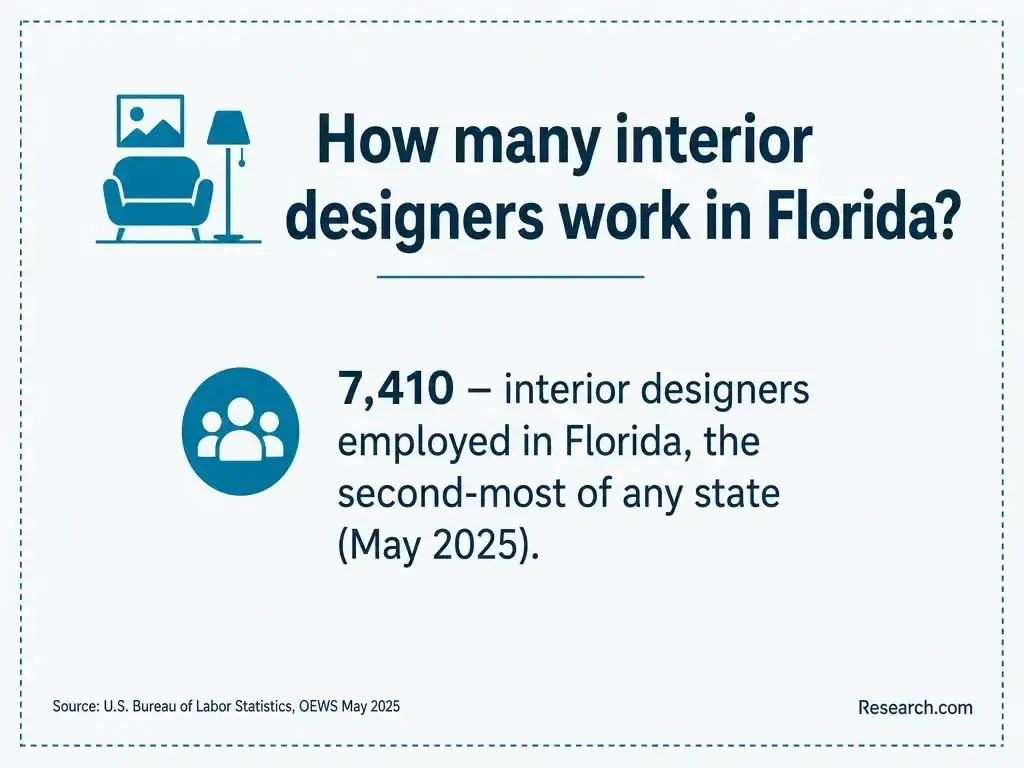
Florida generally permits people to perform ordinary interior design work without holding state registration. Its registered interior designer designation is a separate regulated credential, and particular permitting-related work and use of that title are subject to Florida rules, according to the Florida Department of Business and Professional Regulation. Do not assume a school certificate makes you registered or authorizes work reserved to another regulated profession.
Professional examination and registration are advancement considerations, not automatic entry requirements for every design-assistant or decorating job. If your goal is to submit or sign design documents for permitted projects, ask the Florida Department of Business and Professional Regulation which services are covered and verify its current education, experience, examination, and application requirements. Separately check any examination eligibility rules with the Council for Interior Design Qualification. School accreditation, program accreditation, exam eligibility, and state registration answer different questions.
Start with the job you want, then work backward to its required skills. The most affordable ranked option is a useful shortlist candidate, not necessarily the best investment if it lacks drafting instruction, adequate feedback, or a portfolio suited to that job.
Use these checks when speaking with a program representative:
Two common mistakes are comparing tuition without software and lost-work costs, and mistaking an attractive portfolio sample for evidence that every student receives substantial technical instruction. Estimate return using your likely completion time, aid, debt, current earnings, plausible entry-role pay, and the time needed to gain experience - not the national occupational median alone.
A focused course and strong customer-service skills may support showroom sales or decorating assistance. More extensive drawing and studio work may support design-assistant, kitchen-and-bath, or specification-related roles. With experience, a worker may take on more complex client projects, specialize in a sector, or consider self-employment. Job titles and employer requirements differ, so no credential guarantees progression.
Choose a first role that builds the evidence your next role will require: product advising develops client skills; measured layouts develop technical judgment; supervised project work develops coordination. Optional professional examination or Florida registration may become relevant for particular long-term goals, but it should not be confused with a universal prerequisite. If your actual career goal is outside this occupation, research that pathway directly rather than choosing interior design solely because its training appears shorter; searches such as what is the fastest masters degree program address a different educational decision.
The U.S. Bureau of Labor Statistics projects 2.7% national employment growth for interior designers from 2025 to 2035. This is a modest national projection, not a count of Daytona Beach openings. It suggests that students should prepare for competition and seek portfolio work and relevant experience while training rather than assume the credential alone will lead to a designer position.
For a local decision, compare current openings by job title across Daytona Beach and a realistic commuting area. Note whether postings request drafting software, showroom experience, commercial documentation, or an established client portfolio. Those requirements can reveal a better course choice than the national growth rate can.
Investing in training is an important decision, particularly when an inexpensive program may still leave a student needing additional skills or equipment. Research.com's data-science team created the accompanying ranking to help readers compare eligible interior design programs against relevant local options, using documented cost and debt measures rather than tuition advertisements alone.
The most affordable ranking scores tuition, cost of attendance, median student debt, and federal loan default rate. Weights are assigned through an entropy-based method, which gives more weight to measures that distinguish programs. Accreditation, support services, and other quality indicators are not part of this affordability score. Research.com's separate best-programs methodology considers outcomes, earnings, costs, accreditation, recognition, and support; it should not be confused with this cost-focused ranking. Only programs with completions reported to IPEDS are eligible, so the ranking cannot capture every private training provider, employer program, or independent course.
The ranking draws on the following data sources. Some occupation-specific recognition sources support Research.com's broader trade-program research; their inclusion does not mean they accredit interior design programs.
Use the ranking to narrow your search, then verify each program's current price, curriculum, and career fit directly. Further details about the approach appear on Research.com's methodology page.
# 1 position
# 2 position
It can be if its projects match an attainable entry role and its total cost fits your budget. It is less compelling if you need technical drawings or a substantial portfolio that the course does not teach.
You can learn some concepts and software remotely. Before enrolling, confirm how you will complete measured projects, receive detailed critiques, and meet any practical requirements of your intended credential.
No. Florida registration has separate requirements. Check the Florida Department of Business and Professional Regulation if that designation or permitting-related work is your goal.
Not on price alone. Compare the complete cost with the credential, technical coursework, instructor feedback, and portfolio you will receive.
Identify a target entry role, review its local job postings, and ask programs to show the projects beginners complete. An introductory course or showroom role can help you test the field before committing to longer training.