# 1 position


Audited and Verified:
Our Editorial and Data Verification Process
Research.com uses government datasets, official education statistics and primary institutional information to support its career and degree guides. Our review process checks factual accuracy, occupational definitions, source dates and the requirements associated with the credentials discussed.
How This Article Was Fact-Checked
Our editorial team verifies salary estimates, employment projections, education requirements and program information against original data providers and official organizations. Salary figures are checked against the relevant occupational definitions and reporting periods. Information about licensure, accreditation and required in-person training is reviewed separately.
Fact-checked and verified on:

Co-Founder and Chief Data Scientist

Reviewed by Karolina Broda
Fact-Checker and Data Verification
Choosing affordable interior design training in Dayton means looking beyond tuition: a low-cost program may not teach the drafting, software, and project skills employers expect. The U.S. Bureau of Labor Statistics projects 2.7% national growth for interior designers from 2025 to 2035, making program fit as important as price. This guide explains credentials, costs, career prospects, and Ohio's rules. It also accompanies the Most Affordable Interior Design Trade Schools in Dayton for 2027 ranking, created by the Research.com team of data scientists to help students identify training programs worth considering.
Expect applied instruction in planning interior spaces, documenting designs, selecting materials, and presenting a proposal to a client. Interior design goes beyond decoration: projects can involve accessibility, lighting, construction documents, and coordination with contractors. A program's value depends on whether students repeatedly produce drawings, specifications, and a reviewable portfolio - not simply on its credential name.
These pathways serve different goals. Confirm the exact award and curriculum in the provider's current catalog; an individual design course is not necessarily a complete occupational program.
| Pathway | Typical emphasis | Best fit and limitation |
| Short certificate or diploma | Foundational design, software, or a focused skill | Useful for a targeted skill or entry-level support work; may not cover the breadth needed for technical design roles. |
| Associate degree | Broader studio sequence, technical coursework, and general education | Fits students seeking a more substantial portfolio and academic credential; usually takes longer and costs more overall. |
| Employer-sponsored training | Workplace-specific products, sales, drafting, or installation coordination | Can provide paid experience sooner, but its instruction and portability vary by employer. |
Sinclair Community College is a sensible local catalog to check, but verify its current interior-design offerings and awards before treating a course or related program as a direct match. Interior design does not have the standard registered-apprenticeship progression found in some construction trades; work-based learning is more likely to take the form of an internship, supervised project, or entry-level design-assistant job (U.S. Bureau of Labor Statistics; Apprenticeship.gov).
Potential workplaces include residential design studios, furniture and kitchen-and-bath businesses, architecture firms, commercial interiors teams, and firms supporting renovation projects. In the Dayton area, a search confined to jobs titled "interior designer" can miss relevant entry points; compare postings for design assistant, showroom specialist, space planner, and drafting support, then read the actual software and experience requirements.
Some employers primarily sell products; others prepare detailed plans for construction teams. If you want the latter, seek training with measured drawings, specifications, accessibility, and coordination - not a curriculum centered only on styling. Portfolio-based freelance work is another option, but client acquisition and variable income make it a different proposition from an entry-level job (U.S. Bureau of Labor Statistics).
A verified Dayton-specific wage figure is not established here, so the national figure should be a benchmark, not a local pay estimate. The U.S. Bureau of Labor Statistics reports a May 2025 national median annual wage of $67,190 for interior designers. A median covers experienced workers as well as newer ones and does not describe what a certificate or associate-degree graduate will earn.
Before calculating a return on training, check the latest Dayton-area wage estimates in the BLS Occupational Employment and Wage Statistics series and compare them with current local job postings. Match the occupation carefully: showroom sales, design assistance, and interior designer positions may have different duties and pay. Estimate your likely starting earnings separately from the occupational median.
Length depends on the award, course sequence, and attendance pattern. A focused certificate can be shorter than an associate degree, while part-time enrollment extends the calendar even if required credits stay the same. There is no universal Ohio clock-hour requirement for entering ordinary interior design work; ask each provider for its published credits or contact hours, studio schedule, and the time students typically need to finish (Ohio Architects Board; U.S. Bureau of Labor Statistics).
For a working adult, the shortest advertised timeline may not be the fastest route to a credible portfolio. Ask whether design studios run every term, whether courses have prerequisites, and whether prior coursework can count. Search results for a fast online bachelor's degree for working adults answer a different question; compare the actual length and workplace relevance of the trade credential under consideration.
Online instruction can work well for design history, research, software demonstrations, and some digital presentations. In-person studios make it easier to critique physical samples, measure spaces, collaborate on drawings, and meet local professionals. A hybrid program may offer flexibility without giving up those experiences, but its campus attendance and equipment requirements deserve a close look.
When reviewing degree programs for older adults online or other flexible study options, separate scheduling convenience from occupational preparation. For interior design, ask to see recent student portfolios and find out how remote learners receive project critiques, access required software, and complete any site visits or internships. An online format alone does not establish eligibility for a professional credential (Council for Interior Design Qualification).
There is no verified Dayton-wide average covering every interior design certificate, degree, and employer-training route. A single average could also conceal differences in credential length and included equipment. For a useful comparison, request each program's written estimate for the entire credential - not just its first term - and use the same attendance pattern for every option.
Build a job-ready budget that includes mandatory tuition and fees, books, design software and hardware, printing and model materials, transportation to studios or work sites, and earnings forgone while studying. Then subtract grants, scholarships, or employer support you actually qualify for. Federal aid eligibility depends on both the student and the program; verify it through the school and Federal Student Aid rather than assuming that institutional accreditation makes every course aid-eligible.
An application-fee comparison, including lists of accredited online universities free to apply, cannot reveal the full cost of an interior design trade credential. Avoid choosing the lowest advertised tuition until you know which software, studio supplies, and portfolio expenses it excludes.
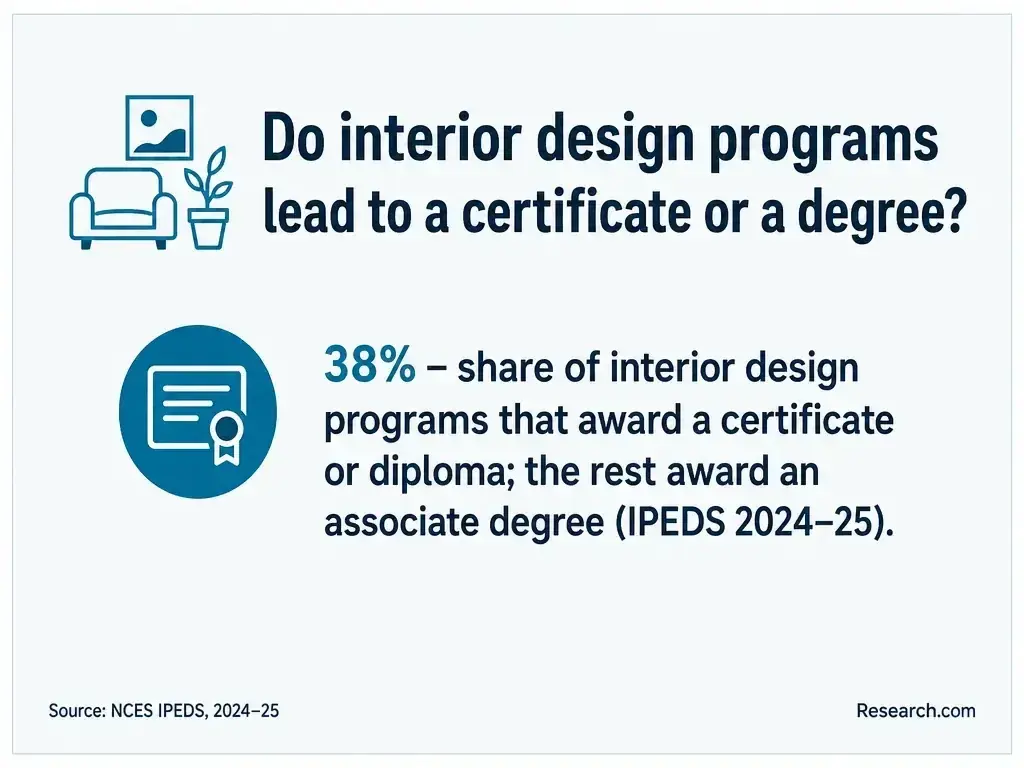
The award could be a certificate, diploma, or associate degree, depending on the program. Those names do not establish a common curriculum, a uniform amount of studio practice, or professional certification. Check the exact credential shown on the transcript and whether the portfolio and coursework meet the expectations of the jobs you want.
Institutional accreditation concerns the school; state authorization concerns its permission to operate; programmatic accreditation evaluates a specific program; and professional certification evaluates an individual against a certifying body's rules. None automatically substitutes for the others. In particular, confirm education and experience eligibility directly with the Council for Interior Design Qualification before counting on a program as a route toward its NCIDQ credential. Lists of doctorate programs without dissertation do not answer that occupation-specific question.
Requirements vary by provider and award. An applicant may need to meet the school's general admission rules and any placement, prerequisite, or portfolio requirements stated for the particular program. Do not assume prior drawing experience is mandatory - or that a program teaches every software skill from scratch - without checking its current catalog.
Ask admissions which courses begin the studio sequence, what computer and software access is required, and whether prior coursework can transfer. If you already work in sales, construction, or drafting, ask whether documented experience can reduce requirements; get any credit decision in writing before budgeting for a shorter completion time.
A strong applied curriculum connects space planning and visual communication with the constraints of real projects. Look for drawing and digital-modeling practice, materials and finishes, lighting, construction documentation, accessibility, client presentations, and budget-conscious specifications. The U.S. Bureau of Labor Statistics identifies computer-aided design, building-code awareness, and collaboration with architects and builders as relevant to interior designers' work.
Ask what students actually submit at the end of each studio: a rendered image alone is different from a package with a floor plan, material schedule, and explanation of design choices. Software and AI-assisted visualization can speed up concepts, but assess whether students still learn to check dimensions, product information, and buildability. Those checks are what make a portfolio useful to a technical design employer.
Do not assume an occupational license is required for every interior design or decorating job in Ohio. Also do not assume a training credential authorizes regulated architectural work or permits a designer to use a protected professional title. Ohio's rules governing architecture and building work, and an employer's project requirements, matter when a role involves construction documents or permit-related responsibilities (Ohio Architects Board; Ohio Revised Code).
The NCIDQ credential is a professional certification, not a school award or a substitute for any applicable state authorization. Its education, supervised-work, and examination requirements must be checked with the Council for Interior Design Qualification. If certification is a long-term goal, get the certifying body's current eligibility rules before enrolling; a school's claim that its courses are "industry recognized" is not an eligibility determination.
Choose for the job you intend to pursue, then test affordability against evidence of preparation. A lower-priced program can be a good investment if it produces a competitive portfolio; a faster program may be a poor bargain if you later need to pay for missing drafting or studio skills. Ranking position is a starting point, not a substitute for this check.
Ask each provider for the same information so the comparison is fair:
Compare those answers with your schedule, current earnings, likely completion time, and affordable borrowing. Be cautious of guaranteed-job or salary claims, unclear software charges, and a program that cannot show the work students produce.
Entry routes can include design-assistant, showroom, kitchen-and-bath support, and drafting-related roles. With a stronger portfolio and relevant experience, a worker may move toward independent project responsibility, a specialty such as commercial space planning, or self-employment. The progression is not automatic: technical responsibility and client-facing work depend on demonstrated skill, employer needs, and any applicable professional rules (U.S. Bureau of Labor Statistics; Ohio Architects Board).
If your main objective is earnings rather than design work, compare interior design with other high paying trades on training cost, working conditions, and entry-level opportunities - not just occupational median pay. Choose interior design when you want the combination of creative problem-solving, technical documentation, and client collaboration that its jobs actually require.
The U.S. Bureau of Labor Statistics projects 2.7% growth nationally from 2025 to 2035 for interior designers. That is a national occupation projection, not a forecast of Dayton openings or a placement rate for any school. Use it as context, then check current Dayton-area postings to see how often employers seek drafting, product knowledge, client service, or an established portfolio.
A practical local search should include nearby employers and related job titles, especially if you cannot relocate. If few openings match the role you want, consider whether a broader, transferable skill set or paid entry-level work would reduce the risk of investing in a narrowly focused credential.
Investing in training is a consequential decision, so Research.com compares programs with other programs in the same occupation and location rather than with unrelated schools. Its most-affordable ranking considers tuition, cost of attendance, median student debt, and federal loan default rate, with weights assigned through an entropy-based method. Accreditation and other quality measures do not contribute to the affordability score. Only programs with completions reported to IPEDS can appear; absence from the ranking does not establish that a provider is unavailable or unsuitable.
Research.com uses the following sources across its trade-school ranking work. Several cover occupations other than interior design and should not be mistaken for interior design accreditors or credentials:
The ranking helps narrow a local cost comparison, not settle it. Check each candidate's current credential, curriculum, total price, and practical training before enrolling. More detail on the approach appears in Research.com's methodology.
# 1 position
# 2 position
Not necessarily. Compare total cost through completion with studio practice, portfolio quality, software access, and the skills requested in local jobs. A low tuition quote can leave out essential supplies.
A certificate may support an entry-level or specialized role, depending on its coursework and your portfolio. Check job requirements and do not assume that every certificate meets professional-certification eligibility rules.
Some coursework can be remote. Ask how the program handles critiques, material samples, site work, and any required practical experience before treating an online credential as equivalent to a studio-based one.
There is no standard registered-apprenticeship requirement for ordinary interior design entry. Supervised work may still matter for particular jobs or optional professional certification (Apprenticeship.gov; Council for Interior Design Qualification).
Confirm its current catalog lists the specific interior-design credential you want, then obtain its course sequence, full cost estimate, and transfer-credit policy. Do not infer that a related design course constitutes a complete program.