# 1 position


Audited and Verified:
Our Editorial and Data Verification Process
Research.com uses government datasets, official education statistics and primary institutional information to support its career and degree guides. Our review process checks factual accuracy, occupational definitions, source dates and the requirements associated with the credentials discussed.
How This Article Was Fact-Checked
Our editorial team verifies salary estimates, employment projections, education requirements and program information against original data providers and official organizations. Salary figures are checked against the relevant occupational definitions and reporting periods. Information about licensure, accreditation and required in-person training is reviewed separately.
Fact-checked and verified on:

Co-Founder and Chief Data Scientist

Reviewed by Karolina Broda
Fact-Checker and Data Verification
Choosing an affordable interior design program means looking beyond tuition: a low-cost credential may be poor value if it does not build a portfolio or fit your career goal. The Research.com team of data scientists created its Most Affordable Interior Design Trade Schools in San Diego for 2027 ranking to help students identify programs worth considering. With U.S. interior designer employment projected to grow 2.7% from 2025 to 2035 (U.S. Bureau of Labor Statistics), this guide helps prospective students and career changers compare training, costs, credentials, and realistic routes into local work.
Interior design training combines visual planning with practical constraints: dimensions, materials, budgets, client needs, and applicable building and accessibility rules. Expect critiques and portfolio projects, not just decorating exercises. An employer may want evidence that you can turn a brief into measured plans, presentations, and specifications using current design software.
The useful distinction is what each pathway lets you demonstrate to an employer. Program titles alone do not establish equivalent training.
| Pathway | Typical focus | Best fit |
| Short certificate or targeted classes | Drafting, design software, materials, or residential design fundamentals | Career changers testing the field or workers adding a specific skill |
| Associate degree | Broader studio sequence, technical coursework, and portfolio development | Students seeking sustained preparation for assistant or junior design roles |
| Employer training | Product knowledge, sales systems, and worksite procedures | Applicants entering through a showroom, furnishings retailer, or design-support job |
A traditional registered apprenticeship is not the standard entry route for interior designers. Paid work as a showroom assistant or design coordinator can nevertheless provide valuable experience; compare its mentoring and portfolio opportunities with the structured instruction a college program offers.
Local possibilities include residential design studios, kitchen and bath firms, furnishings showrooms, architecture practices, hospitality projects, and commercial-space teams. These settings call for different evidence of skill: a showroom may prioritize client consultations and products, while a studio may ask for drafting, specifications, and coordination with contractors (U.S. Bureau of Labor Statistics, Occupational Outlook Handbook).
For a first job, look beyond positions titled "interior designer." Design assistant, CAD support, sales-design consultant, and materials coordinator roles may provide a more realistic entry point. Before enrolling, examine whether the program's assignments resemble the work in the local job postings you would actually apply for.
The latest national median annual wage for interior designers was $67,190 in May 2025 (U.S. Bureau of Labor Statistics). It covers workers at different experience levels and is not a prediction of pay for a newly trained designer - or a San Diego wage figure. Assistant, retail, and independent-contract work may also be classified differently, so the occupational median may not describe those offers.
To assess a local program's payoff, compare actual entry-level postings by job title and required skills, then consult the latest BLS metropolitan occupational wage release for the San Diego area. Ask a school for outcomes specific to its interior design credential, including the share of completers employed in related work, rather than accepting an institution-wide earnings figure as a program result.
A targeted class may take one term; a certificate usually spans multiple courses; and an associate degree generally requires a longer sequence of general education and design studio coursework. Exact timelines depend on the catalog, course availability, prerequisites, and whether you attend part time. Ask for a term-by-term map: studio courses offered only once a year can extend completion even when the published unit total looks manageable.
Interior design does not have a universal clock-hour requirement for entry-level work in California. If your longer-term goal is professional certification, verify how the particular credential and documented work experience fit that certifying organization's current rules. Students considering an associate route can use how long does it take to get an associate degree as a planning question, but should rely on the design program's own course sequence for their completion estimate.
Online courses can work well for design history, business practices, software demonstrations, and some digital critiques. Campus or scheduled in-person activities make it easier to examine material samples, measure spaces, build presentation boards, and receive immediate studio feedback. A hybrid option can reduce commuting while preserving those activities - but only if its in-person sessions fit your work schedule.
Before choosing an online credential, ask how instructors assess field measurements, material selection, drawing accuracy, and the final portfolio. Also confirm whether any required site visits or studios can be completed near San Diego. Listings of affordable online associate degree programs can help you frame cost questions, but a low online price does not establish that an interior design program provides the practical work you need.
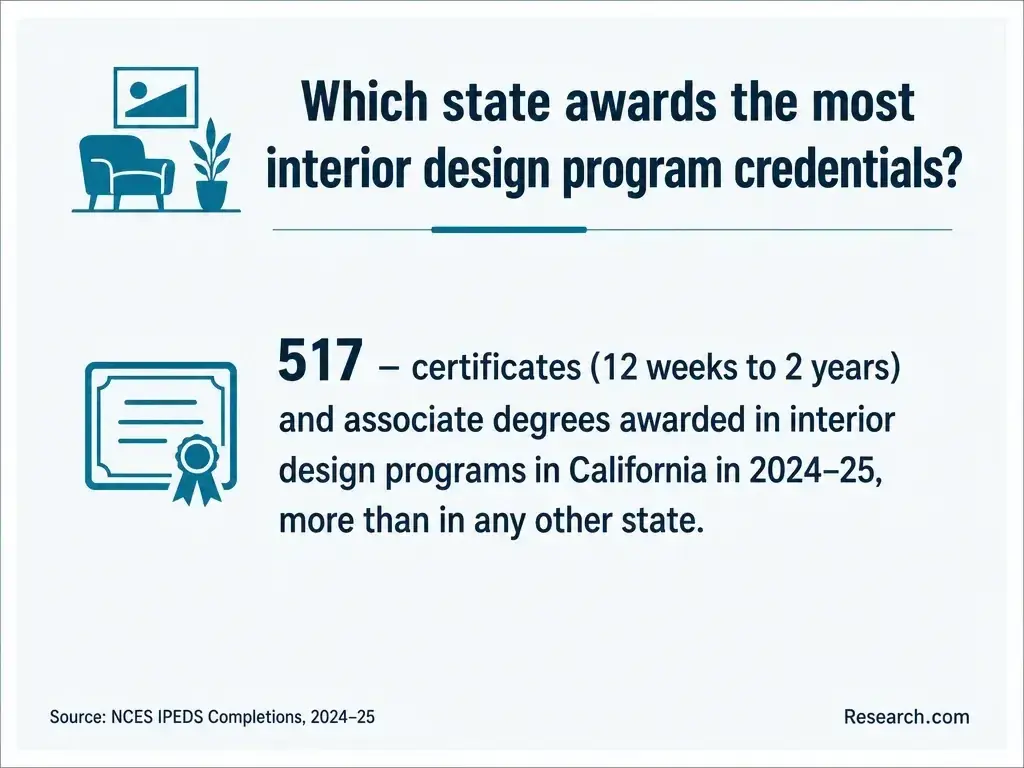
There is no single defensible local average for every interior design certificate, associate program, and employer-training route: they differ in length, fee structure, and whether they appear in college datasets. As a public-college benchmark, California's community college enrollment fee is $46 per unit for eligible students (California Community Colleges Chancellor's Office). That is not a complete program price, and nonresidents may face additional tuition.
Compare the amount you must spend to become ready to apply for work, rather than tuition alone. Request these costs in writing before paying a deposit:
Eligible students should check federal aid for the specific credential and the California College Promise Grant's community college enrollment-fee waiver; eligibility is not automatic (Federal Student Aid; California Community Colleges Chancellor's Office). A broad search such as cheapest college to get a bachelor's degree uses a different credential and cost horizon, so it cannot substitute for an itemized interior design program quote.
Depending on the program, you may earn a certificate of achievement or an associate degree. Individual classes and employer training may build useful skills without awarding either credential. San Diego Mesa College is one local starting point for checking current interior design offerings; verify the exact award, catalog requirements, and whether credits can be applied to another credential directly with the college (San Diego Mesa College).
Institutional accreditation concerns the school; programmatic recognition concerns a particular course of study; California school authorization concerns permission to operate where applicable. None is the same as an occupational license or professional certification. Verify each claim with the responsible organization, and ask whether design credits and prior learning will count before assuming you can shorten the program. Even a list of best accredited online colleges non profit cannot establish the practical content or professional-certification fit of a specific trade credential.
Entry requirements vary by provider and credential. A community college applicant should check general college admission, placement or prerequisite rules, and any separate requirements for sequenced design courses. A private career program may use its own admissions process. Ask whether you need a portfolio to enter or whether the program helps you build one; those are materially different propositions for a beginner.
Confirm computer specifications and software access before the first term, especially if you will work remotely. If you are weighing search results for easiest bachelors degree, check the credential named in each result: it does not answer whether you meet the entry requirements for a local interior design training program.
A job-relevant curriculum should connect space planning and measured drawings to materials, lighting, color, client presentations, and project documentation. Look for hands-on assignments that require revisions after critique, not just attractive renderings. Computer-aided drafting and visualization are useful, but employers also need designers who can explain a specification, check dimensions, and work within a client's budget (U.S. Bureau of Labor Statistics, Occupational Outlook Handbook).
Ask to see examples of capstone or portfolio work and a description of how it is assessed. If a program advertises an internship, confirm whether placements are arranged, how many students obtain them, and whether the work is paid. A promise of "industry exposure" is less useful than a defined opportunity to practice on a real brief.
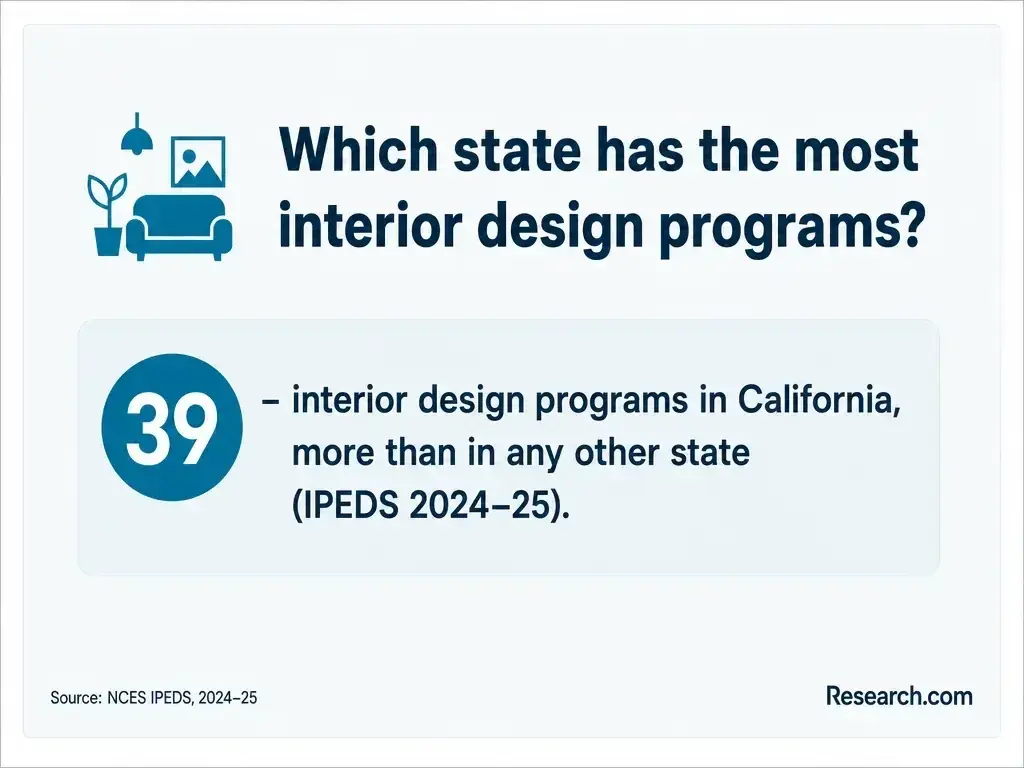
California does not generally require an occupational interior designer license simply to enter design work. Its Certified Interior Designer designation is a separate, regulated certification administered through the California Council for Interior Design Certification (California Council for Interior Design Certification). Certification eligibility involves rules beyond merely completing a school program; check the council's current education, experience, and examination pathways before choosing training for that goal.
Certification also does not grant authority to perform work reserved for licensed architects or other regulated professionals. If you hope to specialize in commercial interiors or pursue an additional professional credential, ask the relevant certifying body to evaluate your planned education and experience. Do not treat a school's accreditation, a certificate of completion, and professional certification as interchangeable.
Start with the job you want, then compare programs against the skills and portfolio evidence that job requires. An inexpensive software certificate may be enough for someone already working in a showroom; a beginner seeking broader studio work may benefit more from a longer, critique-heavy program. Neither the affordability ranking nor institution type alone establishes return on investment.
Use these checks to make competing offers comparable before you enroll:
A useful payoff calculation considers completion probability, aid and debt, time out of work, your current earnings, plausible post-training earnings, and how long you expect to use the credential. Treat a school's salary claim as a question to investigate, not a guaranteed return.
A certificate or associate program may support applications for design assistant, drafting-support, showroom, furnishings-sales, or project-coordination work, depending on the portfolio it helps you produce. With experience, workers may take on more client-facing design responsibilities or specialize in residential, kitchen and bath, hospitality, or commercial projects (U.S. Bureau of Labor Statistics, Occupational Outlook Handbook).
Progression is not automatic. Save strong project documentation, learn how installations and purchasing work, and seek feedback from working designers. Independent client work adds pricing, contracts, and business-development demands; it should not be confused with the first job a training credential makes plausible.
U.S. interior designer employment is projected to grow 2.7% from 2025 to 2035 (U.S. Bureau of Labor Statistics, Employment Projections). That is a national occupation projection, not a forecast of San Diego vacancies or a guarantee of placement. Competition for a particular local role will depend on the applicant pool, project activity, and the skills an employer needs.
Use the projection as context, then test demand locally: collect recent postings across studios, showrooms, and design-support roles; note recurring software and portfolio requirements; and ask programs which employers review student work. If most suitable openings require experience, a lower-cost credential paired with relevant paid work may be more practical than paying extra for an accelerated program with little hands-on exposure.
Education is a consequential investment, so Research.com developed the ranking to help readers compare reported program costs and debt among relevant local options. Programs are evaluated against others in the same occupation and location; only programs reporting completions to IPEDS are eligible. The most affordable ranking scores tuition, cost of attendance, median student debt, and federal loan default rate, with weights assigned through an entropy-based method. Accreditation and other quality measures do not enter this affordability score, so readers should check them separately.
To support data quality and verification across its trade-school rankings, the Research.com team draws on the following sources. Some cover other occupations rather than interior design; their inclusion in the broader methodology does not mean those organizations accredit interior design programs.
The ranking is a cost-screening tool, not proof that the lowest-priced program teaches the skills you need. Providers without IPEDS-reported completions - including some employer training and noncollege programs - may be absent. For more detail on Research.com's approach, see its ranking methodology.
# 1 position
# 2 position
For an eligible student, a California community college can offer a low per-unit enrollment fee. Compare the full certificate cost with paid showroom or design-support work, which may provide training while you earn. The cheapest route depends on what skills you already have.
It can support applications for assistant or showroom roles if you can demonstrate relevant drafting, client, or product skills. A certificate alone does not establish professional certification or guarantee a job.
Some coursework can be remote. Check how the program handles measurement, materials, studio critique, and portfolio assessment before choosing an entirely online option.
California does not generally require an interior designer occupational license for entry-level design work. The regulated Certified Interior Designer designation has separate eligibility rules (California Council for Interior Design Certification).
Request results for that specific credential: completion, related employment, typical entry roles, and how outcomes were measured. Institution-wide figures may not describe interior design students.